


 Request Consultation
At a Glance:
On August 27-28, 2026, the FDA approved the latest 2026-27 COVID-19 vaccines from all three of today’s licensed manufacturers, consisting of Pfizer-BioNTech's Comirnaty, Moderna's Spikevax and mNEXSPIKE, & Novavax/Sanofi's Nuvaxovid. However, each firm reformulated its vaccine to target the XFG variant, a descendant of the JN.1 lineage, which indicates dominance in circulation. The two reasons mentioned earlier lead to the conclusion that there was no need for an efficacy trial, while every candidate passed review steps through a supplemental Biologics License Application (BLA), which relies on manufacturing & immunogenicity data. This seems like a regular, seamless annual upgrade, but below it, it explores that the FDA moved ahead instead of leveraging the reversed & condensed eligibility landscape launched in 2025-2026. This framework restricts approved application to adults 65 & older, as well as younger people with a standard risk condition.
This narrowing has not been met by ACIP, which consistently recommends vaccination for anyone six months and older through shared clinical decision-making, an expansive standard compared with what the FDA's approval actually includes. This further shows a systematic difference, i.e. a recommendation exists for healthy adults under 65, but no FDA-approved product exists for them to receive, leaving pharmacists navigating variable off-label rules and patients facing coverage inconsistency. Moreover, nearly 17 states have acknowledged this by breaking from federal guidance completely, which has resulted in two competitive conditions. These rivals are the Northeast Public Health Collaborative and the Governors Public Health Alliance, which have shifted to ensure their own vaccine access and coverage benchmarks. At the same time, actual uptake has declined significantly; i.e. administered-dose data suggests only 8.9% of the eligible population received a 2025 booster, well below self-reported survey predictions.
An entire report evaluates both axes of the 2026-2027 season, which comprises the technical and regulatory mechanics of the XFG strain update, and the broadening policy fragmentation surrounding who is actually able to get vaccinated. This further directs the four approved products that track approximately a nine-month way from strain selection to approval. This also quantifies the expanding gap between FDA and ACIP guidance and seeks next-generation vaccine platforms, including intranasal, pan-coronavirus, and combination formulations, that could eventually lower the field's reliance on this annual cycle collaboratively.
Let’s Uncover Changes That Appeared & Didn't Appear in the 2026-27 COVID Vaccine Season
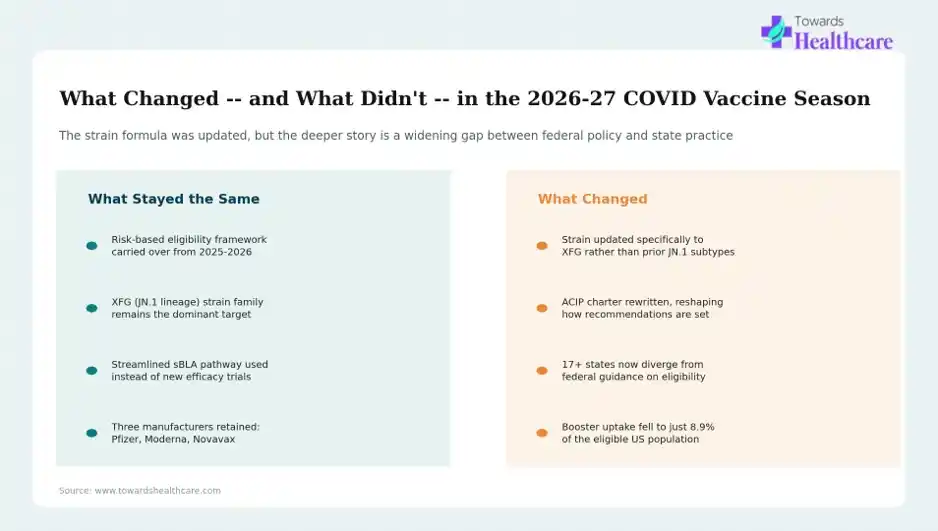
This is a two-sided representation of what carried over from 2025-26, including the risk-based eligibility framework, the JN.1-lineage target, & the streamlined approval pathway, against what shifted, which covers a new strain designation, a rewritten ACIP charter, surging state diversity, and reduced uptake.
Key Insight: Across all changes, the strain update is considered an insignificant modification this season. However, a key modification story is a broadening gap between what the FDA clears, what ACIP recommends, & what each state is currently looking to follow.
Source: FDA; CIDRAP; Stateline, 2026.
Four Timelines Executed One Connection, Where The Strain Has Stepped Within the JN.1 Family
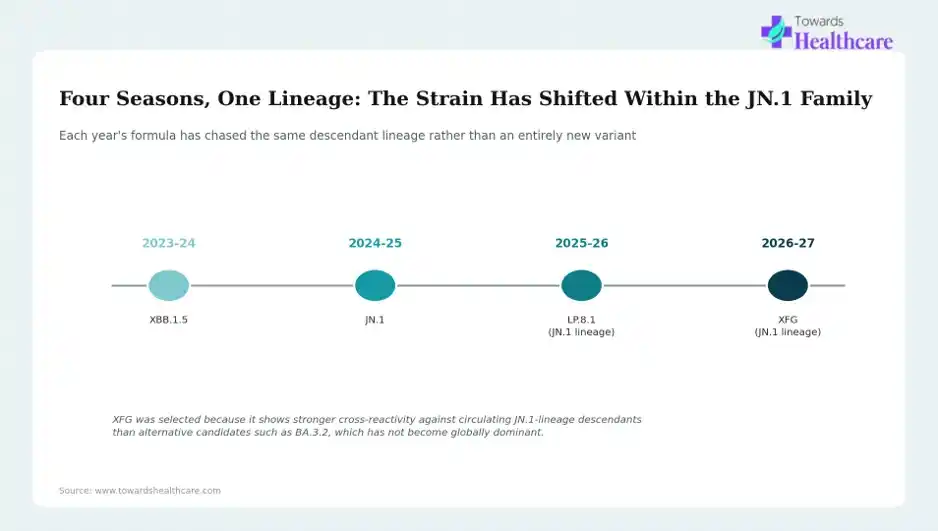
The above-mentioned linkage mainly explores strain composition selected for each COVID-19 vaccine season from 2023-24 through 2026-27, and also tracks the progression from XBB.1.5 through JN.1, LP.8.1, and now XFG.
Key Insight: According to the overall representation, each formula since 2024-2025 has concentrated on every formula since 2024-25 has targeted a descendant of the same JN.1 lineage instead of an antigenically different variant. This is why incremental strain advances, rather than a re-evolved vaccine, have sustained the standard measure.
Source: FDA, Selection of the 2026-2027 Formula for COVID-19 Vaccines.
By 2032, the COVID-19 Vaccine Market is Expected to Expand From $7.8B to $11.4B
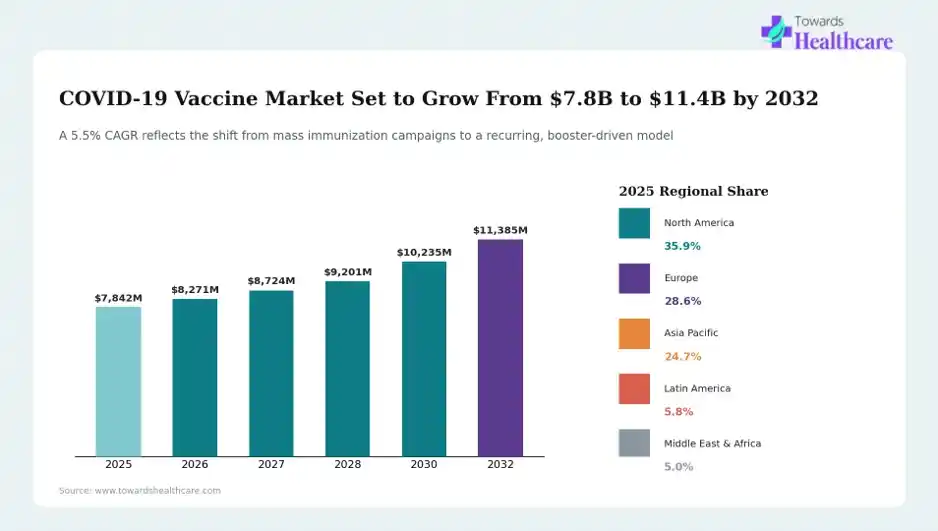
The above graph displays comprehensive estimated COVID-19 vaccine market value from 2025 to 2032 at a 5.5% compound annual growth rate, along with 2025 regional market share, primarily across North America, Europe, Asia Pacific, Latin America, and the Middle East and Africa.
Key Insight: The market has been increasingly showcasing notable rather than aggressive growth, which further indicates a market with a complete shift from pandemic-scale mass immunization to a recurring one. Moreover, the booster-driven segment is one whose size is currently capped by thousands of people who qualify for and choose to receive a yearly shot.
Along with Dominance of mRNA, a Protein-Based Option Still Highlights Sustainability on the Market.
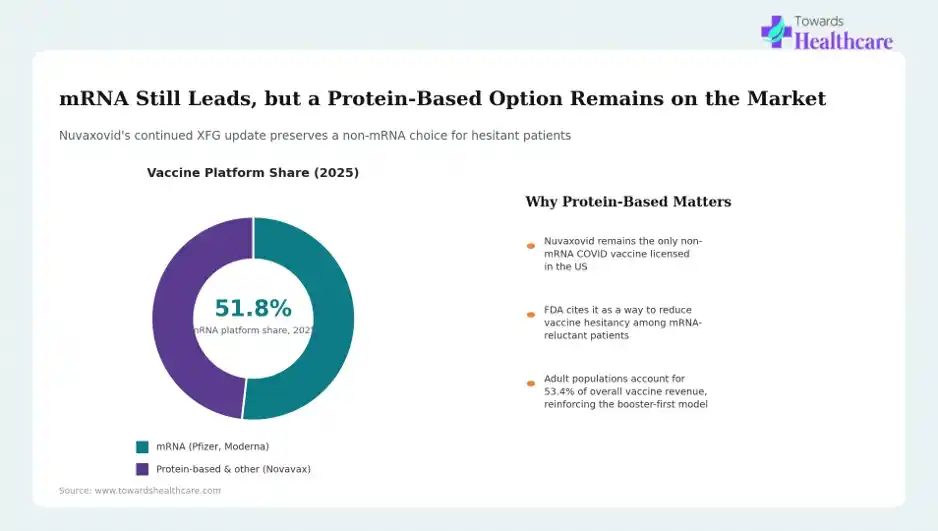
The chart depicts 2025 vaccine platform share (51.8% mRNA) and the rationale for keeping Novavax's protein-based Nuvaxovid updated, coupled with the mRNA products from Pfizer and Moderna.
Key Insight: An entire doughnut chart shows a 51.8% share of the mRNA platform in 2025, while holding a non-mRNA alternative as an intentional mitigation, specifically against vaccine hesitancy rather than a clinical requirement. Furthermore, the FDA has declared platform variation, not only efficacy, as factors under which products are advancing each season.
Source: FDA, 2026-2027 COVID-19 Vaccine Update.
With a Defined Eligibility, Pushing Narrowing for an Upcoming Season
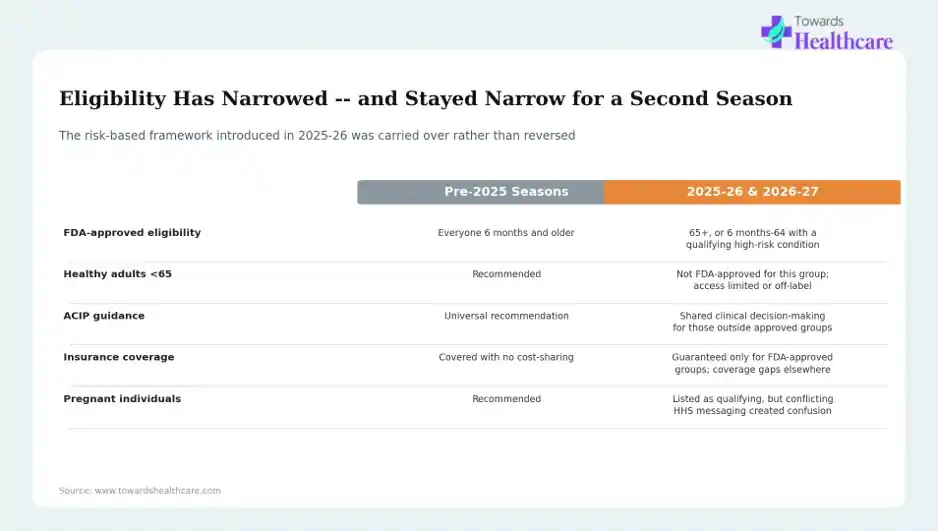
An illustration compares pre-2025 universal eligibility against the risk-based framework unveiled in 2025-26 and carried unchanged into 2026-27, which includes FDA approval scope, ACIP guidance, insurance coverage, and pregnancy recommendations.
Key Insight: Regardless of encountering the narrowed framework, the decision to preserve indicates this is currently the durable policy baseline, not a temporary limitation. However, a step-seek prospective season should expect consistency instead of returning to universal recommendations.
Source: FDA; Immune Deficiency Foundation, 2026.
Engaging Four Products, Three Manufacturers Emphasize One Strain
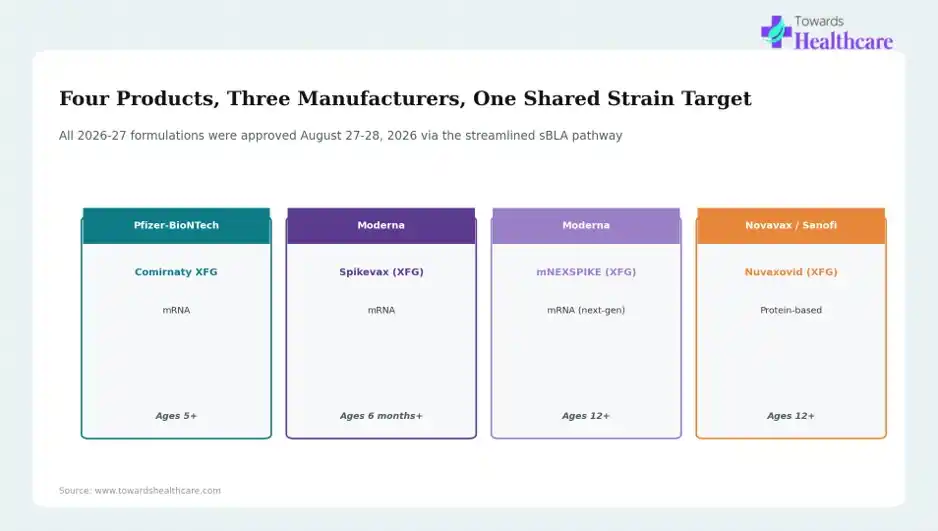
The above representation shows four FDA-approved 2026-2027 COVID-19 vaccine products, such as Comirnaty XFG, Spikevax XFG, mNEXSPIKE XFG, and Nuvaxovid XFG, alongside their platforms and age indications.
Key Insight: All three mentioned manufacturers received approval this cycle, and every product included on the same XFG target. Hence, competitive differentiation within the category currently lies entirely on platform type and age range despite antigenic coverage.
Source: The Cardiology Advisor; FDA approval announcements, August 2026.
Roadmap From Strain Selection to Approval Covered Approximately Nine Months
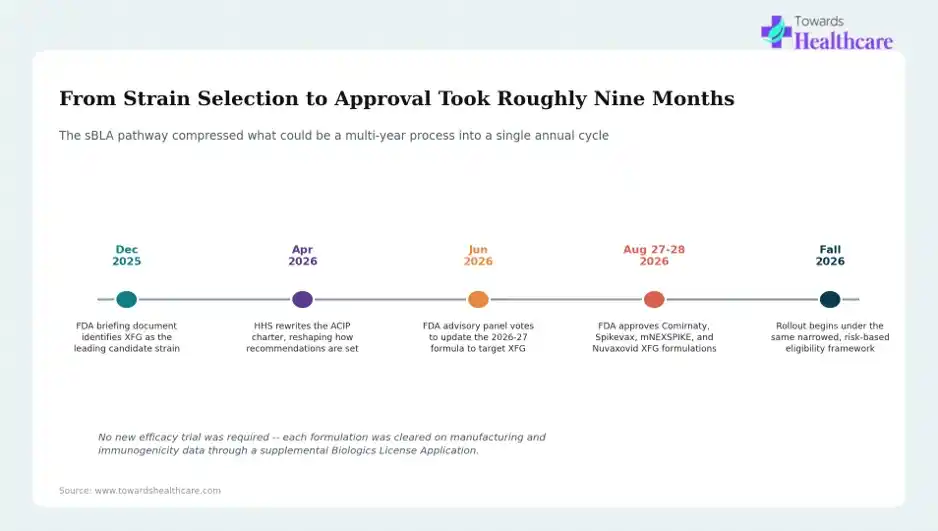
The structural demonstration of the regulatory landscape mainly covers the period from the FDA's December 2025 briefing document identifying XFG through the August 2026 approvals and fall rollout, such as the April 2026 rewrite of the ACIP charter.
Key Insight: A specific consideration of the supplemental Biologics License Application trajectory shows consistency in verifying that annual strain upgrades can shift at commercial-calendar acceleration. A key concern of this season is the policy framework placed on top of it, instead of scientific or regulatory output.
Source: FDA; PharmExec, 2026.
There is No Longer Sync Between FDA Approval and ACIP Guidance
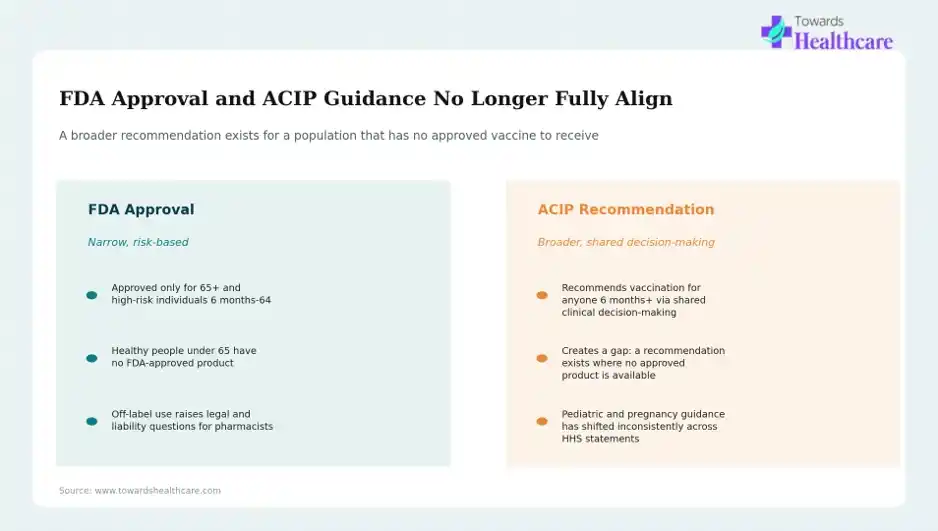
A comparison between the FDA's narrow, risk-based approval and ACIP's broader shared-clinical-decision-making recommendation mainly encompasses the resulting difference for healthy adults under 65 and inconsistent pediatric and pregnancy guidance.
Key Insight: As per our analyst, the overall recommendation as described above shows that, without a corresponding approved product to fulfil it, it does not allow access. Meanwhile, it shifts the burden onto physicians, pharmacists, and patients to direct a divergence that federal policy generated but did not overcome.
Source: Immune Deficiency Foundation; CIDRAP, 2026.
Nowadays, States Are Not Looking for Federal Alignment
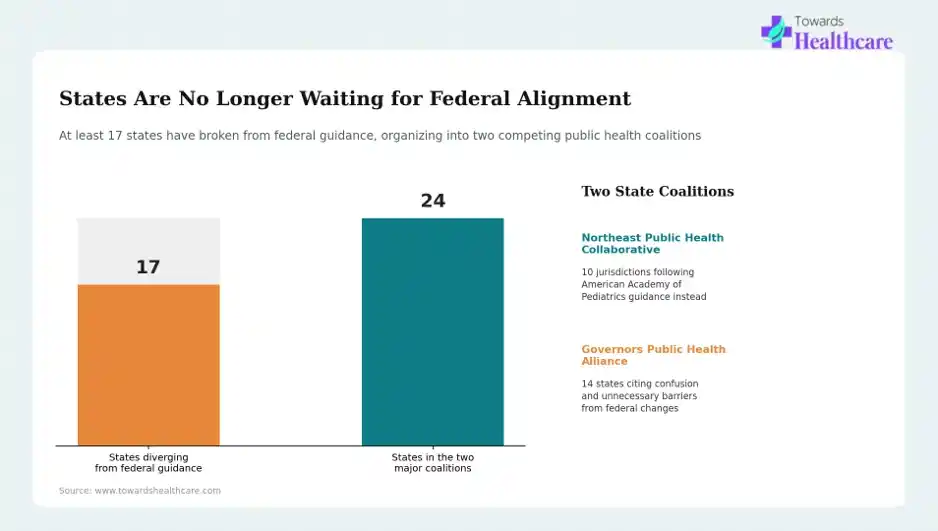
The above representation reflects that roughly 17 states are differentiating from federal vaccine guidance, organized into the 10-jurisdiction Northeast Public Health Collaborative and the 14-state Governors Public Health Alliance.
Key Insight: In particular, the US’s vaccine policy is functionally segmented, while states line up for the first time in the COVID era. However, a patient's actual eligibility and coverage currently relies as much on their state of residence as on federal guidance.
Source: Stateline, States Go Their Own Way as RFK Jr. Shifts Federal Vaccine Policy, 2026.
Booster Uptake Sustains Lower Value, Although with the Narrowed Eligible Population
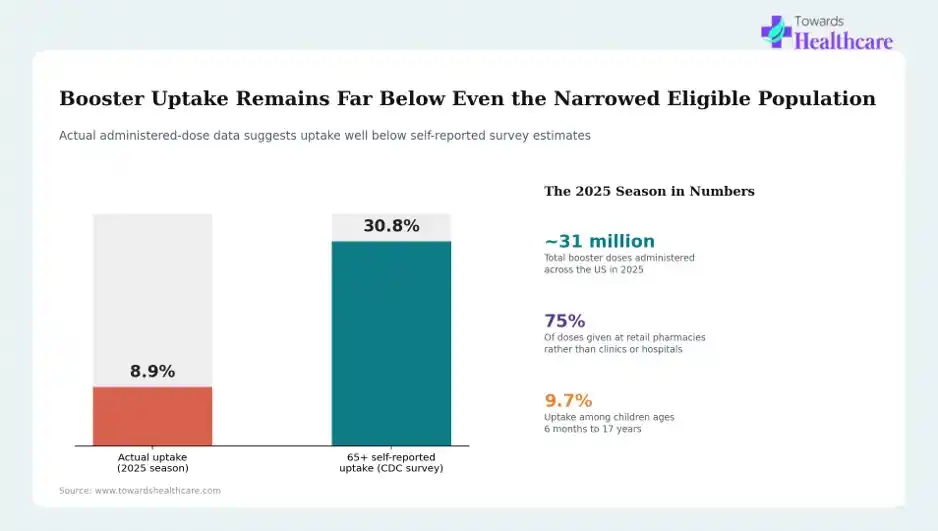
The graph depicts actual administered-dose data with 8.9% uptake in 2025 against a 30.8% self-reported uptake figure among adults 65 and older, coupled with distribution channel and pediatric uptake statistics.
Key Insight: Along with an approximate 31 million total booster doses administered in the US and 38% self-administered uptake among 65+, suggesting real-world uptake may be crucially amplified in public messaging. This results in complications for any evaluation of whether narrowed eligibility is actually reaching its required population.
Source: The Focal Points analysis of CDC and pharmaceutical revenue data, 2026.
An Efficient Access Relies Highly on Age, State, & Where You Look For
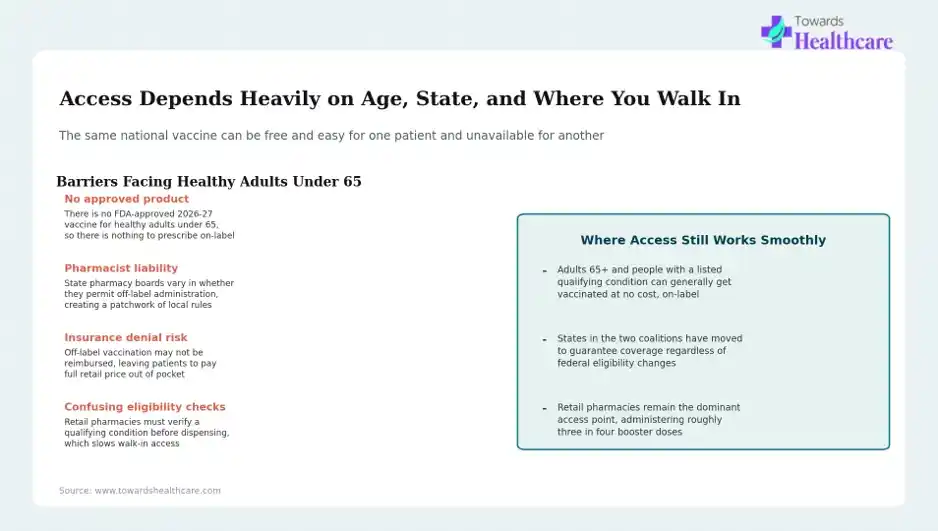
The overall structural framework has been locating barriers faced by healthy adults under 65, i.e. no approved product, pharmacist liability, insurance denial risk, and eligibility verification friction, against the feasible access still available to those 65 and older or in coalition states.
Key Insight: Free & instant availability of the same vaccine to one patient & functionality unobtainable to another solely depends on age, state of residence, and which pharmacy they walk into. Also, this assumes a level of access diversity that the pre-2025 universal framework did not develop.
Source: Instalab; FactCheck.org, 2026.
Prospective Pipeline Projects Beyond Annual Strain Advances
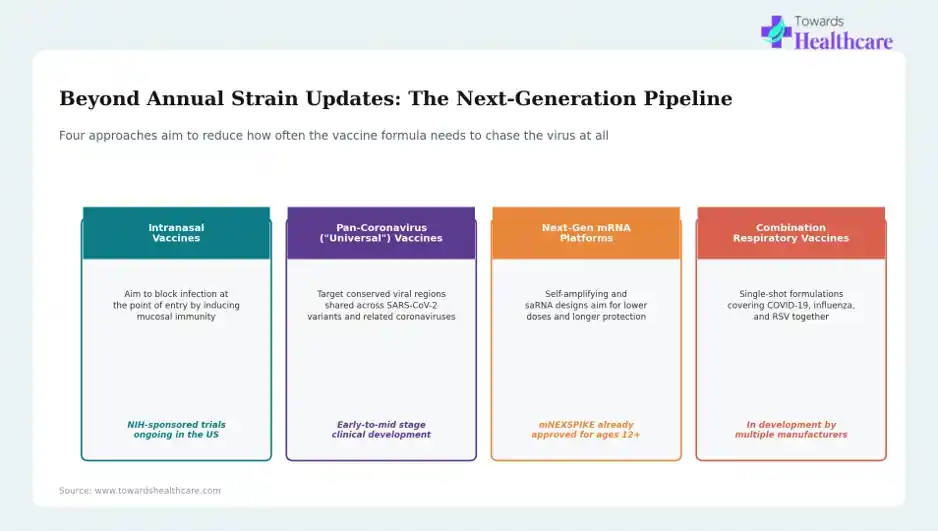
These are four next-generation vaccine approaches in development, which focus on intranasal vaccines, pan-coronavirus ('universal') vaccines, next-generation mRNA platforms, and combination respiratory vaccines, along with their current development stage.
Key Insight: Nowadays, each attempt across the pipeline is created to lower the area’s reliance on approaching individual strains per year. Moreover, mNEXSPIKE has already stepped toward approval, which suggests the momentum away from annual reformulation may start as soon as possible compared with the other three classes.
Source: NIAID; Absolutely Maybe, NextGen Covid Vax Tracker, 2026.
Coming Era With Three Forces Will Transform the Future COVID Vaccine Era
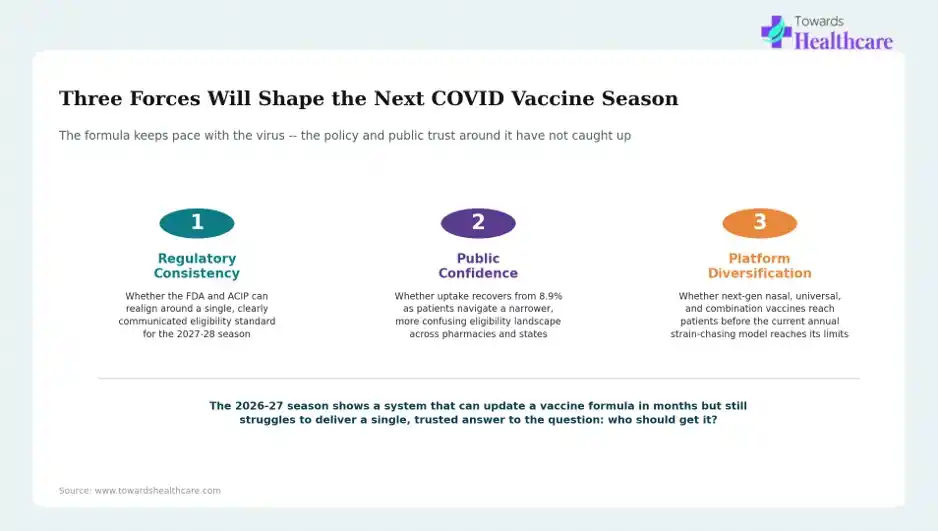
The execution of three variables will decide the pathway of COVID-19 vaccination policy, which primarily comprise regulatory consistency between the FDA and ACIP, recovery of public confidence and uptake, and diversification toward next-generation platforms.
Key Insight: The system has verified it can bolster a vaccine formula in months, while the 2026-2027 season shows it has not so far proven it can provide a single, trusted answer to who should receive that vaccine. Thus, it is the unanswered question, not the strain itself, that will determine the upcoming era.
Source: Towards Healthcare analysis, 2026.
2026-27 COVID-19 Vaccines at a Glance
| Brand Name | Manufacturer | Platform | Age Indication |
| Comirnaty XFG | Pfizer-BioNTech | mRNA | Ages 5+ |
| Spikevax (XFG) | Moderna | mRNA | Ages 6 months+ |
| mNEXSPIKE (XFG) | Moderna | mRNA (next-gen) | Ages 12+ |
| Nuvaxovid (XFG) | Novavax / Sanofi | Protein-based | Ages 12+ |
Recent Updates About COVID-19 Vaccines in 2026
In September 2026, Moderna Singapore received approval from the Health Sciences Authority (HSA) for Spikevax® XFG, Moderna’s latest COVID-19 mRNA vaccine that targets the SARS-CoV-2 XFG variant, for active immunisation against COVID-19 caused by SARS-CoV-2 in Singapore.
In September 2026, Shionogi & Co., Ltd. announced that the European Commission (EC) granted marketing authorization for Zokovea® (ensitrelvir) for post-exposure prophylaxis (PEP) of COVID-19 in adults and adolescents aged 12 years & older.
Source- https://www.shionogi.com/global/en/news/2026/09/20260928.html
Strategic Questions for Industry Leaders
- How should manufacturers plan production and distribution when FDA-approved eligibility and ACIP recommendations no longer fully align?
- What steps could reconcile the gap between FDA approval scope and ACIP's shared-clinical-decision-making recommendation for healthy adults under 65?
- How should companies support pharmacists navigating inconsistent state-level rules on off-label vaccine administration?
- What communication strategies could help rebuild public confidence given the gap between reported and actual booster uptake?
- Should manufacturers pursue state-specific coverage or access agreements given the emergence of rival public health coalitions?
- How should the industry respond if more states pass legislation decoupling their vaccine policy from federal ACIP guidance?
- What data would most convincingly demonstrate the real-world impact of narrowed eligibility on vaccination coverage among high-risk groups?
- How should companies prioritize investment between annual strain-matching updates and next-generation platforms like intranasal or universal vaccines?
- What role should retail pharmacies play in expanding access given they already administer roughly three in four booster doses?
- How should manufacturers address vaccine hesitancy specifically tied to distrust in the federal regulatory and advisory process itself?
- What pricing and reimbursement models would work if coverage guarantees increasingly vary by state rather than by federal policy?
- How should companies evaluate the commercial risk of maintaining three distinct platforms (mRNA, next-gen mRNA, and protein-based) long-term?
- What lessons from the sBLA pathway's speed could apply to accelerating other seasonal vaccine updates, such as for influenza?
- How should the industry engage with state coalitions that are now setting their own vaccine access and insurance coverage standards?
- What surveillance systems would best detect if narrowed eligibility is leading to a measurable rise in COVID-19-related hospitalizations?
- Should companies advocate for restoring universal FDA-approved eligibility, or adapt commercial strategy to the current risk-based model?
- How should pediatric and pregnancy vaccine guidance be clarified given the inconsistent messaging seen across recent HHS statements?
- What combination-vaccine development timelines are realistic given current single-shot COVID, flu, and RSV candidates?
- How should companies monitor for further changes to the ACIP charter that could reshape recommendation-setting authority?
- What would a credible, durable eligibility framework look like if the 2025-26 and 2026-27 seasons represent the new long-term baseline?
Data & Intelligence Pointers
- Track the CDC's COVIDVaxView weekly dashboard for updated administered-dose and coverage estimates as the 2026-27 rollout progresses.
- Monitor state legislative action, particularly bills decoupling state vaccine policy from federal ACIP recommendations.
- Follow further ACIP charter changes and meeting outcomes for signs of expanded or further restricted recommendation authority.
- Watch Pfizer, Moderna, and Novavax quarterly disclosures for 2026-27 season sales as a proxy for real-world uptake.
- Track state-level pharmacy board rulings on off-label COVID-19 vaccine administration for healthy adults under 65.
- Monitor NIH and NIAID trial registries for intranasal and pan-coronavirus vaccine candidates advancing toward later-stage trials.
- Follow insurer and ACA coverage policy updates for any changes to cost-sharing requirements tied to FDA-approved eligibility groups.
- Track hospitalization and severe-outcome data by age and vaccination status to assess the real-world impact of narrowed eligibility.
- Watch for expansion or contraction of the Northeast Public Health Collaborative and Governors Public Health Alliance memberships.
- Monitor combination respiratory vaccine (COVID-flu-RSV) trial readouts from major manufacturers for future single-shot product timelines.
- Follow Towards Healthcare and other market analysts for updated COVID-19 vaccine market size and regional share revisions.
- Track FDA briefing documents and advisory committee meeting schedules for early signals on the 2027-28 strain selection process.
References
- U.S. Food and Drug Administration. "Selection of the 2026-2027 Formula for COVID-19 Vaccines." 2026.
- U.S. Food and Drug Administration. "2026-2027 COVID-19 Vaccine Update." 2026.
- The Cardiology Advisor. "FDA Approves 2026-2027 COVID-19 Vaccines." August 2026.
- PharmExec. "FDA's Advisory Panel Votes in Favor of Updating COVID-19 Vaccine Shots to Target XFG Variant." 2026.
- Immune Deficiency Foundation. "Update: ACIP Meeting Adds to COVID-19 Vaccine Confusion." 2026.
- Stateline. "States Go Their Own Way as RFK Jr. Shifts Federal Vaccine Policy." January 2026.
- CIDRAP. "The State of US Vaccine Policy." Multiple editions, 2026.
- The Focal Points. "In 2025, 31 Million (8.9%) Americans Actually Took a COVID-19 Booster." 2026.
- Absolutely Maybe. "Progress for 'Universal' Vaccine & More NextGen COVID Vax News." 2026.