


 Request Consultation
Overview:
Nowadays, worldwide vaccine-preventable disease control is being assessed from three axes simultaneously. In such cases, COVID-19 has transitioned into an endemic, seasonally managed pattern, with annual strain advances currently known as a regular regulatory exercise. Moreover, Mpox is experiencing contrast, i.e. a newly found recombinant strain has spread throughout three WHO regions within one reporting cycle. This pushes a targeted but urgent risk response. On the other hand, measles is considered the most mitigable of the three concerns, which is re-expanding because routine childhood immunization coverage has stabilized nearly eight to nine points below the 95% threshold needed to terminate sustained transmission, leaving an estimated 29 million children under-protected across the globe.
These three pathways might seem unrelated, but they provide a common structural reason. However, global immunization financing is under acute strain, where a $2.6 billion US pledge to Gavi, the Vaccine Alliance, is currently at risk of withdrawal, threatening vaccine access across numerous low- & middle-income nations, along with a predicted toll measured in preventable deaths. Simultaneously, disease surveillance capacity will generally acquire a developing recombinant strain, such as the one now driving the mpox outbreak. This remains inconsistent across regions, and public trust in vaccination guidance will consistently diminish amid fragmented and shifting messaging.
Alongside, the complete vaccine market is anticipated to surge from nearly $88 billion in 2026 to $126 billion by 2035. This expansion is mainly focused on higher-income markets and does not by itself close the routine-immunization gap, which fuels measles resurgence in the lowest-coverage regions.
This report's assessment covers all three disease trajectories alongside: the coverage data behind measles' resurgence, the timeline and risk assessment of the new mpox recombinant strain, the funding shock facing Gavi, and the broader market and technology transitions, such as the continued growth of mRNA platforms and the pandemic-preparedness emphasis on H5N1 avian influenza as the leading candidate for the next 'Disease X.' Collaboratively, these signals point to the same conclusion that addresses the pathogens variance, but the response system's weak points, i.e. financing, surveillance, and trust are the same across all three.
Core Area: Three Diseases, Three Very Distinct 2026 Trajectories
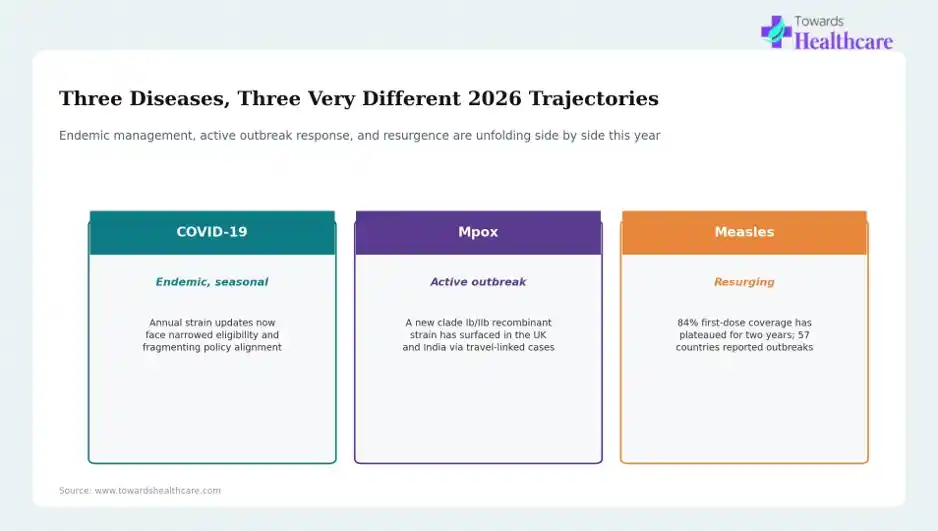
Together, the above framework provides insight into where COVID-19, mpox, and measles each stand in 2026: an endemic, seasonally managed disease; an active, cross-regional outbreak of a new recombinant strain; and a resurging, vaccine-preventable disease with plateaued coverage.
Key Insight: While all three of the above factors are irrelevant, each is a distinct stage of the same foundational failure mode. Furthermore, funding, surveillance, and public trust systems are all under parallel strain.
Source: WHO; CDC; Towards Healthcare analysis, 2026.
Measles Coverage With Plateau Result, i.e. Well Below the Outbreak Ceiling
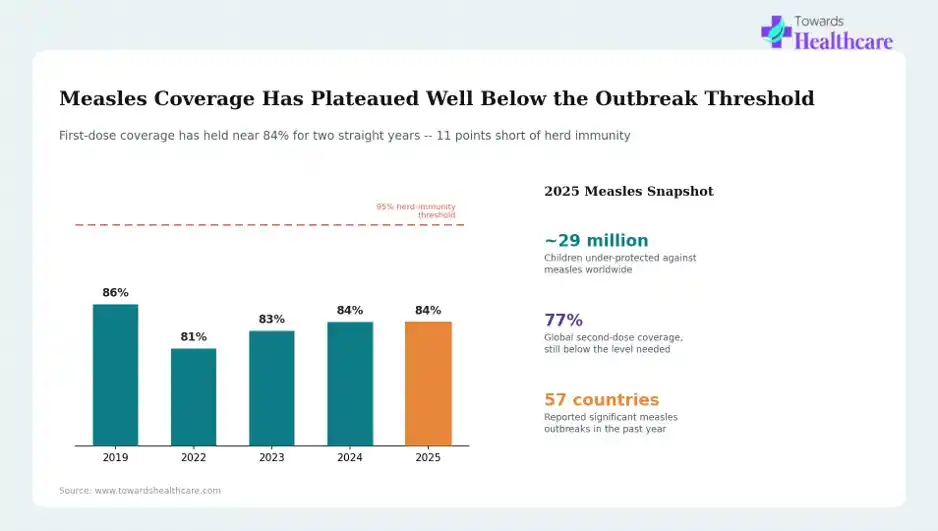
The above chart displays global first-dose measles vaccination coverage from 2019 to 2025, which is plotted against the 95% threshold required to mitigate persistent outbreaks, coupled with the estimated 29 million children left under-protected.
Key Insight: The overall study unlocks 2025 measles insights, where 57 nations recorded significant measles outbreaks in the last year. Along with this, measles coverage has been nearly eight to nine points below the outbreak-prevention threshold for five consecutive years. Thus, this is not a short-term decline but a structural reduction that ensures recurring regional outbreaks until it closes.
Source: WHO/UNICEF Estimates of National Immunization Coverage, 2026.
Novel Strain Expansion: Newly Discovered Mpox Recombinant Strain Has Surpassed Three WHO Regions
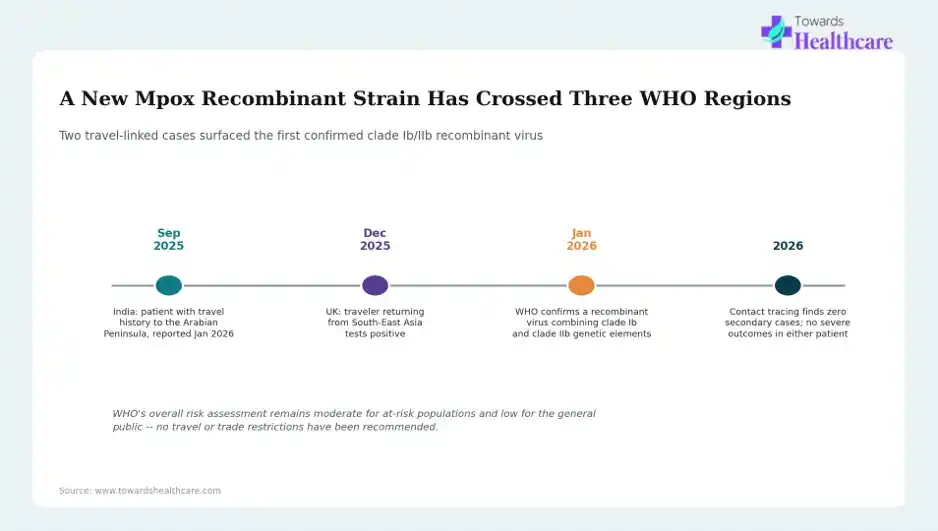
The above-mentioned periodic roadmap covers the development & spread of a novel mpox recombinant strain, from initial detection through confirmed transmission across several WHO regions.
Key Insight: Along with a timeline representation from September 2025 to now, a new recombinant strain has been broadening its impact, specifically across multiple regions. Within a single reporting cycle, this reflects how rapidly a genomically diverse variant can outperform the surveillance systems designed to detect it early.
Source: WHO Disease Outbreak News, 2026.
Despite Aiming Universal, WHO's Risk Assessment Remains Targeted
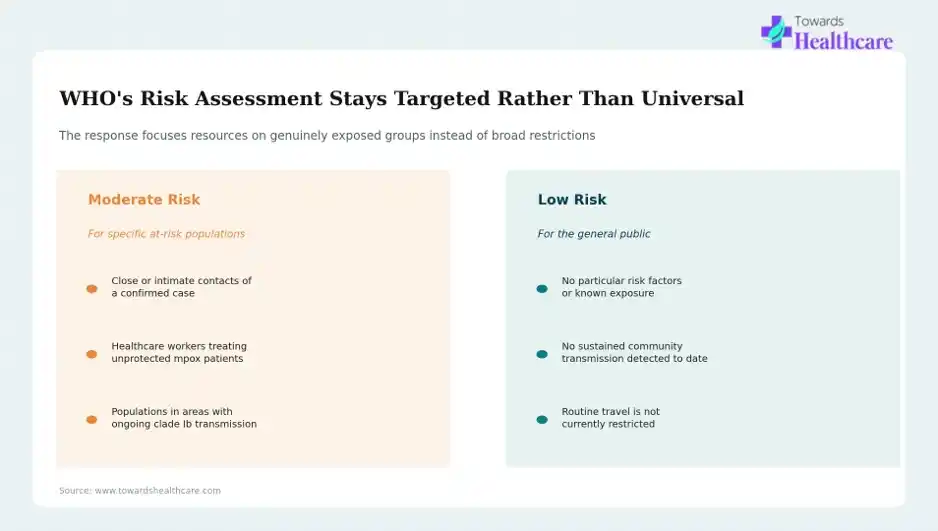
An execution of WHO’s differentiated mpox risk assessment mainly includes moderate risk for populations with high-risk exposure pathways and low risk for the general population, alongside what that distinction means for vaccination and containment strategy.
Key Insight: Instead of a universal risk study, WHO’s targeted evaluation maintains the response proportionate. This also reveals that containment relies broadly on reaching specific at-risk groups regardless of expansive population-level solutions.
Source: World Health Organization, 2026.
Across this Era, 13.5 Million Children Still Receive Zero Vaccine Doses
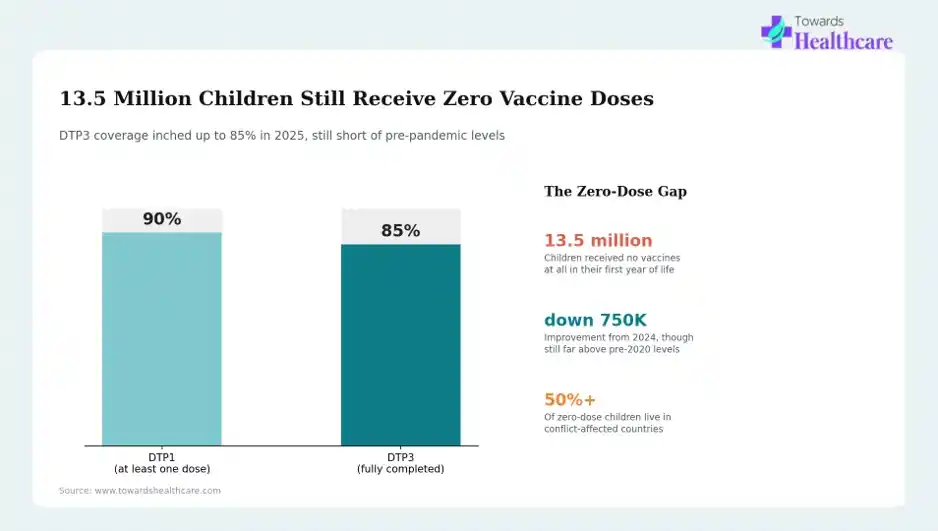
The graph represents global DTP1 and DTP3 routine immunization coverage rates, coupled with the number of children who received no routine vaccine doses at all in the latest reporting year.
Key Insight: Day by day, intensive coverage recovery is moving towards pre-pandemic levels, but this masks a consistent zero-dose population. Moreover, these are the children toughest to reach through routine health systems; they are the ones driving outbreak risk greater than topline coverage counts suggest.
Source: WHO/UNICEF Estimates of National Immunization Coverage, 2026.
Commitment By the U.S. of $2.6 Billion to Gavi Is Currently at Risk.
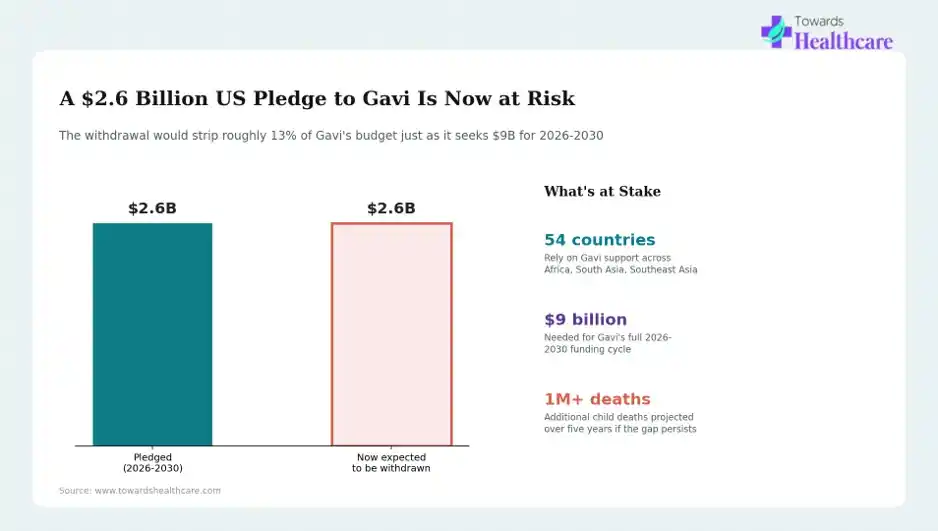
This represents a difference between the US pledge ($2.6B) to Gavi, the Vaccine Alliance, and funding now at risk of withdrawal. Along with this, the broader consequences include numerous countries and nearly a billion dollars in total funding exposure, with an estimated toll in preventable deaths.
Key Insight: Specifically, Gavi's funding model is primarily based on multi-year pledge stability. However, only one large donor rethinking its commitment doesn’t just lower the budget, but also compromises the predictability that allows Gavi to negotiate long-term vaccine procurement contracts at scale.
Source: Gavi, the Vaccine Alliance; Reuters, 2026.
Prospective Look: By 2035, Global Vaccine Market Anticipated to Expand From $88B to $126B
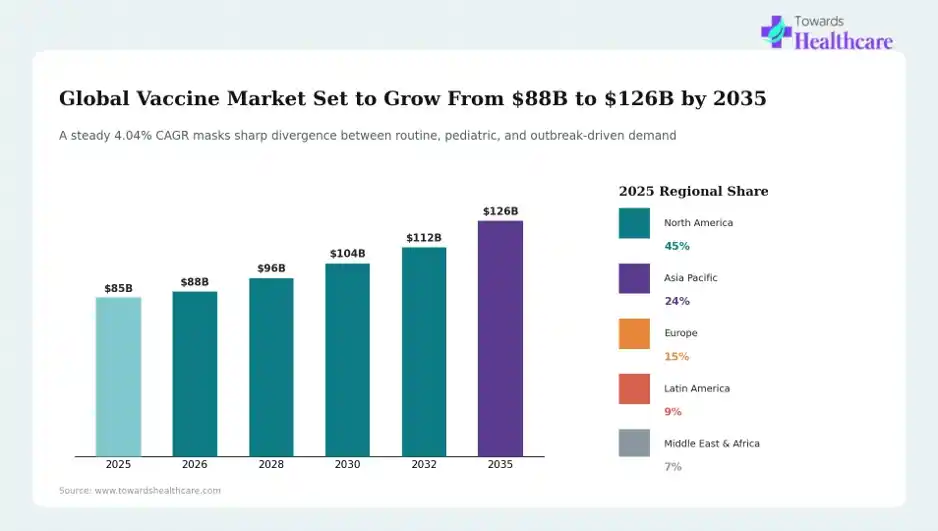
This report uncovers estimated global vaccine market value from 2026 to 2035, side by side with 2025 regional market share across North America, Asia Pacific, Europe, Latin America, and the Middle East and Africa.
Key Insight: With sustainable growth in the entire market value, coupled with steady routine immunization coverage, the market is broadening, although the populations most in need of basic vaccine access are not being targeted.
Source: Towards Healthcare, Vaccine Market Report, 2026.
Break to Progression: Four Barriers Are Stopping Back Global Immunization Growth
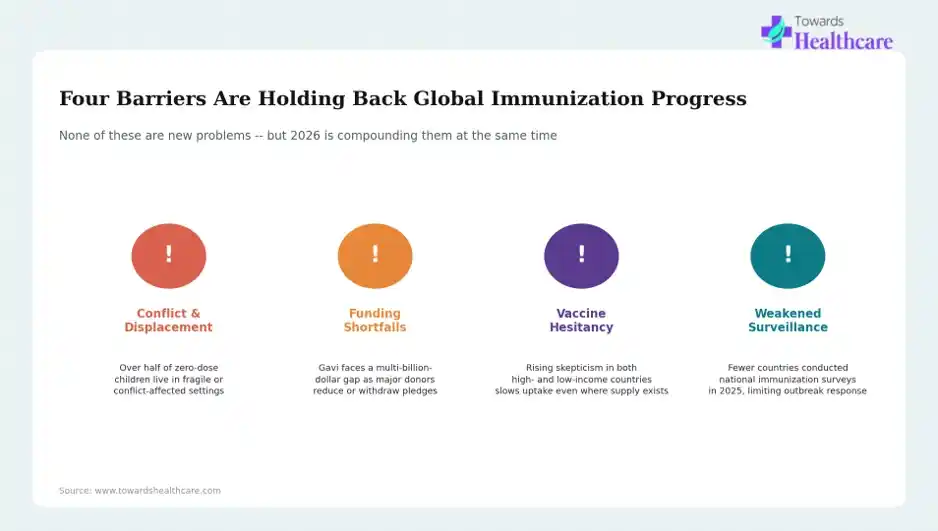
These are four key hurdles across global immunization progress, which mainly comprise conflict and displacement, funding shortfalls, vaccine hesitancy, and weakened disease surveillance.
Key Insight: By assuming these four obstacles strengthen each other, conflict shifts populations more than the reach of health systems. Thus, it strains already-thin funding, which leads to weak surveillance required to find outbreaks before hesitancy has gained traction.
Source: WHO; Gavi, the Vaccine Alliance, 2026.
Nowadays, Protein-Based Platforms Are Dominating, Whereas mRNA Is Expected to Surge Rapidly
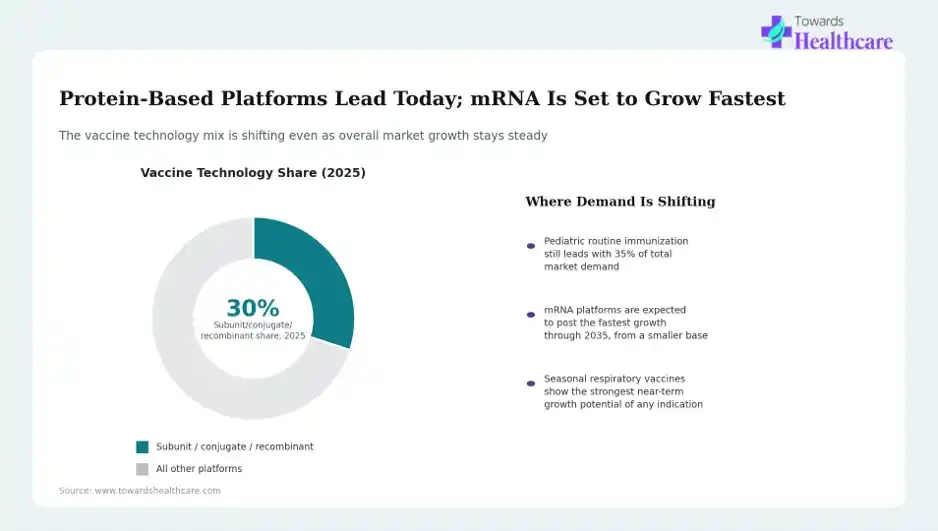
The above chart showcases the 2025 vaccine technology share (30%), prominently powered by subunit, conjugate, and recombinant platforms, along with where demand is moving across pediatric, seasonal respiratory, and mRNA-based segments.
Key Insight: According to analyst assessment, rapid expansion of the mRNA pathway begins from a small base that was established completely based on COVID-19. Therefore, its long-term share will rely on whether the platform can prove itself economically viable for other diseases beyond the one that unveiled it.
Source: Towards Healthcare, Vaccine Market Report, 2026.
Major Sector: Three Diseases, Three Distinct Vaccination Bottlenecks
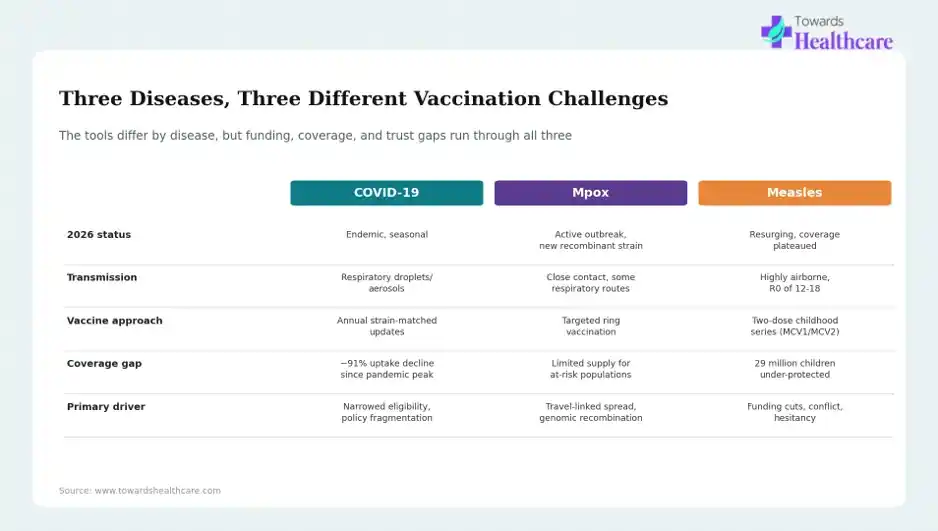
This representation shows a comparison of COVID-19, mpox, and measles throughout 2026 status, transmission route, vaccine approach, coverage gap, and primary driver of that gap.
Key Insight: The overall tools accessibility reflects diversity significantly by disease, such as annual reformulation, targeted ring vaccination, and a two-dose childhood series. Meanwhile, differences in funding, coverage, and trust operate across all three, regardless of which tool is in use.
Source: WHO; CDC; Towards Healthcare analysis, 2026.
Lead Entity: H5N1 Avian Influenza Is Emerging As Key Candidate for 'Disease X'
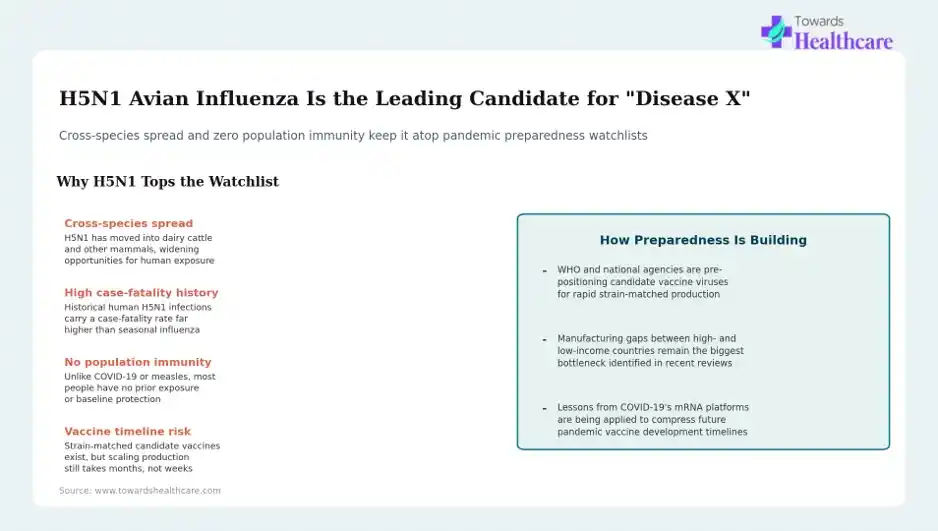
Specific coverage of why H5N1 avian influenza tops pandemic preparedness watchlists underlines cross-species spread into mammals, a high historical case-fatality rate, no population immunity, and vaccine production timelines measured in months, along with how preparedness efforts are developing.
Key Insight: Across the globe, the production difference between high- and low-income nations, not the science of strain-matching, keeps the single biggest challenge found in recent pandemic-preparedness reviews, a lesson carried over directly from COVID-19.
Source: WHO; NIAID, 2026.
Geographical Declaration: Regional Vaccination Coverage Still Ranges a 55-Point Difference
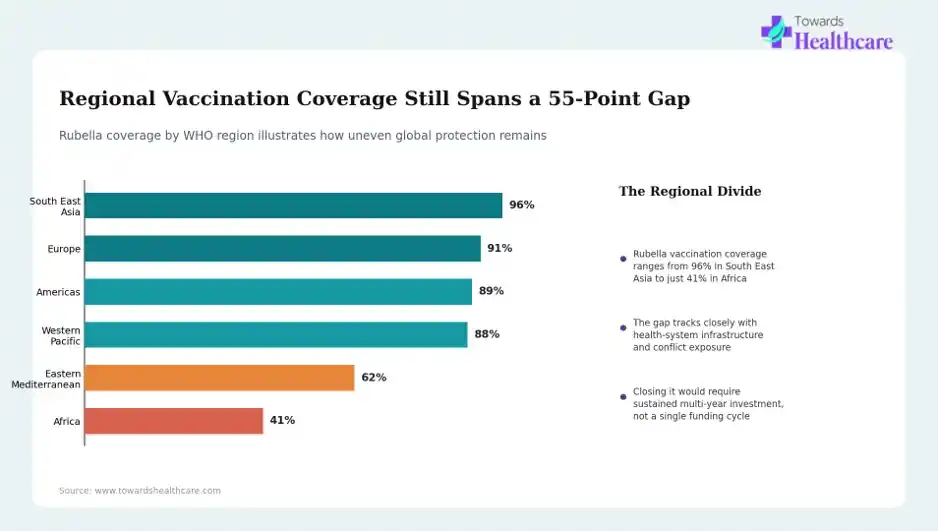
This graph depicts Rubella vaccination coverage by WHO region, which spans from 96% in South East Asia to 41% in Africa, coupled with a focus on what drives the regional gap.
Key Insight: An explored regional division is broadly tracing closeness with health-system infrastructure and conflict exposure instead of vaccine availability alone. However, closing it necessitates continued multi-year investment in delivery systems, beyond a single funding cycle or donor pledge.
Source: WHO/UNICEF Estimates of National Immunization Coverage, 2026.
Conclusion: Three Forces Will Decide the Prospective Public Health Challenge
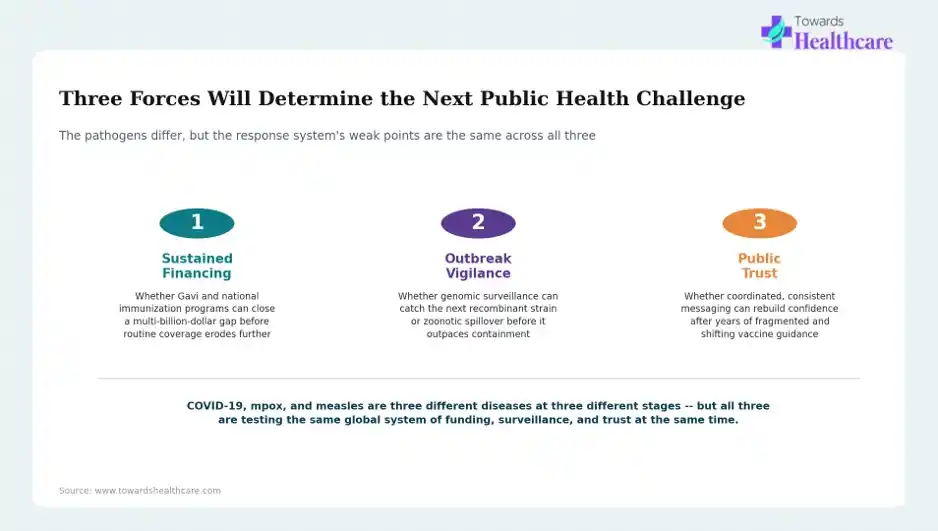
The entire creation of these three variables will determine the trajectory of global vaccine-preventable disease control, which includes sustained financing to close Gavi's funding gap, outbreak vigilance to detect the next recombinant strain or spillover, and public trust to redevelop confidence after fragmented guidance.
Key Insight: According to the complete discussion, the execution of three diverse diseases known as COVID-19, mpox, and measles at three distinct stages further emphasises the need to evaluate the accuracy of the global system of funding, surveillance, and trust simultaneously. Also, the system does not consist of only a single pathogen, but is the real variable to look at.
Source: Towards Healthcare analysis, 2026.
2026 Global Vaccine Landscape at a Glance
| Disease | 2026 Status | Coverage / Scale | Primary Risk Driver |
| COVID-19 | Endemic, seasonal | ~91% uptake decline since pandemic peak | Policy fragmentation, narrowed eligibility |
| Mpox | Active outbreak, new recombinant strain | Spread across 3 WHO regions | Genomic recombination, travel-linked spread |
| Measles | Resurging, coverage plateaued | 84% coverage vs. 95% threshold; 29M children under-protected | Funding cuts, conflict, hesitancy |
Strategic Questions for Industry Leaders
- How should manufacturers and health agencies prioritize resources across an endemic disease (COVID-19), an active outbreak (mpox), and a resurging one (measles) simultaneously?
- What contingency funding models could offset the risk of a major donor, such as the United States, reducing or withdrawing its Gavi pledge?
- How should governments and manufacturers close the gap between overall vaccine market growth and stagnant routine immunization coverage in the lowest-income regions?
- What surveillance investments would most effectively catch the next recombinant strain or zoonotic spillover before it spreads across multiple regions?
- How should companies balance annual strain-matching investment for COVID-19 against R&D for next-generation platforms like pan-coronavirus vaccines?
- What role should regional manufacturing capacity play in closing the mpox vaccine access gap identified in current WHO risk assessments?
- How should the industry respond to a scenario where multiple major donors reduce global immunization funding within the same budget cycle?
- What data infrastructure would best identify and prioritize outreach to the estimated 13.5 million zero-dose children globally?
- Should manufacturers prioritize H5N1 candidate-vaccine stockpiling given its status as the leading 'Disease X' candidate, and at what scale?
- How should companies evaluate long-term investment in mRNA manufacturing capacity given its fastest-growth trajectory from a still-small base?
- What pricing and access models would help close the 55-point regional coverage gap seen in rubella and other routine childhood vaccines?
- How should public health messaging be redesigned to rebuild trust after several years of fragmented and shifting guidance across multiple diseases?
- What triggers should prompt WHO or national agencies to escalate mpox from a targeted, moderate-risk designation to a broader public health response?
- How should companies structure supply agreements to remain resilient if conflict or displacement disrupts distribution in high-burden regions?
- What combination of financing, workforce, and logistics investment would most efficiently raise measles coverage back above the 95% threshold?
- How should industry stakeholders engage with Gavi and national governments to stabilize multi-year vaccine procurement commitments?
- What early-warning indicators would best signal whether the current mpox recombinant strain is on a trajectory toward broader community transmission?
- How should companies weigh continued investment in protein-based platforms against the accelerating shift toward mRNA and next-generation formats?
- What lessons from COVID-19's mRNA platform development could most directly accelerate H5N1 pandemic-preparedness vaccine timelines?
- How should the industry and public health agencies jointly define what durable success looks like across all three disease trajectories over the next five years?
Data & Intelligence Pointers
- Track WHO Disease Outbreak News for updates on the geographic spread and case counts of the new mpox recombinant strain.
- Monitor Gavi, the Vaccine Alliance funding announcements and donor replenishment conferences for changes to the at-risk US pledge.
- Follow WHO/UNICEF Estimates of National Immunization Coverage (WUENIC) for annual updates to measles, DTP1, and DTP3 coverage rates.
- Watch national and regional health ministry reports for zero-dose child outreach program results and funding allocations.
- Track NIAID and WHO pandemic-preparedness updates for H5N1 candidate-vaccine stockpiling and manufacturing capacity announcements.
- Monitor Towards Healthcare and other market analysts for revised global and regional vaccine market size projections through 2035.
- Follow mRNA platform manufacturers' pipeline disclosures for progress on non-COVID indications that could validate the technology's broader growth thesis.
- Track regional WHO office reports for rubella, measles, and DTP coverage by region to monitor the size of the coverage gap over time.
- Watch for updates to WHO's mpox risk assessment, including any shift from targeted, moderate-risk classification to a broader designation.
- Monitor conflict and displacement tracking data (UNHCR, OCHA) alongside immunization coverage data in affected regions.
- Follow multilateral funding conferences and pledging events for signals on overall global immunization financing stability.
- Track publications on pan-coronavirus and combination respiratory vaccine trial progress as indicators of platform diversification timelines.
References
- World Health Organization. "Disease Outbreak News: Mpox." 2026.
- World Health Organization. Mpox Risk Assessment, 2026.
- WHO/UNICEF. "Estimates of National Immunization Coverage (WUENIC)." 2026.
- Gavi, the Vaccine Alliance. Funding and Pledge Status Updates, 2026.
- Reuters. "US Weighs Withdrawing Gavi Pledge, Threatening Global Vaccine Access." 2026.
- Towards Healthcare. "Vaccine Market Size, Share and Growth Report." 2026.
- National Institute of Allergy and Infectious Diseases (NIAID). Pandemic Preparedness Updates, 2026.
- UN News. "Measles Resurgence and Global Immunization Coverage." 2026.
- Measles & Rubella Partnership. Global Progress Reports, 2026.
- Observer Research Foundation (ORF). "Global Health Financing and Immunization Gaps." 2026.