
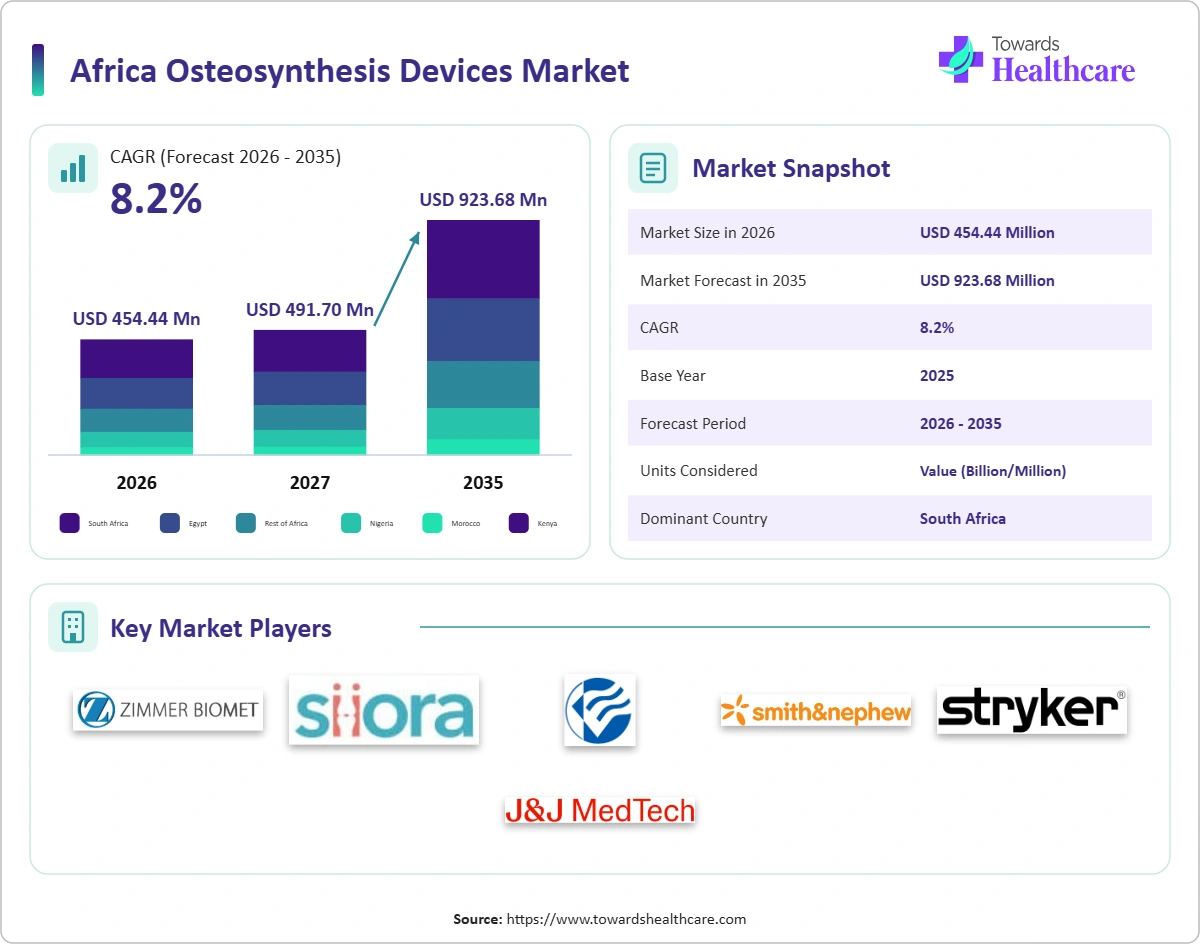
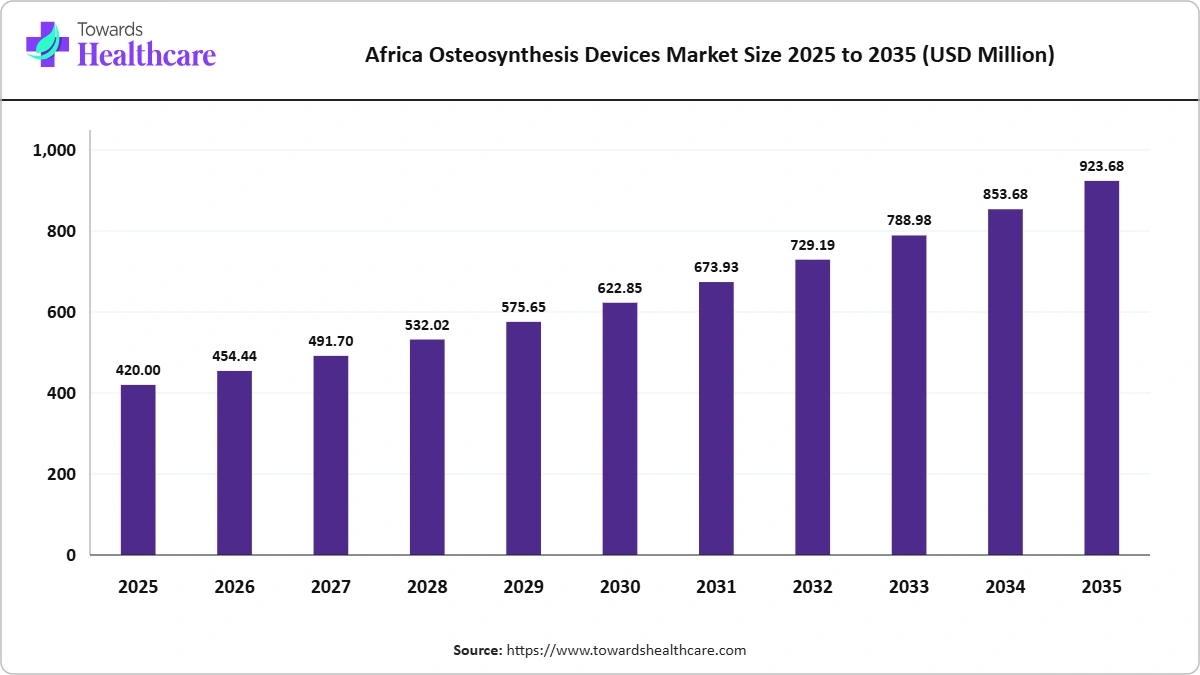
The market is projected to grow from USD 420.00 million in 2025 to USD 923.68 million by 2035 because Africa has a heavy burden of road traffic fractures, and wider access to surgery is raising the demand for implants. Road trauma, population growth, private healthcare, and surgeon training support strong growth. The market is expected to reach USD 622.85 million by 2030 and sustain a CAGR of 8.20% during the forecast period. Fracture care in Africa increasingly uses 3D-printed medical devices for planning and training.
Analyst View: We built the estimate from fracture surgery volumes, implant use, and average prices by country, cross-checked against relevant supplier and import activity. Published estimates for Africa are limited, so our value is evidence-based.
| Driver | Impact | ≈ CAGR Contribution | Time Horizon | Key Regions |
| Road traffic injuries are common | High | +3.20 pp | Short to long term | Africa-wide, strongest in South Africa |
| Populations grow | Medium | +2.70 pp | Medium to long term | Africa-wide, fastest uptake in Kenya |
| Private healthcare expands | Medium | +2.30 pp | Short to medium term | Africa-wide |
| Surgeon training improves | Low | +1.80 pp | Long term | South Africa and Kenya |
Note: Contributions are indicative estimates of each factor's effect on annual growth.
Sources: Expert interviews, secondary sources, Towards Healthcare database and Towards Healthcare analysts.
These drivers together add about 10.00 percentage points to the annual growth of the market, with significant prevalence of road traffic injuries having the largest effect. Their influence is strongest in South Africa, while uptake grows fastest in Kenya.
| Restraint | Impact | ≈ Negative CAGR Contribution | Time Horizon | Key Regions |
| Limited budgets | High | -0.81 pp | Short to medium term | Africa-wide |
| Shortage of orthopaedic surgeons | High | -0.60 pp | Medium term | Smaller and price-sensitive markets |
| Supply chain gaps | Medium | -0.40 pp | Short term | South Africa and other mature markets |
Note: Contributions are indicative estimates of each factor's effect on annual growth.
Sources: Expert interviews, secondary sources, Towards Healthcare database and Towards Healthcare analysts.
These restraints are expected to decrease the annual growth rate of the market by about 1.80 percentage points, because of limited budgets. Their effect decreases over the forecast period as suppliers, buyers, and regulators adapt, leaving a net CAGR of 8.20% from 2026 to 2035.
The demand for affordable implants and intramedullary nailing systems is creating opportunities in East and West Africa, where access to fracture fixation treatments is still limited. Surgeon training collaborations and significant investments to develop local manufacturing capabilities create opportunities to improve the availability of osteosynthesis devices, improve clinical capabilities, and reduce reliance on imports.
Note: 2025 is the base year; 2035 shares and CAGRs are forecasts.
Sources: Expert interviews, secondary sources, Towards Healthcare database, and Towards Healthcare analysts.
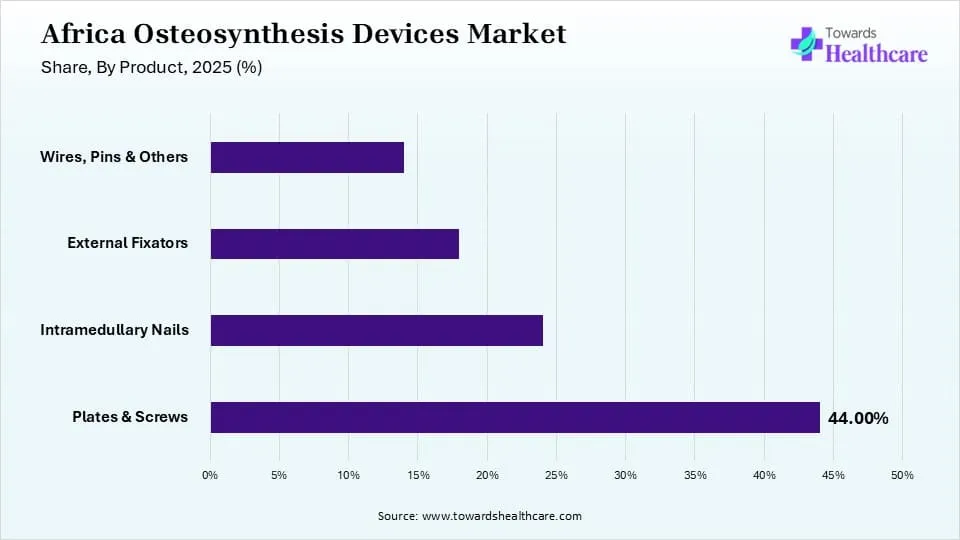
Plates & Screws accounted for 44.00% of the market in 2025 and are projected to expand at a CAGR of 7.59% from 2026 to 2035. Plates and screws hold the dominant share because they are used in a major proportion of fracture surgeries. This segment is expected to grow slower than the overall market over the forecast period.
Intramedullary Nails are growing at the highest rate as surgeons are swiftly adopting nailing for long-bone fractures. The rate of growth of this segment is expected to be higher than the market from 2026 to 2035.
External Fixators are commonly used for open fractures from road accidents. This segment is expected to grow broadly in line with the overall market over the forecast period.
Wires, Pins & Others serve as complementary products and are consistently demanded across various well-established end-use applications. The growth of this segment is expected to stay aligned with the market between 2026 and 2035.
Segment Outlook: Plates & Screws are expected to account for the largest share in the product category through 2035, holding about 41.59% of the market in 2035, while Intramedullary Nails are expected to expand at the highest CAGR of 9.49% during the forecast period. Currently, Wires, Pins & Others hold the smallest share and serve more specialized needs within the market.
Note: 2025 is the base year; 2035 shares and CAGRs are forecasts.
Sources: Expert interviews, secondary sources, Towards Healthcare database, and Towards Healthcare analysts.
The stainless steel segment accounted for 62.00% of the Africa osteosynthesis devices market in 2025 and is projected to expand at a CAGR of 7.44% from 2026 to 2035. Stainless steel leads because it is affordable for public hospitals. The stainless steel segment is expected to grow slower than the overall market over the forecast period.
Titanium is growing at the fastest pace as it is being rapidly adopted in private hospitals. The titanium segment is expected to grow at a faster pace than the overall market between 2026 and 2035.
Segment Outlook: Stainless Steel remains the largest material segment through 2035, holding about 57.79% of the market in 2035. Titanium is expected to grow at the highest CAGR of 9.34% throughout the forecast period. Titanium has started from the smallest base, but its higher rate of growth shows how demand is shifting within the market.
Note: 2025 is the base year; 2035 shares and CAGRs are forecasts.
Sources: Expert interviews, secondary sources, Towards Healthcare database and Towards Healthcare analysts.
Public Hospitals accounted for 56.00% of the market in 2025 and are projected to expand at a CAGR of 7.62% from 2026 to 2035. Public hospitals lead because they treat most of the trauma patients. The rate of growth of this segment is expected to be lower than the market during the forecast period.
Private Hospitals are growing at the fastest pace owing to significant demand from insured patients. This segment is expected to grow at a faster rate than the overall market between 2026 and 2035.
Orthopaedic & Trauma Centres treat complex cases. The orthopaedic & trauma centres segment is expected to grow broadly in line with the overall market over the forecast period.
Segment Outlook: Public Hospitals is projected to be the largest end-user base through 2035, holding about 53.06% of the market in 2035, while Private Hospitals records the highest CAGR of 9.22% from 2026 to 2035. Orthopaedic & Trauma Centres hold the smallest share today and have a relatively small application base within the market.
Analyst View: Segment shares were allocated from demand, product portfolios, and pricing in each category. Plates & Screws, Stainless Steel and Public Hospitals lead their respective categories because they meet the core needs of today's buyers. We expect the shares of Intramedullary Nails, Titanium, and Private Hospitals to increase as newer technologies, users, and applications are growing at a faster rate.
Note: 2025 is the base year; 2035 shares and CAGRs are forecasts.
Sources: Expert interviews, secondary sources, Towards Healthcare database, and Towards Healthcare analysts.
South Africa held a 34.00% share in 2025 and is projected to expand at a CAGR of 7.85% from 2026 to 2035. South Africa is the leader because of its well-established private hospital sector and the presence of orthopaedic specialists. The rate of growth in this country is expected to be lower than the overall market over the forecast period.
Egypt has a large population base and an expanding trauma surgery ecosystem. Egypt is expected to grow broadly in line with the market between 2026 and 2035.
The rest of Africa has large unmet needs. The growth of this region is expected to stay aligned with the market throughout the forecast period.
Nigeria has a high trauma burden from road accidents. Nigeria is expected to grow broadly in line with the overall market between 2026 and 2035.
Morocco expanding health coverage is the key contributor to the growth of the national market. The growth of this country is expected to stay aligned with the overall market over the forecast period.
Kenya accounted for 7.00% of revenue in 2025 and is projected to grow at a CAGR of 9.45% during the forecast period. Kenya is growing at the fastest pace owing to the establishment of new trauma centers and SIGN programs. Kenya is expected to grow at a faster rate than the overall market from 2026 to 2035.
Analyst View: Regional shares were built from demand, installed base, spending and supplier presence in each country. South Africa holds the leading position because of its mature demand base and strong suppliers. We assign Kenya the highest growth premium because investment, adoption, and capacity are expanding fastest there.
| Rank | Company Name | 2025 Share (%) | Key Products / Business | Headquarters |
| 1 | Johnson & Johnson MedTech (DePuy Synthes) | 18.00% | Trauma plates, nails and fixators | United States |
| 2 | Stryker | 10.00% | Trauma systems | United States |
| 3 | Zimmer Biomet | 6.00% | Trauma implants | United States |
| 4 | Smith+Nephew | 6.00% | Trauma products | United Kingdom |
| 5 | Sharma Orthopedic | 5.00% | Trauma implants | India |
| 6 | SIGN Fracture Care International | 4.00% | Intramedullary nail systems for low-resource settings | United States |
| 7 | Siora Surgicals | 4.00% | Orthopaedic implants | India |
| 8 | GPC Medical | 4.00% | Orthopaedic implants | India |
| 9 | Double Medical | 4.00% | Trauma implants | China |
| 10 | Sanatmetal | 3.00% | Orthopaedic implants | Hungary |
Note: Company shares are 2025 estimates.
Sources: Company press releases, expert interviews, secondary sources, Towards Healthcare database, and Towards Healthcare analysts.
Johnson & Johnson MedTech (DePuy Synthes) led the market with an 18.00% share in 2025, followed by Stryker at 10.00% share and Zimmer Biomet at 6.00% share.
Johnson & Johnson MedTech (DePuy Synthes) accounts for the dominant share owing to its trauma plates, nails, and fixators; Stryker competes with trauma systems, and Zimmer Biomet offers trauma implants. Smith+Nephew, Sharma Orthopedic, SIGN Fracture Care International, Siora Surgicals, GPC Medical, Double Medical, and Sanatmetal compete through trauma products, trauma implants, intramedullary nail systems for low-resource settings, orthopaedic implants, orthopaedic implants, trauma implants and orthopaedic implants.
The top 10 companies accounted for 64.00% of revenue in 2025, while the remaining 36.00% was shared among many importers and local distributors. The market is fragmented, and competition centers on price, availability through distributors, surgeon training, public tenders, implant quality, and instrument sets.
Johnson & Johnson MedTech (DePuy Synthes) is headquartered in the United States. It held an 18.00% share in 2025. Its offering centres on Trauma plates, nails, and fixators. In the Towards Healthcare Companies Quadrant, it is positioned as a Leader.
Stryker has its global headquarters in the United States. It accounted for 10.00% of revenue in 2025. Its offering revolves around Trauma systems. It has been positioned as a Leader in the Towards Healthcare Companies Quadrant.
Zimmer Biomet has its corporate headquarters in the United States. The company captured 6.00% of the market in 2025. Its portfolio comprises Trauma implants. Zimmer Biomet has been awarded the status of a Leader in the Towards Healthcare Companies Quadrant.
Headquartered in the United Kingdom, Smith+Nephew accounted for a 6.00% market share in 2025, with its product portfolio primarily focused on Trauma solutions. According to the Towards Healthcare Companies Quadrant, the company is classified as a Leader.
Sharma Orthopedic is headquartered in India. It accounted for 5.00% of revenue in 2025. Its offering centres on Trauma implants. The company has been awarded the status of a Leader in the Towards Healthcare Companies Quadrant.
SIGN Fracture Care International has its global headquarters in the United States. It captured a market share of 4.00% in 2025. Its portfolio consists of Intramedullary nail systems for low-resource settings. In the Towards Healthcare Companies Quadrant, it is positioned as a Leader.
The corporate headquarters of Siora Surgicals is in India. The company accounted for 4.00% of the market in 2025. Its offering centres on Orthopaedic implants. In the Towards Healthcare Companies Quadrant, it is positioned as an Innovator.
GPC Medical is headquartered in India. It held a 4.00% share in 2025. Its offering revolves around Orthopaedic implants. It has been positioned as an Innovator in the Towards Healthcare Companies Quadrant.
Double Medical, part of Xiamen Double Medical Technology Inc., is headquartered in China. It captured 4.00% of revenue in 2025. Its offering centres on Trauma implants. In the Towards Healthcare Companies Quadrant, it is positioned as an Innovator.
The headquarters of Sanatmetal is in Hungary. The company accounted for 3.00% of the market in 2025. Its portfolio comprises Orthopaedic implants. It has been awarded the status of an Innovator in the Towards Healthcare Companies Quadrant.
The Africa osteosynthesis devices ecosystem links implant manufacturers, importers & distributors, training organizations, providers and regulators & payers, with each stage adding value before products reach end users.
| Ecosystem Stage | Role in the Market | Key Companies |
| Implant Makers | Make implants | DePuy Synthes, Stryker, Indian and Chinese makers |
| Importers & Distributors | Import and supply hospitals | Local distributors |
| Training Organisations | Train surgeons | AO Alliance, SIGN |
| Providers | Treat fractures | Public and private hospitals |
| Regulators & Payers | Approve and fund | SAHPRA, Egyptian Drug Authority, insurers |
Sources: Company press releases, expert interviews, secondary sources, Towards Healthcare database and Towards Healthcare analysts.
Implant Makers: Make implants. Key participants include DePuy Synthes, Stryker, Indian and Chinese makers.
Importers & Distributors: Import and supply hospitals. Key participants include Local distributors.
Training Organizations: Train surgeons. Key participants include AO Alliance and SIGN.
Providers: Treat fractures. Key participants include Public and private hospitals.
Regulators & Payers: Approve and fund. Key participants include SAHPRA, the Egyptian Drug Authority, and insurers.
Value in the market flows from upstream material and technology suppliers to manufacturers and service providers, then through distribution partners to end users. Companies that integrate several stages or build long-term relationships with end users will be well-positioned to capture a large share of this value.
The Towards Healthcare Companies Quadrant positions key participants in the Africa osteosynthesis devices market by market strength, reflecting revenue scale, market share, and geographic reach, and by innovation and growth strategy, reflecting product portfolio breadth, research and development intensity, and partnerships. Positions reflect each company's estimated 2025 share of the market and our examination of its product innovation, portfolio breadth, and partnerships.
Sources: Company press releases, expert interviews, secondary sources, Towards Healthcare database, and Towards Healthcare analysts.
Leaders: Johnson & Johnson MedTech (DePuy Synthes), Stryker, Zimmer Biomet, Smith+Nephew, Sharma Orthopedic and SIGN Fracture Care International combine high market share with broad portfolios and strong innovation.
Innovators: Siora Surgicals, GPC Medical, Double Medical and Sanatmetal bring newer technologies and specialised products.
By Product
By Material
By End User
By Country
The market is defined as internal and external fracture fixation implants used in Africa, including plates and screws, intramedullary nails, wires and pins, and external fixators, made from stainless steel and titanium, used for lower extremity, upper extremity, hip and pelvis, and other fractures in public hospitals, private hospitals, and orthopaedic and trauma centers.
The 2025 base year was built bottom-up from demand volumes and average prices by product, material, end user and region, and checked top-down against the market-specific revenues of leading companies and published estimates. Segment, country and company values were allocated from product, material and end user and country demand. Key estimates were verified by cross-checking company disclosures, regulatory and industry data and published third-party estimates, and inputs that could not be reconciled were have not been included. All segment, regional and company figures were reconciled to the same 2025 base year, and the 2026-2035 forecast, which applies a constant CAGR from the 2025 base, was recalculated and validated.
Analyst View: The market is set for steady expansion as road trauma and related demand are continuously growing. Our estimate links value to underlying demand, installed base, and pricing, so the forecast follows real adoption rather than headline hype. The main upside comes from affordable implants and nailing systems, while the main risks are limited budgets and surgeon shortages.