
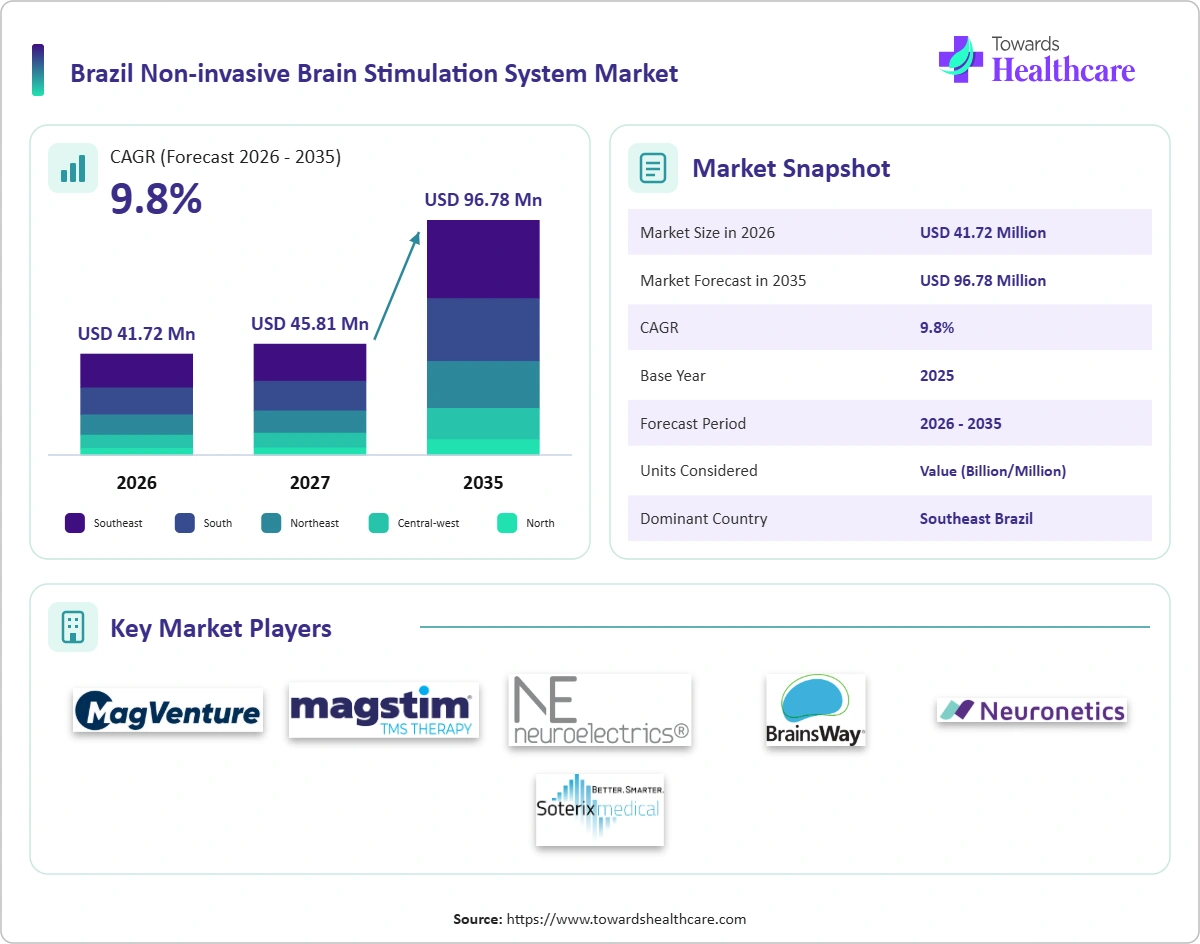
The Brazil non-invasive brain stimulation system market is forecast to expand from USD 38.00 million in 2025 to USD 96.78 million by 2035, registering a CAGR of 9.80% throughout the forecast timeframe. Rising depression prevalence and increasing treatment resistance are driving demand for drug-free alternatives such as TMS and tDCS. Expanding clinics, professional guidance, and growing adoption of advanced psychiatric treatments further support market growth, with revenue expected to reach USD 60.65 million by 2030. Integration of brain stimulation with telehealth follow-ups and precision medicine approaches is also supporting market development.
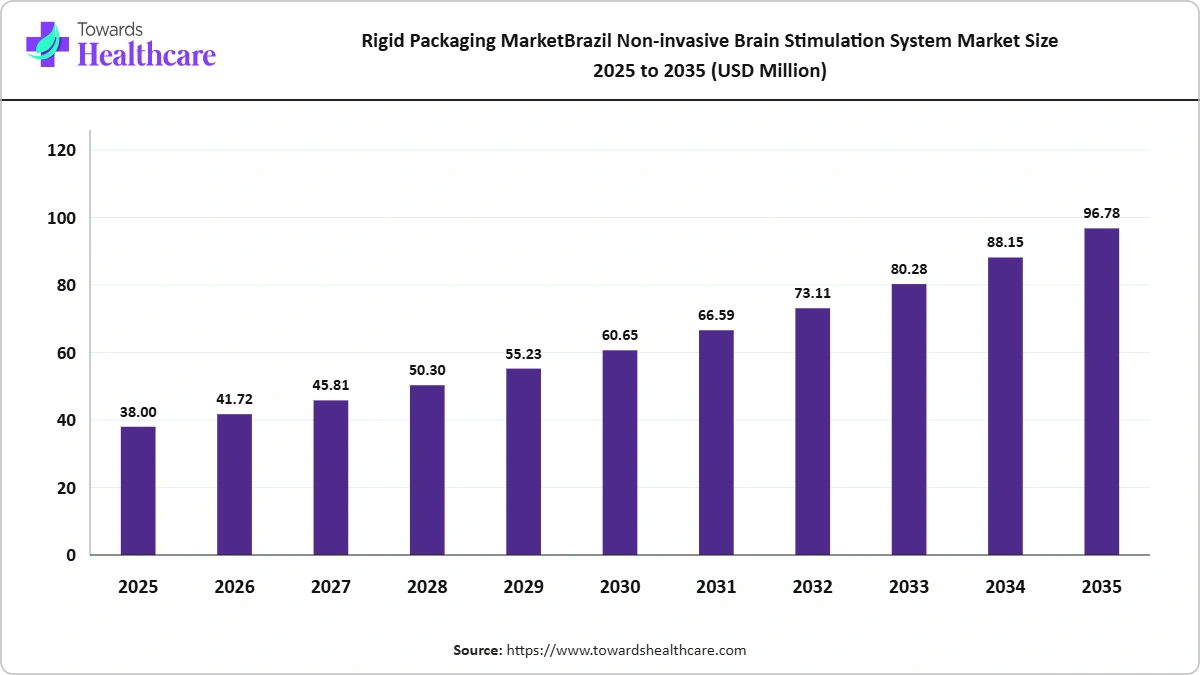
Analyst View: We built the estimate from installed TMS and tDCS devices, new placements and average device prices by region in Brazil, cross-checked against supplier activity. Published estimates for this scope are limited, so our value is evidence-based.
| Driver | Impact | ≈ CAGR Contribution | Time Horizon | Key Regions |
| High depression burden | High | +3.83 pp | Short to long term | All covered regions, strongest in Southeast |
| Treatment-resistant patients | Medium | +3.23 pp | Medium to long term | All covered regions, fastest uptake in Northeast |
| Growing clinics | Medium | +2.75 pp | Short to medium term | All covered regions |
| Professional guidelines | Low | +2.15 pp | Long term | Southeast and Northeast |
Note: Contributions are indicative estimates of each factor's effect on annual growth.
Sources: Expert interviews, secondary sources, Towards Healthcare database and Towards Healthcare analysts.
Taken together, these drivers add about 11.96 percentage points to the annual growth of the Brazil non-invasive brain stimulation system market, with high depression burden having the largest effect. Their influence is strongest in Southeast, while uptake grows fastest in Northeast.
| Restraint | Impact | ≈ Negative CAGR Contribution | Time Horizon | Key Regions |
| Limited insurance coverage | High | -0.97 pp | Short to medium term | All covered regions |
| Device import costs | High | -0.71 pp | Medium term | Smaller and price-sensitive markets |
| Regulatory gaps for tDCS | Medium | -0.47 pp | Short term | Southeast and other mature markets |
Note: Contributions are indicative estimates of each factor's effect on annual growth.
Sources: Expert interviews, secondary sources, Towards Healthcare database and Towards Healthcare analysts.
These restraints are expected to reduce annual growth of the Brazil non-invasive brain stimulation system market by about 2.16 percentage points, led by limited insurance coverage. Their effect eases over the forecast period as suppliers, buyers and regulators adapt, leaving a net CAGR of 9.80% from 2026 to 2035.
Accelerated TMS protocols offer opportunities to improve treatment efficiency and increase clinic capacity. Expanding healthcare infrastructure in Northeast Brazil, growing interest in supervised home-based tDCS, and increasing adoption across pain clinics can widen the addressable market. Potential inclusion of brain stimulation therapies in Brazil's public SUS healthcare system could further improve accessibility and institutional demand.
Sources: Expert interviews, secondary sources, Towards Healthcare database and Towards Healthcare analysts.
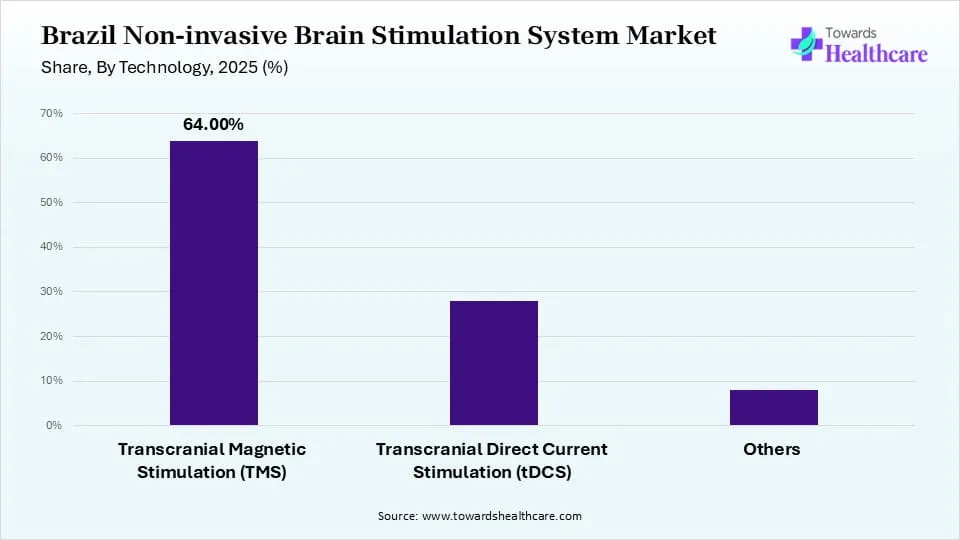
Transcranial Magnetic Stimulation (TMS) segment accounted for 64.00% of the Brazil non-invasive brain stimulation system market in 2025 and is projected to expand at a CAGR of 9.05% from 2026 to 2035. TMS leads because Brazil's Federal Council of Medicine recognises it for depression and other indications. The transcranial magnetic stimulation (tms) segment is expected to grow slower than the overall market over the forecast period.
Transcranial Direct Current Stimulation (tDCS) expansion is driven by the relatively low cost, portability, and accessibility of tDCS devices. The segment is expected to outperform the overall market.
Others demand is supported by emerging neuromodulation technologies and newer brain stimulation methods. However, growth is projected to remain slower than the overall market.
Sources: Expert interviews, secondary sources, Towards Healthcare database and Towards Healthcare analysts.
Depression: Leading the application segment with a 50.00% market share in 2025, this segment is projected to grow at a CAGR of 10.10% from 2026 to 2035. Its dominance reflects the strong clinical evidence supporting TMS and tDCS for major depression. Growth is expected to remain broadly in line with the overall market.
Chronic Pain & Fibromyalgia growing use of TMS for chronic pain management and fibromyalgia treatment supports demand. However, growth is expected to remain below the overall market rate.
OCD & Addiction increasing use of TMS in obsessive-compulsive disorder and nicotine dependence treatment supports adoption, although growth is expected to remain slower than the overall market.
Stroke Rehabilitation & Others demand from stroke rehabilitation and other neurological applications contributes to segment development. Nevertheless, growth is projected to remain below the overall market rate.
Sources: Expert interviews, secondary sources, Towards Healthcare database and Towards Healthcare analysts.
Psychiatric & Neurology Clinics: Dominating the end-user segment with a 56.00% market share in 2025, this category is projected to grow at a CAGR of 10.06% from 2026 to 2035. Its leading position reflects the widespread delivery of TMS treatments through outpatient psychiatric and neurology clinics. Growth is expected to remain broadly in line with the overall market.
Hospitals use stimulation in psychiatry units. The hospitals segment is expected to grow slower than the overall market over the forecast period.
Research & Rehabilitation Centres demand is supported by growing research activities and the use of neuromodulation technologies in rehabilitation settings. Growth is expected to remain slower than the overall market.
Analyst View: Market shares across individual segments were estimated using category-wise demand, product offerings, and pricing patterns. TMS, Depression, and Psychiatric & Neurology Clinics maintain leading positions due to their established clinical applications and alignment with current treatment requirements. Meanwhile, tDCS is expected to gain market share as adoption expands across emerging technologies, patient groups, and therapeutic applications.
| Region | 2025 Share | 2035 Share | CAGR 2026-2035 |
| Southeast | 54.00% | 52.23% | 9.44% |
| South | 18.00% | 18.06% | 9.84% |
| Northeast | 14.00% | 15.65% | 11.04% |
| Central-West | 9.00% | 9.03% | 9.84% |
| North | 5.00% | 5.02% | 9.84% |
Note: 2025 is the base year; 2035 shares and CAGRs are forecasts.
Sources: Expert interviews, secondary sources,Towards Healthcare database and Towards Healthcare analysts.
Southeast: Dominating the regional market with a 54.00% share in 2025, the Southeast is projected to grow at a CAGR of 9.44% throughout the forecast period. São Paulo, Rio de Janeiro, and Minas Gerais drive regional demand through their concentration of private clinics and research centers. However, growth is expected to remain below the overall market rate.
South: This region accounted for 18.00% of the Brazil non-invasive brain stimulation system market in 2025 and is projected to expand at a CAGR of 9.84% from 2026 to 2035. The South has strong private health systems. South is expected to grow broadly in line with the overall market between 2026 and 2035.
Northeast: Holding a 14.00% market share in 2025, the Northeast is expected to register the fastest regional growth, with a CAGR of 11.04% from 2026 to 2035. Expanding clinics and healthcare infrastructure in Recife, Salvador, and Fortaleza are driving market development. The region is projected to outperform the overall market.
Central-West: This region accounted for 9.00% of the Brazil non-invasive brain stimulation system market in 2025 and is projected to expand at a CAGR of 9.84% throughout the forecast timeframe. Central-West includes Brasília. Central-West is expected to grow broadly in line with the overall market between 2026 and 2035.
North: Representing the smallest regional share at 5.00% in 2025, the North is forecast to grow at a CAGR of 9.84% from 2026 to 2035. Limited access to specialized healthcare facilities and neuromodulation services constrains regional adoption. Growth is expected to remain broadly in line with the overall market.
Analyst View: Regional market shares were estimated based on demand patterns, installed equipment, healthcare spending, and supplier presence across Brazil's key regions. The Southeast maintains its leading position due to its established healthcare infrastructure, mature demand, and strong supplier network. Meanwhile, the Northeast receives the highest growth premium, supported by rising investments, increasing adoption, and expanding treatment capacity.
| Rank | Company Name | 2025 Share (%) | Key Products / Business | Headquarters |
| 1 | MagVenture | 18.00% | TMS systems | Denmark |
| 2 | Magstim | 16.00% | TMS systems | United Kingdom |
| 3 | Neurosoft | 10.00% | Neuro-MS TMS | Russia |
| 4 | Soterix Medical | 8.00% | tDCS devices | United States |
| 5 | Neuronetics | 6.00% | NeuroStar TMS | United States |
| 6 | BrainsWay | 5.00% | Deep TMS | Israel |
| 7 | Neuroelectrics | 4.00% | Starstim tDCS | Spain |
| 8 | Neuroconn (neurocare) | 4.00% | tDCS devices | Germany |
| 9 | Flow Neuroscience | 3.00% | Home tDCS | Sweden |
| 10 | Deymed Diagnostic | 3.00% | TMS systems | Czech Republic |
Note: Company shares are 2025 estimates.
Sources: Company press releases, expert interviews, secondary sources, Towards Healthcare database and Towards Healthcare analysts.
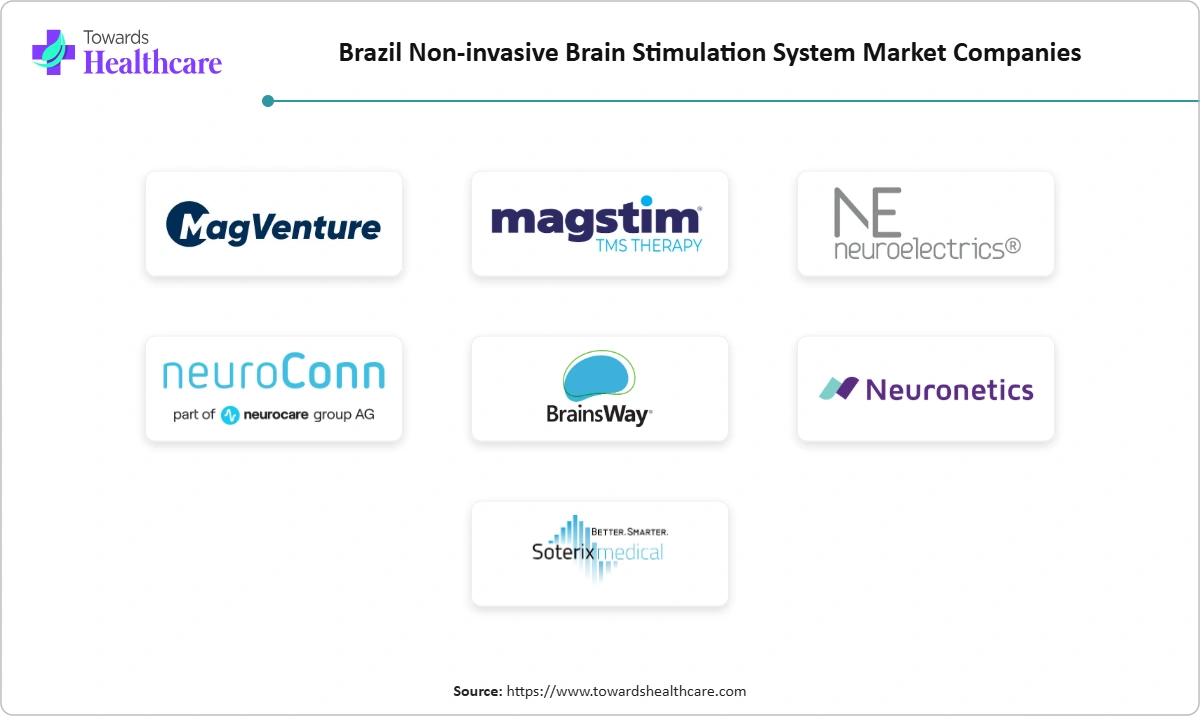
MagVenture led the Brazil non-invasive brain stimulation system market with an estimated 18.00% share of 2025 revenue, followed by Magstim at 16.00% share and Neurosoft at 10.00% share. MagVenture leads with TMS systems, Magstim competes with TMS systems, and Neurosoft offers neuro-MS TMS. Soterix Medical, Neuronetics, BrainsWay, Neuroelectrics, Neuroconn (neurocare), Flow Neuroscience and Deymed Diagnostic compete through tDCS devices, neuroStar TMS, deep TMS, starstim tDCS, tDCS devices, home tDCS, and TMS systems.
The top 10 companies accounted for an estimated 77.00% of 2025 revenue, while the remaining 23.00% was shared among local distributors and clinics. The Brazil non-invasive brain stimulation system market is fragmented, and competition centers on ANVISA registration, clinical evidence, local distribution and service, training support and price.
MagVenture: Based in Denmark, MagVenture held an 18.00% share of the Brazil non-invasive brain stimulation system market in 2025. Its product portfolio focuses on TMS systems for clinical applications. The company occupies a Leader position in the Towards Healthcare Companies Quadrant.
Magstim: The United Kingdom-based company captured approximately 16.00% of the Brazilian market in 2025. Its offerings centre on TMS systems used in neurological and psychiatric treatments. Magstim is classified as a Leader in the Towards Healthcare Companies Quadrant.
Neurosoft: Headquartered in Russia, Neurosoft represented 10.00% market share in 2025. Its portfolio includes Neuro-MS TMS systems for non-invasive brain stimulation. The company is positioned as a Leader in the Towards Healthcare Companies Quadrant.
Soterix Medical: Operating from the United States, Soterix Medical secured approximately 8.00% of the market in 2025. Its product range focuses on tDCS devices for neuromodulation applications. The company holds a Leader position in the Towards Healthcare Companies Quadrant.
Neuronetics: With its headquarters in the United States, Neuronetics accounted for a 6.00% market share in 2025. Its portfolio features NeuroStar TMS systems for depression treatment. The company is recognised as a Leader in the Towards Healthcare Companies Quadrant.
BrainsWay: Based in Israel, BrainsWay captured approximately 5.00% of the Brazilian market in 2025. Its offerings focus on Deep TMS technology for psychiatric and neurological applications. The company is positioned as a Leader in the Towards Healthcare Companies Quadrant.
Neuroelectrics: The Spain-based company held a 4.00% market share in 2025. Its portfolio includes Starstim tDCS systems for advanced brain stimulation applications. Neuroelectrics occupies an Innovator position in the Towards Healthcare Companies Quadrant.
Neuroconn (neurocare): Headquartered in Germany, Neuroconn (neurocare) represented approximately 4.00% of the market in 2025. Its product offerings focus on tDCS devices for non-invasive neuromodulation. The company is classified as an Innovator in the Towards Healthcare Companies Quadrant.
Flow Neuroscience: Operating from Sweden, Flow Neuroscience accounted for 3.00% market share in 2025. Its portfolio centres on home-based tDCS systems designed to support supervised treatment outside clinical settings. The company holds an Innovator position in the Towards Healthcare Companies Quadrant.
Deymed Diagnostic: Based in the Czech Republic, Deymed Diagnostic captured approximately 3.00% of the Brazilian market in 2025. Its product range includes TMS systems for clinical and research applications. The company is positioned as an Innovator in the Towards Healthcare Companies Quadrant.
The Brazil non-invasive brain stimulation system ecosystem links device makers, distributors, clinics & hospitals, professional societies and regulators & payers, with each stage adding value before products reach end users.
| Ecosystem Stage | Role in the Market | Key Companies |
| Device Makers | Make TMS and tDCS devices | MagVenture, Magstim, Neurosoft, Soterix |
| Distributors | Import and service devices | Brazilian distributors |
| Clinics & Hospitals | Treat patients | Psychiatry and neurology clinics |
| Professional Societies | Set practice standards | SBNC, SBNM, CFM |
| Regulators & Payers | Register devices and pay | ANVISA, ANS, SUS |
Sources: Company press releases, expert interviews, secondary sources, Towards Healthcare database and Towards Healthcare analysts.
Device Makers: Make TMS and tDCS devices. Key participants include MagVenture, Magstim, Neurosoft, Soterix.
Distributors: Import and service devices. Key participants include Brazilian distributors.
Clinics & Hospitals: Treat patients. Key participants include Psychiatry and neurology clinics.
Professional Societies: Set practice standards. Key participants include SBNC, SBNM, CFM.
Regulators & Payers: Register devices and pay. Key participants include ANVISA, ANS, SUS.
Value in the Brazil non-invasive brain stimulation system market flows from upstream material and technology suppliers to manufacturers and service providers, then through distribution partners to end users. Companies that integrate several stages or build long-term relationships with end users capture a larger share of this value.
The Towards Healthcare Companies Quadrant evaluates key players in Brazil's non-invasive brain stimulation system market based on market strength and innovation capabilities. Market strength considers revenue scale, market share, and geographic presence, while innovation and growth strategies assess product portfolio diversity, R&D investments, and strategic partnerships. Company positioning is determined by estimated 2025 market shares and an evaluation of product innovation, portfolio breadth, and collaborative initiatives.
Sources: Company press releases, expert interviews, secondary sources, Towards Healthcare database and Towards Healthcare analysts.
Leaders: MagVenture, Magstim, Neurosoft, Soterix Medical, Neuronetics and BrainsWay combine high market share with broad portfolios and strong innovation.
Innovators: Neuroelectrics, Neuroconn (neurocare), Flow Neuroscience and Deymed Diagnostic bring newer technologies and specialized products.
By Technology
By Application
By End User
By Region
The Brazil non-invasive brain stimulation system market was defined as non-invasive brain stimulation systems used in Brazil, including transcranial magnetic stimulation (TMS) systems, transcranial direct current stimulation (tDCS) devices, and other neuromodulation devices, used for major depression, chronic pain and fibromyalgia, obsessive-compulsive disorder, stroke rehabilitation and other conditions in hospitals, psychiatric and neurology clinics, rehabilitation centers and research institutes. The 2025 base-year estimate was developed using a bottom-up approach, combining demand volumes and average prices across technology, application, end-user, and regional segments. The resulting market value was then cross-checked using a top-down approach against market-specific revenues of leading companies and published industry estimates.
Segment, regional and company values were allocated from technology, application and end user and region demand. Key estimates were verified by cross-checking company disclosures, regulatory and industry data and published third-party estimates, and inputs that could not be reconciled were excluded. All segment, regional and company figures were reconciled to the same 2025 base year, and the 2026-2035 forecast, which applies a constant CAGR from the 2025 base, was recalculated and validated.
Analyst View: the Brazil non-invasive brain stimulation system market is set for steady expansion as depression burden and related demand keep growing. Our estimate links value to underlying demand, installed base and pricing, so the forecast follows real adoption rather than headline hype. The main upside comes from accelerated protocols and home tDCS, while the main risks are limited insurance coverage and import costs.