

Pipeline Programs

CGT Companies Tracked

Manufacturing Facilities


The global cholera vaccines market size stood at USD 103.99 million in 2025, grew to USD 114.43 million in 2026, and is forecast to reach USD 270.71 million by 2035, expanding at a CAGR of 10.05% from 2026 to 2035. Rising cholera incidences, growing research and development, and favorable government policies drive the market.
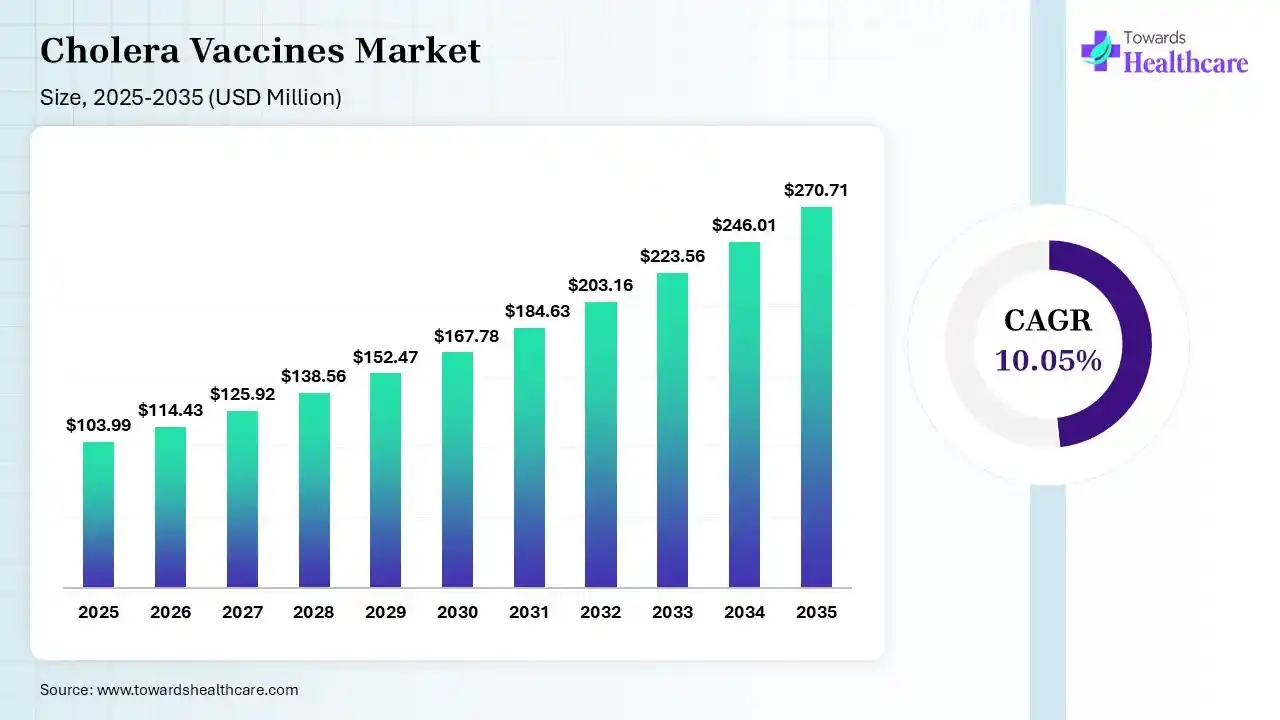
Cholera vaccines are given to reduce the risk of cholera among individuals. Oral cholera vaccines (OCVs) are available in the market. They elicit immune responses in the gut, where the intestinal cells produce antibodies against the cholera microbe. The World Health Organization (WHO) pre-qualified three OCVs: Dukoral, Shanchol, and Euvichol. These vaccines can be given to anyone over 2 years old. OCVs can prevent and control cholera with other standard prevention measures, including improved access to clean water, adequate sanitation, and good hygiene practices. These vaccines are primarily essential for people during cholera outbreaks and in areas where local cholera transmission occurs regularly.
The rising incidences of cholera, especially in developing and underdeveloped nations, increase the demand for cholera vaccines. The increasing traveling by individuals to domestic and foreign nations increases the chances of cholera infections, boosting the market. Favorable government policies to raise awareness about immunization programs also contribute to market growth. Suitable regulatory frameworks promote new product approvals, potentiating market growth. Moreover, growing research and development to develop more effective vaccines fuels market growth.
Artificial intelligence (AI) can screen individuals with a high risk of cholera and detect patterns of gut microbes to identify disease susceptibility. AI and machine learning (ML) can aid in cholera vaccine design and development, focusing on antigen selection, epitope prediction, adjuvant identification, and optimization strategies. This enables researchers to develop effective vaccines, eliminating the trial-and-error approach. AI and ML can also aid in identifying the safety and efficacy of vaccines developed. Additionally, AI and ML can streamline the manufacturing process of cholera vaccines. They introduce automation in manufacturing, improving efficiency, accuracy, and reproducibility. They also reduce human intervention, maintaining sterility and other regulatory parameters. Furthermore, AI can assist in the supply chain management of cholera vaccines. AI can help to maintain cold storage and transportation conditions. Thus, AI and ML can play a vital role in the market, from detecting cholera to managing the vaccine supply chain.
The cholera vaccines market comprises vaccines developed to prevent cholera, an acute diarrheal disease caused by Vibrio cholerae, particularly in populations exposed to contaminated food and water. The market is growing due to recurring outbreaks, inadequate sanitation infrastructure, humanitarian emergencies, and increasing demand for preventive vaccination in high-risk regions. Expansion of mass vaccination campaigns and greater emphasis on outbreak preparedness are key growth drivers. A major trend is the wider use of oral cholera vaccines in targeted populations and emergency response programs. Technological advancements are improving vaccine formulation, manufacturing efficiency, shelf stability, and deployment capabilities. Future opportunities are emerging from expanded immunization coverage, improved disease surveillance, and development of vaccines with longer-lasting protection. International health programs and growing investment in epidemic preparedness are also supporting market development. Increasing vaccine accessibility in vulnerable communities is expected to remain important for sustained market expansion.
Driver
Increasing Travel
The growing demand for traveling is a major growth factor in the cholera vaccines market. The COVID-19 post-pandemic era has seen a surge in both domestic and international travel. According to McKinsey & Company, domestic travel will represent 70% of travel spending by 2030. The demand for traveling rises due to increasing disposable income, easier access to travel, and the desire to experience new cultures. The rising upper middle-class population also increases travel demand. It is estimated that the young population travels the most. The increasing traveling to cholera-prone regions necessitates the demand for cholera vaccines. The availability of unsafe food and water may increase the chances of cholera infections. Thus, exposure to cholera is a risk for individuals traveling to endemic areas and importing bacteria to cholera-free countries by returning travelers, thereby increasing cholera vaccine demand.
Restraint
Limited Supply
The major challenge of the cholera vaccines market is the limited supply of cholera vaccines. Manufacturers face several challenges due to a disrupted supply chain and increasing demand. The limited supply poses a significant challenge to outbreak response efforts, resulting in growing disease spread.
Opportunity
Rising Vaccine Production
The future of the cholera vaccines market is promising, driven by the rising vaccine production due to the increasing number of vaccine manufacturers and technological advancements. The advent of advanced technologies revolutionizes the way vaccines are manufactured. Vaccine production is also increasing owing to rising investments and suitable regulatory frameworks. Favorable policies by the WHO and government agencies increase awareness of immunization against cholera. WHO and UNICEF work in coordination to cater to the demand and supply of vaccines globally. Vaccine production is surging in developing countries to control costs, facilitate socio-economic development, and respond to local epidemics rapidly. The COVID-19 pandemic emphasized the significance of resilient vaccine supply chains. This alerts manufacturers to prioritize the scalability of cholera vaccine production capabilities to strengthen cholera vaccine availability.
| Table | Scope |
| Market Size in 2026 | USD 114.43 Million |
| Projected Market Size in 2035 | USD 270.71 Million |
| CAGR (2026 - 2035) | 10.05% |
| Leading Region | North America |
| Historical Data | 2020 - 2023 |
| Base Year | 2025 |
| Forecast Period | 2026 - 2035 |
| Measurable Values | USD Millions/Units/Volume |
| Market Segmentation | By type, By product, By distribution channel, By region |
| Top Key Players | Bavarian Nordic A/S, Bharat Biotech, Biological E., Celldex Therapeutics, EuBiologics, GlaxoSmithKline, Hilleman Laboratories, Pfizer, Sanofi S.A., Shanghai United Cell Biotechnology Co. Ltd., Shantha Biotechnics, Valneva Sweden AB |
By type, the killed oral O1 and O139 segments held a dominant presence in the cholera vaccines market in 2025 and are expected to grow at the fastest rate in the market during the forecast period. Marketed cholera vaccines are available that contain killed bacteria. Euvichol-S is a killed whole-cell monovalent (O1) oral vaccine, while Shanchol is a killed whole-cell bivalent (O1 and O139) vaccine. Killed or inactivated vaccines are found to be more stable than live vaccines. The storage and transport facilities for killed vaccines are easier. The major advantage of using killed bacteria is they cannot revert to a virulent form and cause infectious disease. All these advantages increase the demand for killed vaccines, promoting the segment’s growth.
By product, the Dukoral segment held the largest share of the cholera vaccines market in 2025. Dukoral is a monovalent, inactivated oral cholera vaccine containing killed bacteria and a recombinant cholera toxin B. It can be given to people of all ages over 2 years, including children, adolescents, and adults. The vaccine is 85% effective against cholera and is orally administered, making it a preferred vaccine. The rising number of vaccination and immunization programs in cholera-prone regions increases the use of Dukoral, augmenting the segment’s growth.
By product, the Vaxchora segment is anticipated to grow with the highest CAGR in the market during the studied years. Vaxchora is the only U.S. FDA-approved vaccine available in the U.S. market. According to the Centers for Disease Control and Prevention, Vaxchora can be administered to a wide range of populations from 2-64 years traveling to areas of high cholera transmission. The rising rates of traveling increase the demand for Vaxchora, propelling the segment’s growth. Vaxchora was found to be 90.3% effective after 10 days of administration, while it was 79.5% effective after 3 months of administration.
By distribution channel, the hospital pharmacy segment led the global cholera vaccines market in 2025. Cholera vaccines are primarily acquired from hospital pharmacies. The availability of trained professionals and appropriate storage systems boost the segment’s growth. Trained healthcare professionals such as doctors and nurses can administer cholera vaccines to patients in the healthcare setting. The presence of suitable infrastructure to maintain cold storage promotes the market. The integrated patient care systems and the increasing immunization programs also potentiate the segment’s growth.
North America dominated the global cholera vaccines market in 2025. The state-of-the-art research and development facilities, advanced healthcare infrastructure, and favorable government policies drive the market. Vaxchora is the only cholera vaccines marketed in the U.S. that is recommended to travelers. Bavarian Nordic, a manufacturer of Vaxchora, reported sales of DKK 35 million from Vivotif and Vaxchora in the first half of 2023. The increasing traveling rates from the U.S. to abroad promote the market. The reported cholera cases in the U.S. and Canada annually are predominantly due to rising traveling. The U.S. citizens made 98.5 million trips abroad in 2023, an increase of 22% from 2022. The U.S. residents spent $215.4 billion abroad, an increase of 33% from 2022. Similarly, Canadian citizens made 319.1 million trips in 2023, with a total spending of $120.4 billion on travel.
U.S. Growth Driven by Strong Disease Prevention Efforts
The U.S. cholera vaccines market is significantly growing due to infections diseases attentions to infections disease preparedness, travel-related vaccination needs, and protection of high-risk populations. Rising concerns about outbreaks following natural disasters and humanitarian emergencies are supporting demand for prevention measures. Strong healthcare infrastructure, established in infectious disease surveillance, is further contributing to market expansion.
Canada Expands Through Infectious Disease Preparedness
Canada’s cholera vaccines market is notably expanding due to increasing emphasis on infectious disease preparedness, travel-related health protection, and vaccination for people visiting or residing in cholera-risk regions. Strong public health infrastructure, disease surveillance capabilities, and access to preventive healthcare support market development. Growing awareness of outbreak risks and the need for rapid preventive measures further contribute to demand for cholera vaccines.
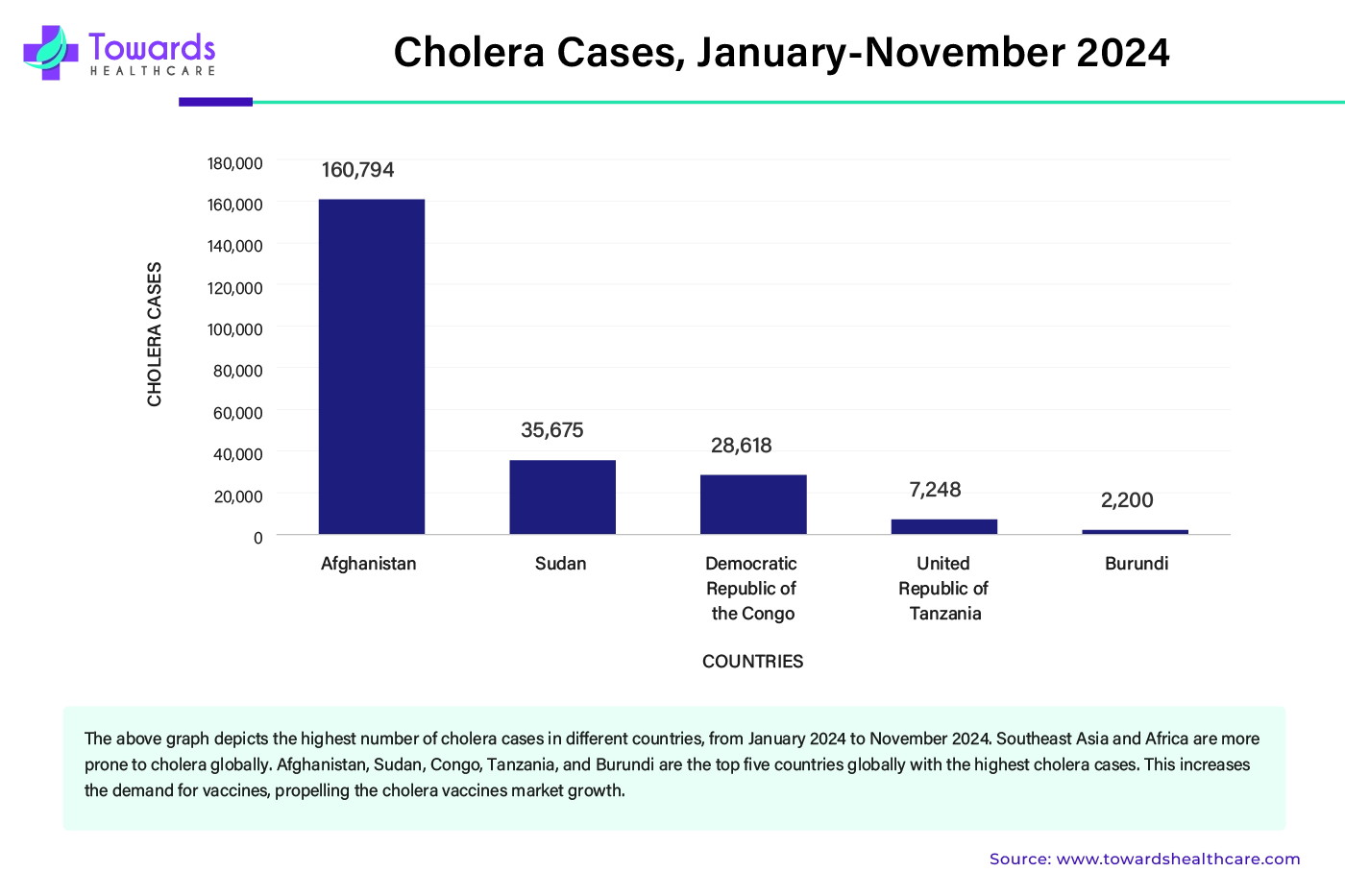
Asia-Pacific is anticipated to grow at the fastest rate in the cholera vaccines market during the forecast period. The growing manufacturing infrastructure, presence of key players, and increasing awareness drive the market. The major manufacturers of cholera vaccines, such as Bharat Biotech, Biological E., and EuBiologics, are present in the Asia-Pacific region. The South and Southeast Asia regions, including Afghanistan, India, Myanmar, Bangladesh, Nepal, and Thailand, are more prone to cholera infections, accounting for the highest number of cholera cases. India, Myanmar, and Bangladesh reported around 6506, 5810, and 241 from January to September 2024. Countries like China, India, and the Republic of Korea are at the forefront of producing cholera vaccines in the region. India is the largest manufacturing region for vaccines globally and exports approximately 60% of the global vaccine demand.
India Expands Through Public Health Preparedness
India’s cholera vaccines market is notably expanding due to the continued need for infectious disease prevention, particularly in areas facing sanitation and safe-water challenges. Growing public health awareness, disease surveillance, outbreak preparedness, and access to vaccination are supporting market development. Increasing healthcare infrastructure and greater focus on controlling waterborne diseases are also creating opportunities for cholera vaccine adoption across high-risk populations.
China Grows Through Strong Infectious Disease Preparedness
China’s cholera vaccines market is significantly growing due to increasing emphasis on infectious disease prevention, outbreak preparedness, and public health surveillance. Improvements in healthcare infrastructure and vaccination accessibility are supporting preventive healthcare efforts. Rising awareness of waterborne disease risks and the need to protect vulnerable populations during potential outbreaks are further creating demand for cholera vaccines and strengthening the country’s overall disease-control capabilities.
Rachel Park, Director of International Business at EuBiologics, commented in an interview that the company expects to increase the production of oral cholera vaccine to more than 50 million doses in 2024, to more than 70 million doses by 2025, and to more than 90 million doses by 2026. He also said that climate change, poverty, conflict, increased availability of oral cholera vaccines, and work by international stakeholders to raise awareness have potentially increased the demand for cholera vaccines.
By Type
By Product
By Distribution Channel
By Region




Principal Consultant
Payal Rabde is a Healthcare Market Research Analyst at Towards Healthcare Research & Consulting with 4+ years of experience in pharmaceuticals, biotechnology, medical devices, and life sciences.
Learn more about Payal Rabde

Reviewed By
Aditi Shivarkar is a seasoned professional with over 14 years of experience in healthcare market research. As a content reviewer, Aditi ensures the quality and accuracy of all market insights and data presented by the research team.
Learn more about Aditi Shivarkar









