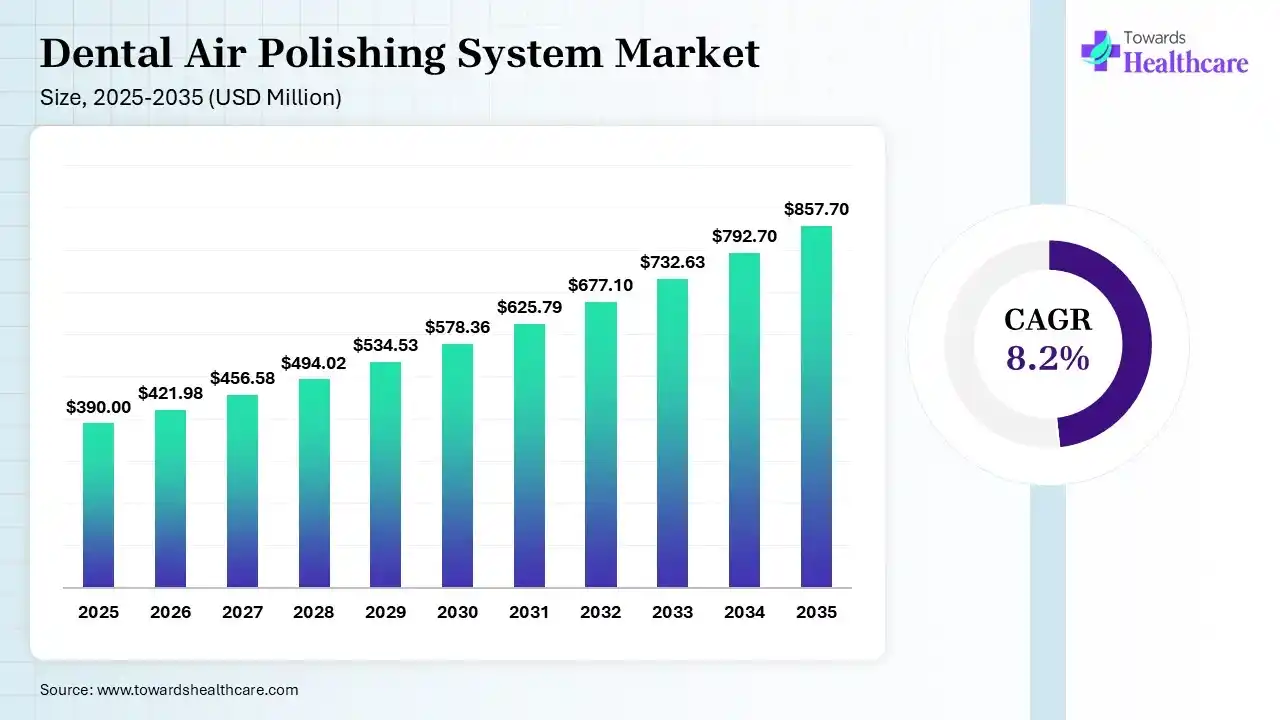
The global dental air polishing system market is expected to reach USD 421.98 million in 2026 and is projected to grow to USD 857.7 million by 2035, at a CAGR of 8.2% during the 2026-2035 forecast period. Market growth is driven by rising demand for preventive dental care, increasing awareness of oral hygiene, and wider adoption of minimally invasive dental cleaning techniques.
Dental professionals are increasingly using air polishing systems to remove biofilm, plaque, and surface stains while supporting periodontal maintenance and implant care. Expanding applications in orthodontic treatment and the maintenance of restorative dental work are further increasing demand beyond routine dental cleaning.
Technological advancements are also supporting market growth. Systems with improved subgingival cleaning capabilities, compatible low-abrasion powders, ergonomic handpieces, and effective infection control features are attracting dental professionals seeking better clinical performance and workflow efficiency. Recurring demand for polishing powders, nozzles, replacement components, and servicing also contributes to market revenue.
North America and Europe benefit from established dental infrastructure and widespread adoption of advanced dental equipment. Asia Pacific offers further growth opportunities as private dental clinics, organized dental chains, and specialist practices expand. However, equipment prices, recurring consumable costs, and clinic budgets will continue to influence adoption across different markets.
Product segmentation centers on tabletop or integrated systems, portable and handheld units, and devices designed to connect to existing dental delivery equipment. Tabletop configurations suit clinics seeking a dedicated platform, while portable units can appeal to practices prioritizing flexibility, lower initial investment, or compatibility with existing chairs.
Application segmentation covers supragingival stain removal, routine prophylaxis, subgingival biofilm management, periodontal maintenance, implant maintenance, orthodontic cleaning, and restorative-care support. Traditional supragingival polishing remains important, but subgingival applications offer a premiumization pathway because they require suitable powders, specialized nozzles, controlled delivery, and clinical training.
Consumables are differentiated by powder chemistry. Sodium bicarbonate is widely associated with supragingival stain removal, while glycine and erythritol powders are used in lower-abrasivity applications, including selected subgingival procedures. Trehalose represents another option in the developing clinical evidence base.
| Segmentation dimension | Principal categories |
| Product type | Tabletop, integrated, portable, handheld |
| Powder type | Sodium bicarbonate, glycine, erythritol, trehalose, other formulations |
| Clinical application | Prophylaxis, stain removal, periodontal maintenance, implant care, orthodontics |
| End user | General dental clinics, periodontal practices, hospitals, dental schools |
| Distribution | Direct sales, dental dealers, specialist distributors, online channels |
| Price tier | Entry-level, mid-range, premium clinical systems |
Reliable public data do not establish a consistent global percentage share for every segment. The full analysis therefore separates documented market observations from modeled segment estimates rather than assigning unsupported precision to individual categories.
The segmentation model quantifies revenue, growth, average selling price, installed-base potential, and consumable attachment opportunities across each major category.
The dental air polishing system market benefits from the growing need for preventive and restorative dental care. Oral diseases affect approximately 3.5 billion people worldwide, supporting demand for routine dental services. However, this figure reflects the overall oral disease burden.
Despite these growth drivers, adoption faces several challenges. Smaller practices may have limited budgets for advanced equipment, while conventional scalers and polishing methods remain widely used. Clinicians must also select suitable powders and operating settings for each treatment indication to avoid damage to tooth surfaces, restorations, or soft tissues.
Market growth will therefore depend on the extent to which air polishing systems gain use across routine hygiene, periodontal maintenance, and implant care. Equipment affordability, clinical suitability, procedure efficiency, and recurring consumable costs will influence purchasing decisions and long-term revenue potential.
The lifetime value of dental air polishing systems depends on equipment price, clinical capabilities, and the recurring cost of consumables. Entry-level and portable systems generally serve practices seeking affordable options, while premium systems offer advanced features for periodontal maintenance, implant care, and other specialized procedures. Prices vary by brand, configuration, accessories, and functionality.
The choice of system also depends on consumable compatibility. Clinics assess the availability and cost of polishing powders, nozzles, handpieces, and replacement components, along with maintenance requirements, warranty coverage, and staff training. Systems that support a suitable range of powders and treatment applications may offer greater flexibility across clinical procedures.
Clinical capabilities also influence long-term value. Features such as subgingival cleaning, ergonomic design, efficient powder delivery, and compatibility with different treatment indications can support broader use within a dental practice. However, performance depends on selecting the appropriate powder and settings for each application.
The key purchasing consideration is the total cost of ownership rather than the initial equipment price alone. A lower-cost system may become more expensive to operate if consumables cost more or service support is limited. Conversely, a premium system may deliver better lifetime value when its clinical capabilities, maintenance requirements, and recurring costs align with the practice’s patient volume and treatment needs.
Demand arises from new clinic openings, equipment upgrades, replacement purchases, and the adoption of air polishing in additional procedures. Supply depends on device manufacturing, handpiece and nozzle production, powder formulation, sterilization-compatible components, quality assurance, and distributor inventory.
Manufacturers must maintain consistent powder quality, reliable device performance, compatibility between systems and consumables, and appropriate regulatory documentation. Limited availability of specialized components or consumables can disrupt clinical workflows and discourage adoption.
For dental clinics, purchasing decisions depend on the consistent availability of compatible powders, replacement parts, and after-sales service. Manufacturers with reliable distribution networks and adequate consumable supplies are better positioned to support continued use and repeat sales.
The dental air polishing system market generates recurring revenue through polishing powders, nozzles, replacement handpieces, spare parts, and maintenance services. Device design, component sourcing, powder formulation, manufacturing, and quality control support product development, while distribution, installation, and clinical training help drive adoption.
Equipment manufacturers earn revenue from initial system sales and upgrades, while consumable suppliers benefit from repeat purchases by dental clinics. Distributors support market access through product availability, delivery, installation assistance, and relationships with dental practices. After-sales service provides an additional source of revenue through maintenance and repairs.
Key cost factors include components, powder preparation, packaging, quality control, shipping, warranty coverage, and distributor margins. Recurring revenue depends on system utilization, consumable compatibility, product availability, and the frequency of repeat purchases.
The market assessment examines supplier relationships, direct and distributor sales channels, and opportunities for regional assembly, local consumable manufacturing, and private-label products. These factors help identify ways to increase repeat sales, manage operating costs, and strengthen long-term market position.
Local distribution influences the availability, adoption, and servicing of dental air polishing systems. Manufacturers rely on importers, regional distributors, and dental equipment dealers to supply devices, polishing powders, spare parts, and accessories to clinics. Strong distribution networks can improve product availability, reduce delivery delays, and provide timely technical support.
Cross-border trade covers equipment and related consumables, but trade classifications may group air polishing systems with other dental equipment. As a result, general dental equipment import data cannot be treated as the direct trade value of air polishing systems. A reliable assessment requires checking product classifications, countries of origin, supplier networks, and potential overlaps with other equipment categories.
The market analysis examines import dependence, regional distribution centers, opportunities for local assembly, and export potential. These factors help assess how manufacturers can improve market access, manage supply costs, and expand their reach across different dental markets.
Product innovation in dental air polishing systems focuses on controlled powder delivery, finer particles, subgingival nozzle design, ergonomic handpieces, and integration with other preventive dental technologies. These improvements aim to support effective biofilm removal across different tooth surfaces, implants, and restorations while minimizing unwanted abrasion.
Powder selection is an important factor in clinical performance. A 2025 systematic review of nine randomized controlled trials involving 462 patients compared erythritol, glycine, and trehalose powders in nonsurgical periodontal treatment. The review found no statistically significant differences among the comparisons for periodontal outcomes, although its network analysis suggested that erythritol may offer greater probing-depth reduction. These findings highlight the importance of powder selection without establishing one powder as universally superior.
The market assessment examines system design, consumable compatibility, published clinical evidence, product launch timelines, available intellectual property information, and the commercial maturity of emerging technologies. It also evaluates whether product improvements offer meaningful clinical benefits or mainly provide incremental design changes.
Manufacturers must comply with applicable medical device regulations, product safety standards, quality system requirements, labeling rules, and post-market obligations in each target region. In the United States, market entry requirements depend on the device’s intended use and regulatory classification. In Europe, manufacturers must meet the applicable requirements under the EU Medical Device Regulation (MDR).
Infection prevention depends on proper reprocessing of reusable components, safe powder handling, and adherence to clinical protocols. Airborne particles and aerosols also require attention to effective suction, adequate ventilation, and appropriate operator training.
Sustainability considerations include durable handpieces, replaceable components, efficient powder packaging, and reduced material waste. Environmental impact should be assessed across the product lifecycle, including consumable packaging, device lifespan, maintenance needs, and actual patterns of clinical use.
General dental clinics typically prioritize versatility, reliability, affordability, and compatibility with existing dental chairs. Periodontists and implant specialists place greater emphasis on subgingival access, suitable powder options, and maintenance support for ongoing periodontal and implant care. Hospitals and dental schools may also require standardized training, formal purchasing procedures, and structured service agreements.
Dental distributors remain important because clinicians often rely on product demonstrations, technical guidance, installation support, and timely access to spare parts. Online channels can improve price transparency and accessory availability, but product compatibility, after-sales service, and technical support remain important purchasing considerations.
The report compares purchasing priorities across clinic types, replacement cycles, application adoption, consumable usage, and the total cost of owning and operating air polishing systems. It also examines barriers that may limit adoption among smaller clinics, including equipment costs, training requirements, and limited access to local distributors or service support.
Competition in the dental air polishing system market depends on clinical performance, product reliability, consumable availability, distributor access, and after-sales support. The market includes established dental equipment companies, specialists in preventive dentistry, and value-oriented manufacturers targeting clinics seeking more affordable options.
| Company | Headquarters | Market position and core strength |
| EMS Electro Medical Systems | Nyon, Switzerland | Specialist preventive dentistry and air polishing |
| Dentsply Sirona | Charlotte, United States | Broad dental equipment and clinical workflows |
| ACTEON Group | Mérignac, France | Dental equipment and preventive-care technologies |
| HuFriedyGroup | Chicago, United States | Dental instruments and air polishing products |
| KaVo Dental | Biberach, Germany | Dental equipment and chairside systems |
| W&H Dentalwerk | Bürmoos, Austria | Dental devices and preventive-care equipment |
| NSK / Nakanishi | Kanuma, Japan | Dental handpieces and precision instruments |
| Mectron | Carasco, Italy | Dental ultrasonic and preventive technologies |
| Woodpecker Dental | Guilin, China | Broad dental equipment at competitive price points |
| Bien-Air Dental | Biel, Switzerland | Dental handpieces and precision equipment |
| Henry Schein | Melville, United States | Dental distribution and practice supplies |
| Benco Dental | Pittston, United States | Dental distribution and practice support |
| Patterson Dental | St. Paul, United States | Equipment distribution and service |
| DentalEZ | Malvern, United States | Dental delivery and operatory equipment |
| Deldent | India | Dental equipment and regional-market participation |
The competitive landscape includes dental air polishing system manufacturers, specialist suppliers, and distributors. The report identifies companies with relevant products and verifies their current market presence by country before assessing direct competitors.
Available market estimates do not establish a consistent public market-share series for all air polishing manufacturers. Assigning precise percentages to individual companies without comparable product-level revenue or shipment data would create false precision.
The competitive model therefore separates three measures: total corporate revenue, estimated revenue attributable to air polishing systems and related consumables, and evidence of competitive reach through product availability, dealer coverage, and clinical positioning.
| Ranking measure | Assessment approach |
| Market-specific revenue | Standalone systems and attributable consumables |
| Unit position | Disclosed or modeled annual shipments |
| Installed-base strength | Evidence of deployed systems and replacement demand |
| Consumable reach | Powder availability and recurring-use potential |
| Geographic reach | Active product presence and distribution coverage |
| Market concentration | Combined share of validated direct competitors |
The full analysis develops top-five and top-ten rankings only where the underlying evidence supports them. It also identifies market-share gaps and the sensitivity of rankings to whether consumables, integrated systems, and distribution revenue are included.
| Company | Primary benchmark area | Competitive assessment |
| EMS | Air polishing specialization | Specialist positioning |
| Dentsply Sirona | Integrated dental workflows | Broad portfolio |
| ACTEON | Preventive and clinical equipment | Technology-focused |
| HuFriedyGroup | Instruments and air polishing | Specialist positioning |
| KaVo Dental | Dental equipment integration | Established equipment portfolio |
| W&H Dentalwerk | Dental technology and service | Broad clinical capabilities |
| NSK | Precision handpieces | Strong adjacent capabilities |
| Mectron | Ultrasonic and preventive devices | Specialist positioning |
| Woodpecker Dental | Price and product breadth | Value-oriented positioning |
The competitive benchmark compares suppliers across six areas: product portfolio, clinical applications, pricing, distribution, technology, and service support. It evaluates air polishing systems, compatible powders, clinical indications, accessories, warranties, geographic reach, and available financial data to assess each supplier’s competitive position.
From our analysis, we can see that competitive advantage is achieved through effective alignment of product capabilities with customers' needs and expectations. Premium suppliers should be able to validate their positioning by providing differentiated clinical applications, good equipment performance, service, and access to compatible consumables. Value-oriented manufacturers, on the other hand, have to prove product reliability, availability, and distributors' confidence to compete on affordability. Thus, our key finding about competitive advantage is that it does not boil down to positioning as a premium or low-price supplier, but whether it is based on customer value or should be validated further.
We think that the suppliers should concentrate on the capabilities that are relevant to their target segment and not on diversification just for the sake of it. The premium suppliers could consider focusing on differentiation based on clinical effectiveness and service reliability, while the value suppliers can improve their market acceptability based on quality, availability of distribution channels, and after-sales service. Our analysis is supplemented further in the full report through benchmarking of clinical indications, compatible powders and accessories, warranty, distribution channels, and financial metrics.
This kind of analysis can also be provided in the form of a database where each record will have fields like company name, product model, product specifications, clinical indications, compatible powders and accessories, price (if available), warranty, geographical distribution, service capabilities, and financial metrics. The user can benchmark suppliers based on capabilities, product type, and geography in addition to using the database along with the strategic report.
Portfolio competition covers dedicated air polishing systems, portable devices, chairside solutions, subgingival nozzle systems, powders, and replacement consumables.
EMS serves as a key benchmark for specialist air polishing equipment. Dentsply Sirona and KaVo offer broader dental equipment portfolios, while ACTEON and Mectron compete across related preventive and clinical technologies. HuFriedyGroup provides an additional benchmark in dental instruments and related clinical products.
The comparison assesses supragingival and subgingival capabilities, compatible powders, integration with existing dental workflows, and consumable availability. It also examines differences in pricing, portability, implant care applications, and the range of compatible supplies.
Product differentiation depends on ergonomic design, pressure and water control, precise powder delivery, nozzle design, access to treatment areas, and ease of maintenance. These features influence handling, cleaning performance, and suitability for different dental procedures.
The competitive analysis compares powder abrasiveness and system compatibility across supragingival cleaning, periodontal pockets, implant maintenance, orthodontic appliances, and restorative materials. Product performance claims are assessed against available clinical evidence to determine whether design features translate into demonstrated clinical benefits.
Patent counts, product-specific research and development costs, and innovation spending are not consistently available across the companies assessed. The analysis therefore focuses on product features, clinical applications, and published evidence when comparing technological differentiation.
General prophylaxis remains an important market entry point, but specialty procedures can support greater differentiation.
| Application | Principal competitive requirements | Opportunity |
| Routine prophylaxis | Ease of use and value | Broad clinic adoption |
| Supragingival stain removal | Effective stain removal and powder compatibility | Established recurring demand |
| Periodontal maintenance | Subgingival access and appropriate powders | Specialist differentiation |
| Implant maintenance | Surface compatibility and controlled cleaning | Premium clinical applications |
| Orthodontic cleaning | Access around brackets and appliances | Expanded preventive use |
| Dental education | Reliability and training support | Institutional procurement |
The report compares verified products across these applications, highlighting dedicated systems, overlapping capabilities, and gaps in product availability or clinical evidence that create opportunities for differentiation.
North America and Europe are established markets for premium dental equipment, while Asia Pacific offers growth opportunities for suppliers with competitive pricing, strong distribution networks, training, and after-sales service.
EMS, Dentsply Sirona, ACTEON, KaVo, W&H, and NSK operate internationally in the dental equipment market. Woodpecker competes in the value-oriented dental equipment segment. Their broader market presence does not necessarily reflect their sales of air polishing systems in every country.
The geographic analysis compares product availability, regulatory registration, distribution, service support, pricing, and portfolio coverage across North America, Europe, Asia Pacific, Latin America, and the Middle East and Africa. Country-level competitive rankings are based on verified air polishing product availability and active market participation.
Air polishing manufacturing requires precision engineering, reliable powder delivery, component quality, and consistent production standards. Relevant benchmarks include manufacturing locations, quality certifications, component sourcing, powder production capabilities, and spare-parts availability.
Company disclosures rarely isolate air polishing production capacity, annual device output, or utilization. The full study therefore distinguishes disclosed facilities from inferred production capability and avoids treating total corporate manufacturing capacity as air polishing capacity.
The assessment also considers regional assembly, contract manufacturing, and local powder distribution as potential ways to reduce lead times and improve access in emerging markets.
Profiles for validated manufacturers and relevant distributors give us more insight into the competitive position of air polishers by allowing for a clear differentiation between corporate size and involvement in this product type. The set of profiles focuses on already proven suppliers, such as EMS, Dentsply Sirona, ACTEON, HuFriedyGroup, W&H, Mectron, and Woodpecker, as well as other validated suppliers. Corporate financials, growth, operating performance, and R&D spending are evaluated when available, whereas product-level data proves the relevance of air polishing portfolio for each company.
Based on our evaluation, corporate size is not enough to determine competitive advantage in air polishing. Competitive advantage of a company depends on its proven air polishing products portfolio, compatible powders and accessories, indication of use, technological advantages, geographic availability, and ability to support customers in terms of distribution, service, and training. In our opinion, the suppliers that possess unique equipment and offer reliable commercial support are likely to have a stronger competitive position than their competitors with a comprehensive dental equipment portfolio. However, the priority of these factors varies from supplier to supplier and should be proven on a product level, rather than assumed on a corporate size basis.
In our opinion, a differentiation of corporate performance in general and estimated air polishing exposure is key to discovering genuine competitive strengths and weaknesses. The following analysis allows determining whether the supplier’s financial capacity results in real category participation, innovation, or improved market access. The complete report includes the evaluation of company ownership, headquarters, employee base, geographical coverage, new product launches, patents, clinical trials, distribution network, support infrastructure, gaps in the portfolio, growth potential, and partnership possibilities. The financial and R&D metrics will be combined with confirmed product capabilities in order to deliver a commercially relevant competitive assessment.
The same intelligence may be structured in the form of a manufacturer-level competitive database with company name, product model, compatible powder, clinical indication, technology features, new product launch data, geographical coverage, distribution network, financial metrics, and estimated air polishing exposure. In cases where there is enough data available, users can filter and compare suppliers in terms of product portfolio, geographical coverage, innovation, and commercial strength with corporate financial metrics being distinguished from category-specific estimates.
It is expected that increasing emphasis on preventative dentistry and implantology will drive the demand for air-polishing systems, because dentists will need to look for techniques to effectively remove biofilm without damaging the delicate surface of the teeth and implants. This can be achieved by the production of gentler polishing powders, making the device user-friendly, as well as designing devices for various applications. Recurrent demand for powders and attachments will be an additional revenue source for the companies.
The primary market research process was carried out by Payal Rabde, Senior Research Associate, who also designed the methodology and did market segmentation, regional trend analysis, buyer intelligence, competitive analysis, and forecasts, laying the foundation for the analytical part of the report.
Aman Singh, Head of Research, has gathered and checked regulatory policies, company financial information, production information, commodity price information, and various other quantitative information sources, which were obtained independently, thereby increasing the quality of evidence supporting the calculations of the market values.
Aditi Shivarkar, VP Research, has validated and refined the research material, verified facts, corrected inconsistencies, and completed the research document, making it accurate and to the point.
By Product Type
By Application
By Powder Type
By End User
By Distribution Channel
By Technology
By Region


Principal Consultant
Payal Rabde is a Healthcare Market Research Analyst at Towards Healthcare Research & Consulting with 4+ years of experience in pharmaceuticals, biotechnology, medical devices, and life sciences.
Learn more about Payal Rabde

Reviewed By
Aditi Shivarkar is a seasoned professional with over 14 years of experience in healthcare market research. As a content reviewer, Aditi ensures the quality and accuracy of all market insights and data presented by the research team.
Learn more about Aditi Shivarkar