


The global exoskeleton market size is predicted to increase from USD 681.53 million in 2026 to approximately USD 2308.97 million by 2035, expanding at a CAGR of 14.52% from 2026 to 2035. The exoskeleton market is growing, as exoskeletons in the healthcare sector are currently used principally in rehabilitation. It relieves them of physically challenging work, like in nursing or in the operating room.
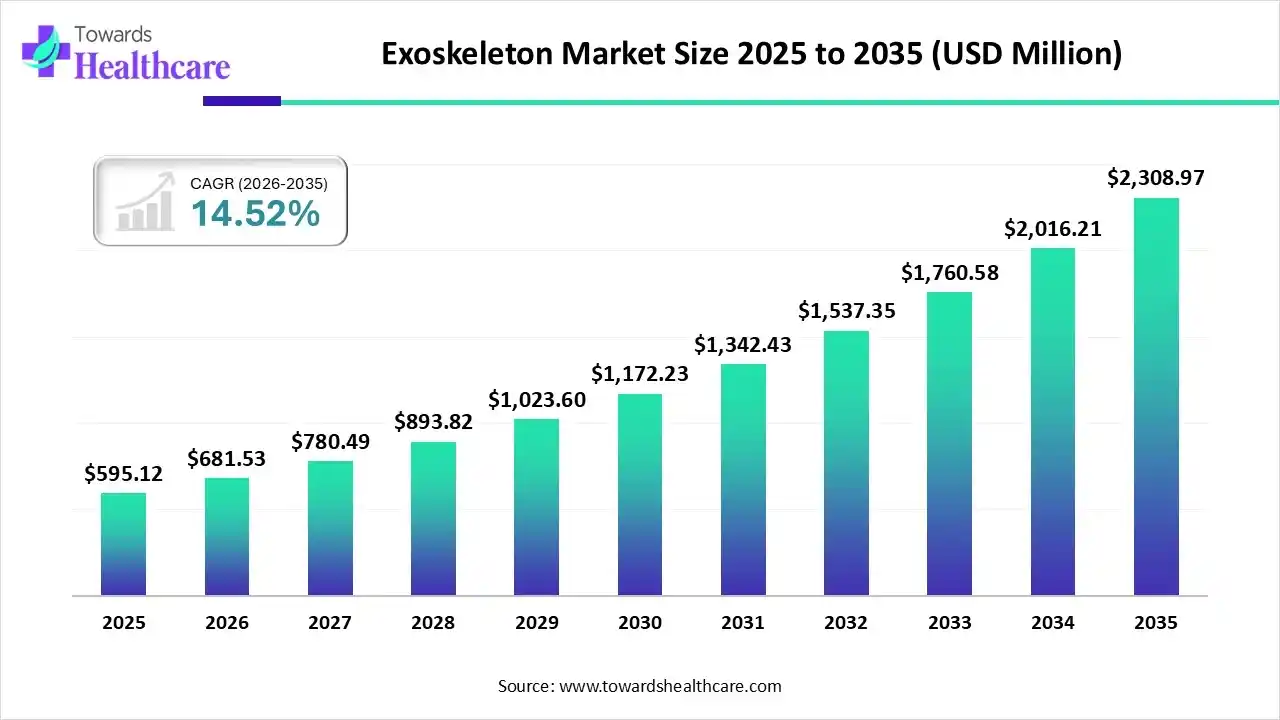
The exoskeleton market is growing, as exoskeletons have broad applications in the military, medical, and construction fields. In the medical field, physical therapists use them as locomotor-assistance and gait-training tools for patients with conditions or injuries that affect mobility. There are two types of exoskeletons, powered and passive. An exoskeleton suit is a wearable tool that improves a patient's strength and performance, enabling them to complete some tasks or to rehabilitate their body. Exoskeleton is intended to offer physical support when consumers are lifting and shifting items or people, like nurses moving patients, seniors seeking physical therapy, receiving assistance when sitting down or standing up.
An exoskeleton is a wearable mechanical or robotic device designed to enhance support or restore human movement by assisting the body’s joints and muscles. It is widely used in rehabilitation, industrial workplaces, defence, and mobility assistance to improve strength, endurance, and functional independence.
The exoskeleton market is expanding due to rising demand for rehabilitation technologies, increasing workplace safety initiatives, and growing adoption of wearable robotics across healthcare and manufacturing. Technological advancements in AI-driven motion control, lightweight materials, smart sensors, and battery efficiency are improving device performance and user comfort. Emerging trends include personalized rehabilitation systems and IoT-enabled connected exoskeleton occupations. Future opportunities lie in broader clinical adoption occupations. Future opportunities lie in broader clinical adoption, aging population support, home-based rehabilitation, and integration with digital health platforms, creating more accessible, intelligent, and adaptive mobility solutions worldwide.
Integration of AI-driven technology in exoskeleton drives market growth, as an AI-driven assistance technology led to a quantifiable lowering in muscle activation during physical movements, indicating that the exoskeleton was efficiently helping the consumer's body. Artificial Intelligence (AI) integration in the wearable exoskeletons is an evolving advancement in building safety. The AI-driven exoskeleton collects load, motion, and environmental information through embedded sensors.
| Table | Scope |
| Market Size in 2026 | USD 681.53 Million |
| Projected Market Size in 2035 | USD 2308.97 Million |
| CAGR (2026 - 2035) | 14.52% |
| Leading Region | North America by 45% |
| Forecast Period | 2026 - 2035 |
| Measurable Values | USD Millions/Units/Volume |
| Key Applications | Neurorehabilitation, Spinal Cord Injury Mobility, Stroke Rehabilitation, Industrial Worker Assistance, Logistics, Manufacturing, Military Load-Carrying, Elderly Mobility Support |
| Primary End Users | Hospitals, Rehabilitation Centers, Industrial Facilities, Defense Organizations, Research Institutes, Individuals with Mobility Impairments |
| Key Growth Drivers | Rising neurological disorders, aging population, workforce injury prevention, AI-powered robotics, favorable reimbursement pathways, industrial automation adoption |
| Measurable Values | USD Millions/Units/Volume |
| Market Segmentation | By Mobility, By Technology, By Extremity, By End Use, By Region |
| Top Key Players | Ekso Bionics, ARMASTEC PTE. LTD, Hocoma, Lockheed Martin Corporation, Suit X, Rex Bionics Plc. |
Which Mobility Segment Led the Exoskeleton Market in 2025?
The mobile segment held the dominant market in 2025, due to the mobile exoskeleton providing superior freedom of movement and making daily life easier for patients with disabilities. To encourage the mobility of aging people and maintain their independence, assistive robotics services like exoskeletons could offer targeted support with movements. They offer targeted support for physical performance and lower the strain of physically demanding responsibilities.
Fixed/Stationary
Whereas the fixed/stationary segment is expected to grow at a significant rate in the market, as these exoskeletons (LLEs) have evolved as a promising service to enhance physical function in older patients. Exoskeletons lessen strain, prevent injuries, and increase endurance in physically demanding professions. The exoskeleton not only assists the power of the consumers, but it rehabilitate the patient. Stationary systems allow for a higher number of repetitions as compared to outdated manual rehabilitation.
Why did the Powered Segment Dominate the Market in 2025?
The powered segment was dominant in the exoskeleton market in 2025, as powered exoskeletons offer real-time support, allowing patients to lift heavier loads or walk longer distances with less fatigue. This makes them specifically significant for patients with mobility issues. Increasing the strength and endurance of workers performing repetitive or strenuous tasks. Powered exoskeletons allow targeted therapy by guiding particular movements, monitoring ongoing progress, and providing consistent assistance in the sessions.
Non-Powered Technology
Whereas the non-powered technology segment is the fastest-growing in the market, as Non-powered exoskeletons are potentially inexpensive to acquire and maintain compared to active exoskeletons, providing a higher return on spending for small-to-medium enterprises. They need no recharging or external power supply, enabling unlimited operational time and removing downtime. They rely on mechanical structures, like springs or pneumatic systems, to offer support or resistance.
Why did the Lower Body Segment Dominate the Market in 2025?
The lower body segment was dominant in the exoskeleton market in 2025, as it supports the wearer’s lower limb strength, making it simple and more suitable to lift heavy objects. The tools support the waist, shoulders, and legs, promoting correct posture and supporting to prevent injuries. Exoskeletons are applicable for rehabilitation in different conditions, significantly neurological and, to a lesser extent, musculoskeletal situations. Lower extremity exoskeletons industrialized for human strength augmentation improve human strength and endurance throughout locomotion.
Upper Body
Whereas the upper body segment is the fastest-growing in the market, as upper-limb exoskeleton helps to maintain a more upright low back posture and better spinal stability. Major upper extremity exoskeletons are anthropomorphic in intended use and help the entire arm or even the whole body. It reduces the physical strain on workers by offering support, promoting ergonomic posture, and mobility.
Why did the Healthcare Segment Dominate the Market in 2025?
The healthcare segment was dominant in the exoskeleton market in 2025, as the application of exoskeletons has the strength to positively influence nurses' work life by reducing work-associated injuries, enhancing physical well-being, improving job satisfaction, and promoting psychological and psychosocial advantages. Exoskeletons play a significant role in the healthcare professions. They help to support patients in their mobility. Exoskeletons are used by patients who walk after a neurological injury, and walking is significant for both functional mobility and activity-driven therapy.
Industry
Whereas the industry segment is the fastest-growing in the market, as exoskeletons are used instead of industrial robots, and eradicate the requirement for entirely automated services. Exoskeletons supports to aging workers to continue to perform labor-intensive work. Exoskeletons help to lower fatigue and avoid injuries while lifting, carrying, pushing, pulling, and performing overhead tasks, improving outcomes in the manufacturing industry.
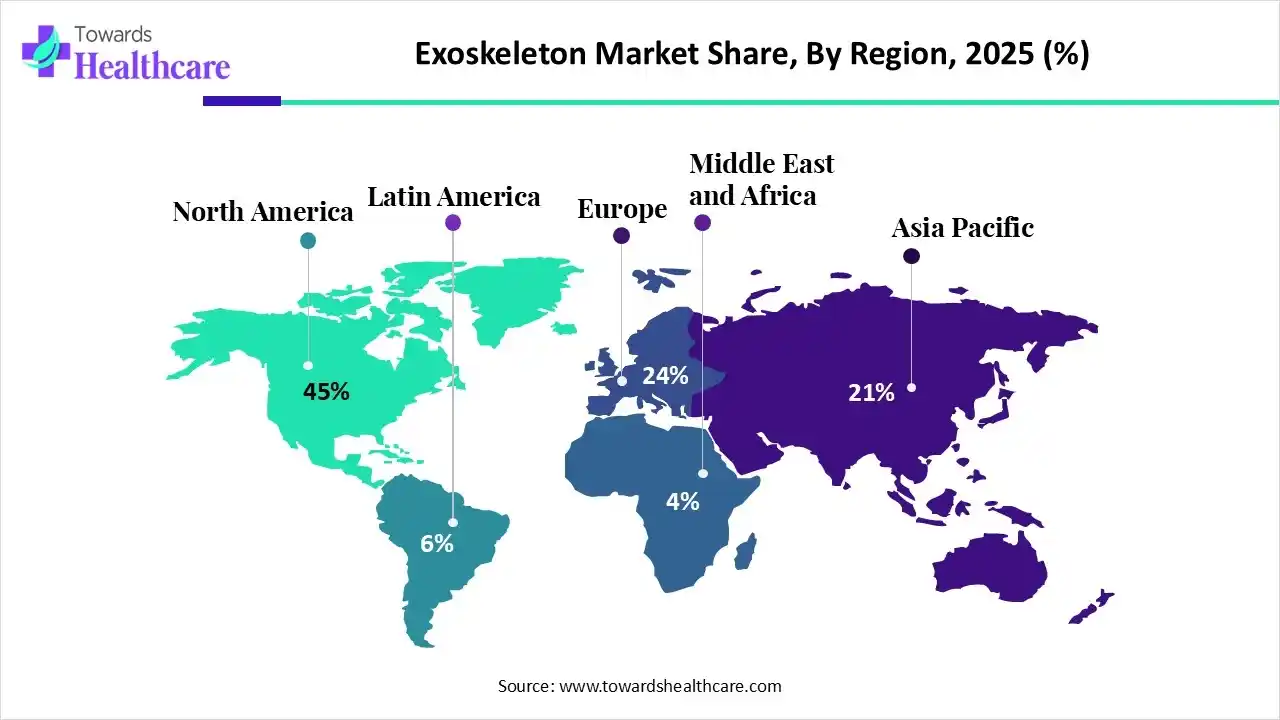
| Regions | Share 2025 (%) |
| North America | 45% |
| Europe | 24% |
| APAC | 21% |
| Latin America | 6% |
| Middle East and Africa | 4% |
In 2025, North America dominated the exoskeleton market by 45% because it is estimated that roughly 12,500 spinal cord injuries occur in this region every year. Increasing spending in R&D for Arctic defence abilities, involving advanced satellite systems for space-driven early warning and surveillance. Ergonomics in production is to design workstations that encourage healthy work postures and maintain worker safety and comfort, which drives the growth of the market.
U.S. Market Trends
In the U.S., nearly 100 units of Wandercraft exoskeletons are in use at rehabilitation organizations and healthcare research centres in the United States. The technological innovation has played a significant role in the alteration of the medical care sector by offering devices that enhance the effectiveness of treatments, data management, and interaction between professionals and patients. The region is a hub for major organization players, like Ekso Bionics Holdings, Inc., and Lifeward Ltd. (ReWalk).
For Instance,
Canada Exoskeleton Market Accelerates with Innovation and Workplace Safety
The Canada exoskeleton market is growing due to increasing investments in rehabilitation technologies, workplace injury prevention, and advanced healthcare infrastructure. Rising adoption of wearable robotic devices in hospitals, industrial manufacturing, and logistics is driving demand. Government support for medical innovation, a growing aging population, and continuous advancements in AI-powered motion control, lightweight materials, and sensor-enabled exoskeletons are further expanding market opportunities across healthcare, defense and occupational safety sectors.
Asia Pacific is expected to see rapid growth in the exoskeleton market, driven by growing life expectancy and declining fertility rates, resulting in a progressively older population in the region. Japan and South Korea are at the forefront of this trend, with some of the world’s highest median ages, which surges the demand of exoskeleton. Industrial Revolution (4IR) technologies are significant in improving industrial competitiveness and output in the Asia-Pacific, leading to high acceptance of both active and passive industrial exoskeletons.
India Market Trends
India faces the highest rehabilitation requirement in Southeast Asia. Rehabilitation research is significant to define the gap between the need and available rehabilitation solutions. India is evolving as a worldwide tech investment home powered by AI, GCCs, youth talent, and digital growth. This technology encourages research and development of digital services to address real-world challenges.
China Exoskeleton Marekt Expands Through Robotic and Industrial Innovation
The China exoskeleton market is expanding due to rapid advancements in robotics, increasing industrial automation, and growing demand for rehabilitation technologies. Rising investments in healthcare infrastructure, elderly mobility support, and workplace safety solutions is accelerating adoption. Strong domestic manufacturing capabilities, government-backed innovation initiatives, and integration of AI smart sensors and lightweight materials are further strengthening China’s position in the global exoskeleton industry.
Europe is anticipated to show significant growth in the exoskeletal market due to an increasing geriatric population. Increasing incidences of neurological disorders are also driving the demand for exoskeleton devices. At the same time, growing government support is also increasing their adoption.
UK Market Trends
The increasing geriatric population across the UK is driving the demand for exoskeletons to improve mobility. Rising incidences of stroke are driving their adoption. The presence of advanced healthcare infrastructure and growing industrial workplace safety needs are also increasing their adoption.
Germany Market Trends
The presence of advanced healthcare infrastructure in Germany is also increasing the adoption of exoskeletons. Expanding industrial manufacturing bases and neurological disorders are also increasing their adoption. Furthermore, growing telemedicine usage is also increasing the demand for exoskeletons.
Latin America is predicted to expand considerably in the exoskeleton market during the upcoming years due to an expanding healthcare infrastructure. At the same time, a growing geriatric population and rising health awareness are also increasing the adoption of exoskeletons.
Brazil Market Trends
Brazil is experiencing a rise in rehabilitation requirements, which is increasing the demand for exoskeletons. An increasing geriatric population is also expanding their adoption rates. Increasing workplace safety is also encouraging the adoption of industrial exoskeletons to reduce physical strain.
Argentina Market Trends
Increasing age-related rehabilitation support in Argentina is driving the adoption of exoskeletons. The growing demand for physical therapies and spinal cord injuries is also encouraging the adoption of exoskeletons. Technological advancements are also attracting patients.
MEA is anticipated to show lucrative growth during the predicted period due to increasing demand for physical rehabilitation requirements. The growing geriatric population and expanding hospital networks are also increasing their adoption rates. The growing healthcare digitalization is also driving their adoption.
Saudi Arabia Market Trends
With the growing healthcare transformation initiatives across Saudi Arabia, the demand for exoskeletons is increasing. Rising demand for recovery services and greater mobility restoration are increasing the adoption of medical exoskeletons. At the same time, a rise in healthcare investments is also driving their adoption.
United Arab Emirates (UAE) Market Trends
Expanding healthcare infrastructure and specialized rehabilitation are increasing the demand for exoskeletons. The growing neurological disorders and government initiatives are also encouraging their adoption. At the same time, increasing advancements in medical tourism and growing technological innovations are also encouraging their use.
| Ecosystem Segment | Key Participants | Role in Market |
| Technology Providers | CYBERDYNE, Sarcos, Wandercraft, Fourier Intelligence | Develop robotics, sensors, AI algorithms, motion-control systems |
| Product Manufacturers | Ekso Bionics, Ottobock, Lifeward (ReWalk), Myomo, B-Temia | Design and manufacture commercial exoskeleton devices |
| Service Providers | Rehabilitation hospitals, mobility clinics | Deploy exoskeletons for patient therapy and mobility support |
| Platform Providers | CYBERDYNE, Wandercraft, Sarcos | Provide integrated hardware-software robotic ecosystems |
| CROs/CDMOs | Limited relevance in exoskeleton sector | Product development generally conducted internally |
| Software Vendors | CYBERDYNE, Wandercraft, Fourier Intelligence | Motion intelligence, gait analytics, rehabilitation software |
| Research Institutions | Harvard Biodesign Lab, Vanderbilt University, ETH Zurich, University of Tsukuba | Robotics research, clinical validation, biomechanical innovation |
| End-User Industries | Healthcare, Manufacturing, Logistics, Defense, Construction | Major deployment sectors driving demand |
| Tier 1 | Tier 2 | Tier 3 | |
| Typical Market Influence | 68% | 22% | 10% |
| Tier 1 | ||||
| Company Name | Headquarters | Country | Why Relevant to This Market | Key Products/Services |
| Ekso Bionics | San Rafael, California | USA | Leading rehabilitation and industrial exoskeleton provider with broad commercial deployment | EksoNR, Ekso Indego |
| CYBERDYNE Inc. | Tsukuba, Ibaraki | Japan | Pioneer in robotic rehabilitation with extensive global installations | HAL (Hybrid Assistive Limb) |
| Ottobock SE & Co. KGaA | Duderstadt, Lower Saxony | Germany | Global mobility leader with strong exoskeleton portfolio following SuitX acquisition | Paexo Series, SuitX Solutions |
| Tier 2 | ||||
| Company Name | Headquarters | Country | Why Relevant to This Market | Key Products/Services |
| Wandercraft | Paris, Île-de-France | France | Fast-growing rehabilitation exoskeleton company with FDA-cleared systems | Atalante, Eve |
| Fourier Intelligence | Shanghai | China | Major rehabilitation robotics provider expanding globally | ExoMotus Series |
| Myomo Inc. | Boston, Massachusetts | USA | Specialized upper-limb powered orthotics and wearable robotics | MyoPro |
| Tier 3 | ||||
| Company Name | Headquarters | Country | Why Relevant to This Market | Key Products/Services |
| Gogoa Mobility Robots | San Sebastián, Basque Country | Spain | Growing rehabilitation exoskeleton developer | BELK Exoskeleton |
| Wearable Robotics S.r.l. | Pisa, Tuscany | Italy | Specialized rehabilitation robotics company | Twin Exoskeleton |
| Rex Bionics Ltd. | Auckland | New Zealand | Long-standing rehabilitation exoskeleton innovator | REX System |
In May 2026, “The integration of advanced wearable robotics into an established clinical ecosystem creates a streamlined pathway from evaluation to real-world use of the ReWalk Personal Exoskeleton,” said Mark Grant, CEO at Lifeward.
By Mobility
By Technology
By Extremity
By End Use
By Region




Principal Consultant
Payal Rabde is a Healthcare Market Research Analyst at Towards Healthcare Research & Consulting with 4+ years of experience in pharmaceuticals, biotechnology, medical devices, and life sciences.
Learn more about Payal Rabde

Reviewed By
Aditi Shivarkar is a seasoned professional with over 14 years of experience in healthcare market research. As a content reviewer, Aditi ensures the quality and accuracy of all market insights and data presented by the research team.
Learn more about Aditi Shivarkar









