The fecal calprotectin test market is projected to grow from USD 312.00 million in 2025 to USD 698.95 million by 2035 because calprotectin is the standard non-invasive marker of gut inflammation, used to triage IBD and monitor patients. IBD growth, guideline support, fewer colonoscopies, and home testing support strong growth, lifting the market to USD 466.98 million by 2030 and sustaining a CAGR of 8.40% from 2026 to 2035. Calprotectin monitoring supports precision medicine in IBD and research on the human microbiome.
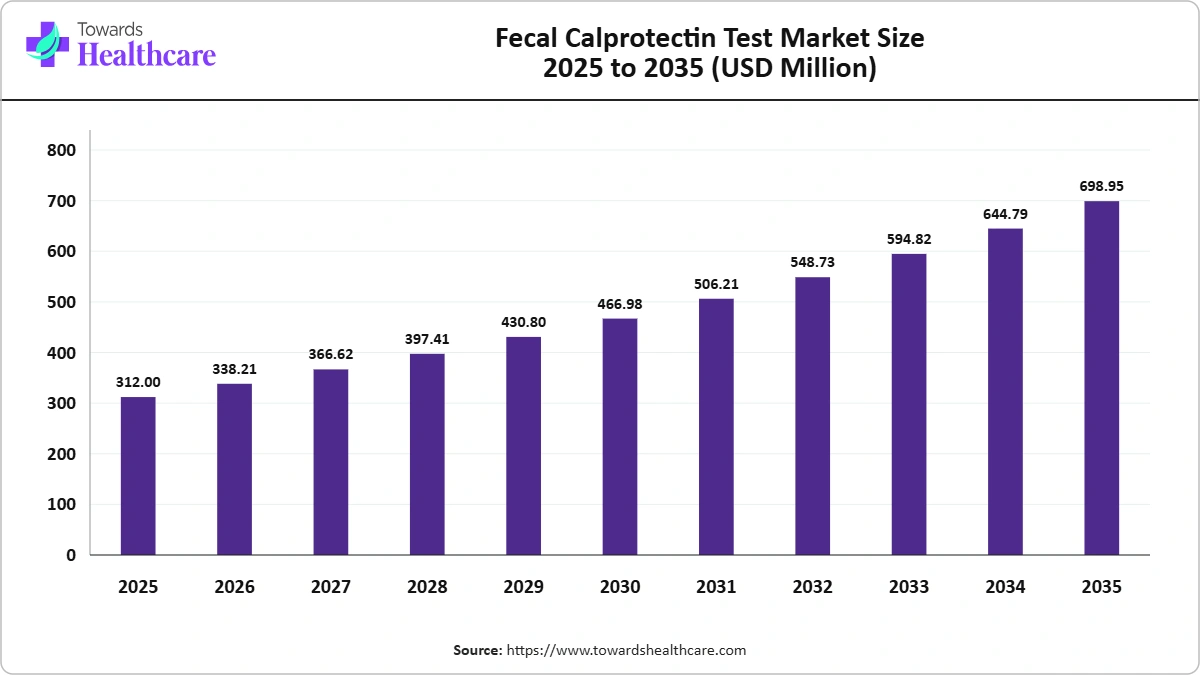
Analyst View: We estimated the market using calprotectin testing volumes across different methods and regions, along with average test prices. The calculations were cross-validated against the activities of relevant diagnostic suppliers. Our valuation is slightly higher than comparable published estimates, reflecting the scope and assumptions applied in our assessment.
| Driver | Impact | ≈ CAGR Contribution | Time Horizon | Key Regions |
| IBD incidence rises | High | +3.28 pp | Short to long term | Global, strongest in Europe |
| Guidelines support calprotectin | Medium | +2.77 pp | Medium to long term | Global, fastest uptake in Asia Pacific |
| It reduces unnecessary colonoscopies | Medium | +2.36 pp | Short to medium term | Global |
| Treat-to-target care | Low | +1.84 pp | Long term | Developed and emerging markets |
Note: Contributions are indicative estimates of each factor's effect on annual growth.
Sources: Expert interviews, secondary sources, Towards Healthcare database and Towards Healthcare analysts.
Taken together, these drivers add about 10.25 percentage points to the annual growth of the fecal calprotectin test market, with IBD incidence rises having the largest effect. Their influence is strongest in Europe, while uptake grows fastest in Asia Pacific.
| Restraint | Impact | ≈ Negative CAGR Contribution | Time Horizon | Key Regions |
| Assay variation between methods | High | -0.83 pp | Short to medium term | Global |
| Stool collection reluctance | High | -0.61 pp | Medium term | Price-sensitive and emerging markets |
| Reimbursement gaps in some regions | Medium | -0.41 pp | Short term | Europe and other mature markets |
Note: Contributions are indicative estimates of each factor's effect on annual growth.
Sources: Expert interviews, secondary sources, Towards Healthcare database and Towards Healthcare analysts.
These restraints are expected to reduce annual growth in the fecal calprotectin test market by about 1.85 percentage points, driven mainly by assay variation across methods. Their effect eases over the forecast period as suppliers, buyers, and regulators adapt, leaving a net CAGR of 8.40% from 2026 to 2035.
Growing opportunities in home-based monitoring, rising IBD prevalence across Asia, wider adoption of automated assays, increased use of calprotectin testing for primary care triage and the integration of digital solutions into IBD management are expected to create new avenues for market expansion.
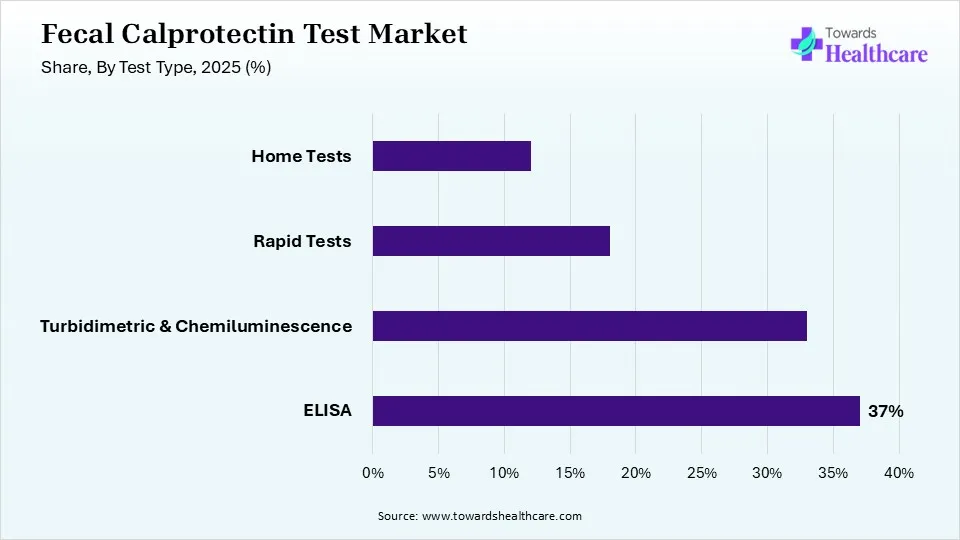
Note: 2025 is the base year; 2035 shares and CAGRs are forecasts.
Sources: Expert interviews, secondary sources, Towards Healthcare database, and Towards Healthcare analysts.
ELISA segment held the largest share of the fecal calprotectin test market in 2025, at 37.00%, and is expected to grow at a CAGR of 7.74% from 2026 to 2035. Its leading position reflects its established role as an early standardized testing method and its widespread use across diagnostic laboratories. However, the ELISA segment is anticipated to expand at a slower pace than the overall market during the forecast period.
Turbidimetric & Chemiluminescence growing integration of turbidimetric and chemiluminescence assays into automated laboratory analyzers is supporting their adoption.
Rapid Tests sits adoption is supported by the ability to deliver results quickly in clinical settings, enabling faster assessment and treatment decisions.
Home Tests increasing patient preference for convenient at-home monitoring of inflammatory bowel disease (IBD) is supporting demand for home-based testing solutions.
Note: 2025 is the base year; 2035 shares and CAGRs are forecasts.
Sources: Expert interviews, secondary sources, Towards Healthcare database, and Towards Healthcare analysts.
IBD Diagnosis (IBD vs IBS) segment held the largest share of the fecal calprotectin test market in 2025, at 48.00%, and is expected to register a CAGR of 7.56% by 2035. Its leading position is driven by clinical guideline recommendations supporting calprotectin testing to distinguish inflammatory bowel disease (IBD) from irritable bowel syndrome (IBS). However, the segment is anticipated to grow at a slower pace than the overall market during the forecast period.
IBD Monitoring increasing adoption of treat-to-target approaches, which rely on regular assessment of disease activity and treatment response, is strengthening demand for calprotectin testing in ongoing IBD management.
Others it includes applications such as colorectal cancer triage and the assessment of gastrointestinal infections. The segment is expected to expand at a slower rate than the overall market during the forecast period.
Note: 2025 is the base year; 2035 shares and CAGRs are forecasts.
Sources: Expert interviews, secondary sources, Towards Healthcare database, and Towards Healthcare analysts.
Diagnostic Laboratories segment held the largest share of the fecal calprotectin test market in 2025, at 50.00%, and is expected to register a CAGR of 7.76% from 2026 to 2035. Its dominant position reflects the high volume of calprotectin tests processed by diagnostic laboratories, which serve as key testing centres for routine and specialized assessments.
Hospitals demand is supported by calprotectin testing among hospitalized patients and through hospital-based specialist clinics for diagnosing and monitoring gastrointestinal conditions.
Clinics & Home Care increasing use of rapid testing in clinical settings and the growing availability of home-based monitoring solutions are supporting its expansion.
Analyst View: Segment shares were allocated from demand, product portfolios and pricing in each category. ELISA, IBD Diagnosis (IBD vs IBS) and Diagnostic Laboratories lead their categories because they meet the core needs of today's buyers. We expect Home Tests, IBD Monitoring and Clinics & Home Care to gain share as newer technologies, users and applications grow faster.
Note: 2025 is the base year; 2035 shares and CAGRs are forecasts.
Sources: Expert interviews, secondary sources, Towards Healthcare database, and Towards Healthcare analysts.
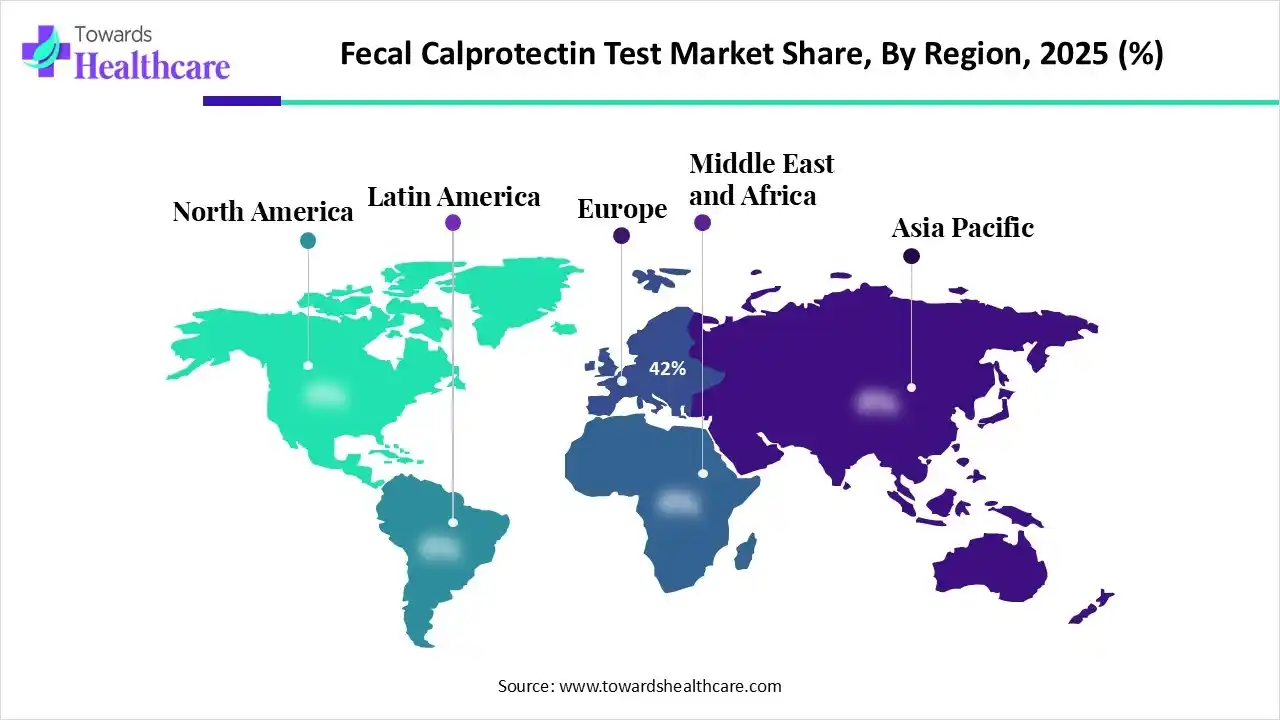
Europe held the largest share of the fecal calprotectin test market in 2025, at 42.00%, and is projected to grow at a CAGR of 7.94% from 2026 to 2035. Its leading position is supported by the established use of calprotectin testing in primary care, guided by NICE recommendations and other clinical guidelines. However, the regional market is expected to expand at a slower pace than the overall market during the forecast period.
North America rising adoption is supported by recommendations from the American College of Gastroenterology (ACG) and broader insurance coverage for diagnostic testing.
Asia Pacific increasing IBD incidence across China, Japan, and South Korea is driving demand for improved diagnostic and disease-monitoring solutions. The region is expected to outperform the overall market during the forecast period.
Latin America the market is supported by the gradual adoption of fecal calprotectin testing across the region. Growth is projected to remain broadly aligned with the overall market over the forecast period.
Middle East & Africa market expansion is supported by the gradual development of diagnostic capabilities, although access to and adoption of calprotectin testing remain limited in several countries.
Analyst View: Regional shares were built from demand, installed base, spending, and supplier presence in each region. Europe leads because of its mature demand base and strong suppliers. We assign Asia Pacific the highest growth premium because investment, adoption and capacity are expanding fastest there.
| Rank | Company Name | 2025 Share (%) | Key Products / Business | Headquarters |
| 1 | BÜHLMANN Laboratories | 16.00% | fCAL ELISA, fCAL turbo and IBDoc home test | Switzerland |
| 2 | Thermo Fisher Scientific | 14.00% | EliA Calprotectin | United States |
| 3 | DiaSorin | 11.00% | LIAISON Calprotectin | Italy |
| 4 | Calpro (Svar Life Science) | 5.00% | CALPROLAB ELISA and rapid tests | Sweden |
| 5 | ALPCO | 4.00% | Calprotectin assays | United States |
| 6 | R-Biopharm | 4.00% | Calprotectin ELISA and rapid tests | Germany |
| 7 | Immundiagnostik | 4.00% | Calprotectin ELISA | Germany |
| 8 | Eurospital | 4.00% | CalFAST rapid test | Italy |
| 9 | Gentian Diagnostics | 3.00% | GCAL turbidimetric calprotectin | Norway |
| 10 | Epitope Diagnostics | 2.00% | Calprotectin ELISA | United States |
Note: Company shares are 2025 estimates.
Sources: Company press releases, expert interviews, secondary sources, Towards Healthcare database and Towards Healthcare analysts.
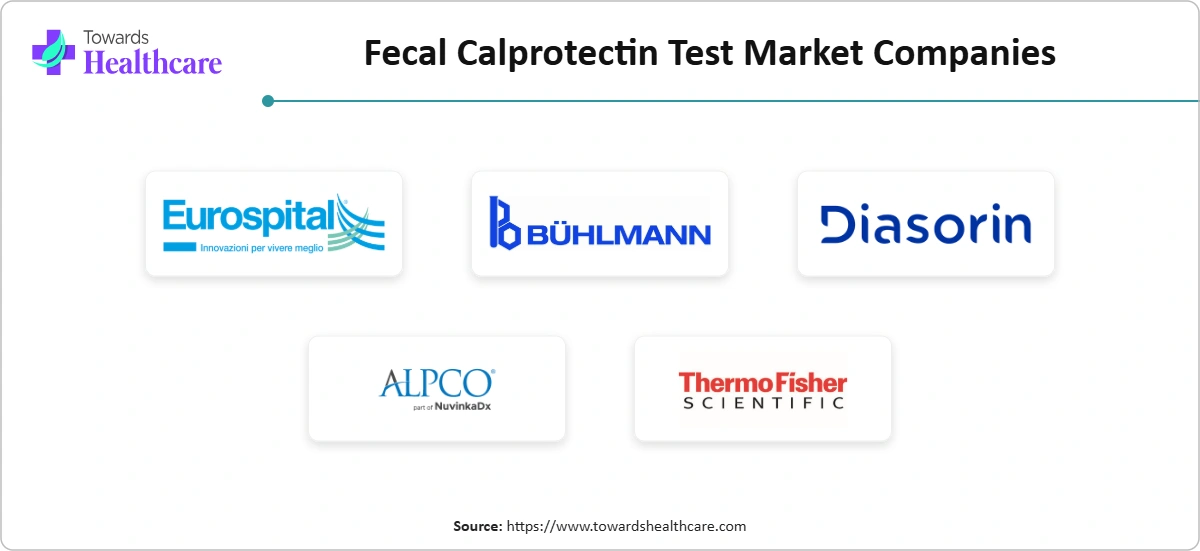
BÜHLMANN Laboratories led the fecal calprotectin test market with an estimated 16.00% share of 2025 revenue, followed by Thermo Fisher Scientific at 14.00% share and DiaSorin at ,11.00% share. BÜHLMANN Laboratories leads with fCAL ELISA, fCAL turbo, and IBDoc home test, Thermo Fisher Scientific competes with eliA Calprotectin, and DiaSorin offers LIAISON Calprotectin. Calpro (Svar Life Science), ALPCO, R-Biopharm, Immundiagnostik, Eurospital, Gentian Diagnostics and Epitope Diagnostics compete through CALPROLAB ELISA and rapid tests, calprotectin assays, calprotectin ELISA and rapid tests, calprotectin ELISA, calFAST rapid test, GCAL turbidimetric calprotectin and calprotectin ELISA.
The top 10 companies accounted for an estimated 67.00% of 2025 revenue, while the remaining 33.00% was shared among many regional ELISA and rapid test makers. The fecal calprotectin test market is moderately concentrated, and competition centres on automation, assay standardisation, home testing, stool extraction devices, clinical evidence and price.
Headquartered in Switzerland, BÜHLMANN Laboratories held an estimated 16.00% share of the fecal calprotectin test market in 2025. Its product portfolio includes fCAL ELISA, fCAL turbo, and the IBDoc home testing solution, covering laboratory-based and at-home testing requirements. In the Towards Healthcare Companies Quadrant, the company is positioned as a Leader.
Based in the United States, Thermo Fisher Scientific captured an estimated 14.00% market share in 2025. The company participates in the fecal calprotectin testing space through its EliA Calprotectin assay, supporting laboratory-based gastrointestinal diagnostics. It is positioned as a Leader in the Towards Healthcare Companies Quadrant.
DiaSorin, headquartered in Italy, accounted for an estimated 11.00% share of the market in 2025. Its LIAISON Calprotectin assay strengthens its presence in automated diagnostic testing and supports the detection of intestinal inflammation. The company is classified as a Leader in the Towards Healthcare Companies Quadrant.
Based in Sweden, Calpro (Svar Life Science) held an estimated 5.00% market share in 2025. Its portfolio includes CALPROLAB ELISA and rapid testing solutions, addressing different laboratory and diagnostic testing needs.
Headquartered in the United States and part of American Laboratory Products Company, ALPCO captured an estimated 4.00% share of the market in 2025. Its portfolio includes calprotectin assays designed to support the assessment of intestinal inflammation. In the Towards Healthcare Companies Quadrant, ALPCO is positioned as a Leader.
R-Biopharm, based in Germany, held an estimated 4.00% market share in 2025. Its calprotectin product range includes ELISA and rapid testing solutions, enabling diagnostic laboratories to select testing formats according to their requirements. The company is positioned as a Leader in the Towards Healthcare Companies Quadrant.
Immundiagnostik, headquartered in Germany, represented an estimated 4.00% of the fecal calprotectin test market in 2025. Its portfolio features calprotectin ELISA assays for laboratory-based assessment of gastrointestinal inflammation.
Based in Italy, Eurospital accounted for an estimated 4.00% market share in 2025. Its CalFAST rapid test supports the detection of fecal calprotectin through a rapid testing format, strengthening its presence in the gastrointestinal diagnostics market. The company is positioned as an Innovator in the Towards Healthcare Companies Quadrant.
Gentian Diagnostics, headquartered in Norway, held an estimated 3.00% share of the market in 2025. Its GCAL turbidimetric calprotectin assay provides an automated testing option for clinical laboratories. The company is positioned as an Innovator.
Based in the United States, Epitope Diagnostics captured an estimated 2.00% market share in 2025. Its product offering includes calprotectin ELISA assays for detecting intestinal inflammation. The company is classified as an Innovator in the Towards Healthcare Companies Quadrant.
The fecal calprotectin test ecosystem links reagent & antibody suppliers, test makers, laboratories, clinicians & patients, and regulators & guidelines, with each stage adding value before products reach end users.
| Ecosystem Stage | Role in the Market | Key Companies |
| Reagent & Antibody Suppliers | Supply antibodies and calibrators | Reagent makers |
| Test Makers | Make lab, rapid and home tests | BÜHLMANN, Thermo Fisher, DiaSorin, Gentian |
| Laboratories | Run tests | Hospital and reference labs |
| Clinicians & Patients | Order and use results | Gastroenterologists, GPs, IBD patients |
| Regulators & Guidelines | Clear tests and guide use | FDA, NICE, ACG, EU IVDR |
Sources: Company press releases, expert interviews, secondary sources,Towards Healthcare database and Towards Healthcare analysts.
Reagent & Antibody Suppliers: Supply antibodies and calibrators. Key participants include Reagent makers.
Test Makers: Make lab, rapid, and home tests. Key participants include BÜHLMANN, Thermo Fisher, DiaSorin, Gentian.
Laboratories: Run tests. Key participants include hospitals and reference labs.
Clinicians & Patients: Order and use results. Key participants include Gastroenterologists, GPs, and IBD patients.
Regulators & Guidelines: Clear tests and guide use. Key participants include FDA, NICE, ACG, EU IVDR.
Value in the fecal calprotectin test market flows from upstream material and technology suppliers to manufacturers and service providers, then through distribution partners to end users. Companies that integrate several stages or build long-term relationships with end users capture a larger share of this value.
The Towards Healthcare Companies Quadrant positions key participants in the fecal calprotectin test market by market strength, reflecting revenue scale, market share and geographic reach, and by innovation and growth strategy, reflecting product portfolio breadth, R&D intensity and partnerships. Positions reflect each company's estimated 2025 share of the fecal calprotectin test market and our assessment of its product innovation, portfolio breadth and partnerships.
Sources: Company press releases, expert interviews, secondary sources, Towards Healthcare database and Towards Healthcare analysts.
Leaders: BÜHLMANN Laboratories, Thermo Fisher Scientific, DiaSorin, Calpro (Svar Life Science), ALPCO and R-Biopharm combine high market share with broad portfolios and strong innovation.
Innovators: Immundiagnostik, Eurospital, Gentian Diagnostics and Epitope Diagnostics bring newer technologies and specialised products.
By Test Type
By Application
By End User
By Region
The fecal calprotectin test market was defined as tests that measure calprotectin in stool to detect intestinal inflammation, including ELISA, turbidimetric and chemiluminescence assays on lab analyzers, rapid lateral flow tests and home tests with smartphone apps, used to differentiate inflammatory bowel disease from irritable bowel syndrome and to monitor Crohn's disease and ulcerative colitis, in hospitals, diagnostic laboratories, gastroenterology clinics and at home. The 2025 base year was built bottom-up from demand volumes and average prices by test type, application, end user and region, and checked top-down against the market-specific revenues of leading companies and published estimates. Segment, regional and company values were allocated from test type, application and end user and region demand.
Key estimates were verified by cross-checking company disclosures, regulatory and industry data and published third-party estimates, and inputs that could not be reconciled were excluded. All segment, regional and company figures were reconciled to the same 2025 base year, and the 2026-2035 forecast, which applies a constant CAGR from the 2025 base, was recalculated and validated.
Analyst View: The fecal calprotectin test market is set for steady expansion as IBD growth and related demand keep growing. Our estimate links value to underlying demand, installed base and pricing, so the forecast follows real adoption rather than headline hype. The main upside comes from home monitoring and Asian IBD growth, while the main risks are assay variation and stool collection reluctance.