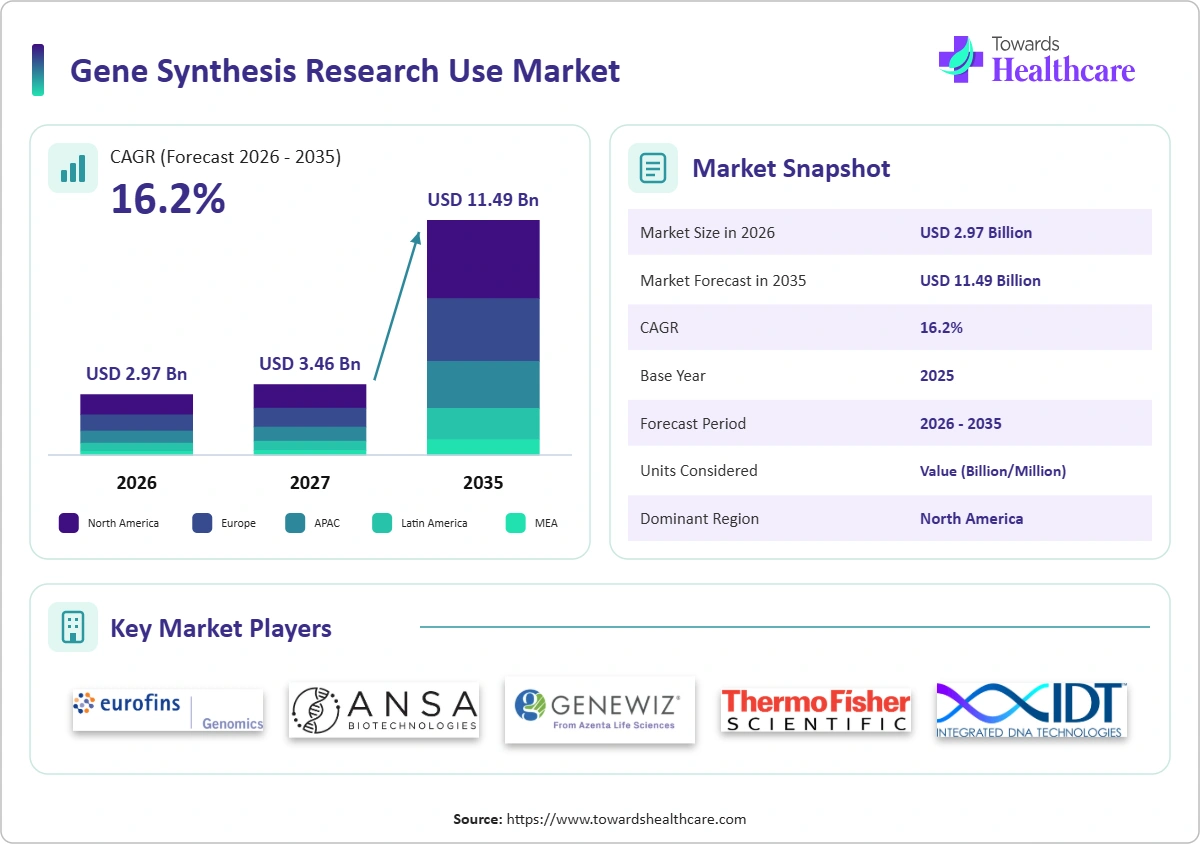
The gene synthesis market is experiencing strong growth as researchers increasingly adopt synthetic gene ordering over traditional, labor-intensive cloning methods. Valued at USD 2.56 billion in 2025, the market is projected to reach USD 5.42 billion by 2030 and further expand to USD 11.49 billion by 2035, registering a CAGR of 16.20% over the forecast period. Rising adoption of AI-driven protein design, AI-based drug discovery, protein engineering, and synthetic biology is accelerating demand for customized gene sequences and genetic variants. Additionally, declining gene synthesis costs and growing applications across genomics, cell therapy, and precision medicine research are creating significant opportunities for market expansion.
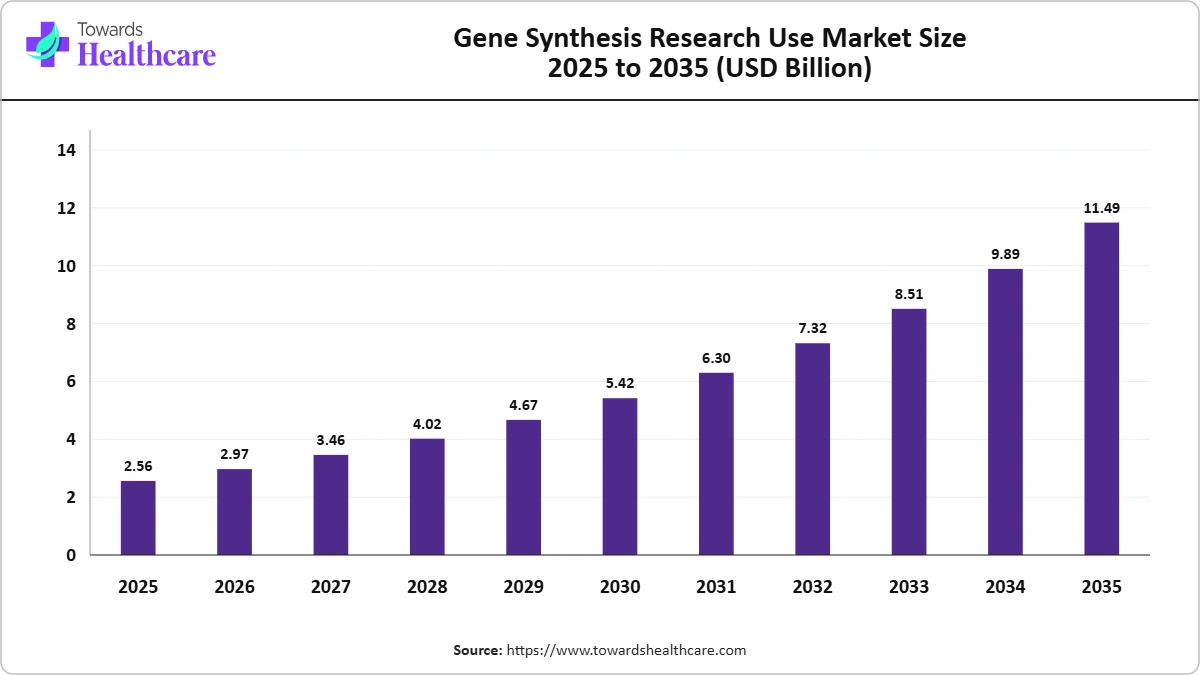
Analyst View: We built the estimate from gene synthesis order volumes and mean prices by product and region, cross-checked against gene synthesis revenues of prominent providers. Our value is a bit higher compared to published comparable estimates.
| Driver | Impact | ≈ CAGR Contribution | Time Horizon | Key Regions |
| Antibody and protein engineering grow | High | +6.32 pp | Short to long term | Global, strongest in North America |
| AI drug discovery needs many variants | Medium | +5.34 pp | Medium to long term | Global, fastest uptake in Asia Pacific |
| Synthetic biology expands | Medium | +4.55 pp | Short to medium term | Global |
| mRNA and gene therapy research | Low | +3.56 pp | Long term | Developed and emerging markets |
Note: Contributions are indicative estimates of each factor's effect on annual growth.
Sources: Expert interviews, secondary sources, Towards Healthcare database and Towards Healthcare analysts.
These drivers together add about 19.76 percentage points to the annual growth of the market, with the growth of antibody and protein engineering having the largest effect. Their influence is strongest in North America, while uptake is growing fastest in Asia Pacific.
| Restraint | Impact | ≈ Negative CAGR Contribution | Time Horizon | Key Regions |
| Price competition | High | -1.60 pp | Short to medium term | Global |
| Biosecurity rules | High | -1.18 pp | Medium term | Price-sensitive and emerging markets |
| Funding cuts in academia | Medium | -0.78 pp | Short term | North America and other mature markets |
Note: Contributions are indicative estimates of each factor's effect on annual growth.
Sources: Expert interviews, secondary sources, Towards Healthcare database and Towards Healthcare analysts.
These restraints are expected to decrease the annual growth rate of the market by about 3.56 percentage points, with the largest contributor being price competition. Their effect eases over the forecast period as suppliers, buyers and regulators adapt, leaving a net CAGR of 16.20% from 2026 to 2035.
The demand for long-gene synthesis, enzymatic DNA technologies, and AI-based design is growing, which is creating new opportunities in the market. Expansion of research activities in Asia and rising demand for synthetic gene libraries are boosting market growth.
Sources: Expert interviews, secondary sources, Towards Healthcare database and Towards Healthcare analysts.
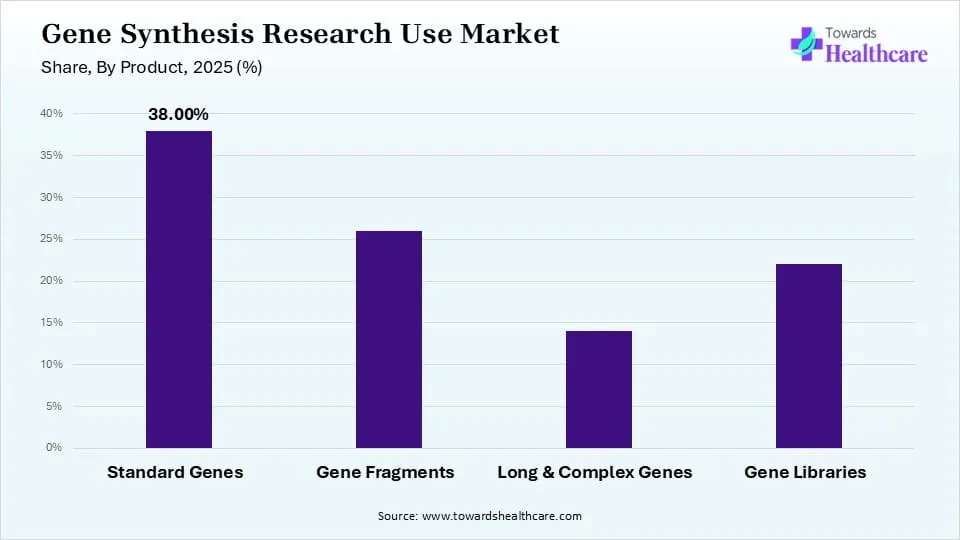
Standard Genes accounted for 38.00% of the market in 2025 and is projected to expand at a CAGR of 15.48% from 2026 to 2035. Standard genes lead because labs order cloned genes for expression and research. This segment is expected to grow at a slower rate than the overall market over the forecast period.
Gene Fragments demand is increasing as faster DNA assembly technologies allow faster and more efficient construction of complete genes. The growth of this segment is expected to be slower than the market between 2026 and 2035.
Long & Complex Genes are growing at the fastest rate owing to advancements in synthesis technologies. The long & complex genes segment is expected to grow faster than the overall market over the forecast period.
Gene Libraries support antibody and protein engineering. This segment is expected to grow at a slower rate than the market from 2026 to 2035.
Antibody & Protein Engineering accounted for 34.00% of the market in 2025 and is projected to expand at a CAGR of 15.55% from 2026 to 2035. Antibody and protein engineering leads because discovery needs many variants. The pace of growth of this segment is expected to be lower than the overall market throughout the forecast period.
Synthetic Biology uses genes for engineered organisms. This segment is expected to grow broadly in line with the overall market between 2026 and 2035.
Vaccine & Therapeutic Research grows with expanding mRNA and gene therapy activities. This segment is expected to grow at a faster rate than the market over the forecast period.
Others include diagnostics research. The growth of this segment is expected to stay aligned with the overall market from 2026 to 2035.
Academic & Research Institutes held a market share of 40.00% in 2025 and are projected to expand at a CAGR of 15.63% during the forecast period. Academic and research institutes lead in order counts. This segment is expected to grow slower than the overall market over the forecast period.
Pharma & Biotech Companies lead in value and grow fastest with AI-driven discovery. This segment is expected to grow at a faster rate than the market during the forecast period.
CROs order for clients. The rate of growth of this segment is expected to be lower than the market between 2026 and 2035.
Analyst View: Segment shares were allocated from demand, product portfolios, and pricing in each category. Standard Genes, Antibody & Protein Engineering, and Pharma & Biotech Companies lead in their respective categories because they meet the core needs of today's buyers. We expect the shares of Long & Complex Genes and Vaccine & Therapeutic Research to increase as newer technologies, users, and applications grow at a faster rate.
Note: 2025 is the base year; 2035 shares and CAGRs are forecasts.
Sources: Expert interviews, secondary sources, Towards Healthcare database and Towards Healthcare analysts.
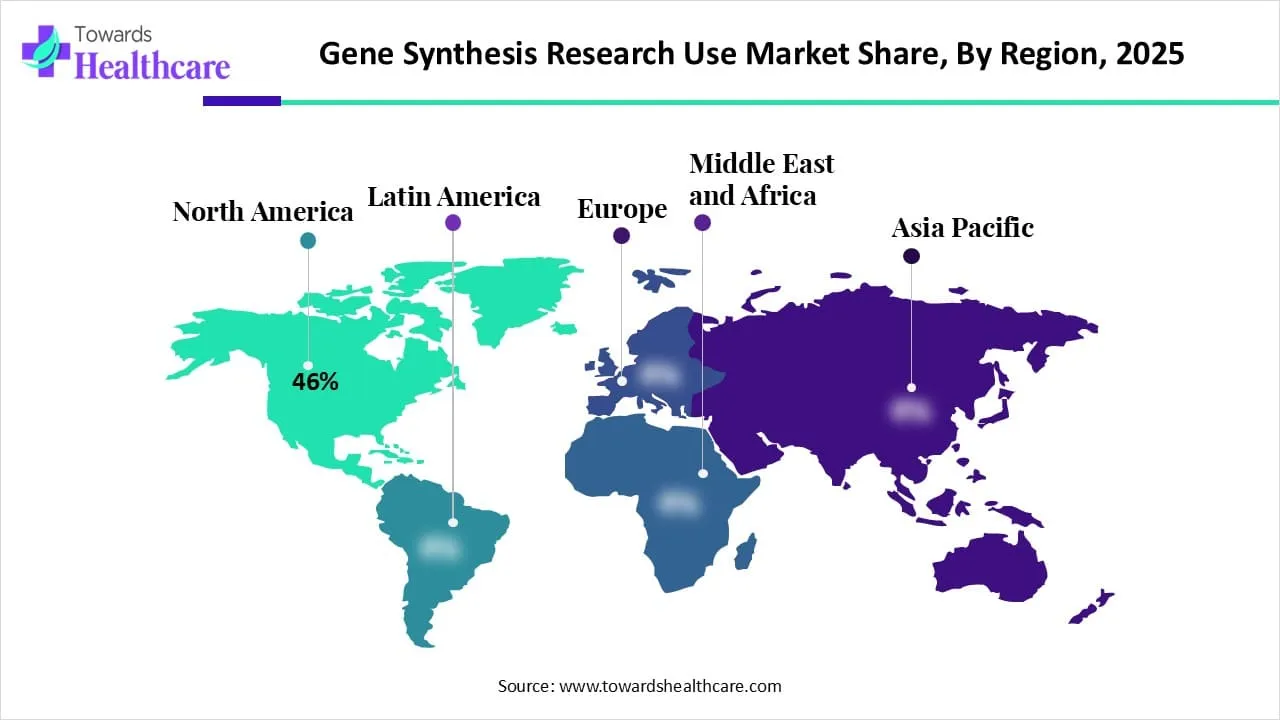
North America held 46.00% of revenue in 2025 and is projected to expand at a CAGR of 15.68% during the forecast period. North America holds the lion’s share because of large research funding, the presence of biotechnology companies, and synthesis providers. North America is expected to grow slower than the overall market between 2026 and 2035.
Europe has a well-established synthetic biology research ecosystem. Europe is expected to grow broadly in line with the overall market over the forecast period.
Asia Pacific is growing at the fastest rate due to the presence of Chinese gene synthesis providers and expanding research activities. The rate of growth of this region is expected to be lower than that of the market from 2026 to 2035.
Latin America has limited demand for gene synthesis. This region is expected to grow broadly in line with the overall market over the forecast period.
Middle East & Africa have limited demand. The growth of this segment is expected to stay aligned with the overall market between 2026 and 2035.
Analyst View: Regional shares were built from demand, installed base, spending, and supplier presence in each region. North America leads because of its mature demand base and the presence of strong suppliers. We assign Asia Pacific the highest growth premium because investment, adoption, and capacity are expanding at the fastest rate in this region.
| Rank | Company Name | 2025 Share (%) | Key Products / Business | Headquarters |
| 1 | Twist Bioscience | 20.00% | Silicon-based gene synthesis and libraries | United States |
| 2 | GenScript | 18.00% | Gene synthesis and cloning | China |
| 3 | Integrated DNA Technologies (Danaher) | 12.00% | gBlocks gene fragments and genes | United States |
| 4 | Thermo Fisher Scientific | 9.00% | GeneArt gene synthesis | United States |
| 5 | Azenta (GENEWIZ) | 8.00% | Gene synthesis services | United States |
| 6 | Eurofins Genomics | 5.00% | Gene synthesis | Luxembourg |
| 7 | Telesis Bio | 2.00% | BioXp benchtop synthesis | United States |
| 8 | Ansa Biotechnologies | 2.00% | Enzymatic DNA synthesis | United States |
| 9 | DNA Script | 2.00% | Enzymatic DNA printing | France |
| 10 | Ribbon Biolabs | 1.00% | Long DNA synthesis | Austria |
Note: Company shares are 2025 estimates.
Sources: Company press releases, expert interviews, secondary sources, Towards Healthcare database and Towards Healthcare analysts.
Twist Bioscience led the market with a 20.00% share in 2025, followed by GenScript at 18.00% share and Integrated DNA Technologies (Danaher) at 12.00% share.
Twist Bioscience leads with silicon-based gene synthesis and libraries, GenScript competes with gene synthesis and cloning, and Integrated DNA Technologies (Danaher) offers gBlocks gene fragments and genes. Thermo Fisher Scientific, Azenta (GENEWIZ), Eurofins Genomics, Telesis Bio, Ansa Biotechnologies, DNA Script and Ribbon Biolabs compete through geneArt gene synthesis, gene synthesis services, gene synthesis, bioXp benchtop synthesis, enzymatic DNA synthesis, enzymatic DNA printing and long DNA synthesis.
The top 10 companies accounted for 79% of revenue in 2025, while the remaining 21% was shared among many regional synthesis providers. The market is moderately concentrated, and competition centres on price per base, turnaround time, accuracy, length and complexity limits, biosecurity screening and online ordering.
Twist Bioscience is headquartered in the United States. It held a market share of 20.00% in 2025. Its offering centres on Silicon-based gene synthesis and libraries. In the Towards Healthcare Companies Quadrant it is positioned as a Leader.
GenScript has its global headquarters in China. The company captured 18.00% of the market in 2025. Its offering revolves around Gene synthesis and cloning. GenScript has been awarded the status of a Leader in the Towards Healthcare Companies Quadrant.
Integrated DNA Technologies (Danaher) has its corporate headquarters in the United States. It accounted for 12.00% of revenue in 2025. Its portfolio comprises gBlocks gene fragments and genes. In the Towards Healthcare Companies Quadrant it is positioned as a Leader.
The headquarters of Thermo Fisher Scientific is in the United States. It held a 9.00% share in 2025. Its offering centres on GeneArt gene synthesis. In the Towards Healthcare Companies Quadrant it is positioned as a Leader.
Azenta (GENEWIZ): Azenta (GENEWIZ) is headquartered in the United States. It captured 8.00% of the market in 2025. Its offering centres on Gene synthesis services. It has been awarded the status of a Leader in the Towards Healthcare Companies Quadrant.
Eurofins Genomics is headquartered in Luxembourg. It accounted for 5.00% of revenue in 2025. Its offering revolves around Gene synthesis. In the Towards Healthcare Companies Quadrant it is positioned as a Leader.
Telesis Bio has its global headquarters in the United States. It held a 2.00% share in 2025. Its provides BioXp benchtop synthesis. It has been positioned as an Innovator in the Towards Healthcare Companies Quadrant.
The headquarters of Ansa Biotechnologies is in the United States. The company captured 2.00% of the market in 2025. Its offering centres on Enzymatic DNA synthesis. In the Towards Healthcare Companies Quadrant it is positioned as an Innovator.
DNA Script has its corporate headquarters in France. It accounted for 2.00% of revenue in 2025. Its portfolio comprises Enzymatic DNA printing. The company has been awarded the status of an Innovator in the Towards Healthcare Companies Quadrant.
Ribbon Biolabs: Ribbon Biolabs is headquartered in Austria. It held a 1.00% share in 2025. Its offering centres on Long DNA synthesis. In the Towards Healthcare Companies Quadrant it is positioned as an Innovator.
The gene synthesis research use ecosystem links oligo & enzyme suppliers, gene synthesis providers, benchtop platforms, users and regulators, and each stage adds value before products reach end users.
| Ecosystem Stage | Role in the Market | Key Companies |
| Oligo & Enzyme Suppliers | Make oligos and enzymes | Oligo makers, enzyme suppliers |
| Gene Synthesis Providers | Make genes | Twist, GenScript, IDT, GENEWIZ |
| Benchtop Platforms | Enable in-lab synthesis | Telesis Bio, DNA Script |
| Users | Use genes | Universities, biotech, pharma |
| Regulators | Set biosecurity screening | HHS guidance, IGSC |
Sources: Company press releases, expert interviews, secondary sources, Towards Healthcare database and Towards Healthcare analysts.
Oligo & Enzyme Suppliers: Make oligos and enzymes. Key participants include Oligo makers and enzyme suppliers.
Gene Synthesis Providers: Make genes. Key participants include Twist, GenScript, IDT, and GENEWIZ.
Benchtop Platforms: Enable in-lab synthesis. Key participants include Telesis Bio and DNA Script.
Users: Use genes. Key participants include Universities, biotech, and pharma.
Regulators: Set biosecurity screening. Key participants include HHS guidance and IGSC.
Value in the market flows from upstream material and technology suppliers to manufacturers and service providers, then through distribution partners to end users. Companies that integrate several stages or build long-term relationships with end users will be well-positioned to capture a large share of this value.
The Towards Healthcare Companies Quadrant positions key participants in the market-by-market strength, reflecting revenue scale, market share and geographic reach, and by innovation and growth strategy, reflecting product portfolio breadth, research and development intensity and collaborations. Positions reflect each company's estimated 2025 share of the market and our evaluation of its product innovation, portfolio breadth and collaborations.
Sources: Company press releases, expert interviews, secondary sources, Towards Healthcare database and Towards Healthcare analysts.
Leaders: Twist Bioscience, GenScript, Integrated DNA Technologies (Danaher), Thermo Fisher Scientific, Azenta (GENEWIZ) and Eurofins Genomics bring together high market share, broad portfolios and strong innovation.
Innovators: Telesis Bio, Ansa Biotechnologies, DNA Script and Ribbon Biolabs provide newer technologies and specialized products.
By Product
By Application
By End User
By Region
The market is defined as synthetic genes and DNA products for research use only, including standard genes, long and complex genes, gene fragments, gene libraries and variant libraries, and codon optimization and cloning services, used in antibody discovery, synthetic biology, vaccine and therapeutic research, and genetic engineering by academic and research institutes, pharmaceutical and biotechnology companies, and CROs.
The 2025 base year was built bottom-up from demand volumes and average prices by product, application and end user and region, and checked top-down against the market-specific revenues of leading companies and published estimates. Segment, regional and company values were allocated from product, application and end user and region demand. Key estimates were verified by cross-checking company disclosures, regulatory and industry data and published third-party estimates, and inputs that could not be reconciled were excluded. All segment, regional and company figures were reconciled to the same 2025 base year, and the 2026-2035 forecast, which applies a constant CAGR from the 2025 base, was recalculated and validated.
Analyst View: The market is set to grow at a steady rate as protein engineering and related demand keep growing. Our estimate links value to underlying demand, installed base and pricing, so the forecast follows real adoption rather than headline hype. The main upside comes from long genes and enzymatic synthesis, while the main risks are price competition and biosecurity rules.