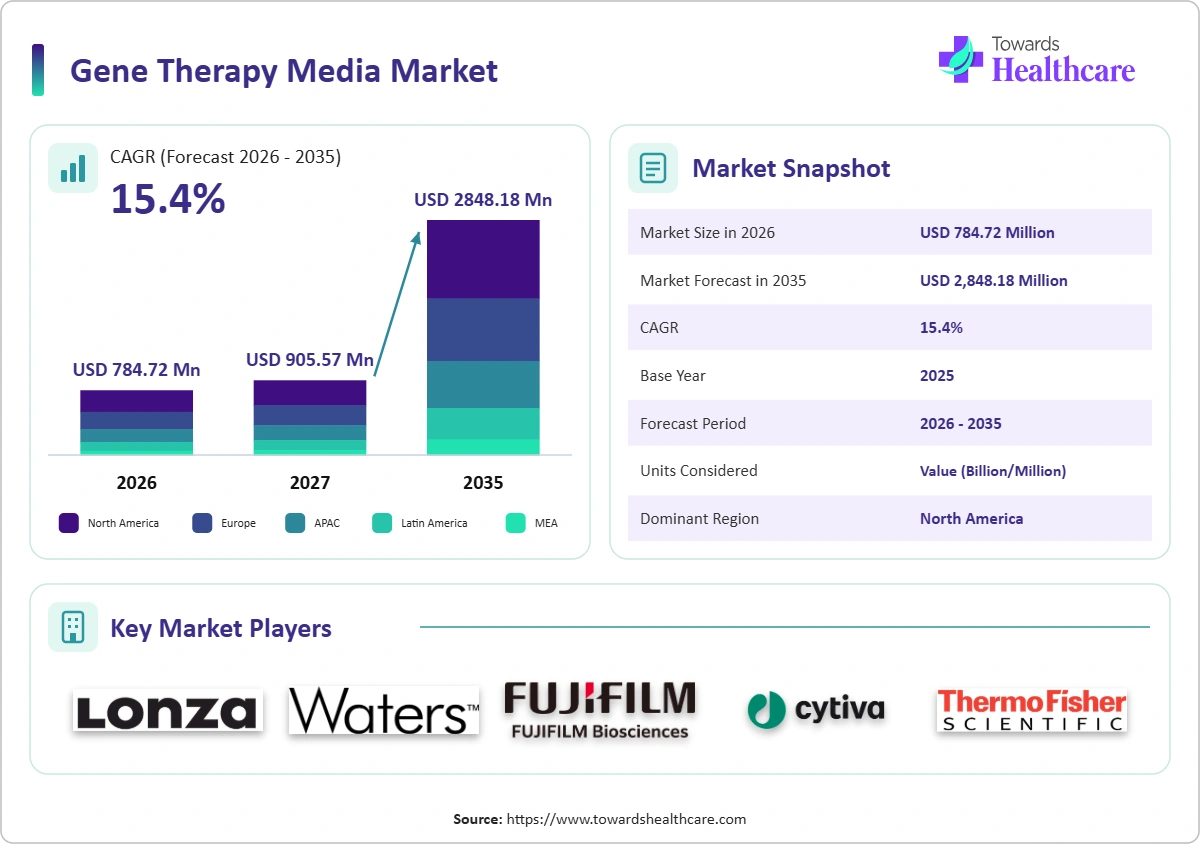
The market is expected to expand from USD 680.00 million in 2025 to USD 2,848.18 million by 2035 as every gene therapy needs viral vectors grown in cells, and optimized media are key to raising yields and cutting costs. Gene therapy pipelines, approvals, CDMO scale-up, and higher-yield processes support very strong growth. The market is expected to reach USD 1,391.68 million by 2030 and sustain a CAGR of 15.40% from 2026 to 2035. Gene therapy media are specialized cell culture media for cell therapy and cell culture vector production.
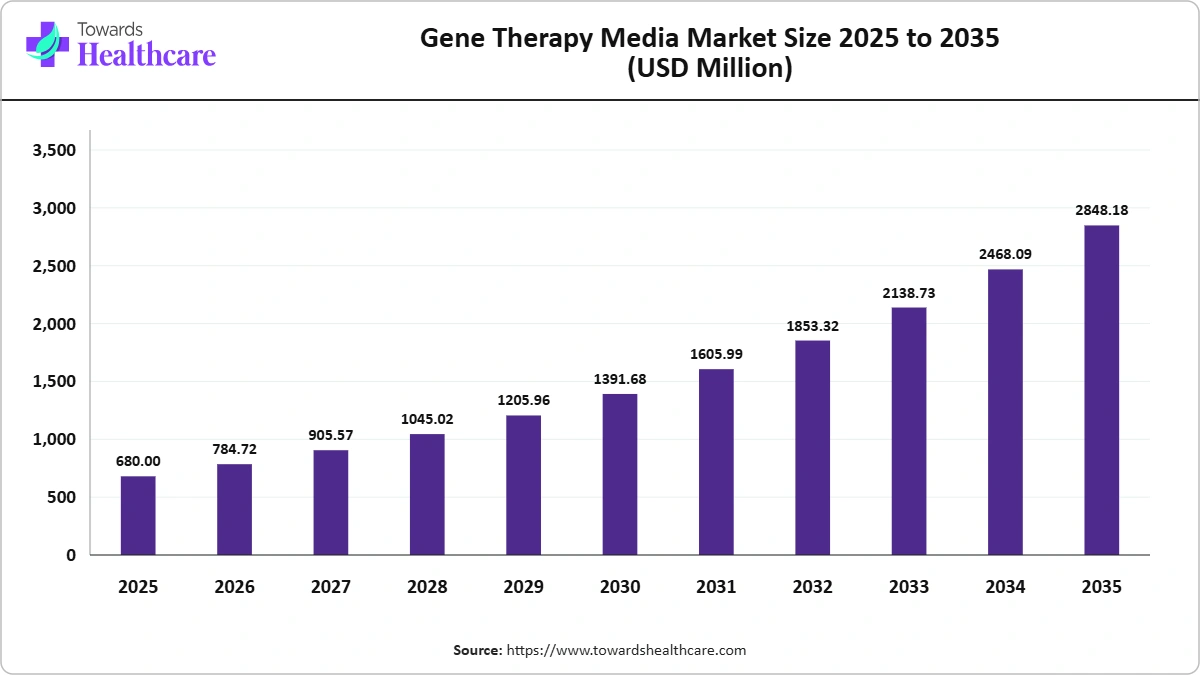
Analyst View: We built the estimate from vector production volumes, media use per batch, and average media prices by region, cross-checked against relevant media supplier activity. Published estimates for this exact scope are limited, so our value is evidence-based.
| Driver | Impact | ≈ CAGR Contribution | Time Horizon | Key Regions |
| Gene therapy pipelines grow | High | +6.01 pp | Short to long term | Global, strongest in North America |
| Approvals increase | Medium | +5.07 pp | Medium to long term | Global, fastest uptake in Asia Pacific |
| Vector yields must rise | Medium | +4.32 pp | Short to medium term | Global |
| CDMOs scale up | Low | +3.38 pp | Long term | Developed and emerging markets |
Note: Contributions are indicative estimates of each factor's effect on annual growth.
Sources: Expert interviews, secondary sources, Towards Healthcare database and Towards Healthcare analysts.
These drivers together add about 18.78 percentage points to the annual growth of the market, with gene therapy pipeline growth having the largest effect. Their influence is strongest in North America, while uptake grows fastest in Asia Pacific.
| Restraint | Impact | ≈ Negative CAGR Contribution | Time Horizon | Key Regions |
| High therapy costs | High | -1.52 pp | Short to medium term | Global |
| Biotech funding swings | High | -1.12 pp | Medium term | Price-sensitive and emerging markets |
| Process lock-in | Medium | -0.75 pp | Short term | North America and other mature markets |
Note: Contributions are indicative estimates of each factor's effect on annual growth.
Sources: Expert interviews, secondary sources, Towards Healthcare database and Towards Healthcare analysts.
These restraints are expected to reduce annual growth of the market by about 3.39 percentage points, led by high therapy costs. Their effect eases over the forecast period as suppliers, buyers, and regulators adapt, leaving a net CAGR of 15.39% from 2026 to 2035.
The demand for perfusion media, custom formulations, and higher-yield products is increasing, which creates growth opportunities in the market. Expansion in CDMO capacity in Asia and rising research into in vivo CAR-T vectors support market growth.
Note: 2025 is the base year; 2035 shares and CAGRs are forecasts.
Sources: Expert interviews, secondary sources, Towards Healthcare database and Towards Healthcare analysts.
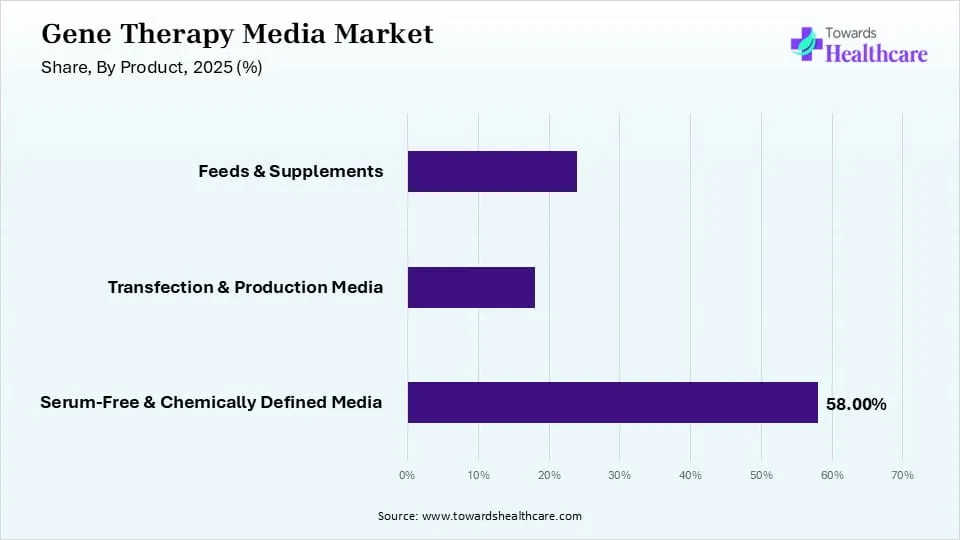
Serum-Free & Chemically Defined Media held a 58.00% share in 2025 and is projected to expand at a CAGR of 14.73% from 2026 to 2035. Serum-free and chemically defined media continue to lead because GMP vector production needs consistent, animal-free inputs. This segment is expected to grow at a slower rate than the overall market over the forecast period.
Transfection & Production Media grow fastest with optimized HEK293 processes. The growth rate of this segment is expected to be higher than the market between 2026 and 2035.
Feeds & Supplements boost titres. This segment is expected to grow broadly in line with the overall market over the forecast period.
AAV dominated the market with a 52.00% share in 2025, registering a projected CAGR of 15.68% from 2026 to 2035. Its strong market position reflects the extensive adoption of AAV vectors in in vivo gene therapies. The segment's growth trajectory remains consistent with the overall market.
Lentiviral established role in CAR-T and other ex vivo therapies support market demand. However, the segment's growth rate trails the overall market.
Adenoviral & Others the segment's growth remains below the overall market rate throughout the forecast period.
Biopharmaceutical Companies held 48.00% of the market in 2025 and are projected to expand at a CAGR of 14.59% from 2026 to 2035. Biopharmaceutical companies hold the largest share as they develop vectors. This segment is expected to grow at a slower rate than the overall market over the forecast period.
CDMOs grow fastest because most of the vector production is outsourced. The rate of growth of this segment is expected to be higher than that of the market between 2026 and 2035.
Academic & Research Institutes develop vectors. This segment is expected to grow slower than the overall market over the forecast period.
Analyst View: Segment shares were allocated from demand, product portfolios, and pricing in each category. Serum-Free & Chemically Defined Media, AAV, and Biopharmaceutical Companies lead in their respective categories because they meet the core needs of today's buyers. We expect the shares of Transfection & Production Media and CDMOs to increase as newer technologies, users, and applications grow at a faster rate.
Note: 2025 is the base year; 2035 shares and CAGRs are forecasts.
Sources: Expert interviews, secondary sources, Towards Healthcare database and Towards Healthcare analysts.
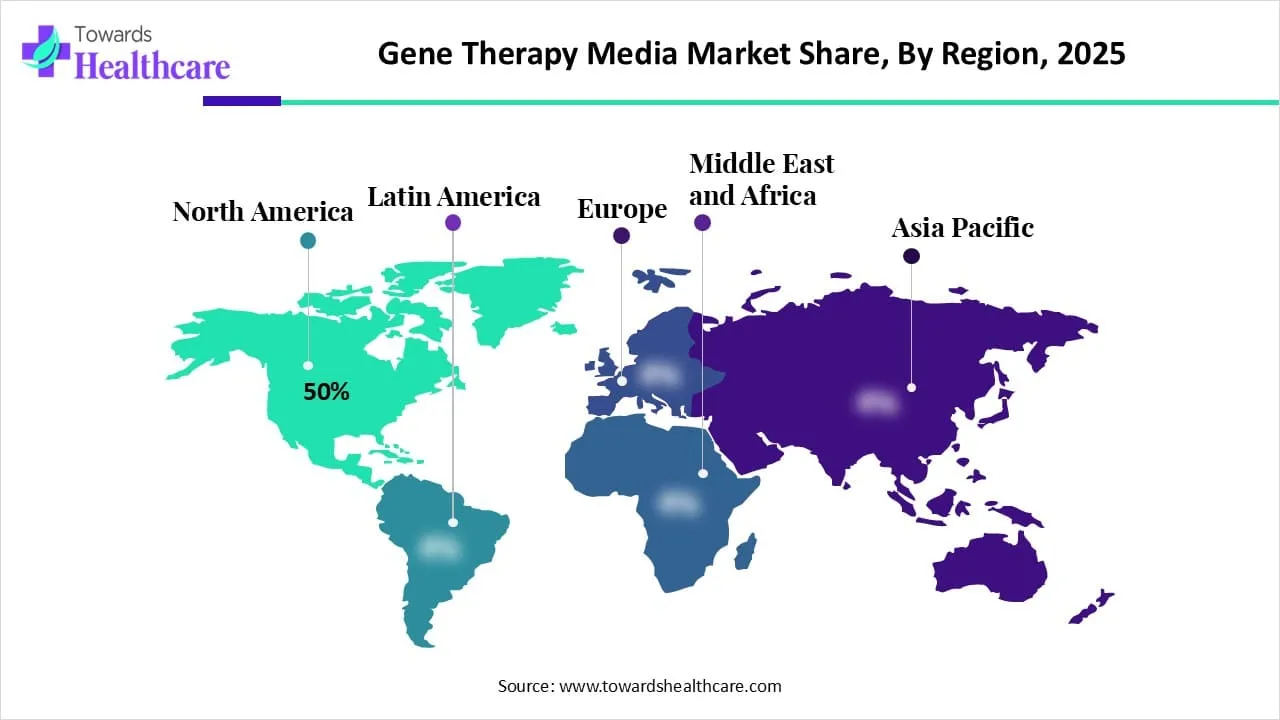
North America dominated the market with a 50.00% share in 2025, supported by the strong presence of gene therapy developers and vector CDMOs in the U.S. The region is projected to grow at a CAGR of 14.97% from 2026 to 2035, below the overall market growth rate.
Europe established vector manufacturing ecosystem supports regional market expansion. Growth across Europe remains broadly in line with the overall market during the forecast period.
Asia Pacific presence of gene therapy CDMOs across China, South Korea, and Japan drives regional expansion. Asia Pacific leads regional growth, with a CAGR above the overall market rate.
Latin America is broadly matching the overall market growth rate.
Middle East & Africa regional market expansion follows a growth trajectory in line with the overall market.
Analyst View: Regional shares were built from demand, installed base, spending, and supplier presence in each region. North America holds the leading position because of its mature demand base and the presence of strong suppliers. We assign Asia Pacific the highest growth premium because investment, adoption, and capacity are expanding at the fastest rate in this region.
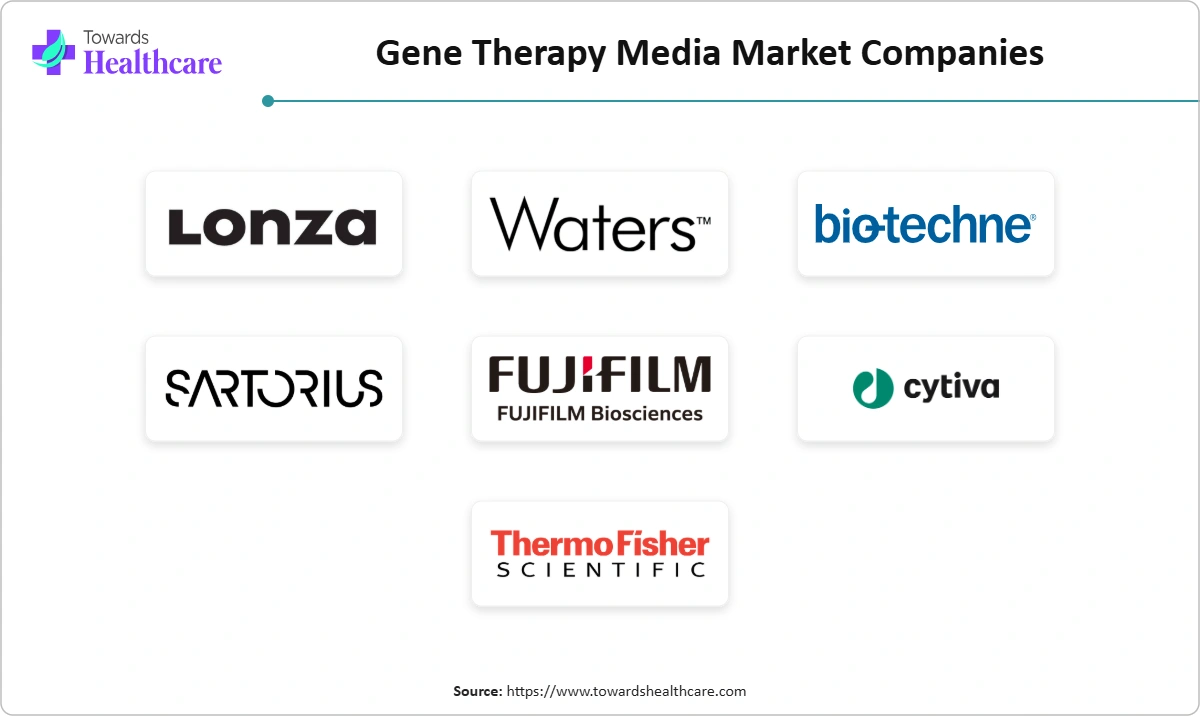
| Rank | Company Name | 2025 Share (%) | Key Products / Business | Headquarters |
| 1 | Thermo Fisher Scientific | 28.00% | Gibco viral production media and systems | United States |
| 2 | Cytiva (Danaher) | 14.00% | HyClone media | United States |
| 3 | Merck KGaA (MilliporeSigma) | 12.00% | Cell culture media and VirusExpress | Germany |
| 4 | FUJIFILM Biosciences | 10.00% | BalanCD HEK293 media | Japan |
| 5 | Lonza | 6.00% | Media and vector services | Switzerland |
| 6 | Sartorius | 5.00% | Media and process solutions | Germany |
| 7 | Corning | 3.00% | Cell culture media | United States |
| 8 | Bio-Techne | 3.00% | GMP supplements and reagents | United States |
| 9 | BD Biosciences (Waters) | 2.00% | Media supplements | United States |
| 10 | PromoCell | 2.00% | Cell culture media | Germany |
Note: Company shares are 2025 estimates.
Sources: Company press releases, expert interviews, secondary sources, Towards Healthcare database and Towards Healthcare analysts.
Thermo Fisher Scientific led the market with a 28.00% share in 2025, followed by Cytiva (Danaher) at 14.00% share and Merck KGaA (MilliporeSigma) at 12.00% share.
Thermo Fisher Scientific leads with Gibco viral production media and systems, Cytiva (Danaher) competes with hyClone media, and Merck KGaA (MilliporeSigma) offers cell culture media and VirusExpress. FUJIFILM Biosciences, Lonza, Sartorius, Corning, Bio-Techne, BD Biosciences (Waters) and PromoCell compete through balanCD HEK293 media, media and vector services, media and process solutions, cell culture media, GMP supplements and reagents, media supplements and cell culture media.
The top 10 companies accounted for 85.00% of revenue in 2025, while the remaining 15.00% was shared among several Chinese media manufacturers and specialist suppliers. The market is concentrated, and competition revolves around vector titre, chemically defined formulations, GMP documentation, supply security, process support and price.
Thermo Fisher Scientific is headquartered in the United States. The company captured 28.00% of the market in 2025. Its offering centres on Gibco viral production media and systems. It has been positioned as a Leader in the Towards Healthcare Companies Quadrant.
Cytiva (Danaher) has its global headquarters in the United States. It held a market share of 14.00% in 2025. Its offering revolves around HyClone media. In the Towards Healthcare Companies Quadrant it is positioned as a Leader.
Merck KGaA (MilliporeSigma) has its corporate headquarters in Germany. It held 12.00% of revenue in 2025. The company’s portfolio comprises Cell culture media and VirusExpress. It has been awarded the status of a Leader in the Towards Healthcare Companies Quadrant.
FUJIFILM Biosciences, part of Fujifilm Holdings Corporation, is headquartered in Japan. The company held a 10.00% share in 2025. Its offering centres on BalanCD HEK293 media. In the Towards Healthcare Companies Quadrant it is positioned as a Leader.
The headquarters of Lonza is in Switzerland. It captured 6.00% of the market in 2025. Its offering revolves around Media and vector services. The company is recognised as a leading player in the Towards Healthcare Companies Quadrant.
Sartorius is headquartered in Germany. It accounted for a market share of 5.00% in 2025. Its offering centres on Media and process solutions. In the Towards Healthcare Companies Quadrant it is positioned as a Leader.
Corning has its corporate headquarters in the United States. It held a 3.00% share in 2025. Corning provides Cell culture media. In the Towards Healthcare Companies Quadrant it is positioned as an Innovator.
Bio-Techne, headquartered in the United States, accounted for 3.00% of the market in 2025. Its product portfolio focuses on GMP supplements and reagents. The company holds an Innovator position.
BD Biosciences (Waters) is headquartered in the United States. It accounted for 2.00% of revenue in 2025. Its offering revolves around Media supplements. According to the Towards Healthcare Companies Quadrant, the company is classified as an Innovator.
PromoCell, headquartered in Germany, accounted for 2.00% of the market in 2025, with a product portfolio focused on cell culture media. The company holds an Innovator position as per the Towards Healthcare Companies Quadrant.
The gene therapy media ecosystem links raw material suppliers, media makers, cdmos, developers and regulators, with each stage adding value before products reach end users.
| Ecosystem Stage | Role in the Market | Key Companies |
| Raw Material Suppliers | Supply amino acids and growth factors | Chemical and protein makers |
| Media Makers | Formulate media | Thermo Fisher, Cytiva, MilliporeSigma, FUJIFILM |
| CDMOs | Produce vectors | Vector CDMOs |
| Developers | Develop gene therapies | Biotech and pharma |
| Regulators | Approve therapies and inputs | FDA, EMA |
Sources: Company press releases, expert interviews, secondary sources, Towards Healthcare database and Towards Healthcare analysts.
Raw Material Suppliers: Supply amino acids and growth factors. Key participants include Chemical and protein makers.
Media Makers: Formulate media. Key participants include Thermo Fisher, Cytiva, MilliporeSigma, FUJIFILM.
CDMOs: Produce vectors. Key participants include Vector CDMOs.
Developers: Develop gene therapies. Key participants include Biotech and pharma.
Regulators: Approve therapies and inputs. Key participants include FDA and EMA.
Value in the market flows from upstream material and technology suppliers to manufacturers and service providers, then through distribution partners to end users. Companies that integrate several stages or build long-term relationships with end users will be well-positioned to capture a large share of this value.
The Towards Healthcare Companies Quadrant evaluates key market participants based on market strength and innovation and growth strategies. Market strength considers revenue scale, market share, and geographic presence, while innovation and growth strategies assess product portfolio breadth, R&D investments, and strategic partnerships. Company positioning reflects estimated 2025 shares of the gene therapy media market, along with an assessment of product innovation, portfolio diversity, and collaborations.
Sources: Company press releases, expert interviews, secondary sources, Towards Healthcare database and Towards Healthcare analysts.
Leaders: Thermo Fisher Scientific, Cytiva (Danaher), Merck KGaA (MilliporeSigma), FUJIFILM Biosciences, Lonza and Sartorius combine high market share with broad portfolios and strong innovation.
Innovators: Corning, Bio-Techne, BD Biosciences (Waters) and PromoCell bring newer technologies and specialised products.
By Product
By Vector Type
By End User
By Region
The market is defined as cell culture media and supplements used to grow cells for gene therapy and viral vector production, including serum-free and chemically defined media, transfection and production media, and feeds and supplements, in research and GMP grades, used for AAV, lentiviral, adenoviral and other vectors by biopharmaceutical companies, CDMOs, and academic and research institutes.
The 2025 base year was built bottom-up from demand volumes and average prices by product, vector type and end user and region, and checked top-down against the market-specific revenues of prominent companies and published estimates. Segment, regional and company values were allocated from product, vector type and end user and region demand. Key estimates were verified by cross-checking company disclosures, regulatory and industry data and published third-party estimates, and inputs that could not be reconciled have not been included. All segment, regional and company figures were reconciled to the same 2025 base year, and the 2026-2035 forecast, which applies a constant CAGR from the 2025 base, was recalculated and validated.
Analyst View: The market is set for steady expansion as gene therapy pipelines and related demand keep growing. Our estimate links value to underlying demand, installed base and pricing, so the forecast follows real adoption rather than headline hype. Growth opportunities lie in perfusion media and Asian CDMOs, and high therapy costs and funding swings pose key challenges.