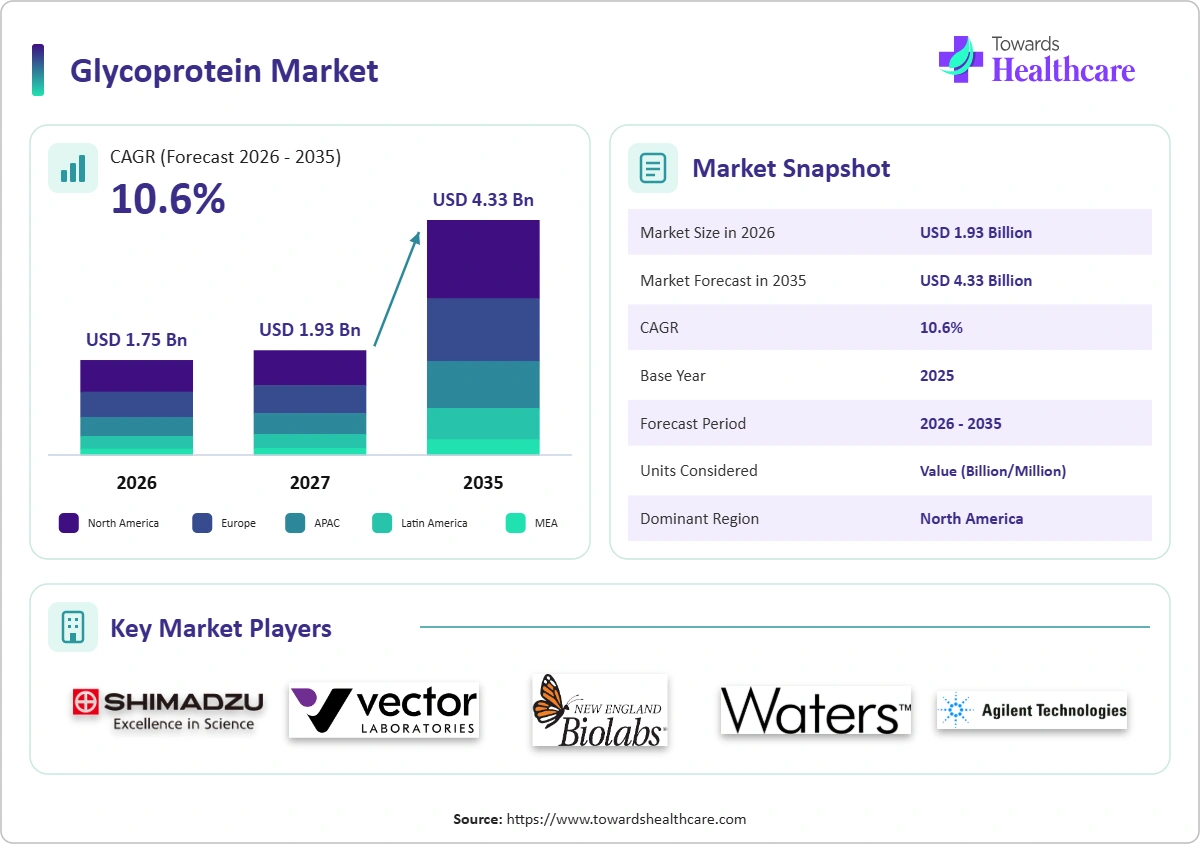
The glycoprotein market is projected to grow from USD 1.58 billion in 2025 to USD 4.33 billion by 2035, registering strong growth over the forecast period. Glycosylation affects how biologic drugs work and how long they last, so every antibody and biosimilar needs glycoprotein analysis. Biologics growth, biosimilars, regulatory requirements, and glycan biomarkers are driving market expansion. The market is projected to reach USD 2.61 billion by 2030 and grow at a CAGR of 10.60% from 2026 to 2035. Glycoprotein analysis supports cell culture media optimization, cell-based vaccine quality, and precision medicine biomarkers.
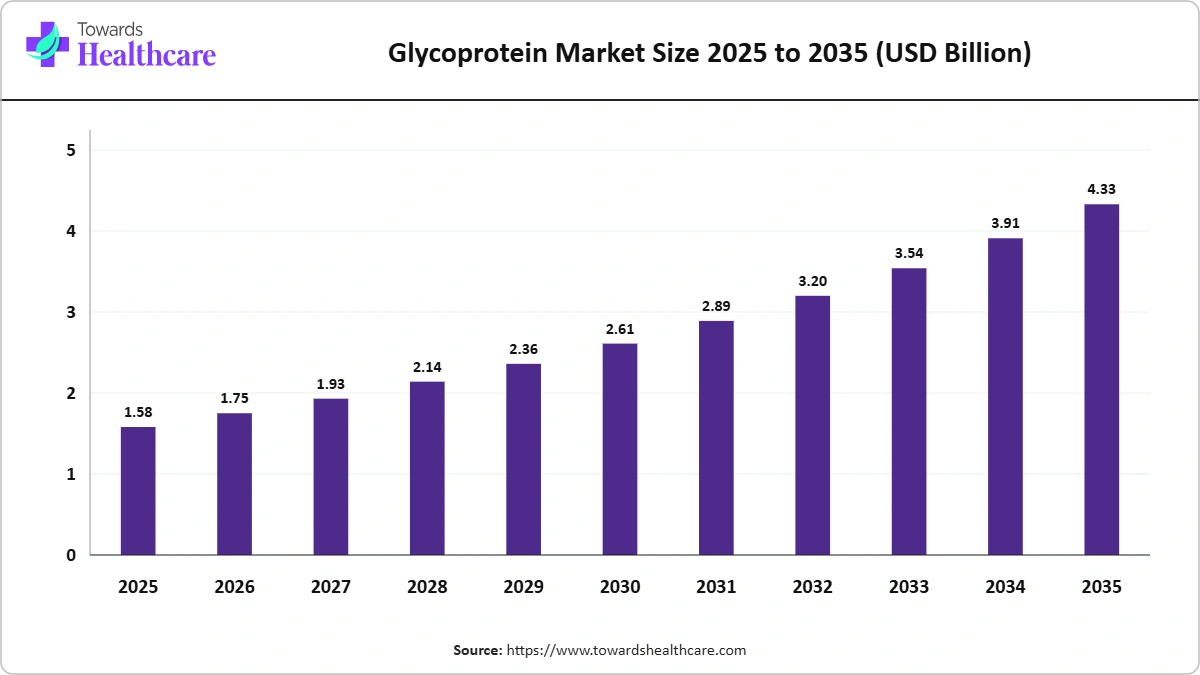
Analyst View: We built the estimate from glycoprotein analysis spending in biopharma and research by product and region, cross-checked against glycoanalysis revenues of relevant suppliers.
| Driver | Impact | ≈ CAGR Contribution | Time Horizon | Key Regions |
| Biologics and biosimilars need glycan analysis | High | +4.14 pp | Short to long term | Global, strongest in North America |
| Regulators require characterisation | Medium | +3.49 pp | Medium to long term | Global, fastest uptake in Asia Pacific |
| Glycan biomarkers emerge | Medium | +2.97 pp | Short to medium term | Global |
| Mass spectrometry improves | Low | +2.33 pp | Long term | Developed and emerging markets |
Note: Contributions are indicative estimates of each factor's effect on annual growth.
Sources: Expert interviews, secondary sources, Towards Healthcare database and Towards Healthcare analysts.
Collectively, these drivers contribute about 12.93 percentage points to the annual market growth, with rising glycan analysis requirements for biologics and biosimilars having the greatest impact. Their impact is greatest in North America, while Asia Pacific is experiencing the fastest adoption.
| Restraint | Impact | ≈ Negative CAGR Contribution | Time Horizon | Key Regions |
| Complex workflows | High | -1.05 pp | Short to medium term | Global |
| High instrument costs | High | -0.77 pp | Medium term | Price-sensitive and emerging markets |
| Skills gaps | Medium | -0.51 pp | Short term | North America and other mature markets |
Note: Contributions are indicative estimates of each factor's effect on annual growth.
Sources: Expert interviews, secondary sources, Towards Healthcare database and Towards Healthcare analysts.
These restraints are estimated to lower annual market growth by about 2.33 percentage points, primarily due to complex analytical workflows. The effect of these restraints is expected to decrease over the forecast period as suppliers, buyers, and regulators are fine-tuning their workflows to maximize growth, supporting a CAGR of 10.60% from 2026 to 2035.
The demand for biosimilar testing and diagnostic applications is growing, and the biopharmaceutical research ecosystem is expanding in Asia, which creates new growth opportunities in the market. Increasing automation and demand for specialized analytical services support market growth.
Note: 2025 is the base year; 2035 shares and CAGRs are forecasts.
Sources: Expert interviews, secondary sources, Towards Healthcare database and Towards Healthcare analysts.
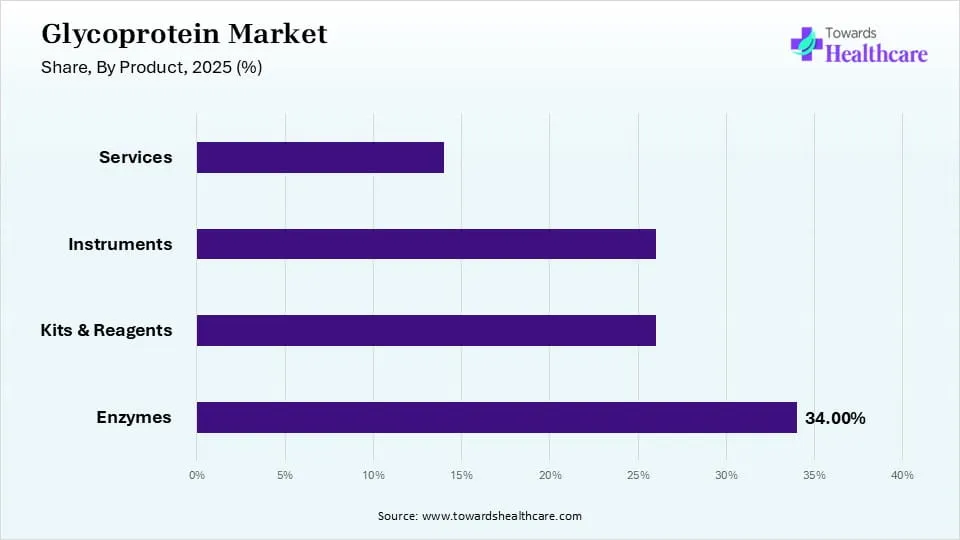
Enzymes accounted for 34.00% of the market in 2025 and are projected to expand at a CAGR of 10.03% from 2026 to 2035. Enzymes lead because PNGase F and other glycosidases release glycans for analysis. This segment is expected to grow at a slower rate than the overall market over the forecast period.
Kits & Reagents are purchased because labs use standard glycan release and labelling kits. The growth of this segment is expected to stay aligned with the market between 2026 and 2035.
Instruments such as LC-MS and HPLC are needed for glycan analysis. This segment is expected to grow broadly in line with the overall market over the forecast period.
Services grow fastest as companies outsource characterization. This segment is expected to grow at a faster rate than the overall market between 2026 and 2035.
Biopharma Development & QC held a 48.00% share in 2025 and is projected to expand at a CAGR of 10.09% during the forecast period. Biopharma development and QC leads because glycosylation is an important quality attribute of antibodies. This segment is expected to grow at a lower pace than the overall market over the forecast period.
Drug Discovery Drug discovery studies glycan targets. The growth of this segment is expected to stay aligned with the market throughout the forecast period.
Diagnostics is growing at the highest rate owing to increasing use of glycan biomarkers. The growth rate of this segment is expected to be higher than the market from 2026 to 2035.
Research the growth of this segment can be attributed to expanding academic and biopharmaceutical research activities. This segment is expected to grow broadly in line with the market over the forecast period.
Pharma & Biotech Companies accounted for 54.00% of the market in 2025 and are projected to expand at a CAGR of 10.16% during the forecast period. Pharmaceutical and biotechnology companies hold leadership because they characterize biologics. This segment is expected to grow at a slower rate than the market between 2026 and 2035.
Academic & Research Institutes study glycobiology. The growth of this segment is expected to stay aligned with the market over the forecast period.
CROs CROs are growing at the fastest rate because glycoprotein analysis and research services are being increasingly outsourced. The CROs segment is expected to grow at a faster pace than the overall market between 2026 and 2035.
Analyst View: Segment shares were allocated from demand, product portfolios, and pricing in each category. Enzymes, Biopharma Development & QC, and Pharma & Biotech Companies lead their categories because they meet the core needs of today's buyers. We expect Services, Diagnostics and CROs to gain share as newer technologies, users and applications grow faster.
Note: 2025 is the base year; 2035 shares and CAGRs are forecasts.
Sources: Expert interviews, secondary sources, Towards Healthcare database and Towards Healthcare analysts.
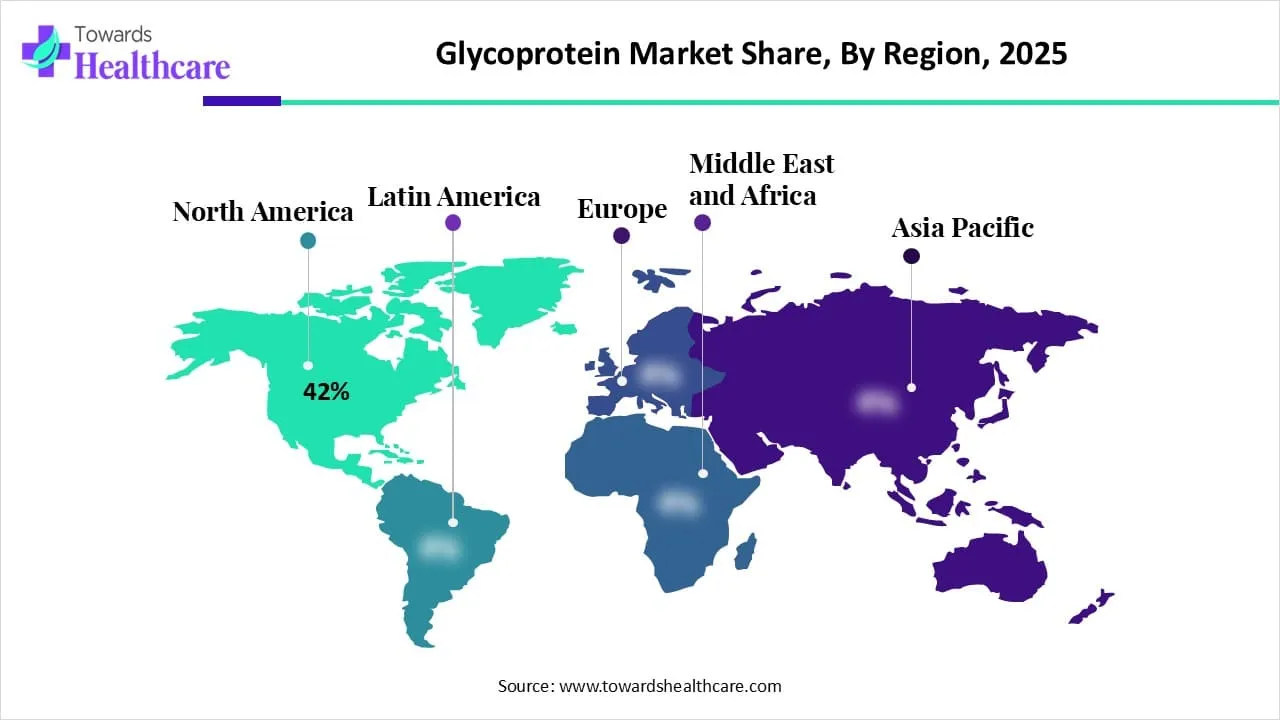
North America accounted for 42.00% of the market in 2025 and is projected to expand at a CAGR of 10.08% over the forecast period. North America leads because of large biologics development and glycobiology research. This region is expected to exhibit a slower rate of growth compared to the overall market between 2026 and 2035.
Europe has a strong biosimilar and glycoscience research ecosystem. Europe is expected to grow broadly in line with the overall market throughout the forecast period.
Asia Pacific grows fastest, with biosimilar development in China, Korea, and India. This region is expected to exhibit a faster growth pace than the market from 2026 to 2035.
Latin America is expected to grow broadly in line with the overall market over the forecast period.
Middle East & Africa growth is expected to stay aligned with the overall market between 2026 and 2035.
Analyst View: Regional shares were built from demand, installed base, spending, and supplier presence in each region. North America leads because of its mature demand base and the presence of strong suppliers. We assign Asia Pacific the highest growth premium because investment, adoption, and capacity are expanding fastest in this region.
| Rank | Company Name | 2025 Share (%) | Key Products / Business | Headquarters |
| 1 | Thermo Fisher Scientific | 18.00% | Glycan reagents and LC-MS | United States |
| 2 | Agilent Technologies | 12.00% | ProZyme glycan kits and LC systems | United States |
| 3 | Waters | 12.00% | GlycoWorks kits and LC-MS | United States |
| 4 | Merck KGaA (MilliporeSigma) | 8.00% | Enzymes and reagents | Germany |
| 5 | New England Biolabs | 6.00% | Glycosidase enzymes | United States |
| 6 | Bruker | 5.00% | Mass spectrometry | United States |
| 7 | SCIEX (Danaher) | 5.00% | Glycan analysis CE and MS | United States |
| 8 | Shimadzu | 4.00% | LC and MS systems | Japan |
| 9 | Vector Laboratories | 3.00% | Lectins and glycan detection kits | United States |
| 10 | Ludger | 1.00% | Glycan analysis kits and services | United Kingdom |
Note: Company shares are 2025 estimates.
Sources: Company press releases, expert interviews, secondary sources, Towards Healthcare database and Towards Healthcare analysts.
Thermo Fisher Scientific led the market with an 18.00% share in 2025, followed by Agilent Technologies at a 12.00% share and Waters at a 12.00% share.
Thermo Fisher Scientific dominates owing to its glycan reagents and LC-MS. Agilent Technologies competes with proZyme glycan kits and LC systems, and Waters offers glycoWorks kits and LC-MS. Merck KGaA (MilliporeSigma), New England Biolabs, Bruker, SCIEX (Danaher), Shimadzu, Vector Laboratories, and Ludger compete through enzymes and reagents, glycosidase enzymes, mass spectrometry, glycan analysis CE and MS, LC and MS systems, lectins and glycan detection kits, and glycan analysis kits and services.
The top 10 companies accounted for 74.05% of revenue in 2025, while the remaining 25.95% was shared among many specialist reagent and service providers. The market is moderately concentrated, and competition centres on analytical sensitivity, workflow speed, regulatory-ready methods, kit standardisation, instrument integration, and price.
The headquarters of Thermo Fisher Scientific is in the United States. It held an 18.00% share in 2025. Its offering centres on Glycan reagents and LC-MS. In the Towards Healthcare Companies Quadrant it is positioned as a Leader.
Agilent Technologies is headquartered in the United States. It accounted for 12.00% of revenue in 2025. The company provides ProZyme glycan kits and LC systems. Towards Healthcare categorizes the company as a Leader in its Companies Quadrant.
Waters has its corporate headquarters in the United States. It captured 12.00% of the market in 2025. Its offering revolves around GlycoWorks kits and LC-MS. The company is recognized as a leading player in the Towards Healthcare Companies Quadrant.
Merck KGaA (MilliporeSigma) is headquartered in Germany. The company held an 8.00% share in 2025. Its portfolio consists of Enzymes and reagents. In the Towards Healthcare Companies Quadrant it is positioned as a Leader.
The headquarters of New England Biolabs is in the United States. It accounted for a market share of 6.00% in 2025. Its offering centres on Glycosidase enzymes. The company has been awarded the status of a Leader in the Towards Healthcare Companies Quadrant.
Bruker is headquartered in the United States. The company captured 5.00% of the market in 2025. Its offering centres on Mass spectrometry. In the Towards Healthcare Companies Quadrant it is positioned as a Leader.
SCIEX (Danaher) has its corporate headquarters in the United States. It held a 5.00% share in 2025. The company provides Glycan analysis CE and MS. Towards Healthcare categorizes the company as an Innovator in its Companies Quadrant.
Shimadzu has its global headquarters in Japan. It accounted for 4.00% of revenue in 2025. Its portfolio comprises LC and MS systems. Shimadzu has been positioned as an Innovator in the Towards Healthcare Companies Quadrant.
The headquarters of Vector Laboratories is in the United States. It captured 3.00% of the market in 2025. Its offering revolves around Lectins and glycan detection kits. In the Towards Healthcare Companies Quadrant it is positioned as an Innovator.
Ludger is headquartered in the United Kingdom. The company held a 1.00% share in 2025. Its offering centres on Glycan analysis kits and services. In the Towards Healthcare Companies Quadrant it is positioned as an Innovator.
The glycoprotein ecosystem links enzyme & reagent manufacturers, instrument manufacturers, service labs, users, and regulators, and each stage adds value before products reach end users.
| Ecosystem Stage | Role in the Market | Key Companies |
| Enzyme & Reagent Makers | Make enzymes and kits | NEB, Agilent, Vector Laboratories |
| Instrument Makers | Make LC-MS and CE | Thermo Fisher, Waters, SCIEX, Bruker |
| Service Labs | Analyse glycans | CROs, Ludger |
| Users | Characterise glycoproteins | Biopharma, universities |
| Regulators | Set quality rules | FDA, EMA, ICH Q6B |
Sources: Company press releases, expert interviews, secondary sources, Towards Healthcare database and Towards Healthcare analysts.
Enzyme & Reagent Makers: Make enzymes and kits. Key participants include NEB, Agilent, and Vector Laboratories.
Instrument Makers: Make LC-MS and CE. Key participants include Thermo Fisher, Waters, SCIEX, Bruker.
Service Labs: Analyze glycans. Key participants include CROs, Ludger.
Users: Characterize glycoproteins. Key participants include biopharma and universities.
Regulators: Set quality rules. Key participants include FDA, EMA, and ICH Q6B.
Market value moves from upstream material and technology suppliers to manufacturers and service providers, followed by distributors and end users. Companies that integrate several stages or build long-term relationships with end users will be well-positioned to capture a large share of this value.
The Towards Healthcare Companies Quadrant positions key participants in the market by market strength, reflecting revenue scale, market share, and geographic reach, and by innovation and growth strategy, covering product portfolio breadth, research and development investment, and strategic partnerships. Company positions are based on estimated 2025 market shares and assessments of product innovation, portfolio diversity, and strategic collaborations.
Sources: Company press releases, expert interviews, secondary sources, Towards Healthcare database and Towards Healthcare analysts.
Leaders: Thermo Fisher Scientific, Agilent Technologies, Waters, Merck KGaA (MilliporeSigma), New England Biolabs and Bruker combine high market share with broad portfolios and strong innovation.
Innovators: SCIEX (Danaher), Shimadzu, Vector Laboratories and Ludger bring newer technologies and specialized products.
By Product
By Application
By End User
By Region
The market is defined as products and services used to study and characterize glycoproteins, including enzymes such as glycosidases and glycosyltransferases, kits and reagents for glycan release and labelling, lectins and antibodies, instruments such as mass spectrometry and HPLC systems used for glycan analysis, and analysis services, applied to biopharmaceutical development and quality control, drug discovery, diagnostics and research by pharmaceutical and biotechnology companies, academic and research institutes, and CROs.
The 2025 base year was built bottom-up from demand volumes and mean prices by product, application and end user and region, and checked top-down against the market-specific revenues of prominent companies and published estimates. Segment, regional and company values were allocated from product, application and end user and region demand. Key estimates were verified by cross-checking company disclosures, regulatory and industry data and published third-party estimates, and inputs that could not be reconciled have not been included. All segment, regional and company figures were reconciled to the same 2025 base year, and the 2026-2035 forecast, which applies a constant CAGR from the 2025 base, was recalculated and validated.
Analyst View: The market is set to expand at a steady pace owing to the growing biologics sector and increasing demand for related products and services. Our estimate links value to underlying demand, installed base, and pricing, so the forecast follows real adoption rather than headline hype. Growth opportunities arise from biosimilar testing and diagnostic applications. Significant intricacies in workflows and high instrument costs pose key challenges.