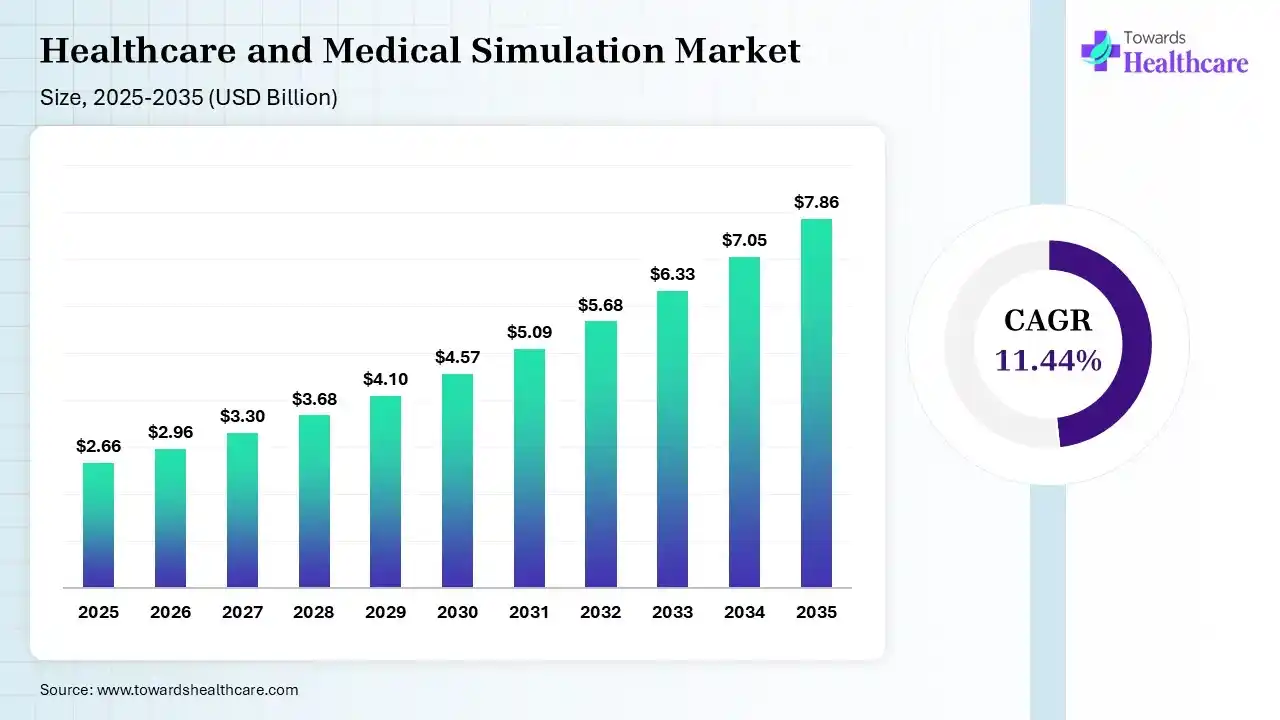
The healthcare and medical simulation market size reached US$ 2.66 billion in 2025 and is anticipate to increase to US$ 2.96 billion in 2026. By 2035, the market is forecasted to achieve a value of around US$ 7.86 billion, growing at a CAGR of 11.44%. Technological advancements, demand for patient safety, and high-quality treatment drive the market.
Healthcare simulation or medical simulation is a modern method to educate and train healthcare professionals to master cognitive, technical, and behavioral skill sets using advanced technologies. The four main purposes of healthcare simulations are education, assessment, research, and health system integration in facilitating patient safety. Healthcare simulation imitates or represents some situation or process so that healthcare workers can gain skills and confidence without the fear of harming a patient or delaying diagnosis and treatment to patients. Simulation centers are built to improve quality and patient safety.
Medical simulation offers numerous advantages such as helping reduce medical errors, building team communication, and improving skills around crisis resource management. The demand for reducing errors and improving patient outcomes drives the need for medical simulation. Students get real-time training and apply theory knowledge without actually involving a patient. This facilitates healthcare professionals in decision-making and reacting to emergencies.
Healthcare and medical simulation refers to the use of realistic models, virtual environments, digital platforms, and simulated clinical scenarios to train healthcare professionals and improve their practical decision-making skills. The market is growing as healthcare institutions increasingly prioritize safe, standardized, and hands-on training platforms. Technological advancements in artificial intelligence, virtual reality, augmented reality, haptic technology, and cloud-based simulation are making training more interactive and realistic. Major drivers include increasing healthcare workflow requirements, growing complexity of medical procedures, demand for continuous professional training, and stronger emphasis on patient safety. Future opportunities include AI-powered personalized training, simulation-based assessment, remote collaboration, and integration with medical education programs. Expanding application across nursing, emergency care, surgery, and allied healthcare is expected to further support market development.
Artificial intelligence (AI) has become a crucial part of healthcare and medical simulation. AI has rapidly emerged due to advancements in algorithms and software. AI-based companies integrate AI and machine learning (ML) in medical simulation to improve their outcome and offer groundbreaking services. AI improves learner’s experiences and aid in clinical skill development before clinical practice. AI can provide education to healthcare professionals in three ways: direct education, supportive education, and learner empowerment. This enables professionals to make timely decisions in emergencies. AI can also lead to improved diagnostic accuracy of professionals, enhanced communication with patients, and better outcomes from rapid response teams.
Enhanced patient care is a priority for many healthcare professionals to achieve high customer satisfaction. The advent of advanced technologies helps healthcare professionals to improve patient care. The demand for enhanced patient care is growing due to increasing awareness, rising demand for better care, keener competition, more healthcare regulation, and the rise in medical malpractice litigation. The quality of patient care is determined by the quality of infrastructure, quality of training, competence of personnel, and efficiency of operational systems. The adoption of healthcare and medical simulation in the healthcare setting helps in the effective training of professionals and primarily focuses on patient care.
The advent of advanced technologies such as artificial intelligence (AI), virtual reality (VR), and augmented reality (AR) revolutionized the entire simulation process. VR enables students to experience visual stimuli delivered via computer graphics and other sensory experiences. AR enables students to interact in real-world environments that are enhanced with virtual imagery. These technologies let students learn how to perform several tasks and procedures involving the human body without ever having to practice on a live patient. Such technologies enhance the overall performance of students and healthcare professionals, providing decision-making ability and better treatment outcomes. AR and VR are helping to train the next-gen healthcare professionals on diagnosis, treatment, rehabilitation, surgery, counseling techniques, etc. Furthermore, AR and VR can give customized training to students and professionals based on their progress and skills. Hence, AR and VR provide numerous opportunities and streamline the healthcare ecosystem.
The major challenge of the market is the high cost of the simulation training, limiting the affordability of the LMIC. This results in improper training for the professionals and students of small healthcare institutions. Another major challenge is the lack of trained professionals to provide appropriate training to the students and staff.
| Metric | Details |
| Market Size in 2026 | USD 2.96 Billion |
| Projected Market Size in 2035 | USD 7.86 Billion |
| CAGR (2026 - 2035) | 11.44% |
| Leading Region | North America |
| Historical Data |
2020 - 2023 |
| Base Year |
2025 |
| Forecast Period |
2026 - 2035 |
| Measurable Values |
USD Millions/Units/Volume |
| Market Segmentation | By product and services, By technology, By end-use, By region |
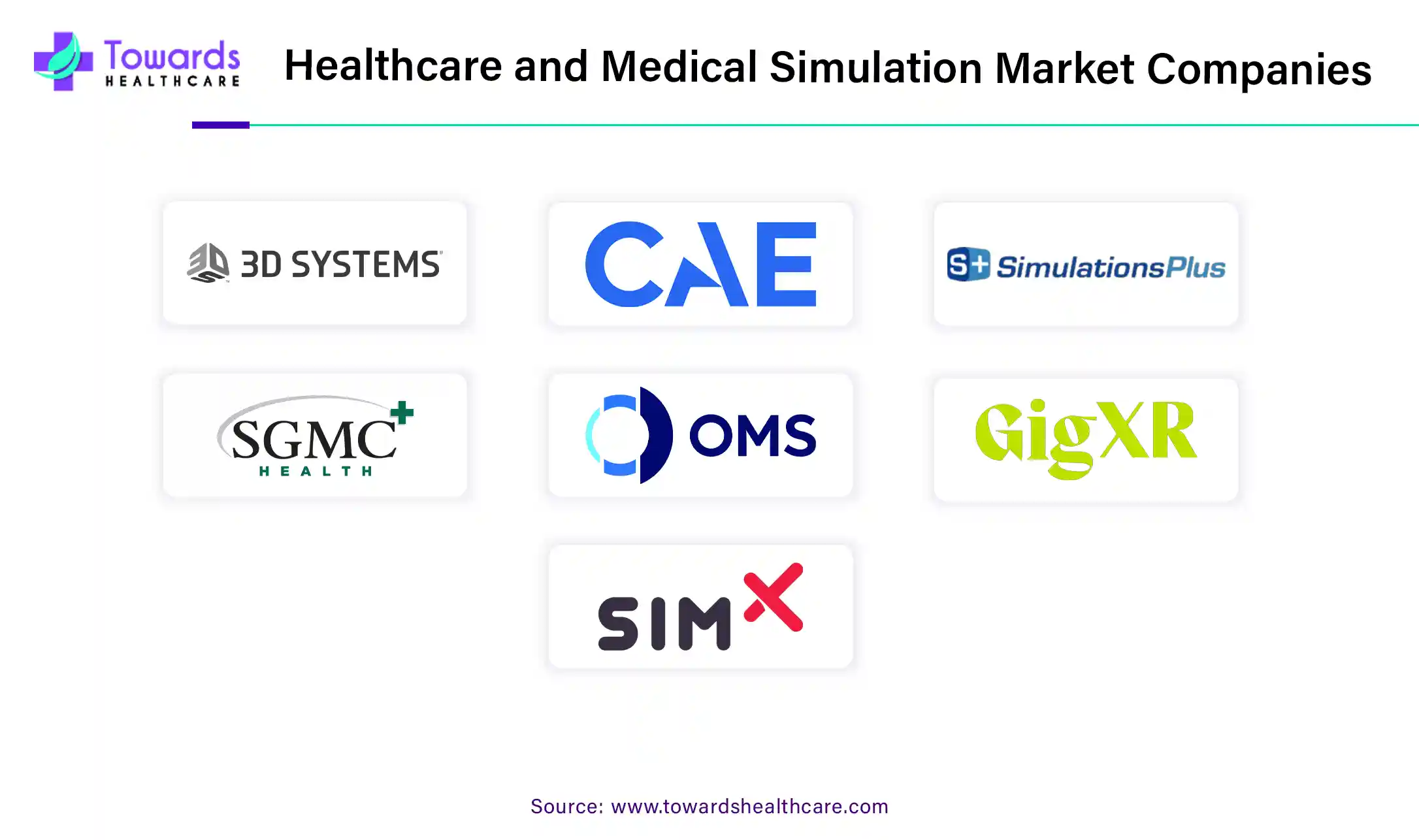
| Top Key Players | 3D Systems, Inc., CAE Healthcare, Inc., Simulations Plus, Inc., SGMC Health, Oxford Medical Simulation, GigXR, Inc., SimX, Medical-X, Laerdal Medical, Mentice, Gaumard Scientific, Simulaids |
By product and services, the anatomical model segment registered its dominance over the global healthcare and medical simulation market in 2023 and is projected to expand rapidly in the market in the coming years. A wide range of anatomical models are used to represent the actual anatomy of the human body. Such models give a precise understanding of the parts of the human body. These models are the primary requirement for healthcare institutions and medical colleges.
By technology, the procedural rehearsal technology segment held a dominant presence in the healthcare and medical simulation market in 2023. Simulation techniques are well-suited for rehearsing elements of a complex procedure or surgery that may be unfamiliar or infrequently performed. This technology is used to significantly improve operative performance and reduce medical errors.
The virtual patient simulation segment is anticipated to grow with the highest CAGR in the market during the studied years. Patient interaction is the biggest fear for medical interns and students. Hence, virtual patient simulation aids patient communication, thereby enhancing clinical reasoning and decision-making skills, boosting confidence, and promoting teamwork.
By end-use, the academic institutes segment led the global healthcare and medical simulation market in 2023. The segmental growth is attributed to the increasing number of medical students in institutes, favorable infrastructure, and growing research on medical simulators.
The hospital segment is expected to grow fastest in the market during the forecast period. Hospitals have sufficient facilities, huge capital investments, and an increasing number of interns for learning advanced medical care.
North America held a significant share of the healthcare and medical simulation market in 2025. The presence of key players, technological advancements, and availability of skilled professionals drive the market. The use of medical simulation techniques is governed by the presence of major players in the US. Favorable government policies also boost the market. The Agency for Healthcare Research and Quality (AHRQ) is the lead Federal Agency that significantly invests in research to identify the best ways to use simulation in healthcare. As of 2023, 1114 simulation centers are registered in the US and Canada, out of which 415 centers are accredited.
U.S. Healthcare and Medical Simulation Market is Expanding
The U.S. healthcare and medical simulation market is expanding due to increasing demand for practical clinical training and improved patient safety. Medical schools, hospitals, and healthcare organizations are adopting advanced simulation technologies to strengthen professional skills and reduce training-related risks; AI-powered platforms and high-fidelity patient simulators is further supporting adoption. Rising healthcare workforce requirements and continuous professional education are also creating strong growth opportunities.
Canada’s Healthcare and Medical Simulation Market is Growing
Canada’s healthcare and medical simulation market is notably expanding due to increasing demand for hands-on clinical training and improved patient safety. Medical institutions are adopting simulation-based education to strengthen healthcare professionals’ practical skills. Growing use of virtual reality, AI-enabled training, and advanced patient simulators is supporting market development. Rising healthcare workflow needs, nursing education and emphasis on continuous professional training are further creating growth opportunities.
Asia-Pacific is anticipated to grow fastest in the healthcare and medical simulation market during the forecast period. The rapidly evolving technological advancements, increasing investments & collaborations, and favorable government policies drive the market. The market is also driven by the growing research and development to check the efficacy of simulation systems. Several government agencies support the development of simulation labs and centers in the region. The Japanese government collaborated with the WHO to train and test Pacific Island countries’ readiness to respond to health emergencies through workshops and emergency simulation exercises.
For instance,
UK Healthcare and Medical Simulation Market Is Advancing
The UK healthcare and medical simulation market is notably expanding due to rising demand for practical clinical training, patient safety, and standardized healthcare education. Hospitals and medical institutions are increasingly adopting high-fidelity simulators, virtual reality, and digital learning platforms to strengthen professional skills. Growing healthcare workforce requirements, continuous training needs, and technological advancements in immersive education are further supporting adoption and creating new opportunities across medical and nursing education.
Germany’s Healthcare and Medical Simulation Market Is Significantly Growing
Germany’s healthcare and medical simulation market is significantly growing due to increasing demand for advanced clinical training and improved patient safety. Hospitals, universities, and medical training institutions are adopting high-fidelity simulators, virtual platforms, and immersive technologies to enhance practical skills. Rising healthcare workforce requirements, growing emphasis on standardized medical education, and advancements in artificial intelligence, virtual reality, and digital simulation are further supporting market expansion.
Jacob Paul, CEO of Nasco Healthcare, commented on his appointment as the new CEO of the company that he is glad to lead the world-class team and to fulfill the company’s mission to prepare healthcare workers to be ready to deliver optimal patient outcomes and save lives using their medical simulation and healthcare training products.
By Product and Services
By Technology
By End-Use
By Region



Principal Consultant
Payal Rabde is a Healthcare Market Research Analyst at Towards Healthcare Research & Consulting with 4+ years of experience in pharmaceuticals, biotechnology, medical devices, and life sciences.
Learn more about Payal Rabde

Reviewed By
Aditi Shivarkar is a seasoned professional with over 14 years of experience in healthcare market research. As a content reviewer, Aditi ensures the quality and accuracy of all market insights and data presented by the research team.
Learn more about Aditi Shivarkar