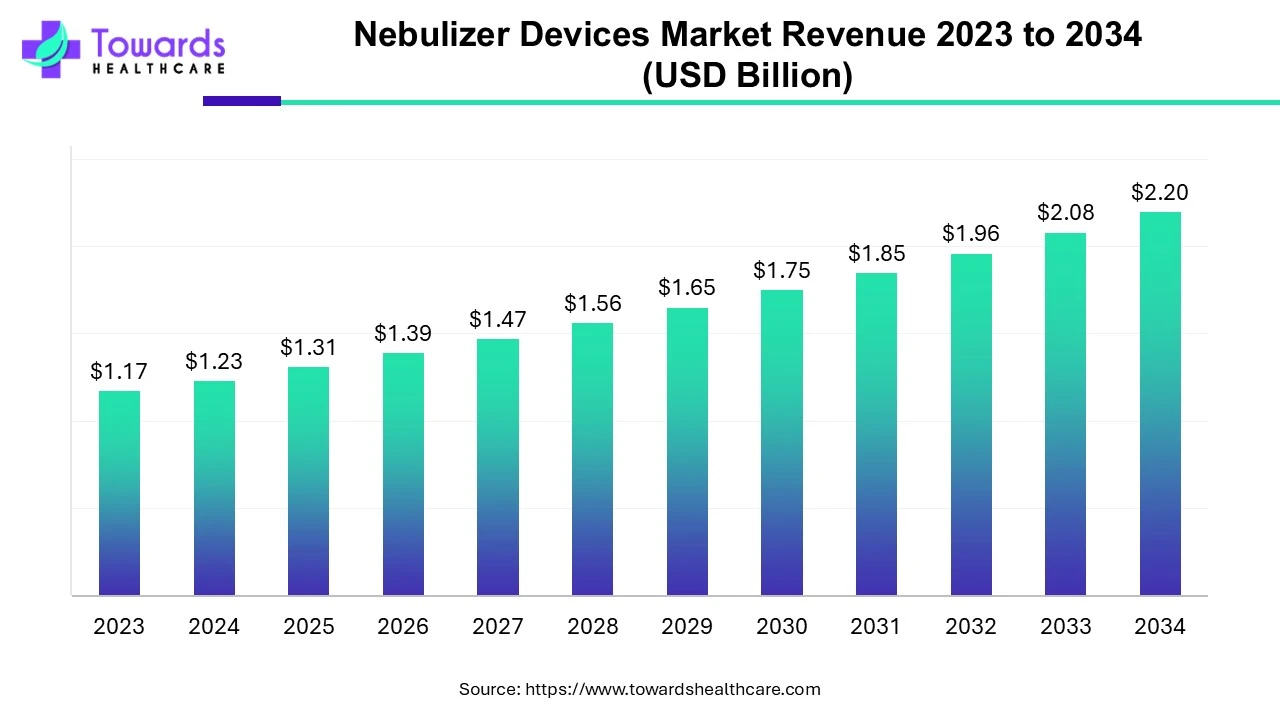
The nebulizer devices market size was estimated at US$ 1.17 billion in 2023 and is projected to grow to US$ 2.2 billion by 2034, rising at a compound annual growth rate (CAGR) of 5.94% from 2024 to 2034.
A nebulizer is a medical device that converts liquid medication into mist to deliver to the lungs directly through inhalation. It is commonly used in COPD, asthma, cystic fibrosis, bronchiectasis, and other respiratory conditions. Nebulizers come in home (tabletop) and portable models. Home nebulizers are larger and have to be plugged into an electrical outlet. In contrast, portable nebulizers run on batteries or can be plugged into a car outlet. There are three different types of nebulizers: jet, mesh, and ultrasonic. The medications that are used with a nebulizer are bronchodilators (to open the airways) and corticosteroids (to fight inflammation).
The rising incidences of chronic respiratory disorders increase the demand for nebulizers. It is estimated that COPD cases globally among those aged 25 years or above will increase by 23% from 2020 to 2050, accounting for 600 million cases. The growing research and development and increasing investments in the medical device sector boost the market.
Nebulizer devices are medical equipment that convert liquid medication into a fine mist that can be inhaled directly into the lungs for respiratory treatment. The nebulizer devices market is growing as respiratory conditions become more prevalent and patients increasingly seek convenient treatment options outside hospitals. Key trends include compact portable nebulizers, quieter operation, battery-powered devices, and greater adoption of home-based respiratory care. Technological advancements in mesh nebulization, smart connectivity, miniaturized components, and improved aerosol delivery. Major drivers include increasing cases of asthma and chronic respiratory diseases, aging populations, growing home healthcare adoption, and demand for easy-to-use drug delivery systems. Future opportunities include connected nebulizers that support treatment monitoring, integration with mobile applications, personalized medication delivery, and expansion across emerging healthcare markets. These developments are expected to improve accessibility, adherence, and overall respiratory disease management.
The demand and use of nebulizers are increasing with the rising incidences of chronic respiratory disorders. The latest innovations in the medical sector can revolutionize respiratory drug delivery, fostering enhanced treatment and care. Several researchers are currently investigating novel technologies to deliver medications through a nebulizer. Some novel technologies include electro-hydrodynamic spray technology, condensation liquid aerosol technology, and inkjet technology. Research is ongoing to reduce the size of nebulizers, making them more efficient and increasing portability. The advent of advanced technologies like artificial intelligence can modernize nebulizers. Nebulizers with AI can monitor patient use and provide feedback to the patient and caregiver. AI can also control the amount of drugs inhaled by patients, resulting in less drug wastage.
The major challenge of the market is the high cost of the device. The average cost of the device is $50-$200, which is comparatively higher than an inhaler. This limits the affordability of many patients in low- and middle-income countries and of those without insurance. Another major challenge is the high risk of infection from unsterile chambers or tubings. The long-term use of nebulizers can cause serious infections in the lungs.
North America dominated the nebulizer devices market in 2023. The rising incidences and prevalence of chronic respiratory disorders, increasing investments & collaborations, favorable government policies, and advanced healthcare infrastructure drive the market. COPD affects approximately 11.7 million individuals annually in the US. According to the Asthma and Allergy Foundation of America, more than 27 million people in the US are living with asthma. It was found that asthma was more common in females (10.8%) than in males (6.5%). There were around 40,000 people with cystic fibrosis in the US and 4,445 people in Canada in 2022. This necessitates the use of nebulizers in the region.
U.S. Nebulizers Devices Market is Expanding With Home Respiratory Care
The U.S. nebulizers devices market is significantly growing due to the increasing prevalence of asthma and chronic respiratory conditions. Rising preference for home-based treatment, an aging population, and greater awareness of respiratory care are supporting demand. Technological improvements in portable, quiet, and mesh nebulizers are improving convenience and usability. Expanding healthcare access and the growing adoption of connected respiratory devices are also creating opportunities for market growth.
Canada’s Nebulizers Devices Makre tis Expanding With Better Respiratory Care
Canada’s nebulizer devices market is notably expanding due to rising respiratory disorders, aging populations, and increasing demand for convenient home-based treatment. Greater awareness of respiratory disease management is encouraging device adoption among patients. Advances in portable and easy-to-use nebulizers are improving accessibility and treatment convenience. Expanding home healthcare services and continued development of modern respiratory care technologies are further supporting market growth.
Asia-Pacific is anticipated to grow with the highest CAGR in the nebulizer devices market during the studied years. The rising geriatric population, increasing incidences & collaborations, growing research and development activities, and expanding healthcare infrastructure drive the market. According to the Global Asthma Report, around 35 million people in India suffered from asthma in 2022. Japan's government issued new guidelines, “Health Japan 21,” in fiscal 2024 to reduce the death rate of COPD patients from 13.3 per 100,000 in 2021 to 10.0 per 100,000 by 2032. Similarly, the Indian and Chinese governments are also at the forefront of eradicating COPD cases through screening and management.
India’s Nebulizer Devices Market is Gaining Stronger Momentum
India’s nebulizer devices market is notably growing due to increasing respiratory disorders, expanding healthcare access, and rising awareness of effective inhalation therapy. Growing adoption of home-based treatment is encouraging demand for convenient nebulization devices. Rising healthcare spending, improving diagnostic capabilities, and wider availability of portable nebulizers are further supporting market expansion. Increasing respiratory care needs across urban and semi-urban areas are also creating new growth opportunities.
China’s Nebulizer Devices Market is Expanding With Respiratory Care Demand
China’s nebulizer devices market is notably increasing due to rising respiratory illness, growing healthcare expenditure, and expanding access to medical services. Greater awareness of respiratory disease management is encouraging nebulizer adoption, particularly for home-based care. Advancements in portable and mesh nebulizers are improving convenience and treatment efficiency. Expanding healthcare infrastructure, an aging population, and increasing demand for affordable respiratory devices are further supporting market development.
Europe is expected to grow significantly in the nebulizer devices market during the forecast period. The increasing respiratory diseases are increasing the demand as well as the production of nebulizer devices in Europe. This is further supported by the government.
UK Market Trends
The industries in the UK are increasing their production due to the increasing demand for the use of nebulizer devices. At the same time, growing diseases are also driving the use of these devices. Thus, this promotes the market growth.
Germany Market Trends
Germany is experiencing a rise in collaboration between industries to meet the demand for nebulizer devices. This is also supported by the government investments. At the same time, the growing geriatric population, as well as home care, increases the use of these devices.
By type, the jet segment held a dominant presence in the nebulizer devices market in 2023. Jet nebulizers use compressed gas to convert liquid medication to mist. They are more effective in delivering drugs that cannot be delivered through pressurized metered-dose inhalers and dry powder inhalers. They are widely preferred because of their ease of use, delivery of a wide range of medications, and low cost.
The mesh segment is predicted to witness lucrative growth in the market over the forecast period. Mesh nebulizers use a micropump technology to create a fine mist of medication. They are more efficient than jet nebulizers and can provide higher drug doses to patients. Also, it is demonstrated that mesh nebulizers have 2-3 times higher lung deposition than jet nebulizers. The demand for higher dose administration and technological advancements augment the segment's growth.
By application, the COPD segment led the global nebulizer devices market in 2023. The rising incidences of COPD due to the increasing prevalence of smoking in LMICs and the aging population in high-income countries boost the segment growth. It is estimated that the global prevalence of COPD is 10.3% and around 3 million deaths annually. Nebulizers can directly transfer the drugs deep into the lungs when inhalers are not effective.
The asthma segment will gain a significant share of the market over the studied period. The rising prevalence of asthma due to increasing smoking and air pollution in LMICs drives the segment's growth. The advent of digital technology and telemedicine aids in the monitoring of patients with asthma.
By end-user, the hospitals & clinics segment accounted for a considerable share of the nebulizer devices market in 2023. Hospitals & clinics have favorable infrastructure to install nebulizers and sufficient capital investments. Additionally, favorable reimbursement policies and the increasing number of patients potentiate segment growth.
The home healthcare segment is projected to expand significantly in the market in the coming years. The rising geriatric population globally favors home healthcare devices. According to the WHO, 1 in 6 people globally will be 60 years and above by 2030. By 2050, the global geriatric population will double to 2.1 billion. The rising incidences of chronic respiratory disorders in the geriatric population increase the demand for home healthcare devices.
By Type
By Application
By End-User
By Region



Principal Consultant
Payal Rabde is a Healthcare Market Research Analyst at Towards Healthcare Research & Consulting with 4+ years of experience in pharmaceuticals, biotechnology, medical devices, and life sciences.
Learn more about Payal Rabde

Reviewed By
Aditi Shivarkar is a seasoned professional with over 14 years of experience in healthcare market research. As a content reviewer, Aditi ensures the quality and accuracy of all market insights and data presented by the research team.
Learn more about Aditi Shivarkar