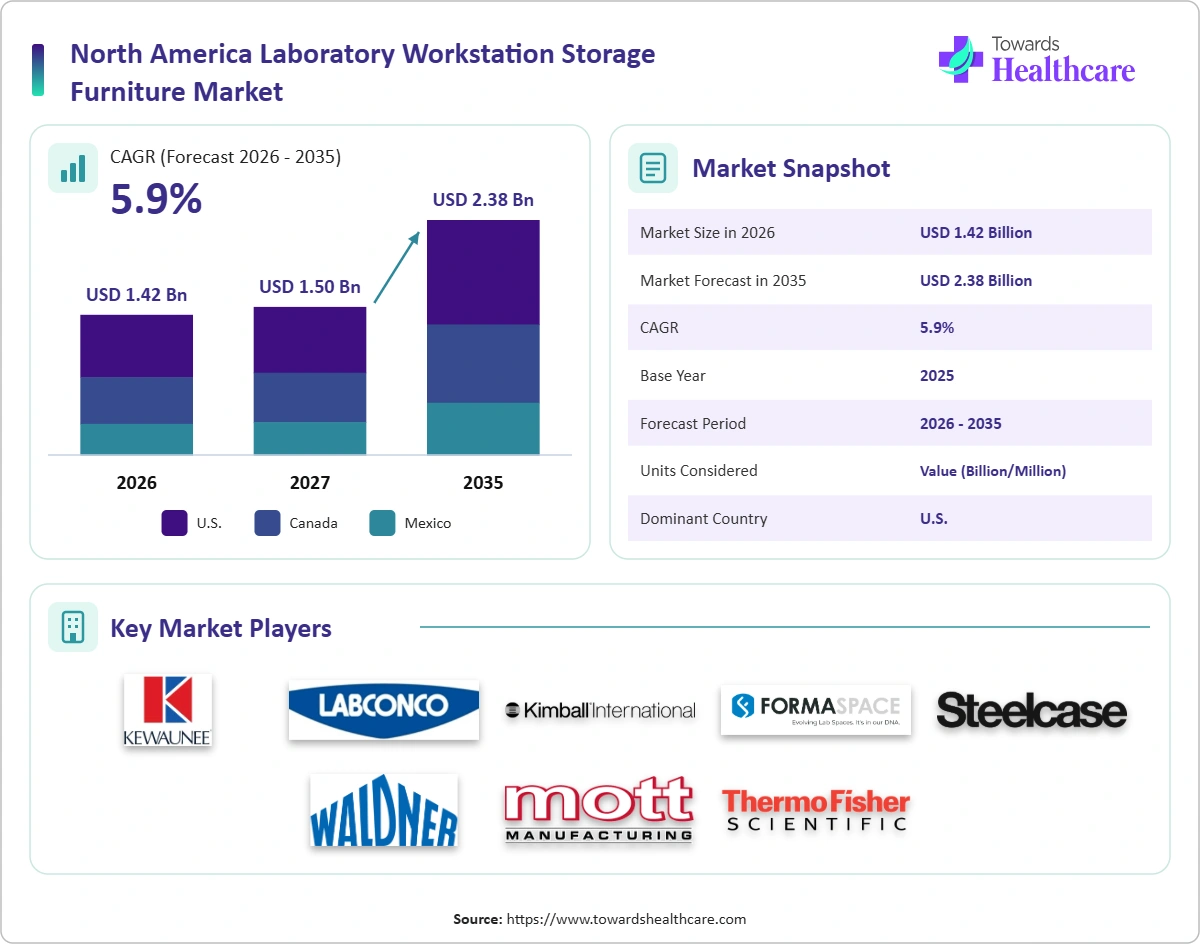
The North America laboratory workstation storage furniture market is projected to grow from USD 1.34 billion in 2025 to USD 2.38 billion by 2035 as laboratory construction, renovation, and research infrastructure investments continue to generate demand for specialized furniture and storage systems. Pharmaceutical and biotechnology companies, academic institutions, hospitals, and industrial laboratories require durable workbenches, chemical-resistant cabinets, shelving systems, and flexible workstation configurations.
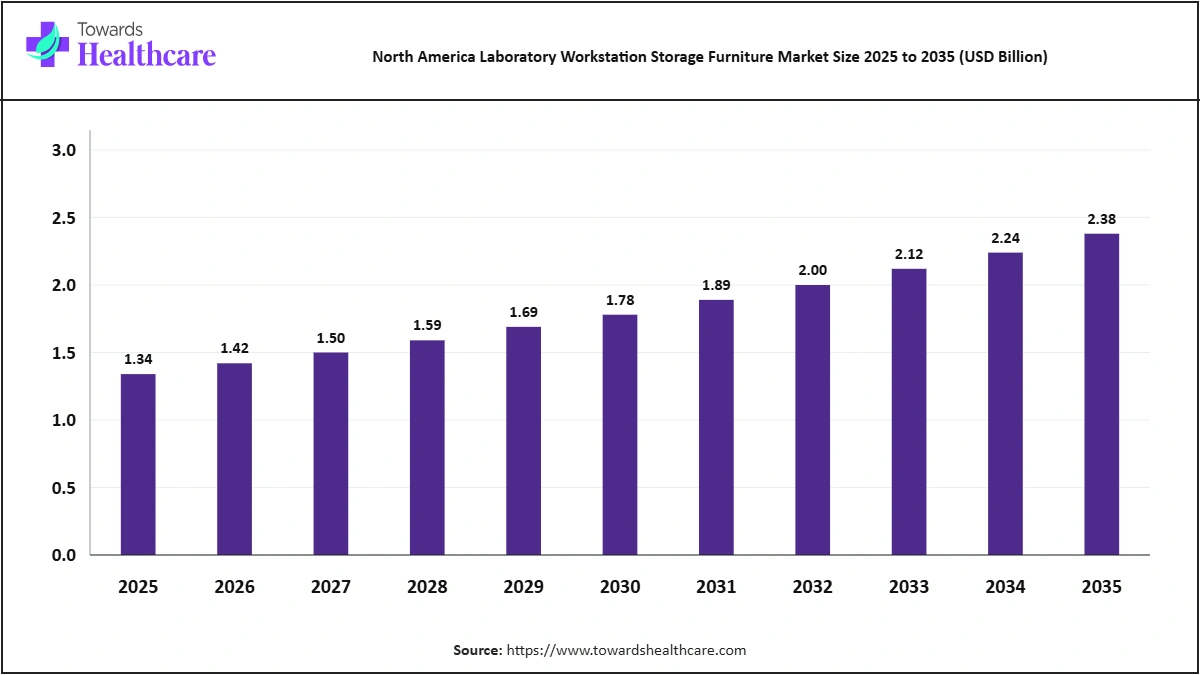
The expansion of biotechnology clusters, increased clinical testing capacity and modernization of research facilities are driving market expansion. Additionally, the demand for adaptable laboratory designs is promoting the use of modular and mobile furniture systems. These factors are expected to increase market revenue to USD 1.78 billion by 2030 and sustain a CAGR of 5.9% from 2026 to 2035. Laboratory workstations accommodate specialized equipment and experimental arrangements, including microscopes, cell culture systems, and biological safety cabinets.
Analyst View: We estimated the market using laboratory construction and renovation activity, furniture demand, and average spending per square foot, with cross-validation against revenues of leading laboratory casework manufacturers and published market estimates. The assessment incorporates product-level demand, end-user purchasing patterns, distribution channels, and country-level laboratory infrastructure development.
| Driver | Impact | ≈ CAGR Contribution | Time Horizon | Key Regions |
| Lab construction grows | High | +2.30 pp | Short to long term | North America-wide, strongest in U.S. |
| Biotech clusters expand | Medium | +1.94 pp | Medium to long term | North America-wide, fastest uptake in Mexico |
| Labs need flexibility | Medium | +1.66 pp | Short to medium term | North America-wide |
| Renovations replace old casework | Low | +1.30 pp | Long term | U.S. and Mexico |
Note: Contributions are indicative estimates of each factor's effect on annual growth.
Sources: Expert interviews, secondary sources, Towards Healthcare database and Towards Healthcare analysts.
Increasing laboratory construction, biotechnology cluster expansion, demand for flexible laboratory configurations, and replacement of aging casework collectively contribute around 7.20 percentage points to annual market growth. Laboratory construction represents the largest individual growth contributor because new research facilities require extensive furniture installations. Biotechnology expansion supports demand, particularly in established U.S. life sciences centers, while Mexico is expected to record comparatively faster growth in demand for laboratory furniture as its clinical and industrial laboratory infrastructure develops.
| Restraint | Impact | ≈ Negative CAGR Contribution | Time Horizon | Key Regions |
| Construction cycles | High | -0.58 pp | Short to medium term | North America-wide |
| Biotech funding swings | High | -0.43 pp | Medium term | Smaller and price-sensitive markets |
| Long lead times | Medium | -0.29 pp | Short term | U.S. and other mature markets |
Note: Contributions are indicative estimates of each factor's effect on annual growth.
Sources: Expert interviews, secondary sources, Towards Healthcare database and Towards Healthcare analysts.
Construction cycles, biotechnology funding fluctuations, and extended manufacturing lead times are expected to reduce annual market growth by approximately 1.30 percentage points. Construction-related uncertainties represent the largest restraint because laboratory furniture procurement is strongly associated with facility development and renovation schedules. However, increasing demand for laboratory modernization, improved supplier coordination, and greater adoption of modular furniture are expected to support market resilience, resulting in a projected CAGR of 5.9% from 2026 to 2035.
Increasing demand for modular laboratory furniture and mobile workstations represents an important opportunity for manufacturers. The development of semiconductor, battery, and advanced materials laboratories is creating additional demand for specialized industrial laboratory furniture. Mexico offers opportunities through expanding clinical and industrial laboratory infrastructure. Converting existing office and commercial buildings into research laboratories, along with providing furniture reconfiguration, maintenance, and installation services, can create additional revenue opportunities in the forecast period.
Note: 2025 is the base year; 2035 shares and CAGRs are forecasts.
Sources: Expert interviews, secondary sources, Towards Healthcare database and Towards Healthcare analysts.
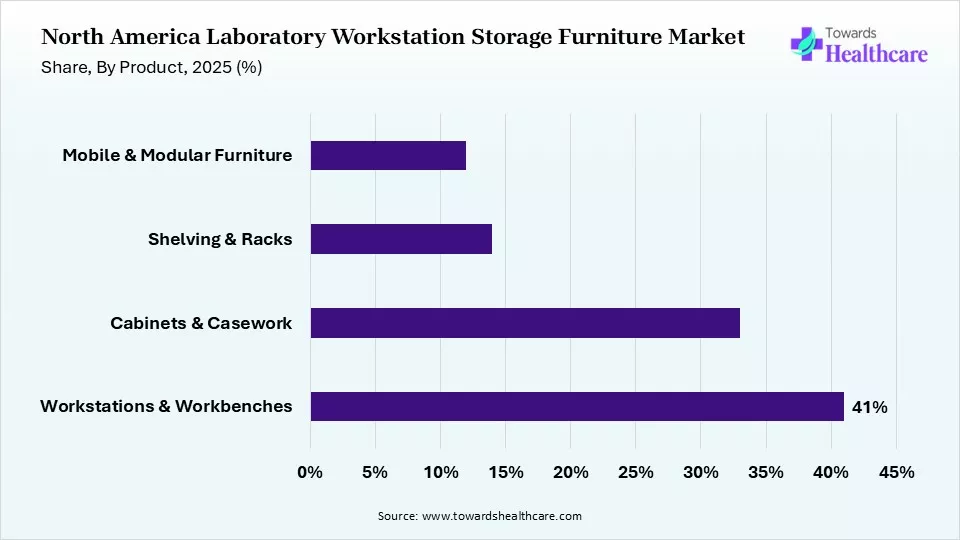
Workstations and workbenches held 41% of the market, equivalent to USD 0.5494 billion in 2025, and are projected to expand at a CAGR of 5.33% from 2026 to 2035. Laboratory workstations and workbenches are essential for experiments and sample preparation, with high demand in pharmaceutical, biotechnology, academic, clinical, and industrial sectors. Their durability against regular use and chemical exposure drives this demand. However, the growth rate of this segment is expected to be slower than the total market during the forecast period.
Laboratory cabinets and casework offer organized storage for various laboratory materials, driven by the need for safe storage, chemical resistance, and compliance with design standards. Continued expansion in this segment is anticipated due to renovation projects and the replacement of outdated storage systems.
Shelving and racks are essential for organizing laboratory consumables and equipment, enhancing storage capacity and accessibility in confined spaces. The growth of this segment is driven by demand from research institutes, hospitals, pharmaceutical companies, and industrial laboratories.
Mobile and modular furniture systems enhance laboratory adaptability by enabling modifications to workstation configurations and repositioning of equipment, catering to evolving research needs. Their flexibility is particularly beneficial for biotechnology facilities and organizations with frequent equipment upgrades, driving demand for adaptable layouts and anticipated faster market growth.
Mobile and modular furniture is expected to gain share, reaching 14.71% by 2035, while recording the highest product-level CAGR of 8.23%. Increasing demand for flexible layouts, modular laboratory interiors, and adaptable research infrastructure will continue to support this shift in product demand.
Note: 2025 is the base year; 2035 shares and CAGRs are forecasts.
Sources: Expert interviews, secondary sources, Towards Healthcare database and Towards Healthcare analysts.
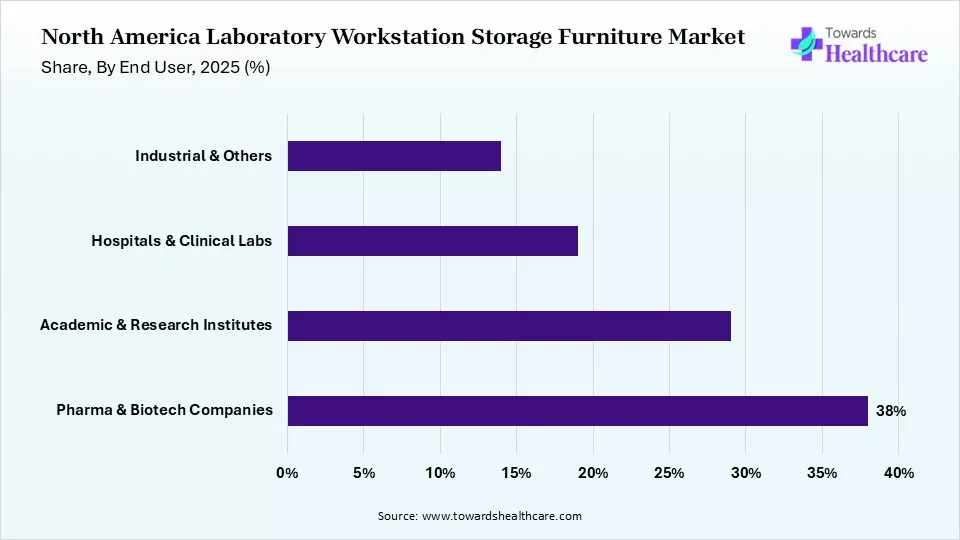
In 2025, pharma and biotech companies dominated the market, holding a 38% market share, worth USD 0.5092 billion, and are projected to expand at the fastest CAGR of 6.27% from 2026 to 2035. Pharmaceutical and biotechnology companies need specialized lab workstations, chemical-resistant cabinets, modular furniture, and storage systems to facilitate drug discovery, molecular biology, cell culture, and bioprocess research. The growth of biotechnology clusters and investments in pharmaceutical research are likely to enhance demand during the forecast period.
Universities and research institutions require laboratory furniture for experiments and teaching. Growth in research infrastructure and renovation of labs is expected to sustain demand, aligning with overall market growth.
Hospitals and clinical laboratories require specialized workstations, storage cabinets, and shelving to support diagnostic testing, sample preparation, and laboratory operations. Expanding clinical testing capacity and modernization of healthcare laboratory infrastructure are expected to support demand throughout the forecast period.
Industrial laboratories utilize specialized furniture for various functions, including product testing and quality control. The growth in semiconductor, battery, chemical, and advanced manufacturing is driving demand for laboratory workstations and storage solutions, suggesting steady growth through 2035.
The segment is projected to record the highest end-user CAGR of 6.27%. Increasing biotechnology investment, pharmaceutical research activities, and laboratory modernization will sustain its position.
Note: 2025 is the base year; 2035 shares and CAGRs are forecasts.
Sources: Expert interviews, secondary sources, Towards Healthcare database and Towards Healthcare analysts.
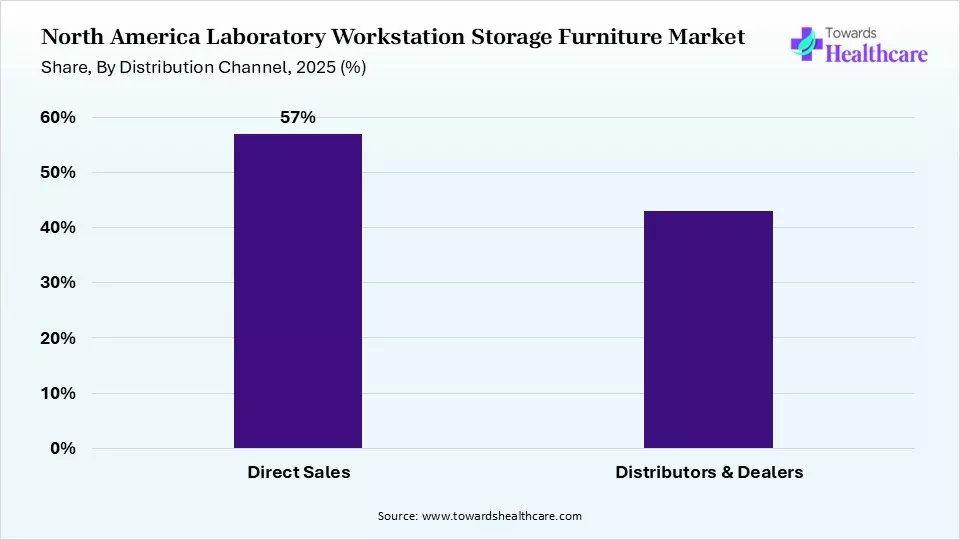
In 2025, based on the distribution, direct sales accounted for 57% of the market, valued at USD 0.7638 billion. Direct sales are projected to register a CAGR of 5.37% from 2026 to 2035. These sales play a crucial role in large laboratory construction and renovation, emphasizing customized furniture, detailed planning, and coordinated installation. Manufacturers collaborate with pharmaceutical companies, universities, hospitals, and research institutions for tailored solutions, though this segment is projected to grow more gradually than the broader market.
Distributors and dealers facilitate access to laboratory furniture, offering installation services, technical support, and regional supply networks, especially for smaller purchases and customers favoring established local suppliers. Increasing demand from smaller research facilities and industrial laboratories is expected to support faster growth.
Distributors and dealers are expected to increase their share to 45.80%, recording the highest channel-level CAGR of 6.57%. Expanding regional distribution networks and demand for smaller furniture orders are expected to support this shift through 2035.
Analyst View: Segment estimates were developed by allocating market demand according to furniture requirements, product portfolios, purchasing patterns, and distribution structures across each category. Workstations and workbenches, pharma and biotech companies and direct sales represent the leading segments because they address essential laboratory infrastructure and procurement requirements. However, mobile and modular furniture and distributors and dealers are expected to gain share as flexible laboratory designs, smaller laboratory projects, and specialized industrial applications expand.
| Country | 2025 Share | 2035 Share | CAGR 2026-2035 |
| U.S. | 86.00% | 84.87% | 5.78% |
| Canada | 9.00% | 9.24% | 6.18% |
| Mexico | 5.00% | 5.88% | 7.38% |
Note: 2025 is the base year; 2035 shares and CAGRs are forecasts.
Sources: Expert interviews, secondary sources, Towards Healthcare database and Towards Healthcare analysts.
The United States leads the pharmaceutical and biotechnology industry due to its robust life sciences clusters, strong academic research infrastructure, and ongoing laboratory construction. Major laboratory furniture manufacturers and established distribution networks aid market development. Demand is anticipated to remain high in pharmaceutical research facilities, universities, hospitals, and industrial laboratories, with broad growth projected in line with the overall market.
Canada benefits from established research universities, biotechnology firms, pharmaceutical development, and expanding clinical labs. Investments in academic and laboratory modernization will likely increase demand for workstations and storage systems, with Canada poised to grow in line with market trends.
Mexico new investments in healthcare facilities, clinical testing laboratories, and industrial manufacturing are driving demand for laboratory furniture, alongside the growth of quality control and testing laboratories. Mexico is expected to grow faster than the overall market and increase its regional share to 5.88% by 2035.
Analyst View: Our country-level market estimates were developed using laboratory infrastructure, furniture demand, installed facilities, spending patterns, and supplier presence across the U.S., Canada, and Mexico. The United States maintains its lead with its mature life sciences ecosystem, established laboratory construction market, and broad supplier presence. Mexico receives the highest growth premium because of increasing clinical and industrial laboratory investments and expanding demand for modern laboratory infrastructure.
| Rank | Company Name | 2025 Share (%) | Key Products / Business | Headquarters |
| 1 | Kewaunee Scientific | 11.94% | Laboratory casework, workstations, and fume hoods | United States |
| 2 | Thermo Fisher Scientific | 7.46% | Lab furniture and storage | United States |
| 3 | Mott Manufacturing | 5.97% | Laboratory casework and furniture | Canada |
| 4 | Labconco | 4.48% | Workstations and storage | United States |
| 5 | Waldner | 3.73% | Laboratory furniture systems | Germany |
| 6 | Sheldon Laboratory Systems | 3.73% | Lab casework and furniture | United States |
| 7 | Hamilton Scientific | 3.73% | Laboratory furniture | United States |
| 8 | Steelcase | 2.99% | Lab and healthcare furniture | United States |
| 9 | Formaspace | 2.99% | Custom lab workbenches | United States |
| 10 | Kimball International | 2.24% | Lab and healthcare furniture | United States |
Note: Company shares are 2025 estimates.
Sources: Company press releases, expert interviews, secondary sources, Towards Healthcare database and Towards Healthcare analysts.
In 2025, the top ten companies in the North American laboratory workstation storage furniture market accounted for an estimated 49.26% of market revenue, while the remaining 50.74% was distributed among regional casework manufacturers, specialized furniture suppliers, and dealers.
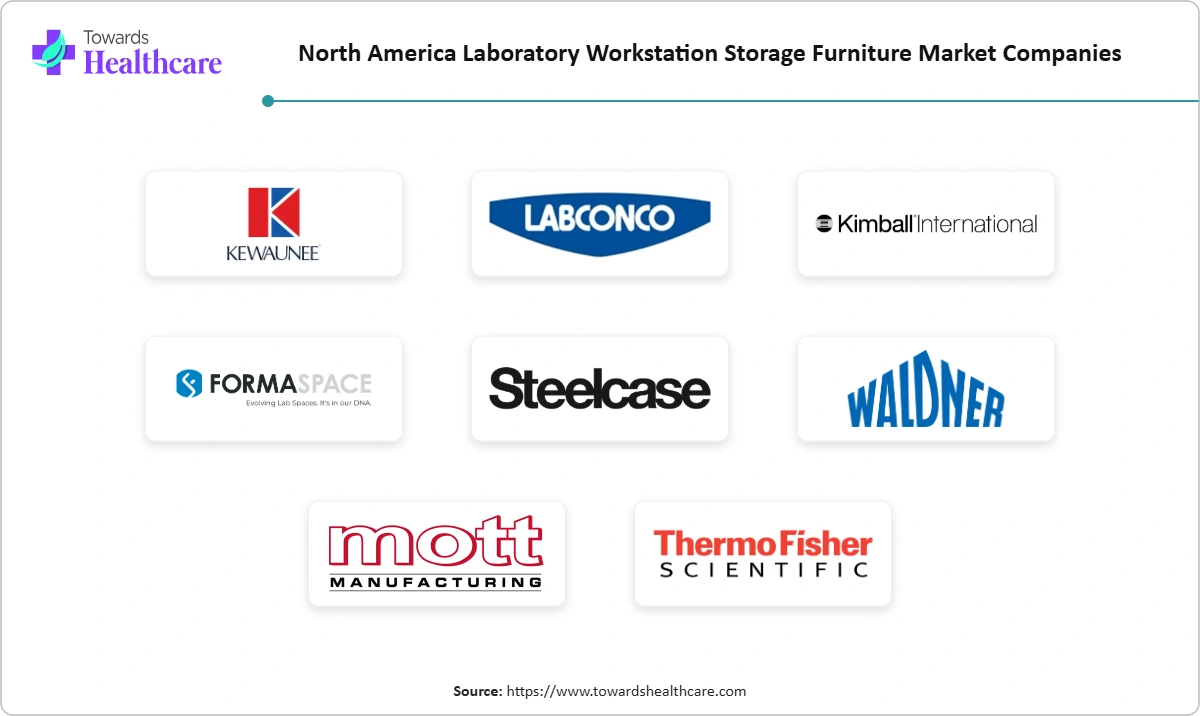
Kewaunee Scientific is estimated to have led the North American market with an estimated 11.94% share of 2025 revenue, followed by Thermo Fisher Scientific at 7.46% and Mott Manufacturing at 5.97%. Kewaunee Scientific maintains its competitive position through laboratory casework, workstations, and fume hoods, while Thermo Fisher Scientific competes through laboratory furniture and storage solutions. Mott Manufacturing offers laboratory casework and furniture designed for research and institutional environments.
Other prominent competitors in the market include Labconco, Waldner, Sheldon Laboratory Systems, Hamilton Scientific, Steelcase, Formaspace, and Kimball International, specializing in laboratory workstations, storage systems, custom workbenches, and healthcare furniture solutions.
The market is moderately fragmented, with competition centered on product durability, chemical resistance, customization capabilities, modularity, manufacturing lead times, installation services, project management, compliance requirements, and pricing.
Kewaunee Scientific: Headquartered in the United States, Kewaunee Scientific held an estimated 11.94% share of the North America laboratory workstation storage furniture market in 2025. Its offering includes laboratory casework, workstations, and fume hoods designed for research, pharmaceutical, academic, and industrial laboratory environments. Based on the Towards Healthcare Companies Quadrant assessment, the company is positioned as a Leader.
Thermo Fisher Scientific: Based in the United States, Thermo Fisher Scientific accounted for an estimated 7.46% market share in 2025. Its relevant market offering includes laboratory furniture and storage solutions that support scientific research and laboratory operations. The company is placed as a Leader.
Mott Manufacturing: Headquartered in Canada, Mott Manufacturing held an estimated 5.97% market share in 2025. Its portfolio includes laboratory casework and furniture designed for specialized laboratory applications. The company is categorized as a Leader.
Labconco: Based in the United States, Labconco accounted for an estimated 4.48% share of the market in 2025. Its relevant offering includes laboratory workstations and storage solutions designed for laboratory environments. The company is classified as a Leader.
Waldner: Headquartered in Germany, Waldner held an estimated 3.73% market share in 2025. Its offering includes laboratory furniture systems designed to support integrated laboratory environments and specialized research workflows. The company is ranked as a Leader.
Sheldon Laboratory Systems: Based in the United States, Sheldon Laboratory Systems accounted for an estimated 3.73% market share in 2025. Its product offering includes laboratory casework and furniture for research and educational laboratories. The company is positioned as a Leader.
Hamilton Scientific: Headquartered in the United States, Hamilton Scientific held an estimated 3.73% market share in 2025. Its market offering includes laboratory furniture designed for research and institutional environments. The company is placed as an Innovator.
Steelcase: Based in the United States, Steelcase accounted for an estimated 2.99% share of the market in 2025. Its relevant offering includes laboratory and healthcare furniture, supporting specialized workplace and clinical environments. According to the Towards Healthcare Companies Quadrant, the company is positioned as an Innovator.
Formaspace: Headquartered in the United States, Formaspace held an estimated 2.99% market share in 2025. Its portfolio includes customized laboratory workbenches designed to meet specific research and industrial requirements. The company is classified as an Innovator.
Kimball International: Based in the United States and part of HNI Corporation, Kimball International accounted for a 2.24% share of the market in 2025. Its relevant offerings include laboratory and healthcare furniture designed for specialized institutional environments. The company is categorized as an Innovator in the Towards Healthcare Companies Quadrant.
The North America laboratory workstation storage furniture ecosystem links material suppliers, furniture makers, lab planners & contractors, dealers & distributors, and users, with each stage adding value before products reach end users.
| Ecosystem Stage | Role in the Market | Key Companies |
| Material Suppliers | Supply steel, resin, and wood | Steel and epoxy resin makers |
| Furniture Makers | Build casework and benches | Kewaunee, Mott, Sheldon, Formaspace |
| Lab Planners & Contractors | Design and install labs | Architects, contractors |
| Dealers & Distributors | Sell to labs | Lab dealers, Fisher Scientific, VWR |
| Users | Equip labs | Pharma, universities, hospitals, industry |
Sources: Company press releases, expert interviews, secondary sources, Towards Healthcare database and Towards Healthcare analysts.
Material Suppliers: These companies supply essential materials used in laboratory furniture manufacturing, including steel, epoxy resin, wood, laminates, and specialized surface materials. Material quality and availability influence furniture durability, chemical resistance, manufacturing costs, and product performance.
Furniture Makers: Manufacturers design and produce laboratory casework, workbenches, cabinets, shelving systems, and modular furniture. Key participants include Kewaunee Scientific, Mott Manufacturing, Sheldon Laboratory Systems, and Formaspace.
Lab Planners & Contractors: Laboratory planners, architects, and contractors are crucial in designing laboratory spaces, selecting, and installing furniture, integrating utilities, and executing large construction and renovation projects.
Dealers & Distributors: Distribution partners provide laboratory furniture and products to end users, facilitating sales, product availability, installation, and customer service. Key participants include specialized dealers like Fisher Scientific and VWR.
Users: Pharmaceutical and biotechnology companies, universities, research institutions, hospitals, clinical laboratories, and industrial organizations purchase laboratory furniture to support research, testing, quality control, and clinical operations.
Value in the North America laboratory workstation storage furniture market flows from upstream material suppliers to furniture manufacturers and laboratory service providers, followed by distribution partners and end users. Companies that integrate product manufacturing with laboratory planning, installation, customization, and long-term customer support can strengthen their competitive positions and capture a larger share of market value.
The Towards Healthcare Companies Quadrant positions major participants in the North America laboratory workstation storage furniture market according to market strength and innovation capabilities. Market strength reflects revenue scale, estimated market share, and geographic reach, while innovation and growth strategy consider product portfolio breadth, product development, customization capabilities, technological advancement, and strategic partnerships.
Sources: Company press releases, expert interviews, secondary sources, Towards Healthcare database and Towards Healthcare analysts.
Leaders: Kewaunee Scientific, Thermo Fisher Scientific, Mott Manufacturing, Labconco, Waldner, and Sheldon Laboratory Systems combine established market positions with broad laboratory furniture portfolios and strong industry presence.
Innovators: Hamilton Scientific, Steelcase, Formaspace, and Kimball International focus on specialized laboratory furniture, customized workstations, and differentiated furniture solutions for research and healthcare environments.
By Product
By End User
By Distribution Channel
By Country
The North America laboratory workstation storage furniture market was defined as the market for laboratory workstations and storage furniture sold across the United States, Canada, and Mexico. The study explores different furniture types such as workstations, workbenches, cabinets, shelving, and mobile furniture, catering to demand from pharmaceutical and biotechnology companies, academic and research institutes, hospitals, clinical laboratories, and industrial laboratories, facilitated by direct sales and distributor networks.
2025 base year market estimate for laboratory furniture was developed using a bottom-up approach, assessing demand volumes and average selling prices across multiple categories and regions. It was further validated through a top-down review of revenues from major manufacturers and third-party estimates. Market values at various levels were assigned based on product portfolios, lab construction activities, and other factors. Estimates were validated through company disclosures, interviews, and industry data, while unresolvable inputs were excluded from the analysis.
All segment, regional, and company estimates were reconciled against the same 2025 base year. The 2026-2035 forecast was developed using the projected market growth trajectory and validated against expected changes in laboratory construction, biotechnology investments, renovation activity, demand for modular furniture, and industrial laboratory development.
Analyst View: The North America laboratory workstation storage furniture market is projected to grow steadily due to ongoing laboratory construction, research investments, and clinical infrastructure development. Our analysis indicates that the essential role of laboratory furniture across research, clinical and industrial facilities, there is an increasing demand for specialized workstations and adaptable furniture configurations, supporting market growth through 2035.
Our market forecast links demand to actual infrastructure needs rather than just investment announcements, with significant opportunities in modular furniture, mobile workstations, and clinical infrastructure expansion in Mexico. Challenges include fluctuations in construction, funding uncertainties, lead times, and material costs. Manufacturers that focus on customization, modular products, efficient supply chains, and integrated services are likely to enhance their competitive standing through 2035.