
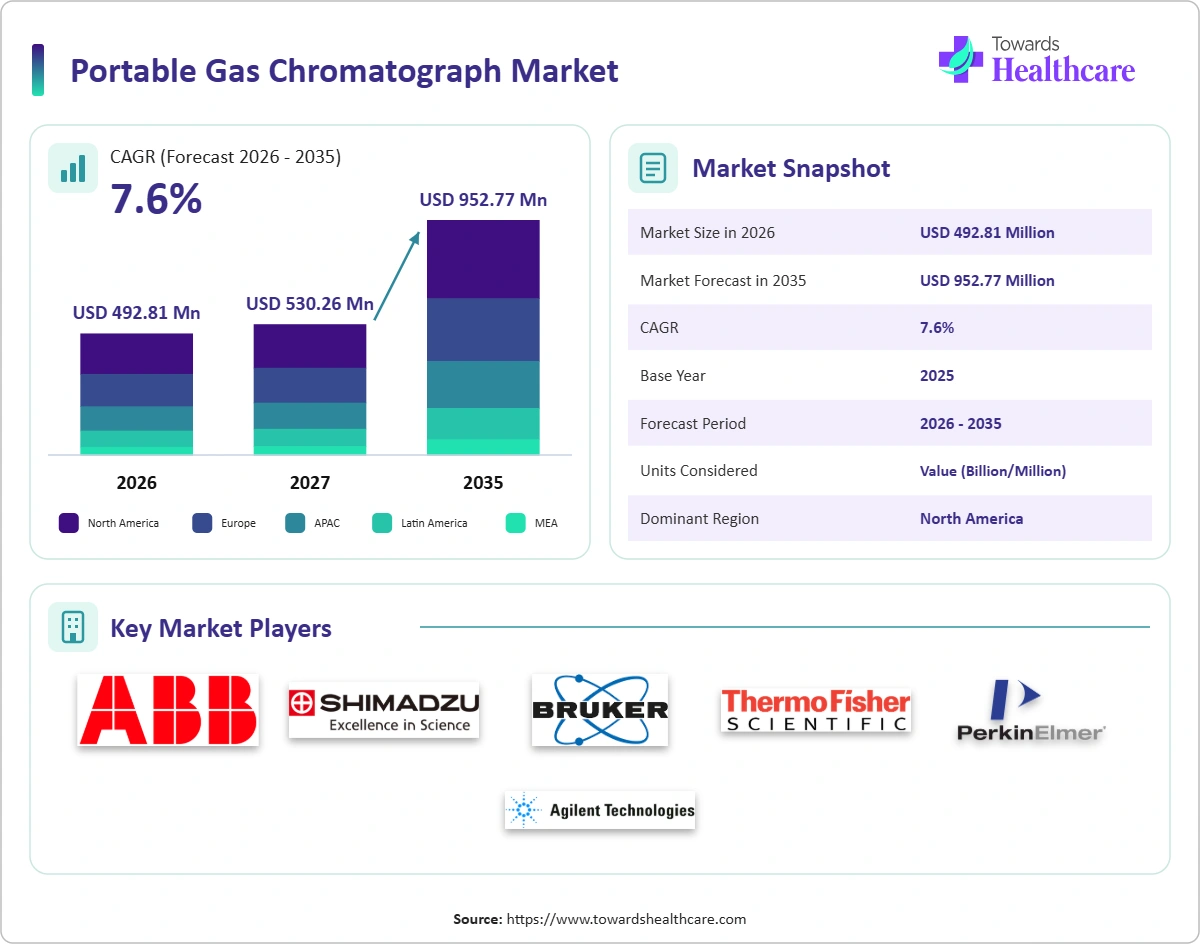
The market is projected to expand from USD 458.00 million in 2025 to USD 952.77 million by the end of the forecast period owing to the fact that field teams need fast chemical answers on site, and portable GC and GC-MS minimize delays from sending samples to labs. A significant pace of growth of market is being supported by environmental rules, remediation projects, security needs and oil and gas monitoring. The market is expected to reach USD 660.58 million by 2030 and sustain a CAGR of 7.60% during the forecast period. Portable chromatographs complement life science microscopes and lab genomics tools in field research.
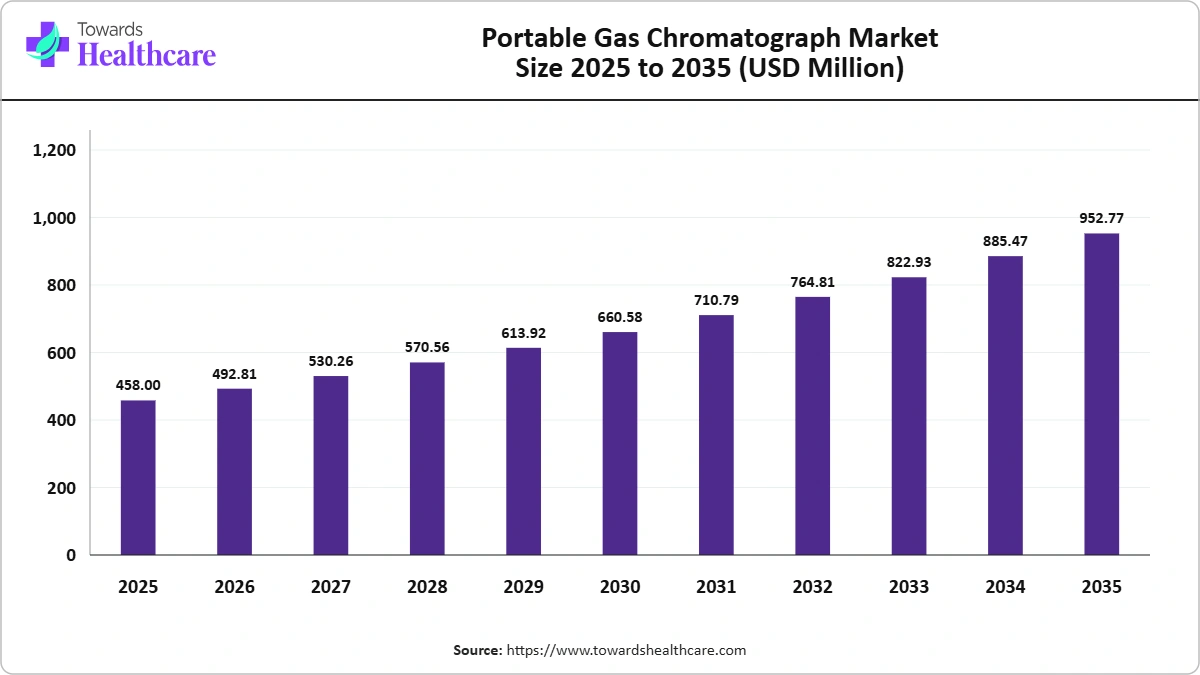
Analyst View: We built the estimate from portable GC and GC-MS unit sales and mean prices by application and region, cross-checked against field analytical revenues of leading suppliers.
| Driver | Impact | ≈ CAGR Contribution | Time Horizon | Key Regions |
| Environmental rules tighten | High | +2.97 pp | Short to long term | Global, strongest in North America |
| Remediation needs fast results | Medium | +2.50 pp | Medium to long term | Global, fastest uptake in Asia Pacific |
| Security agencies need chemical identification | Medium | +2.13 pp | Short to medium term | Global |
| Oil and gas monitoring | Low | +1.67 pp | Long term | Developed and emerging markets |
Note: Contributions are indicative estimates of each factor's effect on annual growth.
Sources: Expert interviews, secondary sources, Towards Healthcare database and Towards Healthcare analysts.
These drivers together add about 9.27 percentage points to the annual growth of the market, with the tightening of environmental regulations having the largest effect. Their influence is strongest in North America, while uptake is growing at the fastest pace in Asia Pacific.
| Restraint | Impact | ≈ Negative CAGR Contribution | Time Horizon | Key Regions |
| High instrument cost | High | -0.75 pp | Short to medium term | Global |
| Lower sensitivity than lab GC | High | -0.55 pp | Medium term | Price-sensitive and emerging markets |
| Training needs | Medium | -0.37 pp | Short term | North America and other mature markets |
Note: Contributions are indicative estimates of each factor's effect on annual growth.
Sources: Expert interviews, secondary sources, Towards Healthcare database and Towards Healthcare analysts.
These restraints are expected to decrease the annual growth rate of the market by about 1.67 percentage points, with a major contribution from high instrument cost. Their effect decreases from 2026 to 2035 as suppliers, buyers, and regulators adapt, leaving a net CAGR of 7.60% during the forecast period.
Growing remediation projects, stringent environmental regulations in Asia, and increasing food safety screening are creating opportunities for portable gas chromatograph manufacturers. Expansion of instrumental rental services and growing demand for methane and emissions monitoring are creating new revenue opportunities.
Note: 2025 is the base year; 2035 shares and CAGRs are forecasts.
Sources: Expert interviews, secondary sources, Towards Healthcare database and Towards Healthcare analysts.
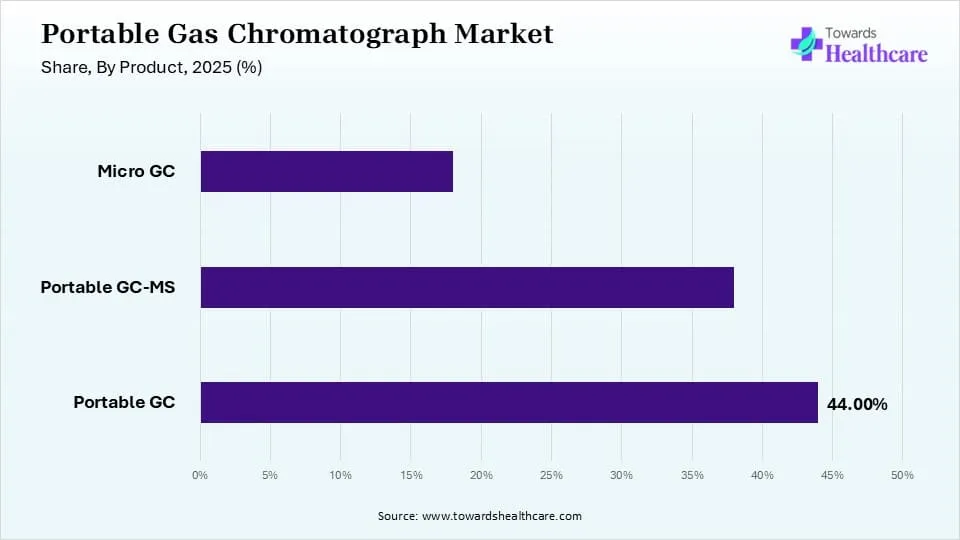
Portable GC accounted for 44.00% of the market in 2025 and is projected to expand at a CAGR of 6.77% from 2026 to 2035. Portable GC holds the lion’s share owing to the fact that it is widely used by field teams for VOC and gas analysis. This segment is expected to grow slower than the overall market over the forecast period.
Portable GC-MS grows fastest because it plays an instrumental role in the identification of unknown chemicals in the field. The rate of growth of this segment is expected to be higher than the overall market between 2026 and 2035.
Micro GC is widely used for natural gas and biogas analysis. This segment is expected to grow at a slower rate than the market over the forecast period.
Segment Outlook: Portable GC is projected to account for the largest share in the product category through 2035, holding about 40.73% of the market in 2035. Portable GC-MS is expected to grow at the highest CAGR of 8.67% during the forecast period. Currently, Micro GC holds the smallest share, and its application base is relatively small within the market.
Note: 2025 is the base year; 2035 shares and CAGRs are forecasts.
Sources: Expert interviews, secondary sources, Towards Healthcare database, and Towards Healthcare analysts.
Environmental Monitoring accounted for a market share of 32.00% in 2025 and is expected to expand at a CAGR of 6.98% from 2026 to 2035. Environmental monitoring holds leadership as fast on-site results are needed for VOC and soil vapor testing. The pace of growth of this segment is expected to be lower than the market throughout the forecast period.
Oil, Gas & Petrochemicals use field gas analysis. The rate of growth of this segment is expected to stay aligned with the market between 2026 and 2035.
Defense, Hazmat & Security segment is growing at the fastest rate because the importance of chemical threat identification is rapidly increasing. The defense, hazmat & security segment is expected to grow faster than the overall market over the forecast period.
Food, Agriculture & Forensics use field screening. This segment is expected to grow broadly in line with the market between 2026 and 2035.
Others include the usage of portable gas chromatographs for industrial hygiene. The rate of growth of this segment is expected to stay aligned with the market during the forecast period.
Segment Outlook: Environmental Monitoring is expected to lead the application segment through 2035, holding about 30.19% of the market in 2035, while Defense, Hazmat & Security records the highest CAGR of 8.88% from 2026 to 2035. Others hold the smallest share today and serve more specialized needs within the market.
Note: 2025 is the base year; 2035 shares and CAGRs are forecasts.
Sources: Expert interviews, secondary sources, Towards Healthcare database and Towards Healthcare analysts.
Government & Defense Agencies captured 34.00% of the market in 2025 and is projected to expand at a CAGR of 7.01% during the forecast period. Government and defense agencies are the leaders because they purchase portable gas chromatographs for response teams. The pace of growth of this segment is expected to be lower than the market from 2026 to 2035.
Environmental Consultants use field instruments. This segment is expected to grow at a faster rate than the overall market over the forecast period.
Industrial Companies it is becoming increasingly important for industrial companies to monitor emissions and processes. The rate of growth of this segment is expected to stay aligned with the market between 2026 and 2035.
Research Institutes test new methods. This segment is expected to grow broadly in line with the overall market over the forecast period.
Segment Outlook: Government & Defense Agencies is expected to be the largest end-user base through 2035, and is expected to hold 32.17% of revenue in 2035. Environmental Consultants are expected to grow at the highest CAGR of 8.61% from 2026 to 2035. Currently, Research Institutes hold the smallest share and serve more specialized needs within the market.
Analyst View: Segment shares were allocated from demand, product portfolios, and pricing in each category. Portable GC, Environmental Monitoring, and Government & Defense Agencies lead in their respective categories because they meet the core needs of today's buyers. We expect Portable GC-MS, Defense, Hazmat & Security, and Environmental Consultants to gain share as newer technologies, users, and applications grow at a faster rate.
Note: 2025 is the base year; 2035 shares and CAGRs are forecasts.
Sources: Expert interviews, secondary sources, Towards Healthcare database, and Towards Healthcare analysts.
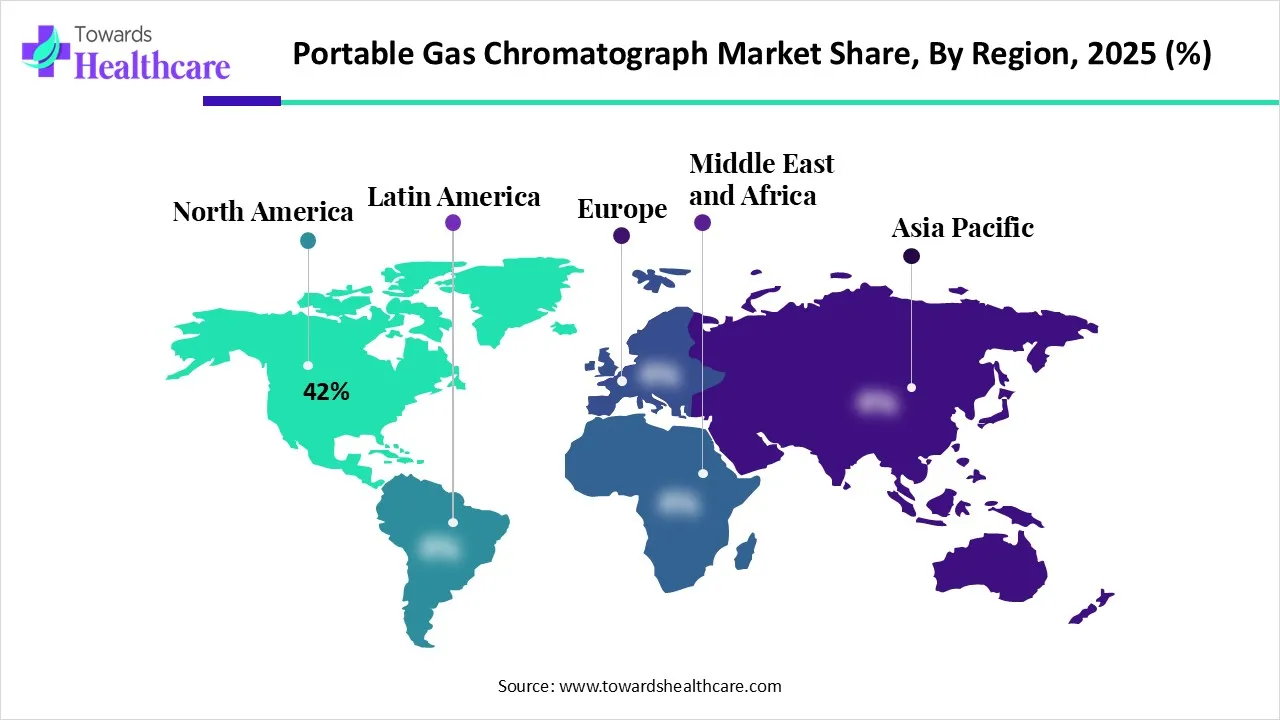
North America accounted for 42.00% of the market in 2025 and is projected to expand at a CAGR of 7.08% from 2026 to 2035. North America holds the leading position because of a large environmental remediation ecosystem and well-established homeland security and oil and gas markets. North America is expected to grow at a slower rate than the overall market over the forecast period.
Europe has stringent emissions and environmental regulations. The growth of this region is expected to be aligned with the overall market between 2026 and 2035.
Asia Pacific grows fastest, with key growth drivers being tighter pollution rules in China and India. This region is expected to grow at a faster rate than the overall market between 2026 and 2035.
Latin America regional market demand is driven by oil and mining applications. Latin America is expected to grow broadly in line with the market between 2026 and 2035.
Middle East & Africa demand for portable gas chromatographs is fueled by oil and gas sectors in this region. The pace of growth of this region is expected to stay aligned with the market throughout the forecast period.
Analyst View: Regional shares were built from demand, installed base, spending, and supplier presence in each region. North America leads because of its mature demand base and the presence of strong suppliers. We assign Asia Pacific the highest growth premium because investment, adoption, and capacity are expanding at the fastest rate in this region.
| Rank | Company Name | 2025 Share (%) | Key Products / Business | Headquarters |
| 1 | Teledyne FLIR | 14.00% | Griffin portable GC-MS | United States |
| 2 | Inficon | 13.00% | HAPSITE person-portable GC-MS and Micro GC | Switzerland |
| 3 | Agilent Technologies | 11.00% | 990 Micro GC | United States |
| 4 | PerkinElmer | 10.00% | Torion portable GC-MS | United States |
| 5 | Thermo Fisher Scientific | 6.00% | Portable analysers | United States |
| 6 | Bruker | 5.00% | Mobile GC-MS for defence | United States |
| 7 | Shimadzu | 4.00% | Compact GC systems | Japan |
| 8 | ABB | 4.00% | Process and field gas analysers | Switzerland |
| 9 | Defiant Technologies | 2.00% | FROG handheld GC | United States |
| 10 | EN-SCAN (Astrotech) | 1.00% | Labrador HH-GC | United States |
Note: Company shares are 2025 estimates.
Sources: Company press releases, expert interviews, secondary sources, Towards Healthcare database, and Towards Healthcare analysts.
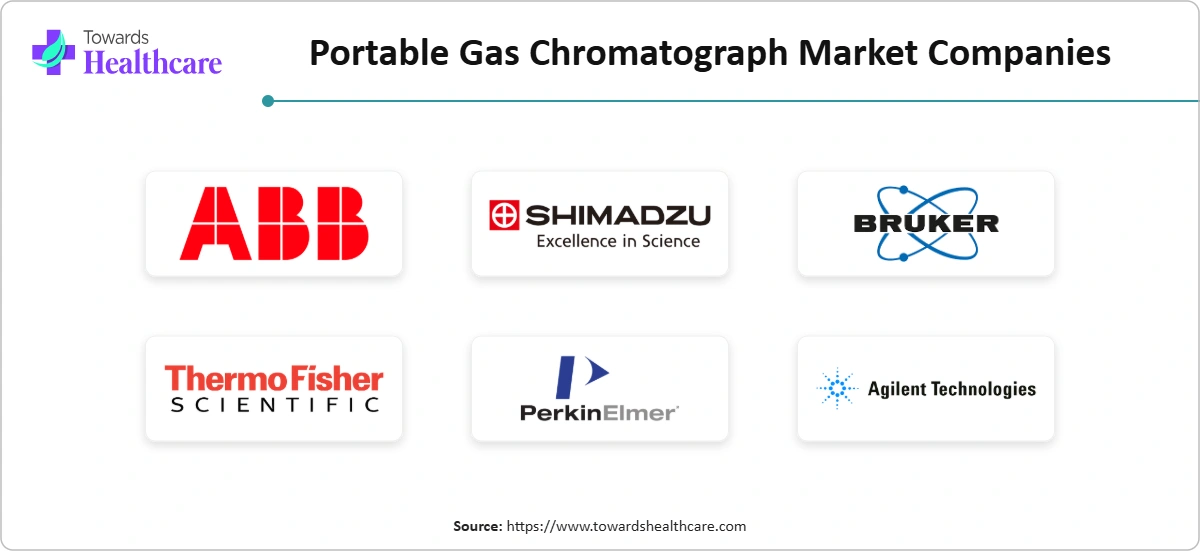
Teledyne FLIR led the market with a 14.00% share in 2025, followed by Inficon at 13.00% share and Agilent Technologies at 11.00% share. Teledyne FLIR leads with Griffin portable GC-MS, Inficon competes with HAPSITE personal portable GC-MS and Micro GC, and Agilent Technologies offers 990 Micro GC. PerkinElmer, Thermo Fisher Scientific, Bruker, Shimadzu, ABB, Defiant Technologies and EN-SCAN (Astrotech) compete through Torion portable GC-MS, portable analyzers, mobile GC-MS for defence, compact GC systems, process and field gas analyzers, FROG handheld GC and Labrador HH-GC. The top 10 companies accounted for 70.00% of revenue in 2025, while the remaining 30.00% was shared among many niche field instrument manufacturers. The market is moderately concentrated, and competition revolves around detection limits, speed, weight and ruggedness, library identification, ease of use in protective gear, and service.
Teledyne FLIR is headquartered in the United States. The company captured a market share of 14.00% in 2025. Its offering centers on Griffin portable GC-MS. Teledyne FLIR has been positioned as a Leader in the Towards Healthcare Companies Quadrant.
Inficon, part of INFICON Holding AG, is headquartered in Switzerland. It accounted for 13.00% of the market in 2025. Its offering revolves around HAPSITE personal-portable GC-MS and Micro GC. In the Towards Healthcare Companies Quadrant, it is positioned as a Leader.
Agilent Technologies has its global headquarters in the United States. Agilent Technologies held 11.00% of revenue in 2025. The company’s portfolio comprises 990 Micro GC. It has been awarded the status of a Leader in the Towards Healthcare Companies Quadrant.
PerkinElmer has its corporate headquarters in the United States. It captured 10.00% of the market in 2025. Its offering centres on Torion portable GC-MS. In the Towards Healthcare Companies Quadrant, it is positioned as a Leader.
Headquartered in the United States, Thermo Fisher Scientific contributed 6.00% of the total revenue in 2025, with its product portfolio encompassing Portable Analyzers. According to the Towards Healthcare Companies Quadrant, the company is positioned as a Leader.
Bruker is headquartered in the United States. The company held a 5.00% share in 2025. Its offering centers on Mobile GC-MS for defense. In the Towards Healthcare Companies Quadrant it is positioned as a Leader.
Shimadzu has its global headquarters in Japan. It accounted for 4.00% of the market in 2025. Its offering revolves around Compact GC systems. Shimadzu has been awarded the status of an Innovator in the Towards Healthcare Companies Quadrant.
ABB is headquartered in Switzerland. ABB captured a market share of 4.00% in 2025. The portfolio of ABB comprises Process and field gas analyzers. In the Towards Healthcare Companies Quadrant it is positioned as an Innovator.
Defiant Technologies has its corporate headquarters in the United States. It accounted for 2.00% of revenue in 2025. Its offering centers on FROG handheld GC. It has been positioned as an Innovator in the Towards Healthcare Companies Quadrant.
Headquartered in the United States, EN-SCAN (Astrotech) accounted for a 1.00% market share in 2025, with its product offering primarily centered on the Labrador HH-GC. According to the Towards Healthcare Companies Quadrant, the company is positioned as an Innovator.
The portable gas chromatograph ecosystem links component suppliers, instrument manufacturers, distributors & service, users and regulators, with each stage adding value before products reach end users.
| Ecosystem Stage | Role in the Market | Key Companies |
| Component Suppliers | Supply columns, detectors and pumps | Column and detector makers |
| Instrument Makers | Make portable GC and GC-MS | Teledyne FLIR, Inficon, PerkinElmer, Agilent |
| Distributors & Service | Sell, rent and support | Distributors, rental firms |
| Users | Analyse in the field | Agencies, consultants, industry |
| Regulators | Set environmental and safety rules | EPA, OSHA, EU agencies |
Sources: Company press releases, expert interviews, secondary sources, Towards Healthcare database and Towards Healthcare analysts.
Component Suppliers: Supply columns, detectors, and pumps. Key participants include Column and detector makers.
Instrument Makers: Make portable GC and GC-MS. Key participants include Teledyne FLIR, Inficon, PerkinElmer, Agilent.
Distributors & Service: Sell, rent, and support. Key participants include distributors and rental firms.
Users: Analyze in the field. Key participants include Agencies, consultants, and industry.
Regulators: Set environmental and safety rules. Key participants include EPA, OSHA, EU agencies.
Value in the market flows from upstream material and technology suppliers to manufacturers and service providers, then through distribution partners to end users. Companies that have the capability to integrate several stages or build long-term relationships with end users will be well-positioned to capture a large share of this value.
The Towards Healthcare Companies Quadrant positions key participants in the market by market strength, highlighting revenue scale, market share and geographic reach, and by innovation and growth strategy, reflecting product portfolio breadth, research and development intensity and partnerships. Positions reflect each company's estimated 2025 share of the market and our evaluation of its product innovation, portfolio breadth, and collaborations.
Sources: Company press releases, expert interviews, secondary sources, Towards Healthcare database and Towards Healthcare analysts.
Leaders: Teledyne FLIR, Inficon, Agilent Technologies, PerkinElmer, Thermo Fisher Scientific and Bruker combine high market share with broad portfolios and strong innovation.
Innovators: Shimadzu, ABB, Defiant Technologies and EN-SCAN (Astrotech) bring newer technologies and specialized products.
By Product
By Application
By End User
By Region
The market is defined as portable and transportable gas chromatographs used for on-site chemical analysis, including portable GC with FID, PID and TCD detectors, portable and person-portable GC-MS, and micro GC systems, used for environmental monitoring, oil and gas and petrochemicals, defense, hazmat and homeland security, food and agriculture, forensics, and industrial hygiene by government agencies, environmental consultants, industrial companies and research institutes.
The 2025 base year was built bottom-up from demand volumes and mean prices by product, application and end user and region, and checked top-down against the market-specific revenues of key players and published estimates. Segment, regional and company values were allocated from product, application and end user and region demand. Key estimates were verified by cross-checking company disclosures, regulatory and industry data, and published third-party estimates, and inputs that could not be reconciled have not been included. All segment, regional and company figures were reconciled to the same 2025 base year, and the 2026-2035 forecast, which applies a constant CAGR from the 2025 base, was recalculated and validated.
Analyst View: The market is set for steady expansion as environmental rules and related demand keep growing. Our estimate links value to underlying demand, installed base, and pricing, so the forecast follows real adoption rather than headline hype. The main upside comes from remediation projects and emissions monitoring, while the main risks are high costs and lower sensitivity than lab instruments.