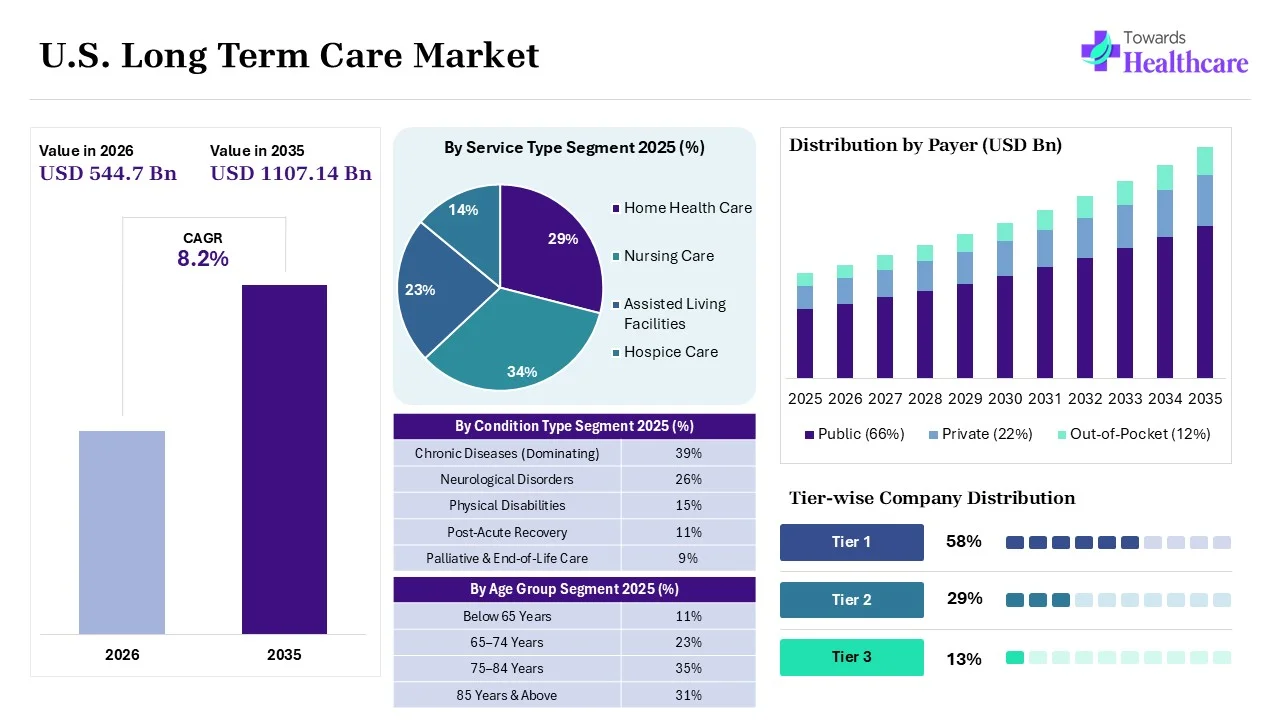
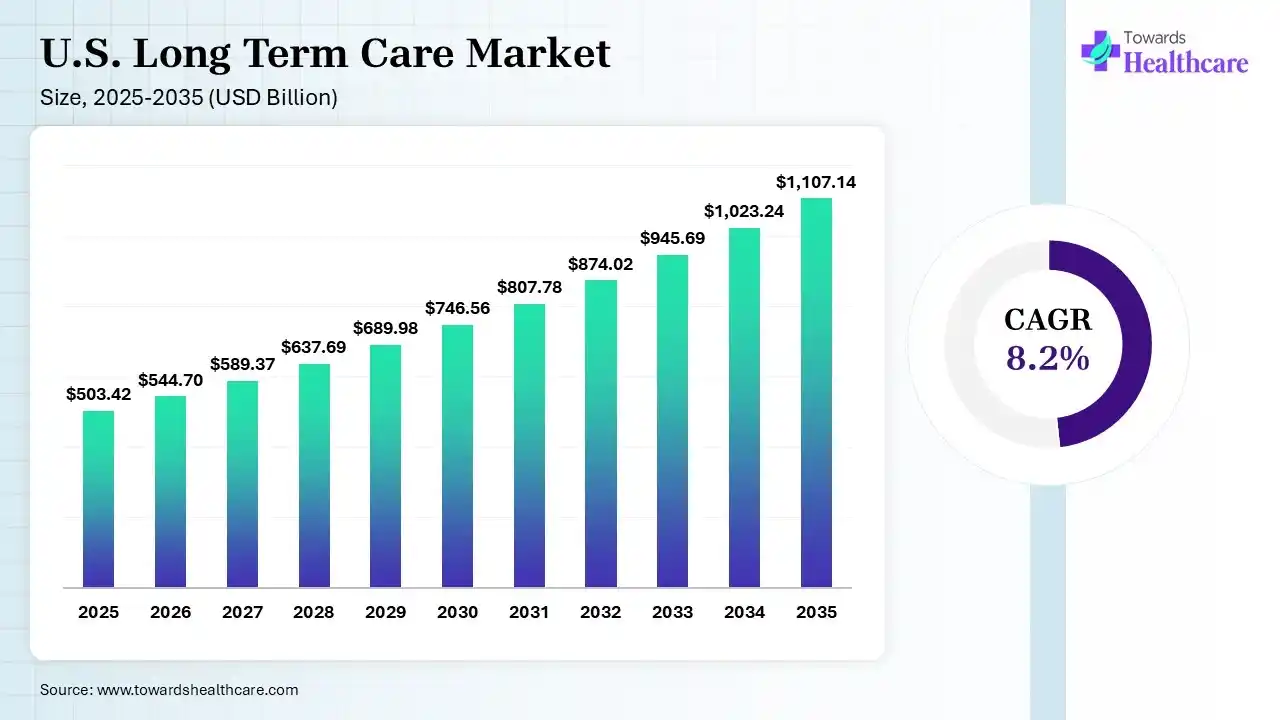
The U.S. long term care market size touched US$ 503.42 billion in 2025, with expectations of climbing to US$ 544.7 billion in 2026 and hitting US$ 1107.14 billion by 2035, driven by a CAGR of 8.2% over the forecast period.
Long-term care includes significant types of services intended to meet an individual’s health or personal care requirements when they can no longer do everyday activities on their own. Long-term care arises rapidly, such as after a stroke or heart attack. Increasing requirements for long-term care are gradually seen in aging persons, as many people need more care as they get frailer or as a severe, ongoing illness or health condition gets worse. This type of care involves a variety of support facilities to help patients live as independently and carefully as possible. It is offered in various places by different caregivers, depending on a person’s needs.
Long-term care is given in a residential setting, such as an assisted living or a nursing home.This care provides a variety of services which supports to meet both the medical and non-medical requirements of patients with a chronic illness or disability who cannot care for themselves for long periods. Long-term care is significantly focused on modified and corresponding services which promote independence, increase patients' quality of life, and meet individuals' needs over a period of time.
U.S. long-term care encompasses a broad range of medical, personal, rehabilitative, and supportive services designed for older adults and individuals with chronic illnesses, disabilities, or functional limitations who require ongoing assistance with daily living. Growth is driven by the rising adoption of home-based care, increasing aging population, and growing prevalence of chronic diseases requiring continuous support. Expanding demand for personalized care plans, skilled nursing, and assisted living services is further accelerating development. Technological advancements such as AI-powered care coordination, remote patient monitoring, wearable health devices, telehealth, and electronic health records are enhancing care quality and operational efficiency. Future opportunities lie in value-based care models, smart senior living communities, digital health integration, and predictive analytics, enabling more accessible, efficient, and patient-centered long-term care services across the United States.
AI-powered care models make this progressively feasible by increasing hospital-grade monitoring and helping in home and community settings. This advanced technology provides many advantages, such as constant monitoring, fall identification and prevention, and remote consultations, supporting lower unnecessary institutionalization while conserving quality of life. AI and IoT-driven technology shifted beyond experimentation to proven enablers of scalable, maintainable care models. AI-based technology in long-term care is significantly renovating the industry, offering new ways to enhance operational efficiency and resident care. As the population ages and the demand for long-term care services increases, healthcare providers are turning to AI and machine learning to meet these tasks head-on. This advanced technology is poised to play a significant role in the future of long-term care (LTC). These technologies are evolving as promising services to address some of the industry’s most pressing challenges.
Home Health Care:
There is an escalating global demand for home health care as life expectancies rise, and because older adults increasingly depend on in-home services to maintain independence. To improve overall well-being, caregivers and health workers are progressively integrating non-traditional therapies. Practices like mindfulness, yoga, nutrition counseling, and music therapy are highly utilized to enhance mental, emotional, and physical resilience. For older demographics, this holistic approach supports "active aging" and helps patients manage chronic conditions safely within their own homes.
Remote Patient Monitoring:
Remote Patient Monitoring (RPM) is significant because care is seamlessly delivered, actively enhancing patient results, significantly reducing institutional expenses, and exponentially increasing access to care for millions. By allowing medical providers to safely gather, transmit, and analyze real-time biometric data outside of traditional facilities, RPM redefines healthcare. This continuous oversight empowers doctors to prevent complications and hospitalizations before they occur. Consequently, patients gain greater autonomy over their chronic conditions while avoiding costly, time-consuming travel, which is vital for patients across India.
| Table | Scope |
| Market Size in 2026 | USD 544.7 Billion |
| Projected Market Size in 2035 | USD 1107.14 Billion |
| CAGR (2026 - 2035) | 8.2% |
| Historical Data | 2020 - 2023 |
| Base Year | 2025 |
| Forecast Period | 2026 - 2035 |
| Measurable Values | USD Millions/Units/Volume |
| Market Segmentation | By Product Type, By Payer, By Application, By Care Setting, By Condition Type, By Ownerships |
| Top Key Players | Brookdale Senior Living, Sunrise Senior Living, Atria Senior Living, Genesis HealthCare, ProMedica Senior Care |
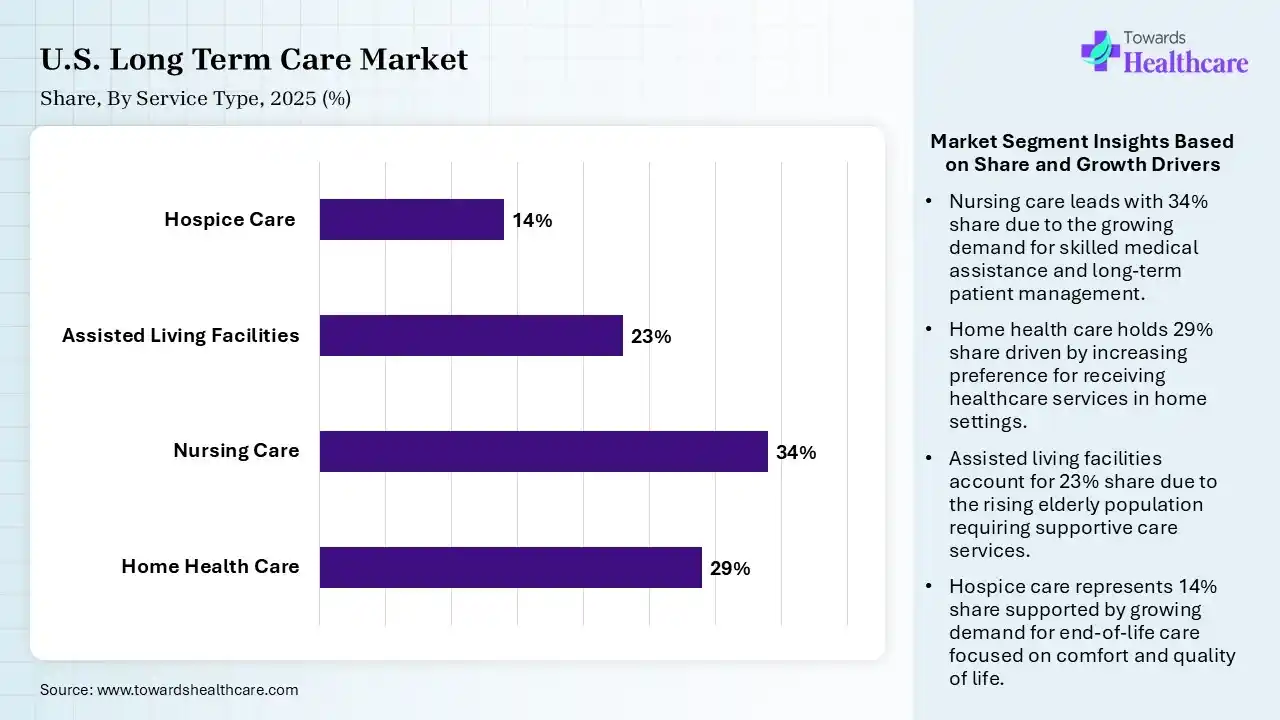
| Segment | Share 2025 (%) |
| Home Health Care | 29% |
| Nursing Care | 34% |
| Assisted Living Facilities | 23% |
| Hospice Care | 14% |
The Nursing Care Segment Led the U.S. Long Term Care Market in 2025
The nursing care segment contributed the largest market share of 34% in 2025, as nursing care confirms that significant signs are monitored often, therapeutics are administered appropriately, and any changes in condition are promptly reported. Nursing care provides an affordable alternative to hospital care while maintaining a advance standard of quality and targeted attention.
The home health care segment held a significant share of 29% in 2025, as this type of healthcare reduces the requirement and risk of gaining access and travel to physician clinics and healthcare facilities. A growing number of basic and sophisticated services are being offered by home health care agencies, integrated with developments in technology obtainable in the home.
The assisted living facilities segment held a significant share of the U.S. long term care market of 23%, as assisted living is an improved fit for seniors who need more inclusive assistance with daily activities and require access to 24/7 support and supervision.
The hospice care segment held a significant share of 14%, and is expected to grow at the fastest CAGR of 9.60 % during the forecast period in the market, as hospice solutions are a dedicated form of medical care that seeks to offer comfort and maintain a patient's quality of life for those facing a life-limiting disease, illness, or terminal condition.
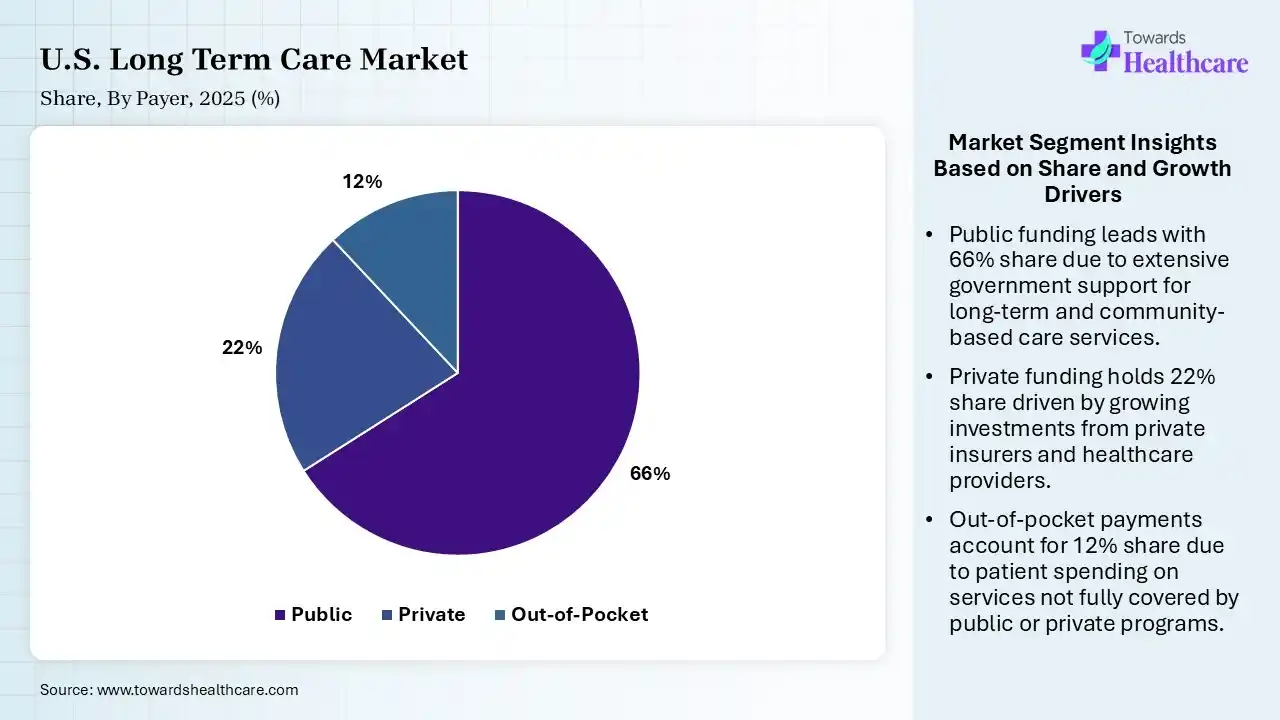
| Segment | Share 2025 (%) |
| Public | 66% |
| Private | 22% |
| Out-of-Pocket | 12% |
Public Segment Led the U.S. Long Term Care Market in 2025
The public segment contributed the largest market share of 66%, as public health care technology typically offers access to healthcare solutions for citizens, regardless of pay. Sponsored by taxes, public health care lowers overall costs via centralized administration and bulk buying. Public payers absorb the economic challenges, preventing families from spending their life savings or continuing to go bankrupt to pay for care.
The private segment held a significant share of 22% of the U.S. long term care market and is expected to grow at the fastest CAGR of 9.30 % during the forecast period, as private care stands out as a flexible, targeted service that adapts to separate needs. From hospitals and retirement homes to long-term care amenities, rehabs, and isolated residences, private care solutions provide unparalleled flexibility and expertise.
The out-of-pocket segment held a significant share of 12% of the market, as opting for out-of-pocket payment confirms that providers focus exclusively on the requirement, offering undivided attention and targeted care throughout behaviour. Paying out of pocket for solutions is an opportunity to obtain one-on-one care from a provider.
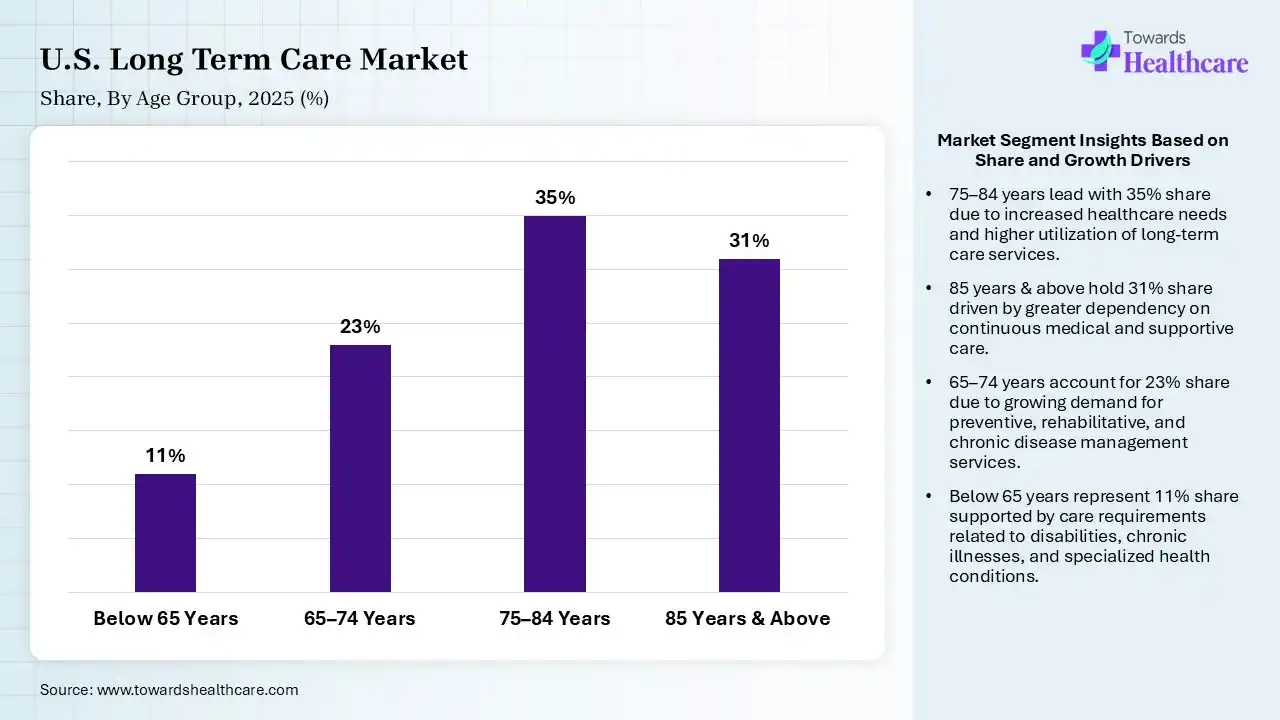
| Segment | Share 2025 (%) |
| Below 65 Years | 11% |
| 65–74 Years | 23% |
| 75–84 Years | 35% |
| 85 Years & Above | 31% |
The 85 Years & Above Segment led the U.S. Long Term Care Market in 2025
The 85 years & above segment contributed the largest market share of 31%, and is expected to grow at the fastest CAGR of 9.80 % during the forecast period, as long-term-care technology allows older patients, who experience noteworthy declines in capacity, to receive the care and provision that enables them to live a life consistent with their human dignity, fundamental freedoms, and basic rights. This service includes traditional health services like management of long-term geriatric conditions, palliation, rehabilitation, promotion, and preventative solutions.
The 75–84 years segment held a significant 35% share of the market, as long-term care facilities offer a secure and monitored environment, lowering the challenges of accidents or injuries for seniors who have mobility challenges or reasoning impairments. Long-term care providers assist residents with tasks like dressing, bathing, grooming, medication management, and mealtime preparation.
The 65–74-year segment held a significant 23% share of the U.S. long term care market, as elderly long-term care offers significant help for physicians who need continuing assistance because of age-associated limitations or chronic health conditions. These care facilities strive to create nurturing environments where seniors thrive in their golden years. Elderly long-term care provides modified attention and is tailored to the unique requirements and preferences of every resident.
The below 65 years segment held a significant share of 11% in the market, as long-term care for seniors offers advantages to older adults and their relatives. In addition to offering seniors companionship, social interaction, and access to healthcare solutions, chronic care facilities provide healthy meals and other amenities to support health and wellness. Long-term care homes allow seniors to feel independent and have companionship.
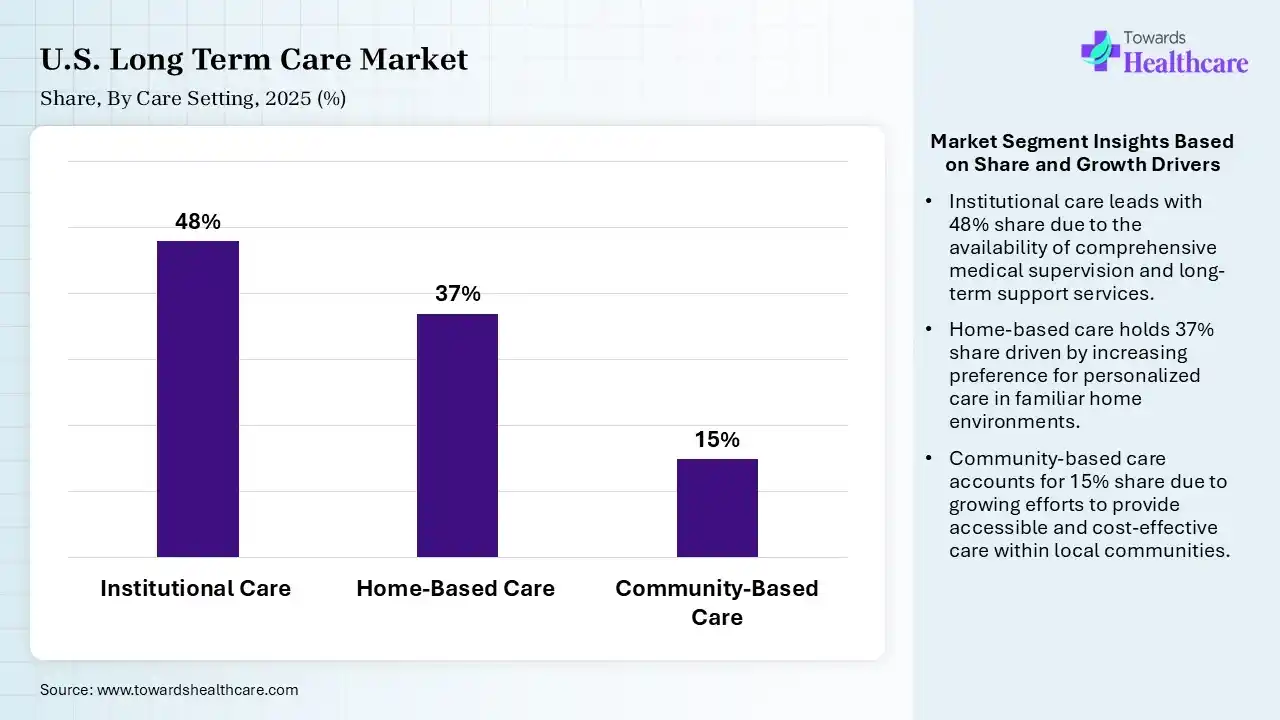
| Segment | Share 2025 (%) |
| Institutional Care | 48% |
| Home-Based Care | 37% |
| Community-Based Care | 15% |
The Institutional Care Segment led the U.S. Long Term Care Market in 2025
The institutional care segment contributed the largest market share of 48%, as an institutional care setting offers opportunities for increased social interaction through group activities, digital platforms, and virtual reality experiences, fostering a sense of community and combating loneliness among residents. Institutional care facilities often provide specialized care services, including AI-driven rehabilitation therapies, robotics for mobility assistance, and comprehensive medical monitoring.
The home-based care segment held a significant share of 37% in the market and is expected to grow at the fastest CAGR of 9.40% during the forecast period. Home care decreases costs, improves health outcomes, and reduces hospital stays. Home care services are an affordable solution, saving time and money due to hospital visits. It is professional care given to everyone in need in the comfort of their homes.
The community-based care segment held a significant share of 15% in the market, as Community-based services help manage chronic illnesses, mental health conditions, and disabilities more effectively by shifting from reactive to proactive care. This approach also strengthens the relationship between healthcare providers and those they support, encouraging open communication and trust.
| Segment | Share 2025 (%) |
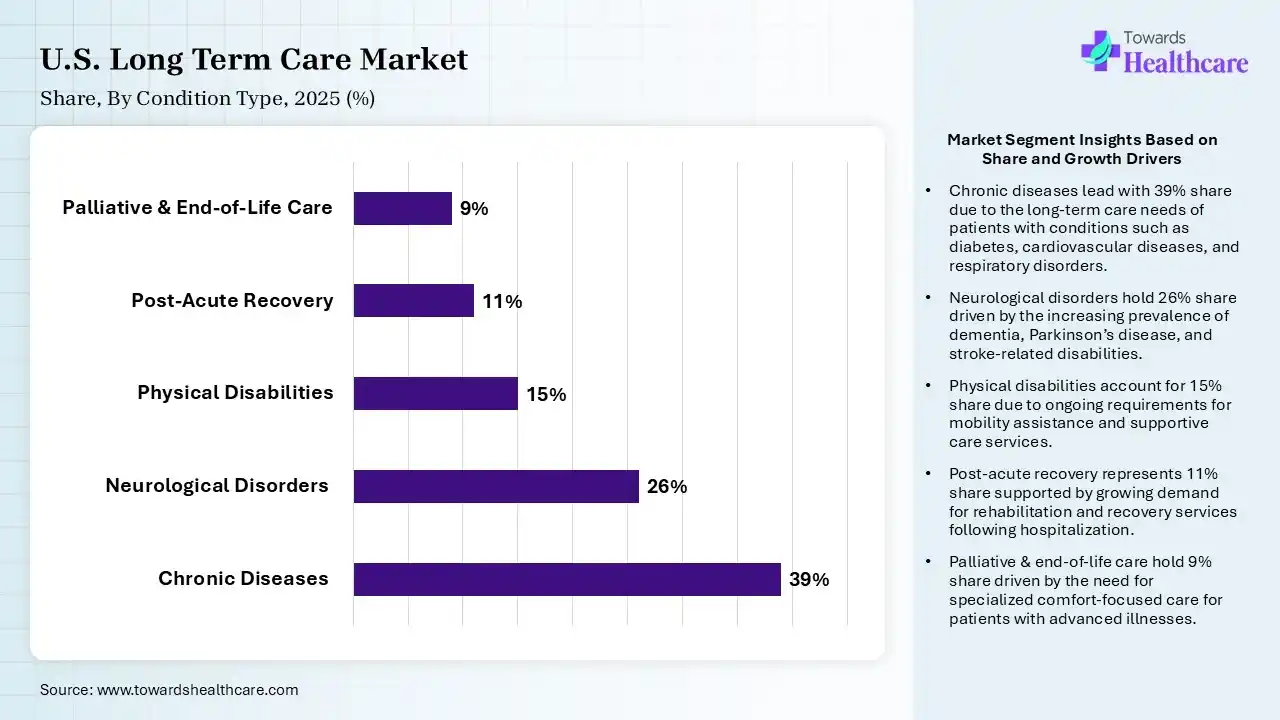
| Chronic Diseases | 39% |
| Neurological Disorders | 26% |
| Physical Disabilities | 15% |
| Post-Acute Recovery | 11% |
| Palliative & End-of-Life Care | 9% |
The Chronic Diseases Segment led the U.S. Long Term Care Market in 2025
The chronic diseases segment contributed the largest market share of 39%, as long-term inpatient care centres potentially enhance family satisfaction and overall patient results. This type of care increases healthcare expertise and decision support, enhancing patients' self-management and growing the efficiency of practice teams.
The neurological disorders segment held a significant share of 26% in the market and is expected to grow at the fastest CAGR of 10.10% during the forecast period, as long-term neurology care is intended to help recovery beyond the acute phase. It is not a one-time management plan but a continuous and adaptive strategy that includes the patient’s advancement. Neurological recovery based heavily on repetition and consistency. The brain progressively forms new connections via continuous stimulation, a process that cannot be rushed.
The physical disabilities segment held a significant share of 15% in the U.S. long term care market, as long-term care services involve different support services intended to help individuals with disabilities, chronic illnesses, or other conditions. It supports them in maintaining their independence by offering home health aides who assist with activities such as dressing, bathing, and meals. Long-term care offers much-needed assistance to individuals with disabilities in a variety of ways.
The post-acute recovery segment held a significant share of 11% in the market, as post-acute care is care offered for those patients recently been discharged from the hospital but also need acute care. Post-acute care is obtainable at long-term hospitals, inpatient rehabilitation facilities, and skilled nursing services.
| Segment | Share 2025 (%) |
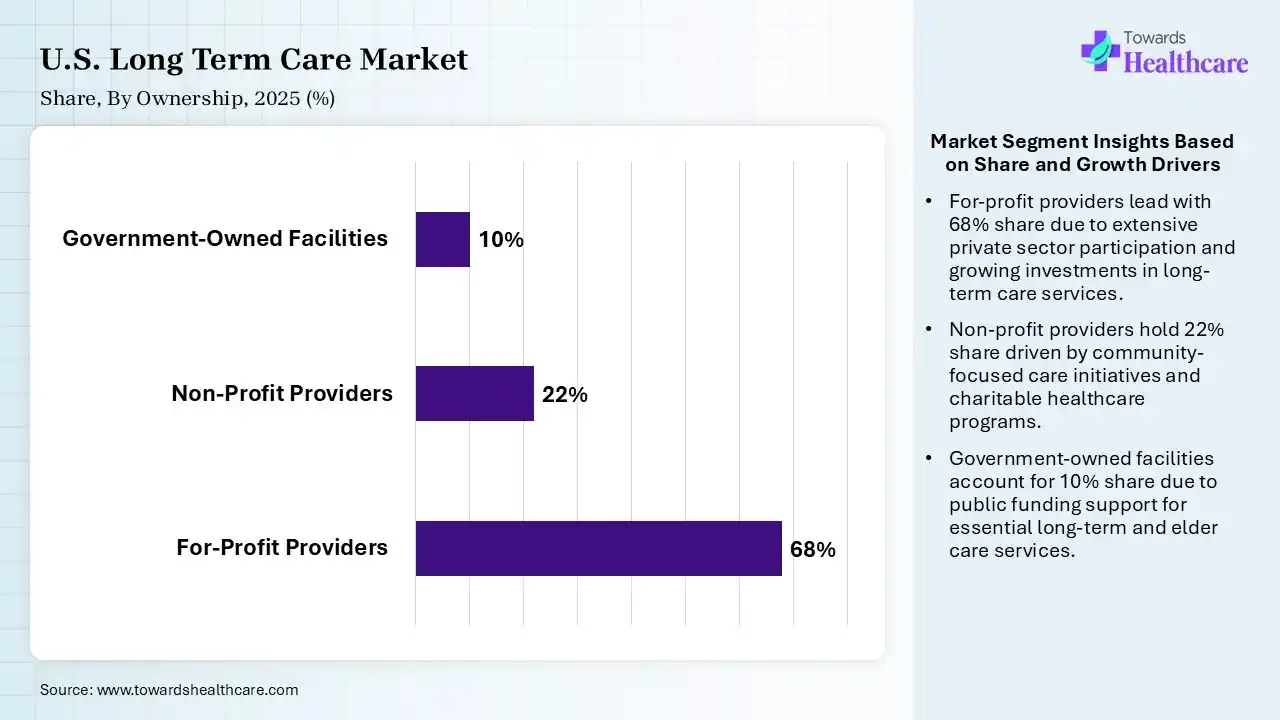
| For-Profit Providers | 68% |
| Non-Profit Providers | 22% |
| Government-Owned Facilities | 10% |
The For-Profit Providers Segment led the U.S. Long Term Care Market in 2025
The for-profit providers segment contributed the largest market share of 68%, as for-profit long-term care (LTC) providers offer various benefits for residents and families, involving advance accessibility, premium amenities, and efficient processes. For-profit organizations are more responsive to market demands, and they often face fewer challenges to expansion.
The non-profit providers segment held a significant share of 22% in the market, as non-profit care centers have fewer total deficiencies and lower rates of hospitalization. Non-profit senior living communities are judged on the quality of care provided, the strength of the community culture, and even an organization’s economic stability.
The government-owned facilities segment held a significant share of 10% in the U.S. long term care market and is expected to grow at the fastest CAGR of 8.80% during the forecast period, as government-owned long-term care facilities offer advanced financial predictability, higher structural quality compliance, and structured healthcare staffing as compared to private, for-profit organizations. Government programs support paying for certain health care and long-term care-related expenditures.
The U.S. long-term care market is growing due to the rapidly aging population, increasing prevalence of chronic diseases, and rising demand for continuous medical and personal care services. Greater preference for home-based and community-based care, expanding Medicare and Medicaid support, and the adoption of digital health technologies are improving care accessibility and efficiency. Additionally, workforce expansion and value-based care initiatives are further accelerating the sector's growth.
R&D:
Manufacturing Processes:
Patient Services:
| Company | Headquarters | Latest Update |
| Brookdale Senior Living | United States | Senior living communities in the U.S. offer independent living, assisted living, and memory care |
| Sunrise Senior Living | United States | A prominent provider known for its dedicated memory care and resident-centered communities |
| Atria Senior Living | United States | Operates hundreds of independent and assisted living communities across multiple states |
| Genesis HealthCare | United States | The nation's largest providers of skilled nursing and rehabilitation operate hundreds of centers. |
| ProMedica Senior Care | United States | Cardinal Health Wound Solutions are products used to aid in the removal of foreign materials from wounds and skin. |
In April 2025, “With more than 11,000 Americans turning 65 each day over the next four years, the demand for long-term care services is likely to surge. Our industry needs to understand how consumers are using LTCI policies to help carriers develop fiscally sustainable products that meet the needs of present and future retirees,” said David Levenson, president and CEO, LIMRA and LOMA.
By Product Type
By Payer
By Application
By Care Setting
By Condition Type
By Ownerships










Principal Consultant
Payal Rabde is a Healthcare Market Research Analyst at Towards Healthcare Research & Consulting with 4+ years of experience in pharmaceuticals, biotechnology, medical devices, and life sciences.
Learn more about Payal Rabde

Reviewed By
Aditi Shivarkar is a seasoned professional with over 14 years of experience in healthcare market research. As a content reviewer, Aditi ensures the quality and accuracy of all market insights and data presented by the research team.
Learn more about Aditi Shivarkar