
The veterinary digital pathology market is expected to grow from USD 556.00 million in 2025 to USD 2,134.69 million by 2035. One of the main reasons for this growth is the shortage of veterinary pathologists. At the same time, the number of diagnostic cases is increasing. Digital slides allow laboratories and hospital groups to share cases remotely and use AI tools to make slide reviews faster and more consistent. AI-powered cytology tools used in clinics, cloud-based image management systems and growing demand for veterinary cancer diagnosis are also supporting market growth. The use of digital pathology in preclinical research is adding to demand. The market is expected to reach USD 1,089.44 million by 2030 and grow at a CAGR of 14.40% from 2026 to 2035.
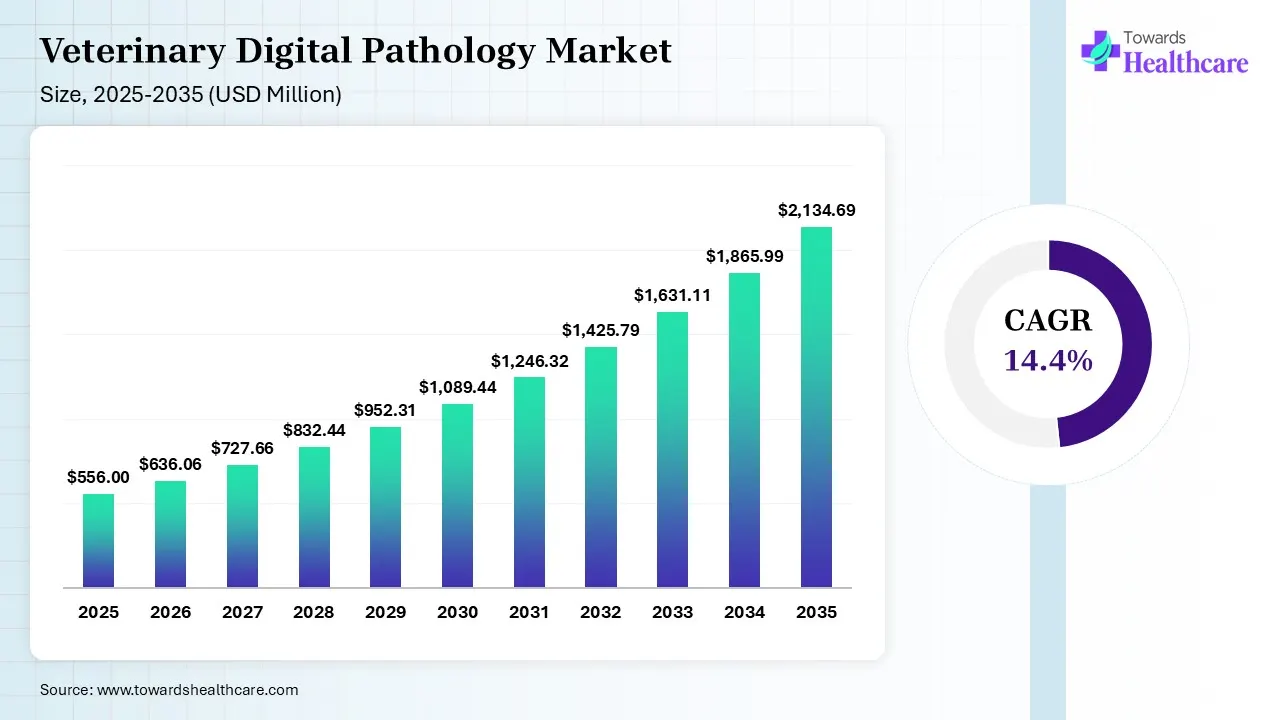
Analyst View: We estimated the market by looking at existing and new installations of whole slide scanners, digital cytology analysers and software across different products, animal types, applications, end users and regions. We then considered average system prices, software subscription fees and service charges for each case.
We compared the total estimate with revenue from veterinary diagnostic imaging and digital pathology reported by leading companies. We also reviewed published market estimates. Based on these comparisons, our base-year estimate is slightly higher than the highest comparable figure. The expected growth reflects wider use of digital systems and AI tools, while also considering the high cost of these systems for smaller veterinary practices.
Driver: Pet ownership and demand for diagnostic testing are increasing. At the same time, there are not enough veterinary pathologists to handle all diagnostic cases. AI tools can help make slide reviews faster and more consistent. Growing demand for veterinary cancer diagnosis is also supporting the market. Pharmaceutical research is using digital slides more often in toxicology studies.
Restraint: Whole slide scanners and software can be expensive, especially for small veterinary practices. Digital images also require large amounts of storage space. AI tools have not been fully validated for every animal species. Connecting digital pathology systems with existing veterinary practice software can be difficult, and staff may need training before they can use the technology effectively.
Opportunity: AI-powered analysers used directly in clinics could make digital pathology available to more veterinary practices. Cloud-based telepathology services could help reach underserved and emerging markets. Digital tools could also support livestock disease monitoring. Partnerships with human pathology providers may help bring existing technologies into veterinary healthcare. Training and education are additional areas where digital pathology can be used.
| Segments | 2025 Share | 2025 Market Value |
| Whole Slide Imaging Systems | 45.60% | USD 253.54 million |
| Image Analysis Software | 28.40% | USD 157.90 million |
| Storage & Communication Systems | 26.00% | USD 144.56 million |
Sources: Expert interviews, secondary sources, Towards Healthcare database and Towards Healthcare analysts.
Whole slide imaging systems held the largest product share in 2025, at 45.60% (USD 253.54 million). Laboratories use these scanners to turn glass slides into digital images that can be viewed and shared on a computer.
Image analysis software accounted for 28.40% (USD 157.90 million). This is the fastest-growing product segment as AI tools are increasingly used to examine cell samples, assess tumours and identify parasites.
Storage and communication systems accounted for 26.00% (USD 144.56 million). These systems help laboratories store, manage and share digital pathology images.
| Segments | 2025 Share | 2025 Market Value |
| Companion Animals | 61.20% | USD 340.27 million |
| Livestock | 24.60% | USD 136.78 million |
| Exotic & Other Animals | 14.20% | USD 78.95 million |
Sources: Expert interviews, secondary sources, Towards Healthcare database and Towards Healthcare analysts.
Companion animals accounted for 61.20% (USD 340.27 million) of the market in 2025. Dogs and cats make up a large share of veterinary biopsy and cytology cases, supporting demand for digital pathology tools.
Livestock accounted for 24.60% (USD 136.78 million). Digital pathology can help with disease monitoring and herd health management.
Exotic and other animals accounted for 14.20% (USD 78.95 million). This segment includes animals that are not covered by the companion animal and livestock categories.
| Segments | 2025 Share | 2025 Market Value |
| Diagnosis | 62.40% | USD 346.94 million |
| Research & Drug Development | 37.60% | USD 209.06 million |
Sources: Expert interviews, secondary sources, Towards Healthcare database and Towards Healthcare analysts.
Diagnosis accounted for 62.40% (USD 346.94 million) of the market in 2025. This was mainly because clinical cytology and histopathology tests for companion animals generate a large number of cases.
Research and drug development accounted for 37.60% (USD 209.06 million). This segment includes preclinical toxicology studies, where digital slides and AI-based image analysis are being used more often.
| Segments | 2025 Share | 2025 Market Value |
| Veterinary Reference Laboratories | 38.60% | USD 214.62 million |
| Veterinary Hospitals & Clinics | 34.80% | USD 193.49 million |
| Research Institutes & Pharma | 26.60% | USD 147.90 million |
Sources: Expert interviews, secondary sources, Towards Healthcare database and Towards Healthcare analysts.
Veterinary reference laboratories held 38.60% (USD 214.62 million) of the market in 2025. Large laboratory networks are investing in digital systems so slides can be reviewed by specialists in different locations.
Veterinary hospitals and clinics accounted for 34.80% (USD 193.49 million). This is the fastest-growing end-use segment as more clinics introduce digital cytology analysers.
Research institutes and pharmaceutical companies accounted for 26.60% (USD 147.90 million). These users apply digital pathology in research and drug development.
Analyst View: We estimated the value of each segment by matching system installations and spending with products, animal types, applications and end users. We also considered company disclosures and laboratory data. Whole slide imaging systems, companion animals, diagnosis and reference laboratories lead the market because of ongoing digital adoption. We expect AI software and in-clinic use to account for a larger share in the coming years.
| Region | 2025 Share | 2025 Market Value |
| North America | 40.40% | USD 224.62 million |
| Europe | 28.60% | USD 159.02 million |
| Asia Pacific | 22.40% | USD 124.54 million |
| Latin America | 5.00% | USD 27.80 million |
| Middle East & Africa | 3.60% | USD 20.02 million |
Sources: Expert interviews, secondary sources, Towards Healthcare database and Towards Healthcare analysts.
North America held the largest market share in 2025, at 40.40% (USD 224.62 million). The region benefits from large veterinary laboratory networks operated by companies such as IDEXX, Zoetis and Antech. High spending on pet healthcare, large veterinary hospital groups and a shortage of pathologists are also encouraging the use of remote slide reviews.
Europe accounted for 28.60% (USD 159.02 million). Demand is supported by reference laboratories, veterinary schools and digital pathology suppliers such as 3DHISTECH, Philips and Leica.
Asia Pacific accounted for 22.40% (USD 124.54 million) and is expected to be the fastest-growing region. Growth is supported by the expansion of veterinary services in China, Japan, South Korea and Australia, along with suppliers such as Hamamatsu and Motic.
Latin America accounted for 5.00% (USD 27.80 million), while the Middle East and Africa accounted for 3.60% (USD 20.02 million). Both regions are still at an early stage of market adoption.
The Middle East and Africa accounted for 3.60% (USD 20.02 million) in 2025. Veterinary hospitals and research centres in Gulf countries are among the early adopters of digital pathology technology.
Analyst View: We estimated regional market shares based on system installations and spending in each region. North America leads because it has large veterinary laboratory networks and strong demand for diagnostic services. We expect Asia Pacific to grow the fastest as veterinary healthcare services expand and more clinics and laboratories adopt digital tools.
| Rank | Company Name | Market-Specific Revenue (USD Million) | 2025 Share | Key Products / Business | Headquarters |
| 1 | IDEXX Laboratories | 92.00 | 16.55% | Digital pathology network and Invue Dx | United States |
| 2 | Zoetis | 68.00 | 12.23% | Vetscan Imagyst AI analysis | United States |
| 3 | Antech Diagnostics | 52.00 | 9.35% | Reference laboratory digital pathology | United States |
| 4 | Leica Biosystems | 38.00 | 6.83% | Aperio whole slide scanners | Germany |
| 5 | Hamamatsu Photonics | 26.00 | 4.68% | NanoZoomer slide scanners | Japan |
| 6 | Philips | 18.00 | 3.24% | IntelliSite Pathology Solution | Netherlands |
| 7 | 3DHISTECH | 14.00 | 2.52% | Pannoramic slide scanners | Hungary |
| 8 | Proscia | 10.00 | 1.80% | Concentriq digital pathology platform | United States |
| 9 | Indica Labs | 9.00 | 1.62% | HALO image analysis software | United States |
| 10 | Scopio Labs | 8.00 | 1.44% | Full-field digital cytology | Israel |
Sources: Company press releases, expert interviews, secondary sources, Towards Healthcare database and Towards Healthcare analysts.
IDEXX Laboratories benefits from its global reference laboratory network, which uses digital pathology for remote slide review. Its Invue Dx analyser also supports cellular analysis in veterinary clinics.
Zoetis offers Vetscan Imagyst, an AI-powered platform used in clinics for cytology, skin-related analysis and parasite detection. Antech Diagnostics provides digital pathology services through its reference laboratories.
Leica Biosystems, Hamamatsu Photonics, Philips, 3DHISTECH, Proscia, Indica Labs and Scopio Labs compete by offering slide scanners, image management systems, AI analysis software and digital cytology solutions.
The top 10 companies accounted for an estimated 60.25% (USD 335.00 million) of market revenue in 2025. The remaining 39.75% (USD 221.00 million) came from other scanner manufacturers, AI software start-ups, telepathology providers and regional laboratory groups.
The market is moderately concentrated among veterinary diagnostic companies, while suppliers of human pathology technology also provide scanners and software. Companies compete on image quality, scanning speed, AI accuracy, integration with existing workflows, access to pathologists, cloud-based features and cost.
Veterinary diagnostic companies have an advantage when they can combine digital pathology with their existing laboratory and in-clinic services.
The veterinary digital pathology market includes several connected groups. Hardware companies make scanners and imaging devices, while software and AI developers provide tools to store and analyse images. Veterinary diagnostic companies and reference laboratories use these systems to review samples and provide results. Clinics, hospitals and research organisations use the results for animal healthcare and research.
| Ecosystem Stage | Role in the Market | Key Companies |
| Scanners & Hardware | Make whole slide scanners and imaging devices | Leica Biosystems, Hamamatsu, 3DHISTECH, Motic, Grundium |
| Software & AI | Provide image management and AI analysis tools | Proscia, Indica Labs, Philips, Visiopharm, Aiforia |
| Veterinary Diagnostic Companies | Add digital pathology to their diagnostic services | IDEXX, Zoetis, Antech |
| Laboratories & Pathologists | Review digital slides and prepare diagnostic reports | Reference laboratories, telepathology networks, veterinary schools |
| End Users | Use results for treatment and research | Veterinary clinics, hospitals, pharma and research institutes |
Sources: Company press releases, expert interviews, secondary sources, Towards Healthcare database and Towards Healthcare analysts.
The Towards Healthcare Companies Quadrant compares major companies in the veterinary digital pathology market based on their market strength and plans for innovation and growth.
Market strength considers factors such as revenue, market share and geographic reach. Innovation and growth strategy considers the range of products offered, research and development spending, and business partnerships.
The positions are based on each company's estimated 2025 veterinary digital pathology revenue and our assessment of its AI capabilities, platform integration and partnerships.
Sources: Company press releases, expert interviews, secondary sources, Towards Healthcare database and Towards Healthcare analysts.
By Product
By Animal Type
By Application
By End Use
By Region
The veterinary digital pathology market covers whole slide imaging systems, image analysis software, storage and communication systems, digital cytology and telepathology services used in animal healthcare worldwide.
The 2025 market estimate was prepared by calculating the number of scanner, analyser and software installations across products, animal types, applications, end users and regions. Average system prices and service fees were then used to estimate the market value.
The total estimate was also compared with revenue from veterinary diagnostic imaging and digital pathology reported by leading companies.
Market values for individual segments, regions and companies were assigned based on product types, animal types, applications, end users and regional demand.
Key estimates were checked against company disclosures, regulatory and industry data, and published third-party estimates. Figures that could not be matched or supported were excluded.
All segment, regional and company figures were aligned with the same 2025 base year. The forecast for 2026–2035 was then calculated using a constant CAGR from the 2025 base and checked for consistency.
Analyst View: The veterinary digital pathology market is growing quickly as laboratories move from traditional slide-based work to digital systems and AI tools become more common in veterinary clinics. Our estimate links market demand to system installations, prices and service revenue. The forecast therefore reflects the growth of laboratory digitisation, AI adoption and veterinary diagnostic services. The main growth opportunities come from AI-powered tools used directly in clinics and the wider use of telepathology. The main challenges are the high cost of digital systems and the need to validate AI tools for veterinary use.