


Running an ABA clinic means managing a lot of moving parts at once — treatment plans, therapist schedules, insurance authorizations, billing cycles, compliance requirements, and clinical data collection, all simultaneously. When any one of those pieces breaks down, the effects ripple across the entire operation. The right practice management software brings these functions together so your team spends less time on administrative friction and more time delivering care.
The challenge is that the ABA software market offers many options with very little transparency. Features sound similar across platforms, pricing is rarely published, and the differences that actually matter in day-to-day clinical use are not obvious from a sales demo. This guide cuts through that noise. Below are the seven best ABA practice management software solutions for 2026, what each one does best, and which type of practice it fits.
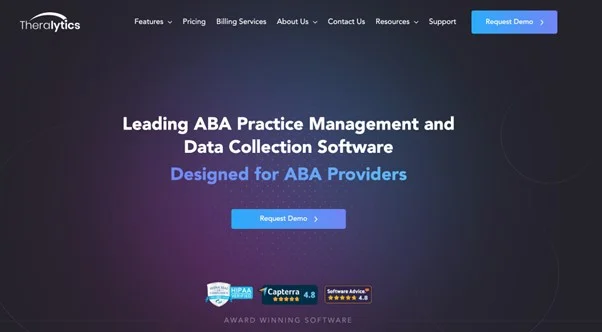
Theralytics is the strongest all-around option for ABA practices in 2026. It was built specifically for ABA workflows, and that focus shows in how the clinical and administrative sides of the platform work together rather than sitting as separate modules. Data collected during a session feeds directly into billing and reporting. Progress graphs update automatically. Supervisors and BCBAs always work from current, accurate information rather than disconnected spreadsheets.
The interface was designed around how RBTs and BCBAs actually work. Most staff reach full proficiency within two to three days of implementation, and with free onboarding and training, there's no disruption when new therapists join. Offline-capable data entry means therapists are not dependent on a stable internet during sessions — a daily requirement for in-home and school-based teams.
Theralytics is also the only platform on this list with publicly listed pricing, which matters when you are trying to plan around a budget. The per-client model scales predictably, and a free startup tier gives new clinics time to get established before costs begin.
On compliance, Theralytics meets 2026 HHS Technical Safeguard requirements including biometric MFA and real-time audit trails, and holds SOC 2 Type II certification — independently audited proof of ongoing data security, not just a self-reported checklist.
Pricing: Free startup package (6 months or until first client) | $20/client/month for Practice Management or Data Collection | $30/client/month for both combined.
Ideal for: Growing practices from 10 to 500+ clients that want clinical and administrative operations covered in one connected, scalable platform.
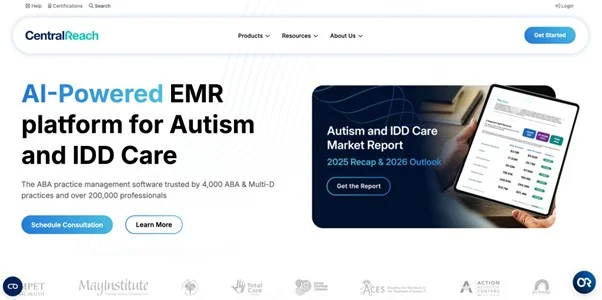
CentralReach is the established enterprise platform in the ABA space. For large, multi-site organizations, it provides capabilities that smaller platforms cannot match: multi-location billing hierarchies, payroll, advanced claims management, HR tools, and an integrated learning management system with over 60 features. Its AI assistant, cari, is trained on more than one billion ABA-specific data points and powers scheduling, note drafting, and operational analytics.
The tradeoffs are real. CentralReach carries a steep learning curve and is widely reported as non-intuitive by users who came from simpler systems. System downtime is a recurring complaint. Costs rise quickly as modules are added, and most organizations need several modules to get full value. For smaller clinics, much of the platform's depth goes unused while still contributing to cost and complexity.
Pricing: Custom enterprise pricing — estimated starting point around $50 per employee per month before add-ons.
Ideal for: Large ABA organizations with 300 or more clinicians, complex payer arrangements, and dedicated IT and administrative resources.
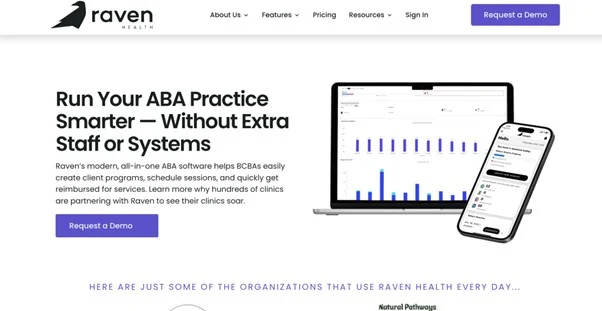
Raven Health was founded by a BCBA who spent years working in homes and schools using software that was never designed for those settings. The result is a platform where the mobile app is the core product, not an afterthought. RBTs can collect data, complete documentation, and coordinate with supervisors from a phone or tablet. Offline mode keeps data collection running in low-connectivity environments, with automatic syncing when internet access returns.
AI-generated session notes are a standout feature, meaningfully reducing the documentation burden at the end of each clinical day. Built-in caregiver communication tools keep families engaged and simplify coordination across the care team. Practices that want to offload billing entirely can use Raven Health's managed billing service as an add-on.
The platform is best suited for startups and small to midsize clinics rather than large enterprises, and some enterprise features are still maturing.
Pricing: Custom — contact Raven Health directly.
Ideal for: Startup and small to midsize clinics with in-home or school-based programs where mobile reliability is a core operational need.
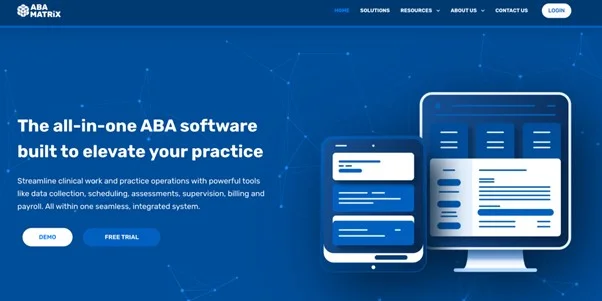
ABA Matrix is built for clinics that have specific clinical requirements that off-the-shelf platforms do not accommodate. BCBAs can configure programs, data collection formats, and reporting to match how the clinic actually operates — without forcing a single treatment model onto the entire team. Multiple behavioral methodologies can coexist within the same system. The assessment and curriculum libraries are extensive, providing a strong clinical foundation that can be adapted for each client.
The tradeoffs are meaningful. The platform carries a steep learning curve, the interface feels less modern than newer alternatives, and initial configuration requires dedicated setup time. Customer support responsiveness has been noted as inconsistent. For practices with experienced clinical staff and the capacity to work through a more involved setup, the clinical precision it enables is genuine.
Pricing: Custom — contact ABA Matrix directly.
Ideal for: Established clinics with experienced BCBAs who need granular control over clinical programming and data structure.

Rethink's most distinctive feature is the depth of its training infrastructure. The platform includes an extensive video library covering ABA principles through specific intervention strategies, and a built-in RBT certification program that lets practices train and certify their own staff without external costs. New hires can be onboarded on clinical skills and software proficiency simultaneously, reducing supervisory burden and shortening the time before a new therapist contributes effectively.
Beyond training, Rethink offers solid clinical tools — treatment planning, data collection, progress monitoring — and a parent portal that extends the practice's reach into the home. Some users note the interface feels less intuitive than newer platforms, and occasional syncing delays have been reported.
Pricing: Custom — contact Rethink Behavioral Health directly.
Ideal for: Growing practices with frequent hiring cycles, high turnover, or rapid expansion that requires consistent clinical onboarding across a growing team.
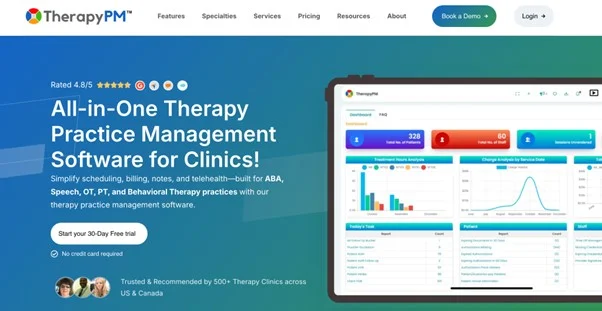
TherapyPMS approaches ABA software from a billing-first perspective. Its core strength is a sophisticated billing engine that handles unit-based billing, modifier management, place-of-service requirements, multi-payer support, and Electronic Visit Verification. Authorization tracking and denial management tools help practices identify and resolve revenue cycle problems before they compound. Detailed financial reporting tracks key metrics like days in accounts receivable, collection rates, and denial rates.
Clinical features are functional but less developed than platforms built primarily for clinical use. The interface can feel dense initially, and the platform may be more than most clinics need if billing is not a primary pain point.
Pricing: Custom — contact TherapyPMS directly.
Ideal for: Established practices with complex payer contracts, high authorization requirements, or persistent claim denial problems.
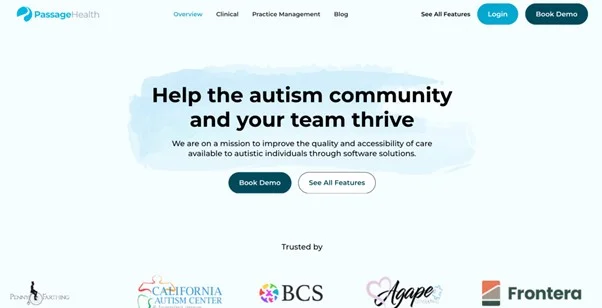
Passage Health is a modern, unified EMR built around a specific problem: the revenue loss and operational friction that result from disconnected scheduling, billing, and clinical systems.
Authorization-aware scheduling prevents sessions from being booked without active coverage. Session-to-billing automation closes the gap between care delivery and claim submission. Real-time authorization blocking surfaces coverage gaps at the point of scheduling — before a session is delivered without a valid authorization.
For practices running multiple disconnected tools and losing time or revenue to manual handoffs between them, Passage Health offers a purpose-built alternative.
Pricing: Custom — contact Passage Health directly.
Ideal for: Growing practices losing time or revenue because scheduling, billing, and clinical data do not communicate with each other.
Before evaluating any platform, identify the specific problem you are trying to solve. Billing errors, documentation overhead, limited clinical visibility, and mobile unreliability are different problems that point to different solutions.
Behavioral health providers often track a wide range of observations beyond structured skill-acquisition targets, especially when coordinating care with other clinicians involved in a child’s development. Session documentation may include patterns such as sleep disruption, sudden changes in attention or mood, unusual sensory responses, or caregiver-reported experiences that need monitoring over time. In some cases, teams also note reports connected to questions like what are hypnagogic hallucinations or caregiver-reported sensory experiences occurring during sleep transitions or periods of heightened anxiety, especially when distinguishing sleep-related perceptions from clinically relevant behavioral indicators. Practice management platforms that support flexible note structures and supervisor review workflows make it easier to capture these observations consistently without interrupting ABA-specific treatment tracking.
Check that any platform you consider meets 2026 security standards: mandatory MFA with biometric support, AES-256 encryption, and SOC 2 Type II certification. Use trial periods to test against your actual workflows, not vendor-configured demos. And speak with current users at practices similar to yours — they will tell you things a sales team will not.
The right ABA practice management software depends on your size, service model, and operational priorities. Theralytics offers the best overall balance for most practices. CentralReach serves large enterprises. Raven Health leads in mobile-first delivery. ABA Matrix delivers clinical flexibility. Rethink Behavioral Health supports staff development. TherapyPMS optimizes revenue cycle management. Passage Health unifies fragmented systems.
Choosing the right platform is a long-term investment in clinical quality and sustainable growth. Take your time, test thoroughly, and choose the one that removes friction for your team rather than adding it.


