


Most healthcare founders underestimate how different a pitch deck needs to be when clinical evidence, regulatory context, and investor skepticism all collide on the same slide. The top pitch deck design firms for healthcare know this tension well, and figuring out which ones actually get the nuance separating a strong science story from an overstated efficacy claim is half the battle. After reviewing dozens of agencies, platforms, and design studios across the healthtech funding space, this guide breaks down five options worth considering for your next fundraising round.
Public information shaped every ranking decision here. Review platform ratings, documented case studies, verified client testimonials, and official website claims were all pulled and compared. Only options showing a real track record in healthcare or healthtech fundraising contexts made the final cut.
See the full research breakdown
Getting a pitch deck wrong in healthcare doesn't just mean a bland presentation. It can mean losing a funding round because a slide overstated clinical results, or because the data visualization made a complex trial outcome unreadable to a non-scientist investor.
Healthcare fundraising sits at an unusual intersection. Founders need to tell a bold story while staying inside tight regulatory guardrails, which is genuinely difficult without design partners who understand both sides.
The firms that specialize here know how to translate dense clinical data into clean, investor-friendly visuals. They know the difference between seed-stage storytelling and Series A expectations. That kind of domain-specific judgment tends to show up directly in investor meeting volume, callback rates, and how quickly a term sheet arrives after deck delivery.
Note: All data in this table is sourced from review platforms and the official websites of the listed companies.
| Company Name | Years Operating | Team Size | Price | Headquartered In |
| Whitepage Studio | 12+ years | 1-10 employees | From $3500+ per project | Boston, USA |
| Storydoc | 6 years | 11-50 employees | From $17.40/month | Tel Aviv, Israel |
| Duck Design | 6 years | 11-50 employees | $1,199-$1,999/month | London, UK |
| Superside | 10 years | 501-1,000 employees | $5,000-$24,000/month | Wilmington, Delaware, USA |
| Slide Bean | 12 years | 25-50 employees | From $8/month | New York, USA |
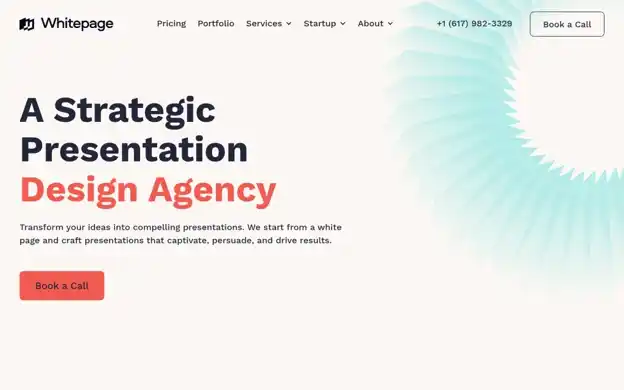
The team at Whitepage has spent over 12 years building investor-ready presentations across healthcare, technology, finance, and nonprofit sectors. For healthcare founders, they've worked on messaging, visual identity, brand guidelines, and sales decks, all areas where clarity and precision genuinely matter. Their focus on data visualization and complex information simplification makes them a natural fit for founders trying to compress years of clinical evidence into a compelling 15-slide deck. With 10,000+ completed projects and clients securing over $1.7 billion in acquisitions, the results speak for themselves. To learn more about their work, visit the Whitepage Studio website, where founders can explore examples of investor presentations, branding projects, and healthcare-focused design work.
The real challenge for healthcare founders isn't finding a designer. It's finding one who won't accidentally overstate a clinical outcome or strip the scientific credibility out of a data slide. WhitePage Studio's direct CEO involvement means high-stakes healthcare decks get senior-level attention from someone who understands what investors are actually scrutinizing.
From what the reviews show, clients come back consistently, which is rare in a space where one-and-done project work is the norm. Clutch testimonials point to strong communication, on-time delivery, and a real ability to understand complex industries without needing excessive hand-holding. Multiple clients mention receiving completed work ahead of schedule, which (honestly) is not something you hear often in the design world.
Storydoc turns static slide decks into scroll-based, web-native documents that track exactly how investors engage with the content. For healthcare founders, this means knowing whether a potential backer dropped off at the clinical trial slide or actually read through the reimbursement model. The platform supports multimedia embedding, CRM connections, and real-time engagement analytics, so teams can iterate based on actual behavioral data rather than guesswork. It's not healthcare-focused, but its strength in turning dense information into digestible visual stories makes it genuinely useful for investor communications.
Healthcare pitch decks rarely get reviewed in a live meeting. They get shared asynchronously, which means knowing how investors actually read them is incredibly useful information. Storydoc's engagement analytics (tracking completion rates, scroll depth, and time per slide) give healthtech founders a feedback loop that static PDF decks simply can't provide.
Users consistently praise the platform for being intuitive and visually impressive, with a customer support score of 9.3/10 on G2 across 56 reviews. The most common criticism is pricing, particularly for early-stage startups where a monthly subscription adds up fast. From what the reviews show, teams that switch from traditional PDF decks tend to see measurably better engagement from the people they're pitching to.

Duck Design runs a subscription-based model where clients pay a flat monthly fee and get unlimited design requests across branding, UI/UX, and graphic design. Their ICARE case study, a pharmaceutical delivery app, shows they can build trust-forward visual identities for healthcare-adjacent products. The unlimited revision model is genuinely useful for complex healthcare communications, where a single clinical data visualization might go through five or six rounds before it's exactly right. That said, their work is broad by design (no pun intended), so healthcare founders should go in with clear direction.
The subscription format removes the per-project pricing anxiety that slows down iterative deck development, which matters when a healthcare pitch deck is being refined through multiple investor meetings. Their demonstrated ability to design for pharmaceutical and medical app contexts shows they can handle the visual vocabulary of the healthcare space, even without deep regulatory knowledge.
Across 58 verified Clutch reviews and a Trustpilot rating of 4.8/5, clients consistently point to fast turnaround times (same-day on some requests) and reliable creative quality. Timezone differences occasionally cause communication delays for international clients, but from what the reviews show, project outcomes aren't meaningfully affected. The word that comes up most often is "reliable," which counts for a lot when you're on a fundraising deadline.
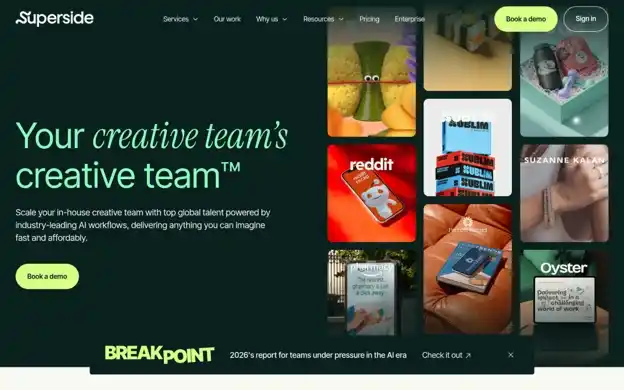
Superside operates as a Creative-as-a-Service platform, pairing enterprise teams with a global network of vetted designers through a subscription model. In healthcare, they've worked with Medecision on visual storytelling, Brio Systems on COVID testing brand and packaging, and Amazon Pharmacy on creative campaigns. Their capacity spans presentation design, branding, packaging, and motion graphics, which makes them a solid fit for larger healthcare organizations managing multiple content streams at once. The 24-to-48-hour turnaround on design tasks is their headline feature (and genuinely impressive at that scale).
Enterprise healthcare brands often need design output at a volume and speed that boutique studios can't match. Superside's dedicated project management layer and AI-supported workflows give large healthtech teams a consistent creative pipeline without the overhead of building an in-house design department.
Reviews are genuinely mixed here, which is worth flagging. G2 shows 4.5/5 across 120 reviews, with clients praising speed and design quality. But Clutch sits at 2.9/5 based on 6 reviews, with concerns around project quoting accuracy and communication responsiveness (think enterprise pricing with enterprise-level friction). Honestly, Superside works best for healthcare organizations that already have internal creative direction and need execution at scale, not for founders who need a design partner to guide the narrative.
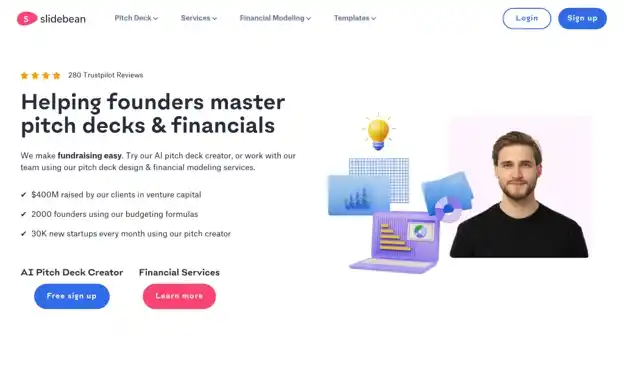
Slidebean is an AI-assisted pitch deck platform built for startup founders. The tool separates content creation from visual design, so founders focus on what to say while the system handles how it looks. Beyond the self-serve platform, their Agency tier offers consulting support for Series A and Series B rounds, including financial modeling templates that matter a lot when you're presenting TAM calculations and reimbursement model projections to healthcare-focused investors. With over 30,000 pitch decks built and involvement in raising more than $250 million, the platform has genuine fundraising credibility.
Biotech and healthtech founders are often first-time fundraisers who know the science cold but have limited experience structuring a pitch narrative for venture capital. Slidebean's AI-driven layout engine removes the design barrier so founders can spend more time refining the clinical story, which is usually where the real investor persuasion happens.
Users rate Slidebean 4.2/5 on Capterra across 59 reviews, with consistent praise for its clean templates and the ease of getting an investor-ready deck out the door quickly. The recurring frustration is limited customization, which can be a real constraint for healthcare founders who need specific data visualizations that don't fit a standard template. From what the reviews show, it's a strong starting point for early-stage fundraising, but growing companies often outgrow the platform as their decks get more complex.
Putting this list together required more than a quick scan of review sites. The process was deliberate, cross-referenced, and focused on what healthcare founders actually need from a pitch deck partner.
The starting point was a broad sweep across design directories, startup resource platforms, agency databases, and review platforms including Clutch, G2, Capterra, and Trustpilot. Search terms focused on pitch deck design for healthcare, healthtech investor presentations, and biotech fundraising deck agencies. This produced a longlist of over 40 firms and platforms operating in the presentation design space.
Unverified options were removed early. Any company without publicly visible client reviews, documented case studies, or a traceable client roster was excluded from further consideration. Review patterns were analyzed for consistency, looking at whether positive ratings clustered around real project outcomes or reflected surface-level platform satisfaction. Companies with review manipulation signals or review gaps were removed.
Website claims were cross-checked against third-party review content. If a company claimed healthcare specialization on their website but had no healthcare case studies or client mentions in verified reviews, that claim was discounted. Conversely, companies with documented healthcare client work were given additional weight even when they didn't explicitly market themselves as healthcare-first agencies.
Each company's broader presence was assessed, including mentions in founder resource lists, appearances in biotech and healthtech investment publications, and any publicly available data on funds raised by their clients post-deck delivery. While this data is often self-reported, patterns across multiple sources helped build a clearer picture of real-world outcomes.
The final filter applied to healthcare relevance. Each company was assessed for dedicated service pages targeting healthtech or biotech founders, verified reviews mentioning healthcare-specific projects, and case study portfolios covering clinical-stage companies, pharmaceutical clients, or digital health platforms. Companies that passed this layer demonstrated they could handle the specific demands of healthcare investor communications, including the balance between scientific rigor and fundraising storytelling.
Choosing the right pitch deck design partner for a healthcare fundraise isn't just about finding good design work. It's about finding a team that understands what healthcare investors are looking at and what they're skeptical of.
The right pitch deck design partner for a healthcare fundraise is the one who gets both the science and the story. Firms with documented healthcare experience, strong client retention, and a clear process for handling complex clinical data will consistently outperform general design shops in this space. As healthtech investment keeps growing and investor scrutiny tightens, founders who work with specialized design partners are better positioned to move from deck delivery to term sheet faster.


