



Top Companies in the ADC Cytotoxic Payloads and Warheads Market & Their Offerings
| Companies | Headqurters | Offerings |
| AstraZeneca plc | Cambridge, UK | Focuses on next-generation ADCs using topoisomerase I inhibitor payloads, supported by strategic collaborations. |
| F. Hoffmann-La Roche Ltd. | Basel, Switzerland | Develops ADCs with maytansinoid (DM1) and auristatin-based payloads, focusing on targeted oncology therapies and advanced linker technologies. |
| ImmunoGen, Inc. | Massachusetts, USA | Specializes in maytansinoid (DM4) and novel DNA-damaging payloads, with strong emphasis on payload innovation. |
| Pfizer Inc. | New York, USA | Offers ADCs with DNA-damaging payloads and expanded capabilities through Seagen acquisition, strengthening its oncology pipeline. |
| Seagen Inc. | Washington, USA | Pioneer in auristatin payloads (MMAE, MMAF) with strong expertise in linker-payload systems used across multiple approved ADCs. |
| Takeda Pharmaceutical Company Limited | Tokyo, Japan | Develops ADCs with auristatin-based payloads, particularly for hematological cancers, through partnerships and in-house research. |
What are the Recent Developments in the ADC Cytotoxic Payloads and Warheads Market? 
- In July 2025, Sutro Biopharma partnered with the U.S. Food and Drug Administration to advance ADC development by creating reference standards and enhancing regulatory and analytical approaches, leveraging its XpressCF cell-free protein synthesis technology.
- In May 2025, Almac Discovery and Formosa Pharmaceuticals entered a global licensing deal to advance and commercialize ALM-401, a novel bispecific antibody-drug conjugate targeting EGFR and ROR1 for the treatment of aggressive solid tumors.
Supply Chain Analysis
Clinical Trials
- Clinical trials for antibody-drug conjugates (ADCs) are increasingly focusing on next-generation payload strategies to improve effectiveness and tackle drug resistance. Researchers are moving beyond traditional microtubule inhibitors toward advanced options like topoisomerase I inhibitors and DNA-damaging agents, along with dual-payload designs to enhance therapeutic synergy.
- Key players: F. Hoffmann-La Roche Ltd., AstraZeneca plc, Pfizer Inc., Seagen Inc., Takeda Pharmaceutical Company Limited.
Distribution to Hospitals, Pharmacies
- The distribution of antibody-drug conjugate (ADC) cytotoxic payloads and finished therapies is highly complex, requiring careful handling of high-potency ingredients and temperature-sensitive drugs. This process becomes even more challenging during conflicts, where disrupted supply chains, security risks, and logistical barriers can lead to delays and shortages.
- Key players: Pfizer Inc., F. Hoffmann-La Roche Ltd., AstraZeneca plc, Lonza Group, Samsung Biologics.
Patient Support and Services
- Patient support for antibody-drug conjugate (ADC) therapies focuses on close monitoring and effective management of side effects linked to their highly potent cytotoxic payloads. Since ADCs like Enhertu and Trodelvy deliver strong chemotherapy directly to cancer cells, care must balance treatment benefits with potential toxicity from off-target effects.
- Key players: AstraZeneca plc, Daiichi Sankyo, Gilead Sciences, Pfizer Inc., and F. Hoffmann-La Roche Ltd.
Market Growth
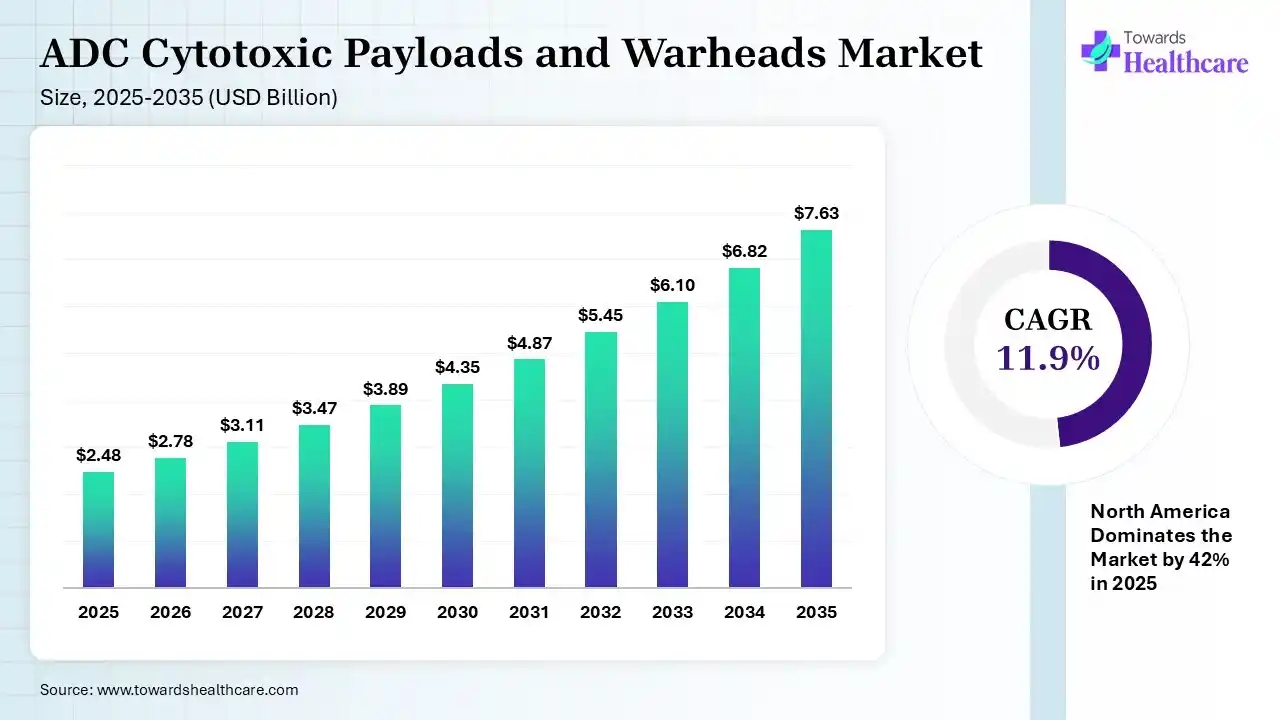
The global ADC cytotoxic payloads and warheads market size was estimated at USD 2.48 billion in 2025 and is predicted to increase from USD 2.78 billion in 2026 to approximately USD 7.63 billion by 2035, expanding at a CAGR of 11.9% from 2026 to 2035.
Keypoints
- Company Overview
- Locations Subsidiaries/Geographic reach
- Key Executives
- Company Financials
- Patents registered
- SWOT Analysis
- Applications Catered
- Strategic collaborations
- Recent Developments
- Competitive Benchmarking