



Top Vendors in the AI in Microscopy Market & Their Offering
Company Profile
| Companies | Headquarters | Offerings |
| Molecular Devices, LLC | California, USA | Develops automated imaging and high-content screening platforms integrated with AI-ready software for cellular analysis, supporting drug discovery and biological research workflows. |
| SigTuple Technologies Pvt. Ltd. | Bengaluru, India | Provides AI-based digital microscopy solutions that automate manual slide examination, enabling faster and more accurate diagnosis in pathology and hematology applications |
| Leica Microsystems | Wetzlar, Germany | Offers advanced optical microscopy systems combined with AI-enabled image analysis software to support life sciences research, digital pathology, and industrial imaging. |
| Nikon Corporation | Tokyo, Japan | Supplies high-precision microscopy and imaging systems increasingly integrated with AI tools for automated image acquisition and enhanced analytical performance in clinical and research settings. |
| Revvity Signals Software, Inc. | Massachusetts, USA | Delivers AI-driven scientific and imaging software platforms that support data analysis, image interpretation, and decision-making across microscopy-based research environments. |
| Oxford Instruments | Oxfordshire, United Kingdom | Provides advanced microscopy hardware, detectors, and imaging technologies used alongside AI algorithms to enable high-resolution analysis in materials science and life sciences research. |
Value Chain Analysis
R&D
- R&D in AI-driven microscopy focuses on automating image capture, improving image clarity, and accelerating data analysis to enhance digital pathology and biological research.
- Key players: Deepcell, ZEISS, Thermo Fisher Scientific, and Leica Microsystems.
Clinical Trials
- Clinical studies show that AI-enabled microscopy systems can match or outperform traditional manual microscopy in diagnostic accuracy, especially for detecting malaria, parasites, and blood cell abnormalities. Widely used in primary care settings, these tools demonstrate higher sensitivity and faster detection, improving infection identification.
- Key players: ZEISS, Leica Microsystems, Olympus Corporation, and Thermo Fisher Scientific.
Regulatory Approvals
-  AI in microscopy is largely governed under Software as a Medical Device (SaMD) and AI/ML-enabled medical device regulations. By late 2024, the U.S. Food and Drug Administration had authorized over 950 AI-driven medical devices, primarily within radiology and pathology.
- Key players: Roche Diagnostics, Philips Healthcare, Hologic, and Siemens Healthineers.
Market Growth
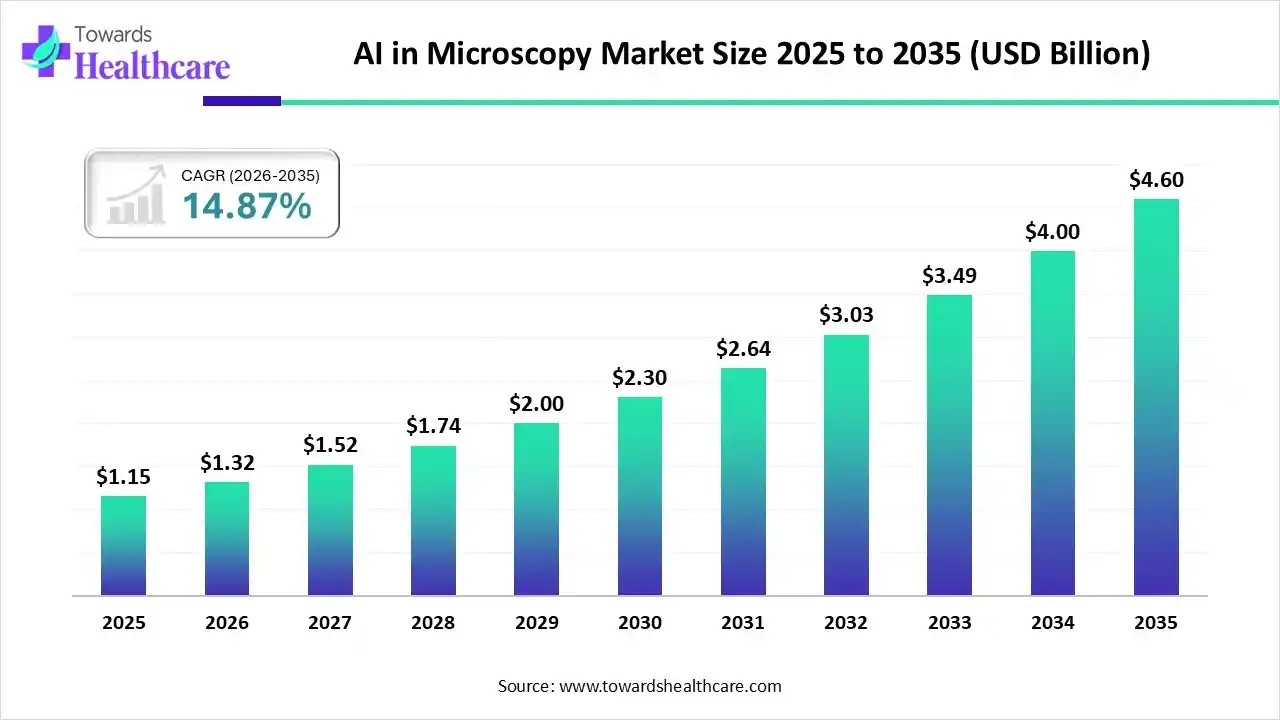
The global AI in microscopy market size was estimated at USD 1.15 billion in 2025 and is predicted to increase from USD 1.32 billion in 2026 to approximately USD 4.6 billion by 2035, expanding at a CAGR of 14.87% from 2026 to 2035.
What are the Recent Developments in the AI in Microscopy Market?
- In August 2025, ZEISS partnered with Alpenglow Biosciences to jointly develop a 3D pathology platform that integrates inverted light-sheet microscopy with AI-based data analysis, aiming to advance imaging capabilities for both clinical diagnostics and research applications.
- In February 2025, Motic Instruments formed a strategic alliance with Media Cybernetics to combine advanced microscope systems with AI-enabled Image-Pro software, supporting enhanced image analysis for both research and clinical imaging applications.
Gain full visibility into the AI in Microscopy landscape with one streamlined view - Access the Dashboard
Keypoints
- Company Overview
- Locations Subsidiaries/Geographic reach
- Key Executives
- Company Financials
- Patents registered
- SWOT Analysis
- Applications Catered
- Strategic collaborations
- Recent Developments
- Competitive Benchmarking