The global AI in microscopy market size was estimated at USD 1.15 billion in 2025 and is predicted to increase from USD 1.32 billion in 2026 to approximately USD 4.6 billion by 2035, expanding at a CAGR of 14.87% from 2026 to 2035.
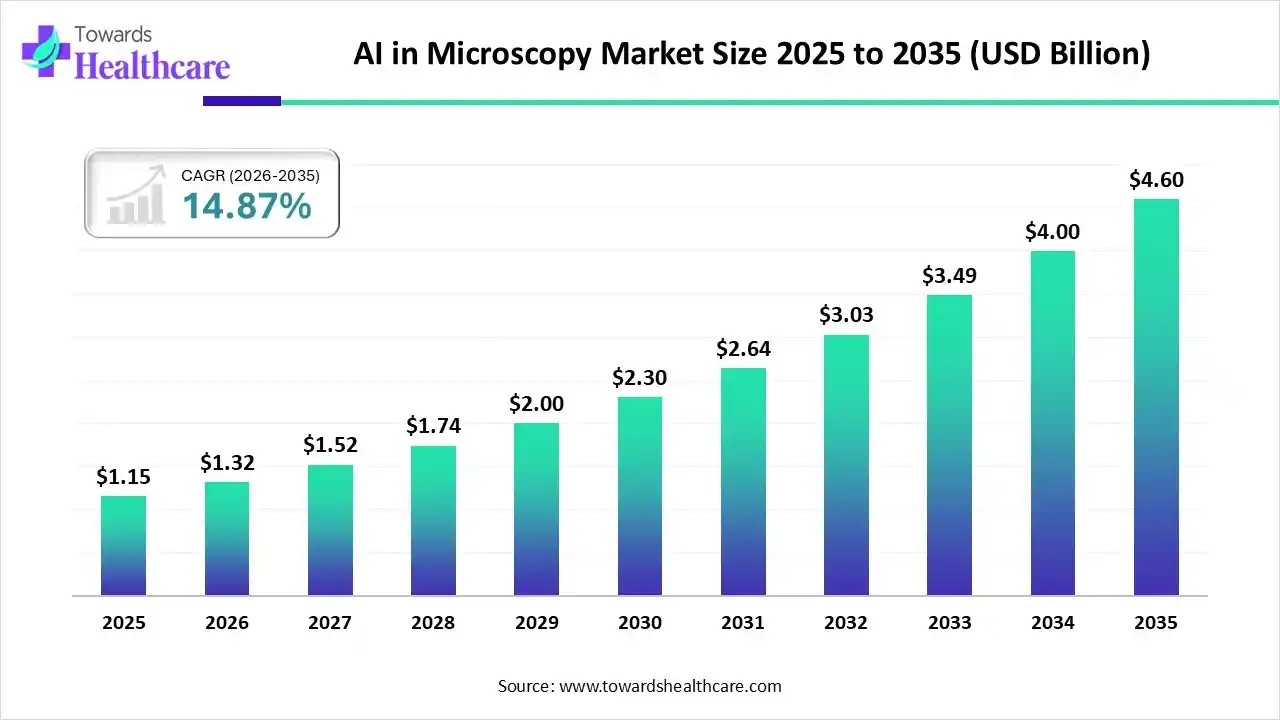
The market is growing due to rising demand for automated image analysis, improved diagnostic accuracy, and faster research workflows, with increasing adoption across life sciences, healthcare, and industrial research applications.
AI in microscopy refers to the use of artificial intelligence algorithms to automate image acquisition, enhance image quality, and enable rapid, accurate analysis of microbiology data for research, diagnostic, and industrial applications. The AI in microscopy market is growing due to increasing demand for automated image analysis, higher diagnostic accuracy, and reduced manual interpretation. AI enables faster data processing, improved reproducibility, and precise detection of complex cellular structures, making it highly valuable in life sciences research, clinical diagnostics, and pharmaceutical development.
For Instance,
| Disease | Global Infectious Disease Cases in (Million) |
| Diarrheal Diseases | 1700 million |
| Lower Respiratory Infections | 650 million |
| Malaria | 282 million |
| Tuberculosis | 10.7 million |
| HIV | 1.3 million |
| Neglected Tropical Diseases (NTDs) | 1495 million |
| Table | Scope |
| Market Size in 2026 | USD 1.32 Billion |
| Projected Market Size in 2035 | USD 4.6 Billion |
| CAGR (2026 - 2035) | 14.87% |
| Leading Region | North America by 53% |
| Historical Data | 2020 - 2023 |
| Base Year | 2025 |
| Forecast Period | 2026 - 2035 |
| Measurable Values | USD Millions/Units/Volume |
| Market Segmentation | By Microscopy Type, By Component, By End-use, By Region |
| Top Key Players | Molecular Devices, LLC, SigTuple Technologies Pvt. Ltd., Leica Microsystems, Nikon Corporation, Revvity Signals Software, Inc., Oxford Instruments |
Why Did the Optical Microscopy Segment Dominate in the Market in 2025?
The optical microscopy segment dominated the AI in microscopy market due to its widespread adoption, affordability, and compatibility with AI-based image analysis tools. Its extensive use in life sciences, clinical diagnostics, and academic research, along with established infrastructure and ease of integration with automation and deep learning software, supported faster implementation compared to advanced, high-cost microscopy technologies.
Electron Microscopy
The electron microscopy segment is expected to grow at the fastest CAGR because AI can significantly enhance its high-resolution imaging capabilities, enabling advanced data interpretation and automated feature detection. Rising demand in materials science, nanotechnology, and advanced biological research, combined with increasing investment in AI-driven analytical tools, is accelerating the adoption of AI-enabled electron microscopy for more detailed and precise imaging than traditional methods.
How the AI-enabled Microscopes (Hardware) Segment Dominated the AI in Microscopy Market in 2025?
The AI-enabled microscopes (hardware) segment dominated the market because integrating AI directly into microscope systems improved real-time image processing, automation, and accuracy. Strong demand from research labs and clinical facilitates foe smaller, ready-to-use instruments, combined with ongoing hardware upgrades and manufacturers' innovation, made AI-enabled microscopes more attractive and accessible than standalone software solutions.
AI-based Microscopy Software
The AI-based microscopy software segment is expected to grow at the fastest CAGR during the forecast period due to its scalability, flexibility, and cost-effectiveness. These solutions can be easily integrated with existing microscope systems, enabling advanced image analysis, automation, and cloud-based data processing. Rising demand for customizable, upgradable AI tools across research, clinical diagnostics, and pharmaceutical applications further supports rapid market expansion.
Why the Hospital Laboratories Segment Dominated the AI in Microscopy Market?
The hospital laboratories segment dominated the market because hospitals increasingly adopt A tools to improve diagnostic accuracy, workflow efficiency, and turnaround times for pathology and clinical tests. Integration of AI enhances the detection of diseases like cancer and infections, supports automated image analysis, and reduces manual errors. Growing healthcare investments and demand for faster, reliable results further drove adoption in hospital settings.
Pharmaceutical & Biotechnology Companies
The pharmaceutical & biotechnology companies segment is expected to grow at the fastest CAGR because these industries are increasingly using AI-powered microscopy to accelerate drug discovery, automate high-throughput screening, and improve cellular analysis. Rising R&D investments, demand for faster development timelines, and the need for detailed biological insights drive the adoption of AI tools that enhance accuracy, efficiency, and scalability in research workflows.
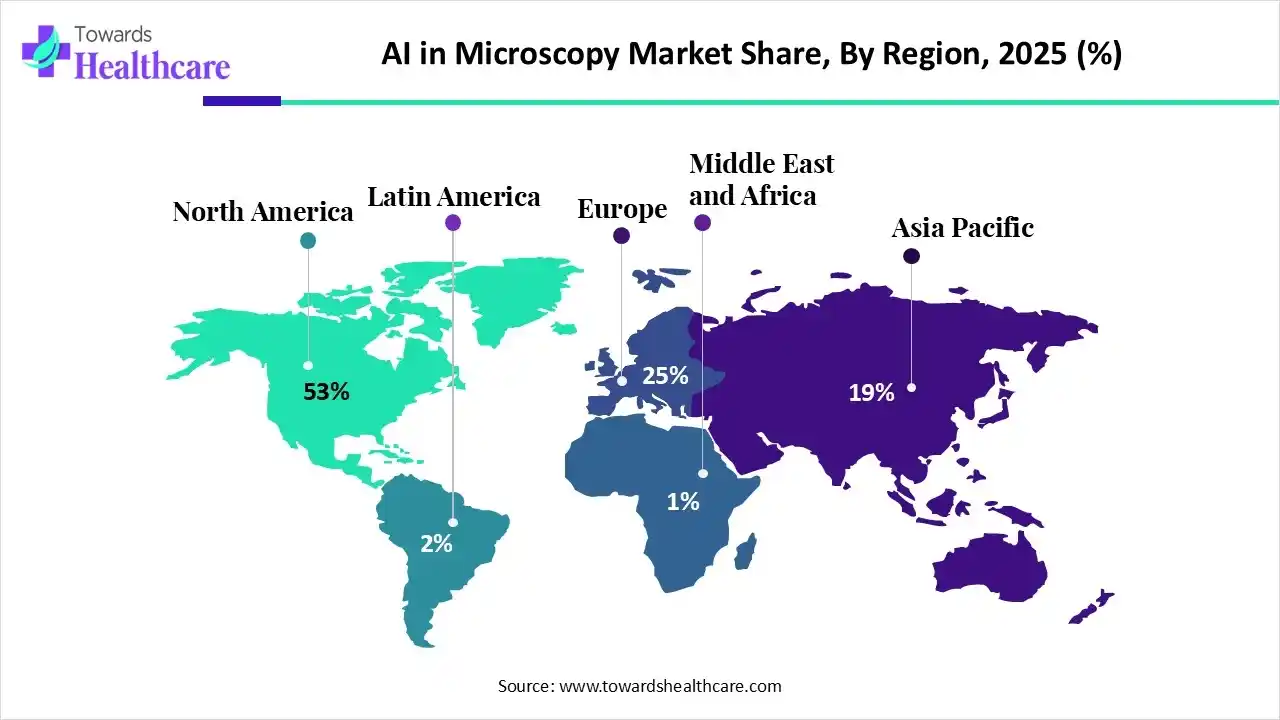
North America dominated the global AI in microscopy market by 53% share in 2025 due to strong investments in healthcare research, early adoption of advanced imaging technologies, and the presence of leading AI and life-science companies. Well-established research infrastructure, high R&D funding, growing use of AI in clinical diagnostics, and supportive government initiatives further accelerated market leadership across the region.
For Instance,
U.S.: Driving Revenue Leadership in AI Microscopy
The United States led the AI in Microscopy market in 2025 by capturing the largest revenue share due to strong R&D investments, early adoption of A-enabled imaging technologies, and the presence of major biotechnology, pharmaceutical, and AI solution providers. Advanced healthcare infrastructure, high research funding, and growing use of AI in clinical diagnostics and drug discovery further strengthened market dominance.
The Asia Pacific region is anticipated to grow by 19% share at the fastest CAHR during the forecast period due to rising healthcare investments, expanding pharmaceutical and biotechnology industries, and increasing adoption of AI-driven imaging technologies. Rapid growth in academic research, improving laboratory infrastructure, government support for digital healthcare, and a large patient population further accelerate demand for AI-enabled microscopy across emerging economies.
What Factors Are Accelerating AI in Microscopy Adoption in India?
India is anticipated to grow at a rapid CAGR during the forecast period due to expanding pharmaceutical and biotechnology sectors, rising healthcare digitization, and increasing adoption of AI-based diagnostic technologies. Growing investments in research infrastructure, supportive government initiatives, cost-effective talent availability, and increasing focus on precision medicine and clinical research are further accelerating the adoption of AI-enabled microscopy across academic, clinical, and industrial laboratories.
Europe is expected to grow by 25% share at a notable CAGR in the AI in microscopy market during the forecast period due to strong government support for research and innovation, increasing adoption of AI in healthcare diagnostics, and well-established life science infrastructure. Rising investments in academic research, growing focus on precision medicine, and collaboration between research institutes and technology providers are further driving the adoption of Ai-enabled microscopy across the region.
Why Is the UK Accelerating the Adoption of AI in Microscopy Market?
The UK is anticipated to grow at a rapid CAGR during the forecast period due to strong investments in biomedical research, increasing adoption of AI in clinical diagnostics, and a well-developed life science ecosystem. Government -backed innovation programs, rising collaboration between academia and industry, and growing demand for advanced imaging in drug discovery and precision medicine are further accelerating market growth across the country.
R&D
Clinical Trials
Regulatory Approvals
| Companies | Headquarters | Offerings |
| Molecular Devices, LLC | California, USA | Develops automated imaging and high-content screening platforms integrated with AI-ready software for cellular analysis, supporting drug discovery and biological research workflows. |
| SigTuple Technologies Pvt. Ltd. | Bengaluru, India | Provides AI-based digital microscopy solutions that automate manual slide examination, enabling faster and more accurate diagnosis in pathology and hematology applications |
| Leica Microsystems | Wetzlar, Germany | Offers advanced optical microscopy systems combined with AI-enabled image analysis software to support life sciences research, digital pathology, and industrial imaging. |
| Nikon Corporation | Tokyo, Japan | Supplies high-precision microscopy and imaging systems increasingly integrated with AI tools for automated image acquisition and enhanced analytical performance in clinical and research settings. |
| Revvity Signals Software, Inc. | Massachusetts, USA | Delivers AI-driven scientific and imaging software platforms that support data analysis, image interpretation, and decision-making across microscopy-based research environments. |
| Oxford Instruments | Oxfordshire, United Kingdom | Provides advanced microscopy hardware, detectors, and imaging technologies used alongside AI algorithms to enable high-resolution analysis in materials science and life sciences research. |
Strengths
Weaknesses
Opportunities
Threats
In January 2026, Alpenglow Biosciences and PathNet announced an alliance to promote the national platform for 3D AI cancer diagnostics. Dr. Nicholas Reder, CEO of Alpenglow Biosciences, noted that PathNet’s leadership in urologic oncology, digitization, AI, and strong national footprint make it an exceptional partner as we bring clinical 3D pathology to market. Together, we are building diagnostic tools that deliver insights not achievable with conventional 2D histology.
By Microscopy Type
By Component
By End-use
By Region





Reviewed By
Aditi Shivarkar is a seasoned professional with over 14 years of experience in healthcare market research. As a content reviewer, Aditi ensures the quality and accuracy of all market insights and data presented by the research team.
Learn more about Aditi Shivarkar