



Companie's Offerings in the Cell Identification Technology Market
| Company | Description |
| Thermo Fisher Scientific | This firm facilitates instrumentation, imaging systems, & molecular tools, massively branded under Invitrogen & Thermo Scientific.  |
| Becton Dickinson and Company | Its offerings cover a complete portfolio of cell identification & analysis technologies, emphasizing flow cytometry, spectral analysis, & single-cell multiomics.  |
| Danaher Corporation | A company explores Molecular Devices, Leica Microsystems, & Beckman Coulter Life Sciences. |
| Merck KGaA | This majorly offers from manual counting to high-throughput imaging & flow cytometry. |
| Agilent Technologies | A firm provides diversity from high-throughput flow cytometry to label-free live-cell imaging. |
| Bio-Rad Laboratories | This company specializes in flow cytometry for both life science research & clinical diagnostics. |
| Sartorius AG | It offers technologies through its CellCelector Flex imaging platform & iQue 3/5 high-throughput cytometry. |
| Illumina | A leader unveils high-throughput technologies for cell identification, characterization, & molecular analysis at the single-cell level. |
| QIAGEN | Its offerings range from sample preparation to digital PCR & NGS-based insights. |
| Miltenyi Biotec | It is focused on its proprietary MACS (Magnetic Activated Cell Sorting) Technology & flow cytometry solutions. |
What are the Recent Developments in the Cell Identification Technology Market?
- In March 2026, Parse Biosciences commercially launched Evercode Whole Transcriptome FFPE kits to allow true whole transcriptome single cell RNA sequencing from formalin-fixed, paraffin-embedded samples.
- In February 2026, Quest Diagnostics rolled out a new blood test by using advanced flow cytometry methods to evaluate measurable residual disease (MRD) in patients with the blood cancer myeloma.
- In June 2025, Thermo Fisher Scientific Inc. unveiled the spectral-enabled Invitrogen Attun Xenith Flow Cytometer, enabling immunology & immuno-oncology researchers to automate & simplify workflows to gain deeper & more accurate insights from critical cellular samples.
Market Growth
The global cell identification technology market size was estimated at USD 18.72 billion in 2025 and is predicted to increase from USD 20.52 billion in 2026 to approximately USD 46.82 billion by 2035, expanding at a CAGR of 9.6% from 2026 to 2035.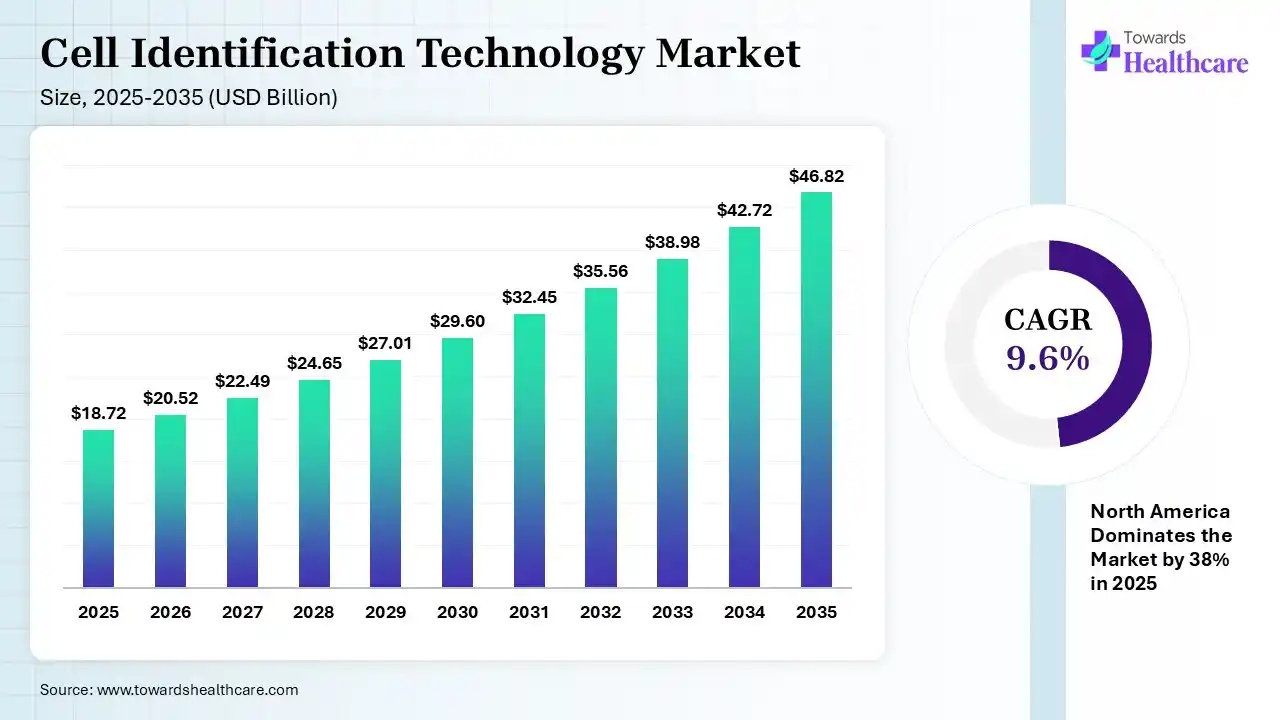
Keypoints
- Company Overview
- Locations Subsidiaries/Geographic reach
- Key Executives
- Company Financials
- Patents registered
- SWOT Analysis
- Applications Catered
- Strategic collaborations
- Recent Developments
- Competitive Benchmarking