



Top Key Players in the Healthcare Data Monetization Market
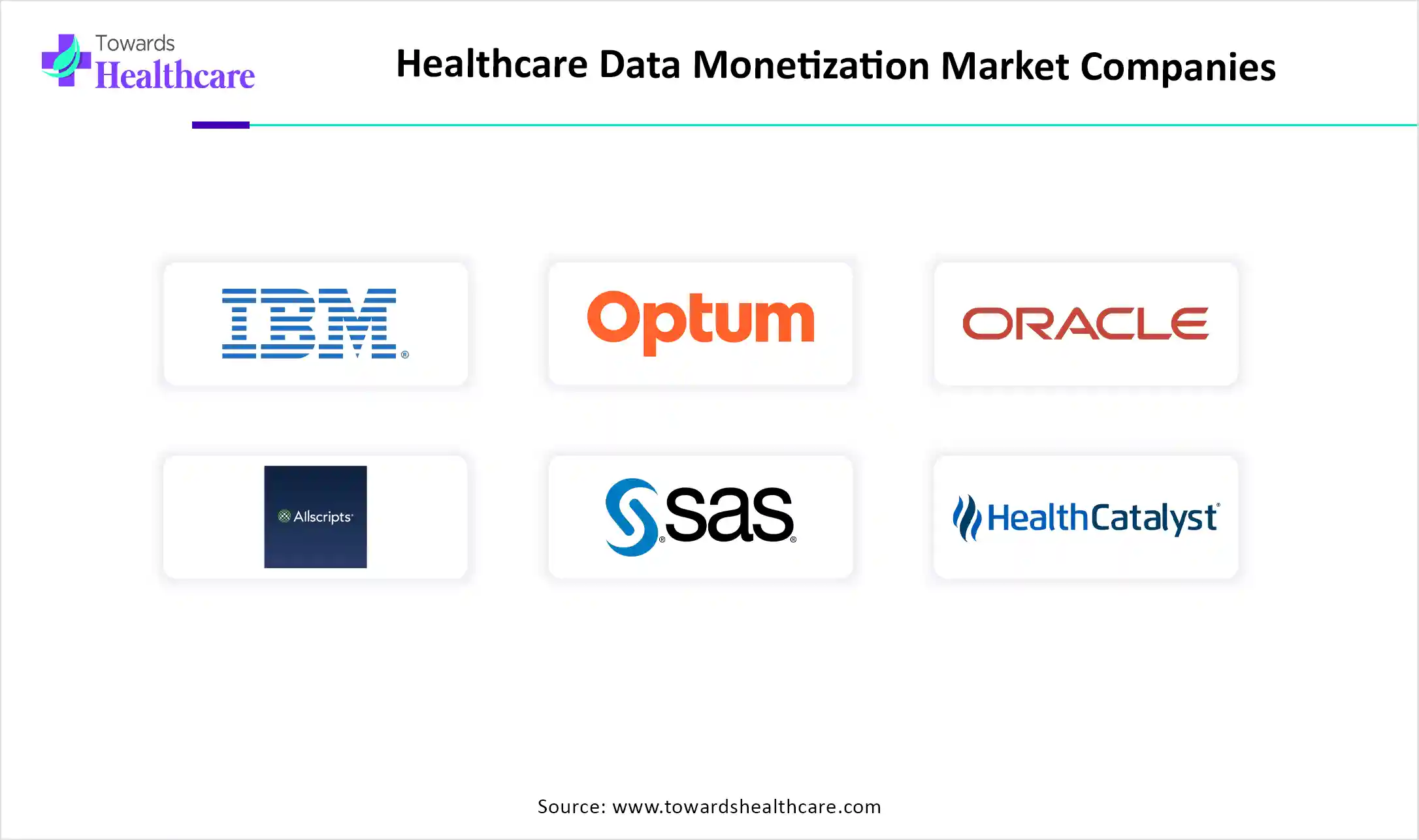
- IBM Corporation
- Optum (UnitedHealth Group)
- Oracle Corporation
- Allscripts Healthcare Solutions
- SAS Institute
- Health Catalyst
- MedeAnalytics
- Truven Health Analytics (IBM Watson Health)
- IQVIA
- Flatiron Health
- Datavant
- Humana Inc.
- Change Healthcare
- Explorys (IBM Watson Health)
- Epic Systems Corporation
- Philips Healthcare
- Innovaccer
- Symphony Health
- Parexel International
Company Profile
| Company | Headquarter | Annual Revenue | Year |
| IBM Corporation | Armonk, New York, USA | $61.9 billion | 2023 |
| Optum (UnitedHealth Group – Optum segment) | Eden Prairie, Minnesota, USA | $226.6 billion | 2023 |
| Oracle Corporation | Austin, Texas, USA | $53.0 billion | FY 2024 |
| SAS Institute | Cary, North Carolina, USA | $3.6 billion | 2023 |
| Health Catalyst | South Jordan, Utah, USA | $0.303 billion | 2023 |
| IQVIA | Durham, North Carolina, USA | $15.37 billion | 2023 |
| Humana Inc. | Louisville, Kentucky, USA | $106.4 billion | 2023 |
| Philips Healthcare (Koninklijke Philips N.V.) | Amsterdam, Netherlands | €18.0 billion | 2023 |
| Epic Systems Corporation | Verona, Wisconsin, USA | $4.1 billion | 2023 (company-reported) |
| Symphony Health (ICON plc parent revenue) | Blue Bell, Pennsylvania, USA | $8.12 billion | 2023 |
IBM Corporation
Overview
IBM is a global technology and consulting company known for hybrid cloud, AI, and industry solutions. In healthcare, IBM focuses on data platforms, hybrid cloud infrastructure, cybersecurity, and analytics that help providers, payers, and life sciences organizations modernize operations and improve outcomes.
Top Products
-
Hybrid Cloud & Red Hat OpenShift for secure, multi-cloud healthcare workloads
-
IBM Watsonx platform for AI development, governance, and model lifecycle
-
IBM Security & QRadar for healthcare cybersecurity and compliance
Global Impact
-
Supports national-scale health systems with secure cloud and analytics modernization
-
Enables cross-border research collaboration via governance-ready data platforms
-
Reduces operational costs for providers through automation and IT optimization
AI Role
-
Watsonx foundation models for clinical NLP, coding assistance, and back-office automation
-
AI-driven observability and AIOps to keep EHR and imaging systems resilient
-
Responsible AI toolkits for bias monitoring, lineage, and audit readiness
SWOT Analysis
-
Strengths: Deep enterprise credibility; hybrid cloud + AI stack; global services footprint.
-
Weaknesses: Complex portfolio; migration costs for legacy clients; slower to market than cloud-natives.
-
Opportunities: GenAI copilots for revenue cycle; AI security; healthcare data interoperability.
-
Threats: Rapid innovation by hyperscalers; evolving regulations; talent competition.
Recent Development
-
Expanded healthcare-ready Watsonx governance features for audited AI use
-
New partnerships to modernize payer analytics on OpenShift and mainframe hybrid stacks
-
Strengthened MDR/XDR offerings to counter healthcare ransomware
Optum (UnitedHealth Group)
Overview
Optum provides care delivery, pharmacy benefits, analytics, and technology solutions. It integrates clinical, claims, and pharmacy data to drive value-based care across millions of members and thousands of provider groups.
Top Products
-
Optum Insight analytics & revenue cycle services
-
Optum Rx pharmacy care services and specialty management
-
Optum Health care delivery and virtual care platforms
Global Impact
-
Scales value-based arrangements that improve quality metrics and total cost of care
-
Advances medication adherence and specialty drug affordability at population scale
-
Accelerates provider financial resilience through outsourced RCM
AI Role
-
Predictive risk stratification and care gap closure models
-
GenAI for coding, prior authorization summarization, and clinical documentation
-
AI-supported pharmacy optimization for therapy selection and adherence
SWOT Analysis
-
Strengths: Scale across payer, PBM, and provider; data richness; execution in value-based care.
-
Weaknesses: Integration complexity; regulatory scrutiny; perceived conflicts across segments.
-
Opportunities: Home-based care analytics; biosimilar adoption; AI-first RCM.
-
Threats: Policy changes on PBMs; cyber threats; competition from tech entrants.
Recent Development
-
Broadened virtual/hybrid care pathways for chronic disease management
-
Rolled out AI-assisted coding and denial prevention programs for providers
-
Expanded biosimilar and specialty optimization initiatives in pharmacy
Oracle Corporation
Overview
Oracle delivers cloud applications and infrastructure. In healthcare, Oracle focuses on clinical systems, data platforms, and payer/provider analytics—aiming to unify operations from front office to EHR and financials.
Top Products
-
Oracle Cloud Infrastructure (OCI) for regulated health workloads
-
Oracle Fusion Cloud Applications (ERP/EPM/HCM/SCM) for health enterprises
-
Healthcare data platform and analytics services integrating clinical + operational data
Global Impact
-
Helps ministries and IDNs consolidate finance, HR, and supply chain for resilience
-
Powers research-scale data warehousing and real-time analytics
-
Supports global supply visibility for critical medical products
AI Role
-
GenAI services embedded in Fusion Apps for finance, HR, and supply chain workflows
-
AI-powered anomaly detection for spend, inventory, and forecasting
-
LLM services on OCI for clinical summarization and patient engagement pilots
SWOT Analysis
-
Strengths: End-to-end apps + IaaS; strong database pedigree; global scale.
-
Weaknesses: Complex licensing; migration effort from legacy systems; ecosystem lock-in perception.
-
Opportunities: Integrated ERP+EHR analytics; AI copilots for admin burden; data sovereignty clouds.
-
Threats: Intense hyperscaler competition; healthcare EHR incumbents; regulatory changes.
Recent Development
-
New GenAI assistants across Fusion Apps tailored for healthcare back-office
-
Expanded healthcare reference architectures on OCI for high availability
-
Deeper integrations between clinical data stores and enterprise analytics
SAS Institute
Overview
SAS is a leader in advanced analytics and AI. Healthcare customers use SAS for fraud/waste/abuse detection, population health, clinical analytics, and quality improvement.
Top Products
-
SAS Viya analytics platform (cloud-native)
-
SAS Health analytics solutions (fraud detection, population health)
-
SAS Model Manager & governance for regulated AI/ML
Global Impact
-
Supports national health analytics programs and payor SIU teams
-
Enables outcomes research and quality reporting across health systems
-
Improves medication safety and utilization management at scale
AI Role
-
Interpretable ML for risk prediction and resource allocation
-
NLP pipelines for unstructured clinical text and claims notes
-
Robust MLOps and validation for audit-ready models
SWOT Analysis
-
Strengths: Depth in statistics/ML; trust in regulated analytics; performance at scale.
-
Weaknesses: Steeper learning curve; premium pricing; modernization effort for legacy users.
-
Opportunities: Cloud-native Viya growth; GenAI + classical analytics combos; real-time decisioning.
-
Threats: Open-source commoditization; hyperscaler-native AI; talent shifts.
Recent Development
-
Expanded Viya on major clouds with serverless options
-
Packaged healthcare accelerators for FWA and population risk
-
New tools for model interpretability and documentation
Health Catalyst
Overview
Health Catalyst provides a healthcare data platform, analytics applications, and services that help providers and payers improve clinical, financial, and operational performance.
Top Products
-
Health Catalyst Data Operating System (DOS)
-
Analytics Apps for quality, cost, and population health
-
Professional services for data/analytics transformation
Global Impact
-
Drives measurable improvements in readmissions, LOS, and throughput
-
Enables enterprise data warehousing for multi-hospital networks
-
Supports value-based initiatives with near–real-time KPIs
AI Role
-
Machine learning libraries embedded in DOS analytics workflows
-
NLP for clinical abstraction and documentation improvement
-
GenAI-enabled insights and guided improvement recommendations
SWOT Analysis
-
Strengths: Healthcare focus; outcomes-driven engagements; strong services.
-
Weaknesses: Competes with larger platform vendors; revenue concentration in providers.
-
Opportunities: Payer growth; cloud-native accelerators; AI-driven quality abstraction.
-
Threats: Budget pressures on hospitals; EHR vendor overlap; data access constraints.
Recent Development
-
New DOS accelerators for operational efficiency and throughput
-
Partnerships to embed SDOH and claims streams into provider KPIs
-
Enhancements to quality abstraction with AI assist
IQVIA
Overview
IQVIA delivers CRO services, real-world evidence, technology platforms, and commercial solutions to life sciences. It connects clinical, claims, and consumer datasets to speed development and improve patient access.
Top Products
-
Orchestrated Clinical Trials & eCOA/eConsent suite
-
Real-World Data & Evidence (RWD/RWE) platforms
-
Commercial tech and analytics for launch and omnichannel
Global Impact
-
Accelerates clinical trials across 100+ countries
-
Informs regulatory and HTA decisions with robust RWE
-
Improves therapy access via predictive field deployment and patient services
AI Role
-
AI site selection and patient matching to reduce trial timelines
-
NLP for medical coding, safety case processing, and signal detection
-
GenAI copilots for study start-up, monitoring, and medical writing
SWOT Analysis
-
Strengths: Scale, data breadth, therapeutic expertise.
-
Weaknesses: Complexity and cost; integration challenges.
-
Opportunities: Decentralized trials; synthetic controls; AI document automation.
-
Threats: Privacy regulation shifts; sponsor insourcing; macro funding cycles.
Recent Development
-
Expanded decentralized and hybrid trial capabilities
-
New AI copilots to automate protocol and TMF tasks
-
Broader partnerships for linked RWD and EHR connectivity
Humana Inc.
Overview
Humana is a leading U.S. health insurer focused on Medicare Advantage, primary care, and home health. It invests in analytics and clinical programs to improve member experiences and outcomes.
Top Products
-
Medicare Advantage plans and care management programs
-
CenterWell primary care, home health, and pharmacy services
-
Population analytics for chronic disease and utilization
Global Impact
-
Advances senior care models emphasizing access, preventive care, and affordability
-
Scales home-based care that reduces avoidable hospitalizations
-
Drives value-based arrangements with providers nationwide
AI Role
-
Risk prediction for admissions and gaps in care
-
AI-assisted member outreach and experience personalization
-
Automation in claims adjudication and fraud detection
SWOT Analysis
-
Strengths: Medicare Advantage leadership; integrated care delivery; data-driven programs.
-
Weaknesses: MA concentration; exposure to rate changes; medical cost trend volatility.
-
Opportunities: Home health expansion; supplemental benefits; AI efficiency gains.
-
Threats: Policy risk; competitive bids; cyber and operational risks.
Recent Development
-
Expanded CenterWell footprint and home health capabilities
-
Enhanced analytics for pharmacy and medication management
-
Launched AI-enabled member engagement pilots for chronic conditions
Philips Healthcare
Overview
Philips Healthcare offers imaging, monitoring, and connected care solutions. The company focuses on patient-centric workflows, informatics, and integrated diagnostics to improve clinical efficiency and outcomes.
Top Products
-
Diagnostic imaging (MR, CT, ultrasound) and Image Guided Therapy
-
Patient monitoring and enterprise informatics
-
Sleep and respiratory care devices
Global Impact
-
Equips hospitals worldwide with connected imaging-to-reporting pathways
-
Scales ICU/telemetry monitoring across national health systems
-
Supports screening and maternal/child health programs in emerging markets
AI Role
-
AI for image reconstruction, triage, and dose optimization
-
Workflow orchestration and reporting automation across imaging suites
-
Predictive analytics for monitoring deterioration and alarm management
SWOT Analysis
-
Strengths: Strong imaging and monitoring portfolio; global service network.
-
Weaknesses: Quality and recall headwinds; complex installed-base upgrades.
-
Opportunities: Integrated diagnostics; AI-guided imaging; ambulatory monitoring.
-
Threats: Competition from other OEMs; supply chain shocks; regulatory scrutiny.
Recent Development
-
Introduced AI-accelerated MR/CT reconstruction upgrades for faster scans
-
Expanded enterprise imaging cloud with vendor-neutral interoperability
-
Advanced acute care monitoring analytics for deterioration prediction
Epic Systems Corporation
Overview
Epic is a leading EHR vendor serving large hospital systems and academic medical centers. Its integrated clinical, revenue cycle, and patient engagement stack supports longitudinal records and coordinated care.
Top Products
-
Epic EHR (Inpatient/Outpatient), MyChart patient portal
-
Epic Revenue Cycle & Cogito analytics
-
Interoperability frameworks (Care Everywhere) and payer-provider tools
Global Impact
-
Powers care coordination for large regional and national networks
-
Enables research and registries with de-identified data at scale
-
Enhances patient access via ubiquitous portals and APIs
AI Role
-
Embedded clinical decision support and sepsis/AKI predictive models
-
GenAI note summarization and ambient scribing pilots
-
Operational AI for scheduling optimization and throughput
SWOT Analysis
-
Strengths: Deep clinical workflow integration; robust ecosystem; reliability.
-
Weaknesses: High total cost; long implementations; customization complexity.
-
Opportunities: Ambient documentation; payer integration; population health AI.
-
Threats: Interoperability mandates leveling the field; best-of-breed challengers; staffing constraints.
Recent Development
-
Rolled out ambient documentation features across specialties
-
Enhanced real-time analytics and registries for population health
-
Expanded payer-provider collaboration modules for prior auth and claims edits
Veradigm (formerly Allscripts Healthcare Solutions)
Overview
Veradigm provides ambulatory EHR, practice management, revenue cycle, and a growing real-world data network. It serves physician groups, life sciences, and payers with data-driven tools.
Top Products
-
Veradigm EHR & Practice Management for ambulatory groups
-
Veradigm Payerpath and revenue cycle solutions
-
Veradigm Network & Life Sciences real-world data services
Global Impact
-
Supports independent practices with cloud EHR and RCM to remain viable
-
Connects life sciences to de-identified EHR data for outcomes research
-
Improves patient engagement and care gap closure via connected tools
AI Role
-
AI-powered claim scrubbing and denial prevention
-
Clinical NLP for chart abstraction and quality reporting
-
GenAI-assisted patient messaging and task automation
SWOT Analysis
-
Strengths: Ambulatory footprint; integrated RCM; growing data network.
-
Weaknesses: Competition from larger EHRs; historical platform fragmentation.
-
Opportunities: Life sciences data partnerships; AI claim automation; cloud migration.
-
Threats: Pricing pressure; regulatory data-sharing shifts; cybersecurity risks.
Recent Development
-
New ambulatory workflow enhancements and interoperability updates
-
Expanded data partnerships for life sciences and payers
-
Introduced AI features for coding and front-office automation
Symphony Health (an ICON plc company)
Overview
Symphony Health provides healthcare data, analytics, and consulting focused on prescription, claims, and patient insights. As part of ICON plc, it supports life sciences commercialization and outcomes analysis.
Top Products
-
Integrated prescription and claims datasets for market insights
-
Patient longitudinal analytics and adherence solutions
-
Commercial effectiveness and forecasting services
Global Impact
-
Informs launch strategy and access for therapies across major markets
-
Enables adherence programs that improve patient outcomes
-
Supports policymakers and payers with utilization and cost analytics
AI Role
-
Machine learning for demand forecasting and patient segmentation
-
NLP to normalize unstructured sources and categorize HCP interactions
-
GenAI to accelerate insight generation and reporting
SWOT Analysis
-
Strengths: Rich pharmacy and claims assets; commercialization expertise; ICON synergy.
-
Weaknesses: Dependent on data licensing; competition in RWD/RWE space.
-
Opportunities: Linked EHR + claims panels; specialty therapy insights; AI summary copilots.
-
Threats: Privacy/consent changes; third-party cookie/ID shifts; data supply risk.
Recent Development
-
Expanded linked datasets and consented patient panels
-
New AI-accelerated dashboards for launch and brand teams
-
Deeper integration with ICON trial and evidence services
Market Growth
The global healthcare data monetization market size is calculated at USD 480 million in 2024, grew to USD 551.4 million in 2025, and is projected to reach around USD 1923.5 million by 2034. The market is expanding at a CAGR of 14.86% between 2025 and 2034.
Healthcare Data Monetization Market Trends
Favorable Government Support: In July 2025, the U.S. government announced opening up app-based innovation and data sharing between patients and the wider healthcare system. The initiative, CMS Aligned Network, enables the sharing of patient medical records. This scheme also allows monetization of sensitive and personal health information.
Increasing Collaboration: In July 2025, Datavault AI, Inc. and IBM announced expanded commercialization of DataScore and DataValue. The integration of AI agents and expertise helps customers streamline their enterprise financial modeling, risk assessment, and pricing strategies.
Latest Announcement by Industry Leaders
Mitesh Rao, CEO of OMNY Health, commented that life science organizations and providers struggle with time and budget constraints that hinder their ability to learn from their data. The company’s AI-driven platforms can streamline this process by partnering with AI developers to leverage data and tools, thereby accelerating breakthrough therapies and monitoring new therapies for safety signals.
Recent Developments in the Healthcare Data Monetization Market
- In January 2025, Selfii announced the launch of TripleBlind Exchange, a first-of-its-kind marketplace to enable secure access to protected health information (PHI). The platform allows application developers to access data, train LLMs, and deploy models. It also enables companies to build data-driven applications and engage in data monetization.
- In October 2024, datma launched datma.FED, an innovative two-sided marketplace, is to revolutionize the sharing, accessibility, and monetization of healthcare data. The platform connects health systems and reference labs with pharmaceutical companies and research organizations.
Become a valued research partner with us, please feel free to contact us at [email protected]
Keypoints
- Company Overview
- Locations Subsidiaries/Geographic reach
- Key Executives
- Company Financials
- Patents registered
- SWOT Analysis
- Applications Catered
- Strategic collaborations
- Recent Developments
- Competitive Benchmarking