



Who are the Top Companies and What are Their Offerings?
Recent Developments in the Market
- In April 2026, at the 2026 World Congress of Nephrology meeting, held in Yokohama, Japan, the findings of phase 3 COMMODORE 1 and 2 clinical trials were announced. The finding reported that crovalimab may offer stable improvement in the fatigue levels of paroxysmal nocturnal hemoglobinuria (PNH) patients.
- In October 2025, PiaSky, a drug for the treatment of paroxysmal nocturnal hemoglobinuria (PNH) developed by Chugai Pharmaceutical Co., Ltd., was launched by Chugai Pharma Taiwan Ltd. (CPT). The drug is the first subcutaneous treatment approved in Taiwan for patients aged 13 years and older with at least 40 kg of body weight.
Market Ecosystem Analysis
| Ecosystem Segment | Key Participants | Role in Market |
| Technology Providers | AstraZeneca/Alexion, Roche, Novartis, Apellis | Development of complement pathway therapies |
| Product Manufacturers | AstraZeneca, Roche, Novartis, Apellis, Sanofi | Manufacturing biologics and targeted therapies |
| Service Providers | Specialty infusion centers, hospital networks | Drug administration and patient monitoring |
| Platform Providers | Complement biology and monoclonal antibody technology firms | Enable next-generation therapeutic development |
| CROs | IQVIA, ICON, Syneos Health, Parexel | Clinical trial management and regulatory support |
| CDMOs | Lonza, Samsung Biologics, Fujifilm Diosynth | Biol |
Market Value Chain Analysis
R&D
- The R&D of the Japan paroxysmal nocturnal hemoglobinuria treatment focuses on mitigating residual extravascular hemolysis, expanding oral or long-acting subcutaneous delivery methods, and overcoming domestic C5 genetic mutations.
- Key players: AstraZeneca plc, Novartis AG, and Chugai Pharmaceuticals.
Clinical Trials and Regulatory Approvals
- The therapeutic safety, efficacy, long-term stabilization of hemoglobin levels, and prevention of intravascular and extravascular hemolysis are evaluated in the clinical trials and regulatory approvals of the paroxysmal nocturnal hemoglobinuria treatment in Japan.
- Key players: AstraZeneca plc, Novartis AG, and Chugai Pharmaceuticals.
Formulation and Final Dosage Preparation
- The formulation and final dosage preparation of the paroxysmal nocturnal hemoglobinuria treatment in Japan involves the development of high-concentration subcutaneous solutions, immediate-release oral tablets, and lyophilised powders.
- Key players: AstraZeneca plc, Novartis AG, and Chugai Pharmaceuticals.
Packaging and Serialization
- The packaging and serialization of paroxysmal nocturnal hemoglobinuria treatment in Japan involve the use of temperature-insulated cold chain boxes with GS-1-compliant data matrix barcodes for real-time traceability.
- Key players: AstraZeneca plc, Novartis AG, and Chugai Pharmaceuticals.
Distribution to Hospitals, Pharmacies
- The specialized cold chain orphan drug networks and strictly monitored medical procurement channels are responsible for the distribution of paroxysmal nocturnal hemoglobinuria treatments to the hospitals and pharmacies in Japan.
- Key players: AstraZeneca plc, Novartis AG, and Chugai Pharmaceuticals.
Patient Support and Services
- The subsidized copayment navigation under the Intractable Diseases Healthcare Act, disease education kits, personalized home nursing coordination, and 24/7 adverse event hotlines are provided in the patient support and services of the paroxysmal nocturnal hemoglobinuria treatment in Japan.
- Key players: AstraZeneca plc, Novartis AG, and Chugai Pharmaceuticals.
| Tier 1 | ||||
| Company Name | Headquarters | Country | Why Relevant to This Market | Key Products/Services Related to PNH |
| AstraZeneca | Cambridge, England | UK | Market leader through Alexion franchise; established standard of care | Soliris (eculizumab), Ultomiris (ravulizumab), Voydeya (danicopan) |
| Novartis | Basel | Switzerland | First oral monotherapy approved in Japan | Fabhalta (iptacopan) (Grand View Research) |
| Roche | Basel | Switzerland | Developer of crovalimab/PiaSky | PiaSky (crovalimab) (Chugai Pharmaceutical) |
| Apellis Pharmaceuticals | Waltham, Massachusetts | USA | Leading C3 inhibition innovator | Empaveli (pegcetacoplan) (Grand View Research) |
| Sanofi | Paris | France | Expanding rare disease portfolio and complement pathway investments | Rare disease biologics and immunology portfolio |
| Tier 2 | ||||
| Company Name | Headquarters | Country | Why Relevant to This Market | Key Products/Services Related to PNH |
| Chugai Pharmaceutical | Tokyo | Japan | Commercializes PiaSky in Japan | PiaSky (crovalimab) (Chugai Pharmaceutical) |
| BioCryst Pharmaceuticals | Durham, North Carolina | USA | Developing complement pathway assets | Oral complement-targeted pipeline (Grand View Research) |
| Amgen | Thousand Oaks, California | USA | Biosimilar and complement-related hematology presence | Bkemv (eculizumab biosimilar) (Reuters) |
| Regeneron Pharmaceuticals | Tarrytown, New York | USA | Complement and immunology research programs | Complement-targeted pipeline assets |
| Johnson & Johnson | New Brunswick, New Jersey | USA | Emerging rare hematology investments | Rare disease and hematology pipeline (Grand View Research) |
| Tier 3 | ||||
| Company Name | Headquarters | Country | Why Relevant to This Market | Key Products/Services Related to PNH |
| Pfizer | New York, New York | USA | Active in rare disease development and hematology | Rare disease biologics pipeline |
| Sobi | Stockholm | Sweden | Commercialization partner for Empaveli in several markets including Japan collaboration activities | PNH commercialization support (Grand View Research) |
| Omeros Corporation | Seattle, Washington | USA | Complement pathway inhibitor development | MASP-2 inhibitor programs |
| Annexon Biosciences | Brisbane, California | USA | Complement biology specialist | Classical complement inhibition platform |
| Akari Therapeutics | Boston, Massachusetts | USA | Focused complement-mediated disease therapies | Complement inhibitor pipeline |
Market Growth
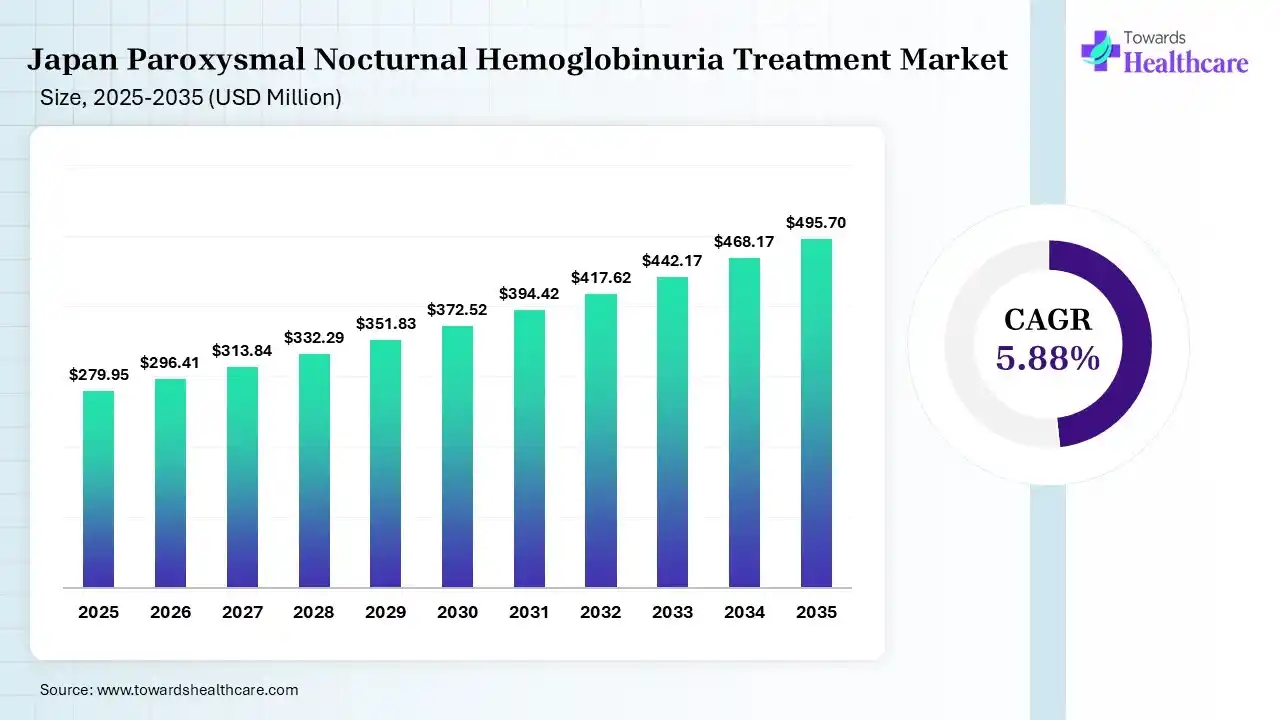
The Japan paroxysmal nocturnal hemoglobinuria treatment market size was valued at US$ 279.95 million in 2025 and is projected to grow to 296.41 million in 2026. Forecasts suggest it will reach approximately US$ 495.7 million by 2035, registering a CAGR of 5.88% during the period.
Keypoints
- Company Overview
- Locations Subsidiaries/Geographic reach
- Key Executives
- Company Financials
- Patents registered
- SWOT Analysis
- Applications Catered
- Strategic collaborations
- Recent Developments
- Competitive Benchmarking