



Top Companies in the Metastatic Pancreatic Cancer Treatment Market & Their Offerings
AstraZeneca PLC
Headquarters: Cambridge, United Kingdom
Offerings: Offers PARP inhibitors (e.g., Lynparza for BRCA-mutated pancreatic cancer) and other targeted therapies, focusing on precision medicine and combination regimens.
Pfizer Inc.
Headquarters: New York, USA
Offerings: Develops targeted agents and immunotherapy options, including monoclonal antibodies and biomarker-driven programs that address mutation-driven tumors.
Novartis AG
Headquarters: Basel, Switzerland
Offerings: Focuses on molecularly targeted therapies and precision oncology treatments such as Lutathera for neuroendocrine tumors, while advancing adaptive clinical strategies.
Amgen Inc.
Headquarters: California, USA
Offerings: Works on precision medicines targeting specific oncogenic mutations like KRAS and immunomodulatory therapies in pancreatic cancer.
F. Hoffmann-La Roche Ltd.
Headquarters: Basel, Switzerland
Offerings: Provides integrated portfolios of targeted drugs, companion diagnostics, and precision medicine solutions to optimize individualized care.
Merck & Co., Inc.
Headquarters: New Jersey, USA
Offerings: Leader in immunotherapy with checkpoint inhibitors and extensive clinical research across combination strategies.
Bristol-Myers Squibb
Headquarters: New York, USA
Offerings: Focuses on immuno-oncology with checkpoint inhibitors and combination regimens to enhance therapeutic efficacy.
Value Chain Analysis
R&D
- Research and development in metastatic pancreatic cancer is centered on tackling drug resistance and the complex tumor microenvironment. Efforts focus on targeted agents such as KRAS and PARP inhibitors, immunotherapies, and new combination regimens like NALIRIFOX.
- Key players: Amgen, AstraZeneca, Bristol Myers Squibb, Roche, Eli Lilly, and Ipsen.
Clinical Trials
- Clinical trials for metastatic pancreatic cancer are strongly focused on KRAS-mutant tumors, advanced immunotherapy combinations such as mRNA vaccines with checkpoint inhibitors, and emerging targets like Claudin 18.2. These efforts aim to improve treatment response and survival.
- Key players: Moderna, BioNTech, Merck & Co., BeiGene, Astellas Pharma, and Zymeworks.
Patient Support and Services
- Patient support in metastatic pancreatic cancer emphasizes enhancing quality of life through coordinated, multidisciplinary care. This includes effective pain control, nutritional guidance, psychological counseling, and palliative services. Such holistic support helps manage symptoms and treatment side effects while addressing emotional well-being.
- Key players: Pancreatic Cancer Action Network (PanCAN), CancerCare, American Cancer Society, Macmillan Cancer Support, and Indian Cancer Society.
Market Growth
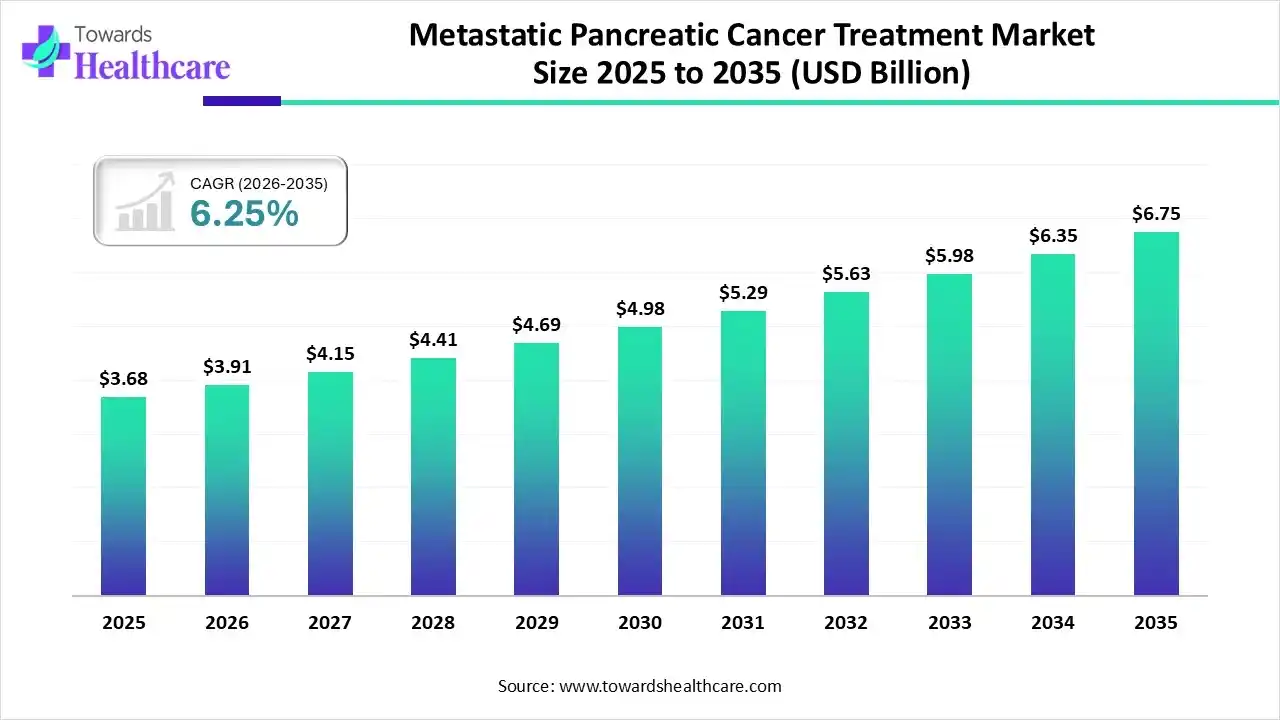
The global metastatic pancreatic cancer treatment market size was estimated at USD 3.68 billion in 2025 and is predicted to increase from USD 3.91 billion in 2026 to approximately USD 6.75 billion by 2035, expanding at a CAGR of 6.25% from 2026 to 2035.
What are the Recent Developments in the Metastatic Pancreatic Cancer Treatment Market?
- In February 2025, the FDA awarded RMAT designation to nogapendekin alfa (Anktiva) and CAR-NK (PD-L1 t-haNK), recognizing their potential to restore immune cell levels during chemo-radiotherapy and support treatment of metastatic pancreatic cancer.
- In February 2025, Alligator Bioscience completed its End-of-Phase 2 meeting with the FDA, clearing the path for a Phase 3 trial of mitazalimab combined with mFOLFIRINOX as a first-line treatment for metastatic pancreatic cancer.
From stats to insights, everything about the Metastatic Pancreatic Cancer Treatment Market is here: Access the Dashboard
Keypoints
- Company Overview
- Locations Subsidiaries/Geographic reach
- Key Executives
- Company Financials
- Patents registered
- SWOT Analysis
- Applications Catered
- Strategic collaborations
- Recent Developments
- Competitive Benchmarking