


Research indicates strong growth opportunities in the Africa vaccine manufacturing market. The Africa vaccine manufacturing market size was estimated at USD 28 million in 2025 and is predicted to increase from USD 38.64 million in 2026 to approximately USD 701.37 million by 2035, expanding at a CAGR of 38% from 2026 to 2035. Analysis also highlights that the Africa Vaccine Manufacturing market is rapidly expanding due to increasing applications, growing vaccine types, advancements in manufacturing technologies, increasing health awareness, and emergency preparedness.
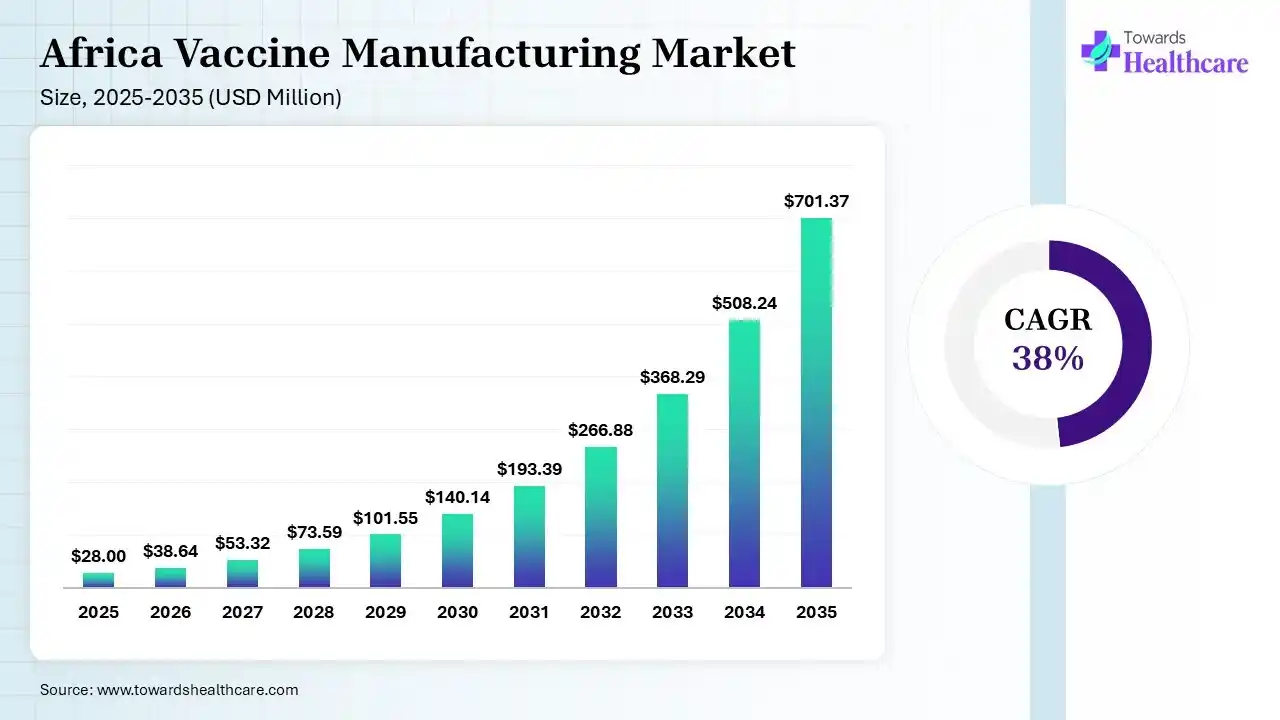
Africa vaccine manufacturing refers to the highly intricate and regulated process of developing biological preparations that provide active immunity against various diseases across Africa. It involves steps such as antigen/drug substance manufacturing, formulation, fill & finish, packaging & labeling, quality control & analytical testing, and R&D & process development. Manufacturing of vaccines should be conducted with exceptional precision in specialized facilities to ensure their safety and effectiveness.
The global vaccines market was valued at US$84.97 billion in 2025 and is expected to expand at a 4.04% CAGR from 2025 to 2035, providing the broadest addressable demand pool for African vaccine manufacturers. Moreover, the market encompasses pediatric routine immunization, outbreak vaccines, adult and travel vaccines, finished vaccine products, therapeutic vaccines, manufacturing services, related procurement models, and fill-finish and packaging.

Routine Pediatric Vaccines Segment Dominates the Market with 46% Share in 2025
| Segment/Sub-segment Name | Market Share (%) | CAGR (%) |
| Routine Pediatric Vaccines | 46% | 14.50% |
| Adult Vaccines | 12% | 21.00% |
| Outbreak & Emergency Vaccines | 15% | 26.5% |
| Travel Vaccines | 5% | 12.00% |
| Therapeutic Vaccines | 4% | 24.00% |
| Other Vaccines | 18% | 17.00% |
Based on our research, the table highlights different types of vaccines, market share, and CAGR. The routine pediatric vaccines segment held the dominant share of 46% in 2025 as governments maintained large-volume childhood programs and growth in UNICEF procurement. The outbreak & emergency vaccines segment is expected to expand rapidly with 26.5% CAGR during the forecast period, due to increasing outbreak preparedness, demand for emergency-responsive supply, and reduced dependence on overseas supply.
Live Attenuated Segment Contributed to the Market with a 22% Share in 2025
| Segment/Sub-segment Name | Market Share (%) | CAGR (%) |
| Live Attenuated | 22% | 17.50% |
| Inactivated | 20% | 18.00% |
| Conjugate | 18% | 20.50% |
| Recombinant & Subunit | 15% | 23.00% |
| Toxoid | 8% | 16.00% |
| Viral Vector | 7% | 25.00% |
| mRNA | 6% | 31.0% |
| Other Platforms | 4% | 14.00% |
The given table illustrates that the live attenuated segment held the largest share of 22% of the market in 2025 due to established technologies and comparatively mature capabilities. The mRNA segment held 6% in 2025 and is anticipated to show the highest growth of 31.0% CAGR during the predicted period, due to expanding capabilities, developing platform expertise, and rapid response to emerging pathogens.
Fill & Finish Segment Led the Market with 47% Share in 2025
| Segment/Sub-segment Name | Market Share (%) | CAGR (%) |
| Antigen/Drug Substance Manufacturing | 10% | 49.0% |
| Formulation | 13% | 42.00% |
| Fill & Finish | 47% | 34.00% |
| Packaging & Labeling | 12% | 27.00% |
| Quality Control & Analytical Testing | 10% | 36.00% |
| R&D & Process Development | 8% | 44.00% |
As per the analysis, the table highlights different stages of manufacturing along with their market share and CAGR. The fill & finish segment held the major share of 47% in 2025 as it represented the strongest existing African capability and continued new investments. The antigen/drug substance manufacturing segment is predicted to show the fastest growth with 49% CAGR during the upcoming years, due to increasing new projects and rising demand for end-to-end manufacturing.
Small Commercial Scale Segment Held a Major Revenue Share of the Market in 2025
| Segment/Sub-segment Name | Market Share (%) | CAGR (%) |
| Pilot Scale | 20% | 30.00% |
| Small Commercial Scale | 38% | 36.00% |
| Medium Commercial Scale | 30% | 42.00% |
| Large Commercial Scale | 12% | 55.0% |
The above-mentioned table confirms that the small commercial scale segment led the market with a 34% share in 2025 due to existing African production being concentrated in smaller facilities, and a rise in demand supported gradual commercial scale-up. The large commercial scale segment held 12% market share in 2025 and is expected to expand rapidly with 55% CAGR during the forecast period, as continental targets require substantially larger facilities, growing major projects, and expansion of export-oriented capacity.
National Governments Segment Held a Dominant Share of 42% of the Market
| Segment/Sub-segment Name | Market Share (%) | CAGR (%) |
| National Governments | 42% | 34.00% |
| Gavi / UNICEF Procurement | 28% | 31.00% |
| NGOs & Global Health Organizations | 12% | 28.00% |
| Private Hospitals & Clinics | 8% | 23.00% |
| Pharmaceutical Distributors | 6% | 20.00% |
| Other Buyers | 4% | 18.00% |
Based on the information gathered, the table covers various buyers or end users, market share, and CAGR. The national governments segment registered dominance over the market with 42% share in 2025 and is expected to show the highest growth with a CAGR of 34% during the upcoming years, as national immunization programs generate recurring procurement, governments increasingly prioritize domestic supply security, and public procurement remains central to vaccine access.
Routine Immunization Segment Accounted for 55% of Market Share
| Segment/Sub-segment Name | Market Share (%) | CAGR (%) |
| Routine Immunization - Dominating | 55% - Dominating | 16.00% |
| Outbreak Response - Fastest Growing | 18% | 27.0% - Fastest Growing |
| Adult & Occupational Immunization | 11% | 22.00% |
| Travel Vaccination | 7% | 12.00% |
| Therapeutic Applications | 4% | 24.00% |
| Other Applications | 5% | 18.00% |
As per the survey conducted, the table suggests that the routine immunization segment held the dominant share of 55% in 2025 due to growth in childhood programs and a rise in UNICEF procurement, which provided substantial routine vaccine volumes. The outbreak response segment held 18% market share in 2025 and is anticipated to grow at the fastest CAGR of 27% during the predicted period, due to increasing pandemic preparedness, demand for rapid deployment, and strengthening emergency supply resilience.
Intramuscular Segment Registered Dominance Over the Market with 65%
| Segment/Sub-segment Name | Market Share (%) | CAGR (%) |
| Intramuscular | 65% | 20.00% |
| Subcutaneous | 18% | 22.00% |
| Oral | 10% | 17.00% |
| Intradermal | 4% | 25.00% |
| Intranasal/Other | 3% | 29.0% |
Based on our research, the table highlights different types of vaccines, market share, and CAGR. The intramuscular segment held the dominant share of 65% in 2025, as injectable vaccines remained the principal manufacturing format and were supported by existing African sterile facilities. The intranasal/other segment is expected to expand rapidly with 29% CAGR during the forecast period, due to increasing shift towards needle-free delivery, new platforms simplifying mass immunization logistics, and growing novel delivery systems.
| TAM Indicator | Real Data/Evidence | Interpretation for African Manufacturing |
| Global vaccines market, 2025 | US$84.97B | Global ceiling for vaccine-product demand |
| Global vaccines market, 2035 | US$126.26B | Expanding long-term demand pool |
| Global vaccine CAGR, 2025–2035 | 4.04% | Baseline growth in global vaccine demand |
| Africa vaccine manufacturing market, 2025 | US$28.0M* | Current modeled African manufacturing revenue pool |
| Africa manufacturing CAGR, 2025–2035 | 38.00%* | Reflects rapid localization from a very small base |
| Africa manufacturing opportunity | Local production remains substantially below regional demand | Creates import-substitution and localization opportunity |
| TD vaccine market, 2025 | US$6.52B globally | Relevant pool for tetanus/diphtheria-containing vaccine production |
| TD vaccine market, 2035 | US$11.29B | Expanding recurring vaccine opportunity |
The given table highlights that for Africa, the relevant TAM is not the entire US$84.97 billion, where vaccine demand is the commercially relevant portion that can potentially be supplied through African-based manufacturing, contract manufacturing, technology transfer, regional production, and eventually exports. Moreover, Towards Healthcare estimates that the global TD vaccine market is valued at US$6.52 billion in 2025 and is expanding at a 5.64% CAGR, providing a measurable example of the recurring vaccine categories that African manufacturers could target through technology transfer and domestic production.
Analyst View - Routine Vaccine TAM
The routine segment, depending on procurement economics, offers the largest recurring demand base, where local manufacturers need sufficient volume commitments to offset the cost disadvantage. Therefore, local production is linked to predictable government or pooled procurement commitments and is expected to drive the strongest opportunity.
SAM - Manufacturing Opportunity
| SAM Indicator | Real Data / Evidence | Addressable Opportunity |
| Commercial-scale manufacturing | 40% of global vaccine manufacturing-stage market in your supplied framework | Core commercial production opportunity |
| Contract manufacturing | 25% | CDMO and technology-transfer opportunity |
| Clinical manufacturing | 30% | Clinical lots and development-stage production |
| Fill-finish & packaging | 20% of global vaccine-product market in supplied framework | Most accessible downstream opportunity |
| Finished vaccine products | 45% | Highest-value product opportunity |
| mRNA technology transfer | 14 African manufacturing partners/spokes | Advanced-platform manufacturing SAM |
| Rwanda investment | Up to €95M | Concrete advanced-manufacturing capacity investment |
| South Africa vaccine ecosystem | 203 vaccine-related clinical trials as of Aug. 2025 in supplied data | Supports R&D/manufacturing ecosystem |
Based on the information gathered, the table suggests that SAM narrows the TAM to vaccine manufacturing opportunities that African manufacturers can realistically serve based on technology, infrastructure, regulatory capability, manufacturing stage, and procurement access.
Fill-Finish & Packaging Opportunity: Represents the largest manufacturing-stage segment in the market with a 47% share in 2025, indicating that downstream capability is developing faster than complete upstream antigen manufacturing.
Analyst View - SAM
Thus, the immediate SAM is broader than complete end-to-end vaccine manufacturing, where they help in generating addressable revenue before local manufacturers achieve full drug-substance independence, creating a staged localization pathway as below,
Fill-finish → formulation → analytical capability → upstream antigen production → end-to-end manufacturing.
mRNA Manufacturing: Promotes the development of platform capabilities, creating an identifiable SAM for mRNA drug-substance manufacturing, lipid nanoparticle formulation, analytical testing, clinical manufacturing, etc. CDMO/contract development is also identified as a high-growth component, while the WHO mRNA Technology Transfer Program is being implemented through Afrigen in South Africa and includes 14 manufacturing partners/spokes, including partners in Egypt, Kenya, Nigeria, Senegal and Tunisia.
Analyst View - Advanced Platforms
The strategic value of the mRNA opportunity lies in platform ownership and manufacturing flexibility, with the ability to adapt the platform for additional pathogens, subject to technology, regulatory, clinical, and commercial requirements.
SOM represents the portion of the SAM that African manufacturers can capture based on existing facilities, workforce, technology, regulatory readiness, financing, and procurement relationships.
| SOM Indicator | Evidence | Commercial Meaning |
| Viral-vector manufacturers in Africa | 11 | Existing advanced manufacturing base |
| Manufacturers with formulation/fill-finish capability | 10 of 11 | Downstream capability is more developed |
| South Africa | Biovac + Afrigen | Major vaccine/biomanufacturing ecosystem |
| Uganda | Dei BioPharma | Emerging vaccine/pharma manufacturing base |
| Egypt | mRNA technology-transfer participant | Advanced-platform opportunity |
| Kenya | mRNA technology-transfer participant | Emerging regional manufacturing node |
| Nigeria | mRNA technology-transfer participant | Potential domestic advanced-platform capacity |
| Senegal | mRNA technology-transfer participant | Existing vaccine ecosystem + advanced-platform opportunity |
| Tunisia | mRNA technology-transfer participant | Advanced-platform localization opportunity |
As per the analysis, the table highlights Biovac, Afrigen, and Dei BioPharma among the relevant African biotechnology/manufacturing participants, as well as covers vaccine-development activity in South Africa and other African markets.
Existing Manufacturing Base: It experiences restraints due to limited upstream antigen manufacturing, large-scale GMP capacity, local analytical testing, vaccine-specific workforce, dependence on imported raw materials, uneven regulatory maturity, etc.
This drives the immediate SOM growth in countries with established manufacturing ecosystems and international technology partnerships.
Analyst View - SOM
The African SOM is not evenly distributed, with opportunities concentrated in manufacturing hubs capable of meeting GMP, regulatory, analytical, and procurement requirements, while technology ownership, qualified personnel, regulatory capability, and guaranteed purchase commitments are likely to drive commercial progression.
| Consumer Behavior Factor | Evidence | Market Implication |
| Pediatric routine immunization | 35% of global vaccine market in supplied framework | Large recurring childhood demand |
| Government tender/bulk procurement | 40% of global vaccine commercial/distribution model in supplied framework | Institutional procurement strongly shapes consumption |
| Public-health agencies | 58% of global TD vaccine end-user share in supplied framework | Public programs dominate important vaccine categories |
| Adult/adolescent demand | 69% of global TD vaccine market in supplied framework | Demand is expanding beyond pediatric vaccination |
| Outbreak response | Defined global vaccine application segment | Creates episodic demand spikes |
| mRNA technology exposure | 14 African partners/spokes | Increasing awareness and technical capability |
The above-mentioned table suggests that vaccine consumption is heavily influenced by institutional decisions, and the demand chain follows;
Patient → healthcare provider → immunization program → government/procurement agency → manufacturer.
Analyst View - Adult Vaccine Demand
The adult segment enhances opportunities for manufacturers, while additional commercial channels can be created by private healthcare, employer vaccination, occupational health, and adult immunization programs.
The dominance of government purchasing, donor-supported programs, pooled procurement, large tenders, and international health organizations influences pricing; therefore, locally manufactured vaccines may need to compete on total delivered cost.
The major price-related considerations include,
They are influenced by confidence in vaccine safety, confidence in government immunization programs, healthcare-worker recommendations, accessibility, outbreak severity, etc., which makes manufacturers demand forecasting at the program level.
Analyst View - Consumer Behavior
The strongest demand for African manufacturers is driven by institutional vaccination-program expansion and procurement commitments, while private-sector demand is commercially important for adult, travel, occupational, and specialty vaccines.
| Buyer | Main Purchase Need | Key Selection Criteria |
| National governments | Routine immunization | Price, quality, supply security, tender compliance |
| Ministries of Health | National vaccination programs | Regulatory approval, efficacy, delivery reliability |
| UNICEF/Gavi-linked procurement | Large-scale population programs | WHO prequalification, price, quality, volume capability |
| Public-health agencies | Disease control | Coverage, safety, supply continuity |
| NGOs | Humanitarian vaccination | Rapid availability, affordability, logistics |
| Hospitals | Clinical vaccination | Product availability, regulatory status, cold-chain requirements |
| Private clinics | Adult/travel vaccination | Availability, differentiation, price |
| Distributors | Regional supply | Shelf life, cold-chain, margin, reliability |
| CDMOs | Manufacturing partnerships | GMP, technology transfer, scalability |
| Research institutes | Clinical/development supply | Technical specifications, analytical capability |
Government buyers are central, as predictable, high-volume requirements are created by national immunization programs, where their core buying criteria are,
| 1. Regulatory compliance: Products must satisfy applicable national regulatory requirements. |
| 2. WHO prequalification where required This is particularly important for products targeting international procurement channels. |
| 3. Price competitiveness Large public tenders can be highly price-sensitive. |
| 4. Supply reliability Manufacturers need to demonstrate consistent production and delivery. |
| 5. Production capacity Large procurement contracts require confidence that the manufacturer can meet contracted volumes. |
| 6. Cold-chain capability Temperature-sensitive products require validated storage and distribution. |
| 7. Quality systems Batch release, sterility, potency, and stability data are fundamental. |
It represents a major route through which African manufacturers could access large-scale demand. It also highlights that manufacturers need appropriate regulatory authorization, WHO prequalification where applicable, GMP compliance, validated manufacturing processes, quality-control infrastructure, reliable supply, competitive economics, sufficient production scale, and documented manufacturing history.
Analyst View - Pooled Procurement
Procurement qualification can be as commercially important for African manufacturers as physical manufacturing capacity, where their limited access can lead to underutilization, while additional capacity investments can be justified by a qualified manufacturer with committed demand.
| Model | African Role | Partner Role |
| Fill-finish agreement | Local sterile manufacturing | Antigen/product supplier |
| Technology transfer | Local manufacturing | Technology/IP/process transfer |
| Joint venture | Manufacturing + local market access | Capital + technology |
| CDMO | Manufacturing services | Product owner |
| mRNA hub | Platform development | Technology/training support |
| Regional supply agreement | Manufacturing + distribution | Procurement/product partner |
As per the analysis, the table highlights that the CDMO opportunity is important because, without immediately owning every vaccine technology, African manufacturers can participate in global vaccine supply. The vaccine-market framework also covers CMO/CDMO supply contracts and B2B partnerships as a vaccine commercial model, whereas RNA market research reported CDMO/contract development as a high-growth area.
| Selection Factor | Government | UNICEF/Gavi | Hospital | NGO | CDMO/Partner |
| Price | Very High | Very High | High | Very High | High |
| Regulatory compliance | Very High | Very High | Very High | Very High | Very High |
| WHO prequalification | High/critical for applicable channels | Critical where applicable | Medium–High | High | High |
| Supply reliability | Very High | Very High | High | Very High | Very High |
| Manufacturing scale | Very High | Very High | Medium | High | Very High |
| Technology capability | High | High | Medium | Medium | Very High |
| Cold-chain capability | High | Very High | High | Very High | High |
| Analytical capability | Very High | Very High | Medium | High | Very High |
| Technology-transfer readiness | Medium | High | Low | Medium | Very High |
| Local presence | Very High | Increasingly relevant | Very High | High | High |
The annual immunization planning, tender cycles, donor procurement schedules, and outbreak requirements influence African vaccine procurement. Additionally, two different patterns of predictable demand, including routine vaccines for DTP, measles, polio, pneumococcal, rotavirus, and volatile demand consisting of emergency vaccines for cholera, mpox, Ebola, yellow fever, meningococcal, and pandemic response vaccines, are important for manufacturing economics. Moreover, high utilization and cost efficiency are required by routine vaccines, while flexible capacity and rapid scale-up capability are required for emergency vaccines.
Technology transfer is anticipated to be one of the major mechanisms to close the manufacturing gap across Africa, with key requirements such as process documentation, manufacturing know-how, analytical methods, validation protocols, quality-control procedures, workforce training, GMP implementation, technology ownership or licensing, regulatory documentation, scale-up expertise, stability programs, and supply-chain qualification. Furthermore, an important example of this model was represented by the WHO mRNA Technology Transfer Program, with Afrigen in South Africa serving as the hub and partners across several African countries.
International procurement and regulatory capability are considered a commercial access requirement for manufacturers, as their ecosystem requires capabilities across GMP, quality management, batch release, sterility testing, potency testing, stability testing, microbiological testing, analytical method validation, pharmacovigilance, regulatory submissions, and technology-transfer documentation. Moreover, increasing regulatory support, international collaboration, and technology transfer are considered important components of the region's biotechnology development, according to Towards Healthcare.
| Layer | Definition | Africa Vaccine Manufacturing Interpretation |
| TAM | Entire potential demand pool | Global vaccine demand + African vaccine demand |
| SAM | Opportunity addressable with available technologies/channels | Manufacturing, fill-finish, CDMO, formulation, packaging, advanced platforms |
| SOM | Opportunity realistically obtainable by current/emerging African manufacturers | Existing facilities + technology-transfer projects + qualified manufacturers + procurement-accessible products |
| Near-term SOM | Existing/downstream capabilities | Fill-finish, formulation, packaging, QC |
| Medium-term SOM | Expanding manufacturing capability | Antigen production, recombinant/subunit, conjugate |
| Long-term SOM | Advanced end-to-end manufacturing | mRNA, viral vector, recombinant, multi-product platforms |
The above-mentioned table encompasses layers, definitions, and vaccine manufacturing interpretations. They also help in uncovering emerging market opportunities.
Analyst View - TAM/SAM/SOM
Even though Africa has a large vaccine demand pool, the stronger market-development opportunity is demonstrated by the conversion of that demand into locally captured manufacturing value, which progresses as,
Imported vaccines → local fill-finish → formulation/packaging → technology transfer → local antigen/drug substance → end-to-end manufacturing → regional exports.
The presence of a very small base promotes localization and can produce rapid percentage growth even with a rise in vaccine demand, which highlights that 38% CAGR growth of the market is a manufacturing-localization scenario and not a forecast for African vaccine consumption.
| Opportunity | Current Position | Growth Potential | Primary Buyers |
| Routine pediatric vaccines | Established demand | High | Governments, UNICEF/Gavi |
| Fill-finish | Most developed manufacturing stage | High | Vaccine manufacturers, governments |
| Formulation | Developing | High | Manufacturers/CDMOs |
| QC & analytical testing | Capability gap | High | Manufacturers, regulators |
| Antigen manufacturing | Limited | Very High | Governments, global manufacturers |
| Conjugate vaccines | Strategic opportunity | High | Public programs |
| Recombinant/subunit | Emerging | Very High | Governments, global partners |
| mRNA | Early-stage | Very High | Technology partners, governments |
| CDMO services | Emerging | High | Global pharma/biotech |
| Outbreak vaccines | Limited local capacity | Very High | Governments, NGOs, global health organizations |
| Regional exports | Early-stage | High | African national programs |
| Technology transfer | Increasing | Very High | Global manufacturers + African facilities |
Based on our research, the table illustrates opportunities, their current position, growth potential, and primary buyers. It highlights that antigen manufacturing, recombinant/subunit, mRNA, outbreak vaccines, and technology transfer are expected to show very high growth potential, while routine pediatric vaccines, fill-finish, formulation, QC & analytical testing, conjugate vaccines, CDMO services, and regional exports are anticipated to experience high growth.
By Vaccine Type
By Manufacturing Technology
By Manufacturing Stage
By Manufacturing Scale
By Buyer/End User
By Application
By Route of Administration
The African vaccine manufacturing market is experiencing a shift from a downstream, fill-finish-oriented model toward broader end-to-end manufacturing, where fill-finish represents 47% and antigen/drug-substance manufacturing holds 10% market share. Similarly, antigen manufacturing contributed to highest supplied manufacturing-stage with a 49% CAGR, while large-scale accounts for a 55% CAGR.
Thus, this combination indicates where the structural opportunities are present, which includes upstream manufacturing, larger production facilities, technology transfer, advanced platforms, and procurement-linked capacity expansion.
Therefore, the ability to convert demand into qualified, scalable, and procurement-accessible African manufacturing capacity is recognized as the important commercial bottleneck. Furthermore, based on Towards Healthcare's broader biotechnology research, South Africa is considered a major regional biotechnology hub with vaccine development, CDMO services, technology transfer, and international collaboration as important growth areas.
Based on the assessment, the market is expanding significantly due to rapid healthcare digitalization. The growth in AI integration and adoption of software technologies are also expected to expand innovations. The new collaboration among the major companies can enhance access to their services and accelerate the development of new specialty robots. The strong growth in hospital & pharmacy robots and rehabilitation robots are also expected to create new market opportunities.
Payal Rabde, Senior Research Analyst, led the primary market research, developed the methodology, analysed trends, segmentation, competition, forecasts, and strategic opportunities, forming the report's analytical foundation.
Aman Singh, a multidisciplinary strategist, was responsible for collecting and validating clinical trial data, research publications, company information, partnerships, and other quantitative datasets, strengthening evidence-based analysis and market estimations.
Aditi Shivarkar, an expert business strategist, reviewed the complete research document, performed quality checks, validated findings, refined content, corrected inconsistencies, and finalized the report, ensuring accuracy, clarity, credibility, and publication-ready quality.



Principal Consultant
Payal Rabde is a Healthcare Market Research Analyst at Towards Healthcare Research & Consulting with 4+ years of experience in pharmaceuticals, biotechnology, medical devices, and life sciences.
Learn more about Payal Rabde

Reviewed By
Aditi Shivarkar is a seasoned professional with over 14 years of experience in healthcare market research. As a content reviewer, Aditi ensures the quality and accuracy of all market insights and data presented by the research team.
Learn more about Aditi Shivarkar









