
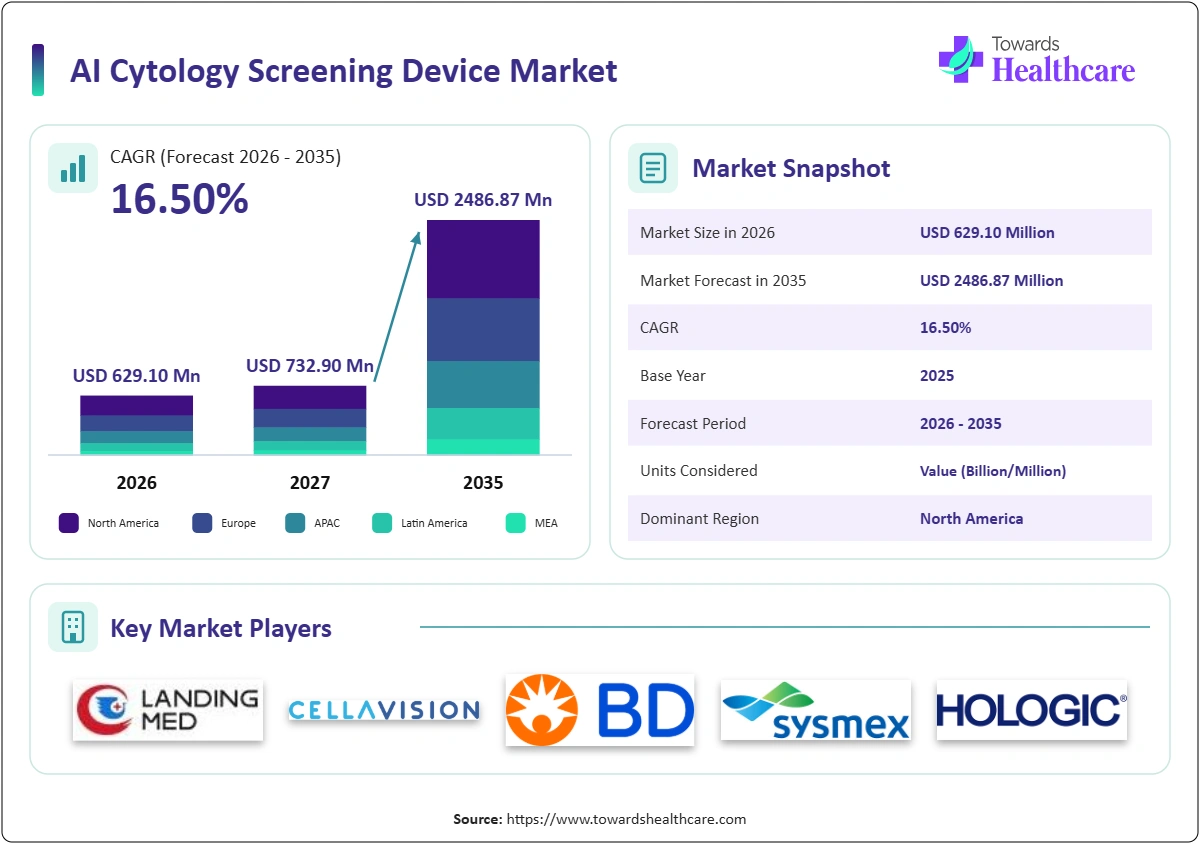
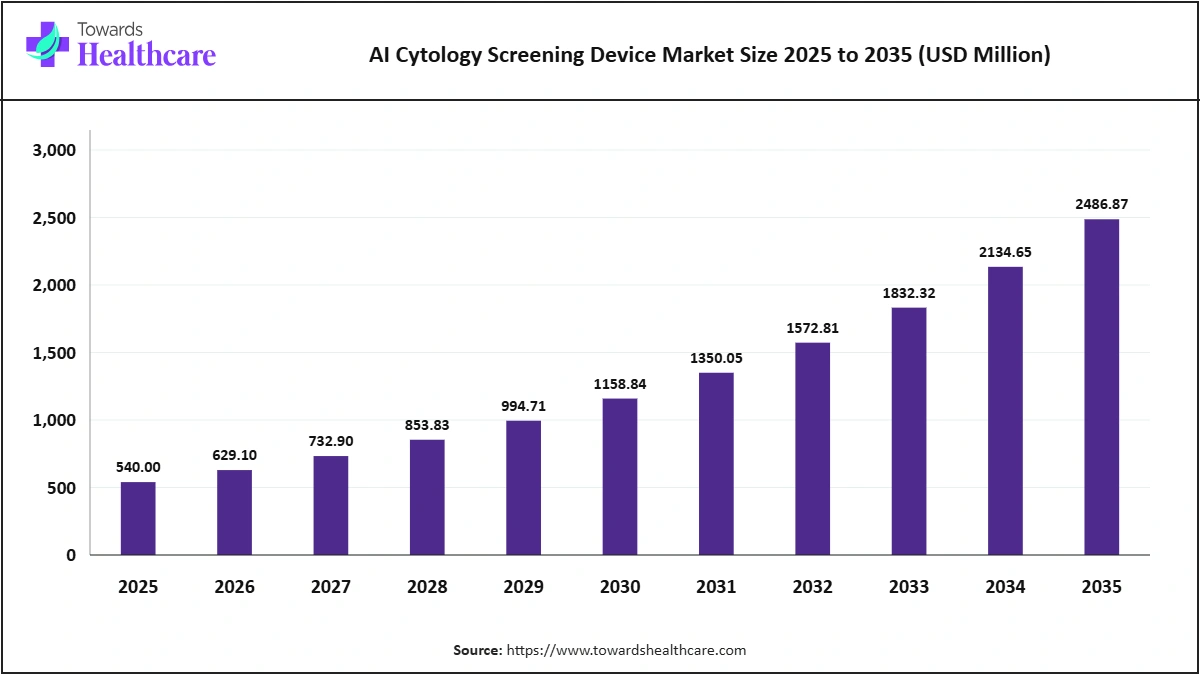
The AI cytology screening device market is projected to grow from USD 540.00 million in 2025 to USD 2,486.87 million by 2035 because laboratories face growing screening volumes and shortages of trained cytologists, and AI-assisted digital systems improve accuracy and productivity in cervical and blood cytology. Regulatory clearances of AI cervical and hematology systems, national screening programmes in Asia, cloud-based remote review and new non-gynecologic applications support very strong growth, lifting the market to USD 1,158.84 million by 2030 and sustaining a CAGR of 16.50% from 2026 to 2035.
Analyst View: We built the estimate from installed and new AI cytology systems by component, application, deployment, end user, and region, multiplied by average system prices, per-slide or subscription software fees, and service revenue. Installations reflect cervical screening and hematology laboratory volumes, the share of laboratories digitizing cytology, and regulatory status in each region. Published estimates vary widely because they define the scope differently, from broad AI in cytology to cervical AI systems only, so our base year is set on an evidence basis between those comparables and cross-checked against supplier revenues. The growth rate reflects rapid adoption of digital cytology, moderated by high system costs, reimbursement uncertainty, and validation requirements.
Driver: The AI cytology screening device market is driven by increasing screening volumes, a shortage of skilled cytologists, and growing demand for accurate and efficient diagnostic solutions. AI technologies improve abnormal cell detection, reduce false-negative results, and streamline laboratory workflows. Additionally, expanding cervical cancer screening programmes, rising healthcare investments, and rapid digitalization across Asia-Pacific are accelerating market adoption.
Restraint: Market growth is constrained by high installation and operational costs associated with digital scanners, AI software, and supporting infrastructure. Unclear reimbursement frameworks create financial uncertainty for healthcare providers, while stringent clinical validation and regulatory requirements increase development timelines. Furthermore, the shift towards primary HPV testing may reduce conventional cytology volumes, while data privacy concerns limit cloud-based deployment.
Opportunity: Significant opportunities exist in cloud-based AI cytology solutions that enable smaller laboratories to access advanced screening technologies at lower upfront costs. Expanding applications in urine, thyroid, and non-gynecologic cytology offer additional growth avenues. Emerging markets present considerable potential due to unmet screening needs, while per-slide pricing models and telecytology integration create recurring revenue opportunities and improve diagnostic accessibility.
Note: 2025 is the base year; 2035 values are forecasts.
Sources: Expert interviews, secondary sources, Towards Healthcare database and Towards Healthcare analysts.
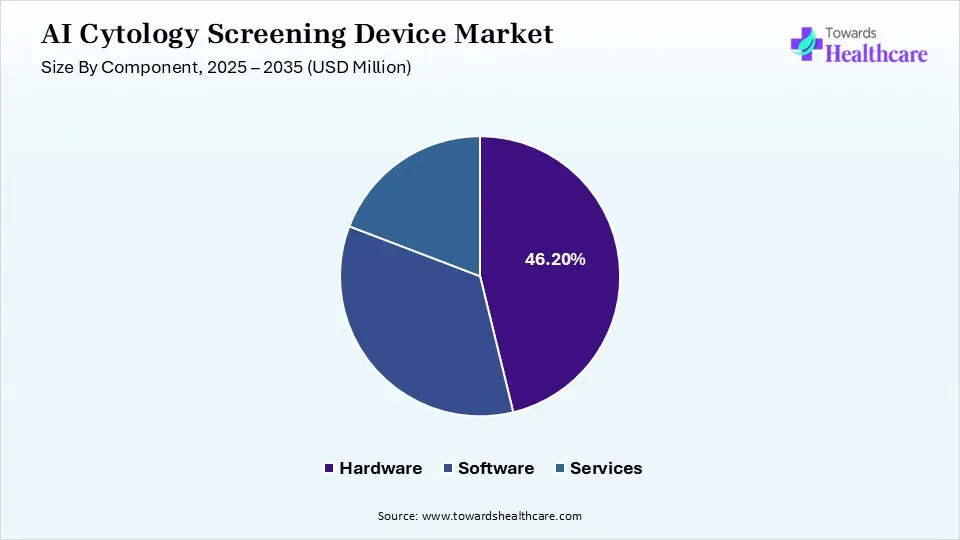
Hardware: This segment accounted for 46.20% (USD 249.48 million) of the AI cytology screening device market in 2025 and is projected to reach USD 1,058.22 million by 2035, expanding at a CAGR of 15.55% from 2026 to 2035. Hardware includes digital slide imagers and scanners for cytology slides, such as Hologic's Genius Digital Imager, BD's FocalPoint and digital morphology analyzers from CellaVision, Sysmex and Scopio Labs. It leads because every laboratory must buy imaging hardware, which has high unit prices.
Software: Software includes AI algorithms that detect and rank abnormal cells, case review applications, and image management. It is the fastest-growing component because vendors are adding new algorithms, charging per-slide or subscription fees, and updating software across the installed base.
Note: 2025 is the base year; 2035 values are forecasts.
Sources: Expert interviews, secondary sources, Towards Healthcare database and Towards Healthcare analysts.
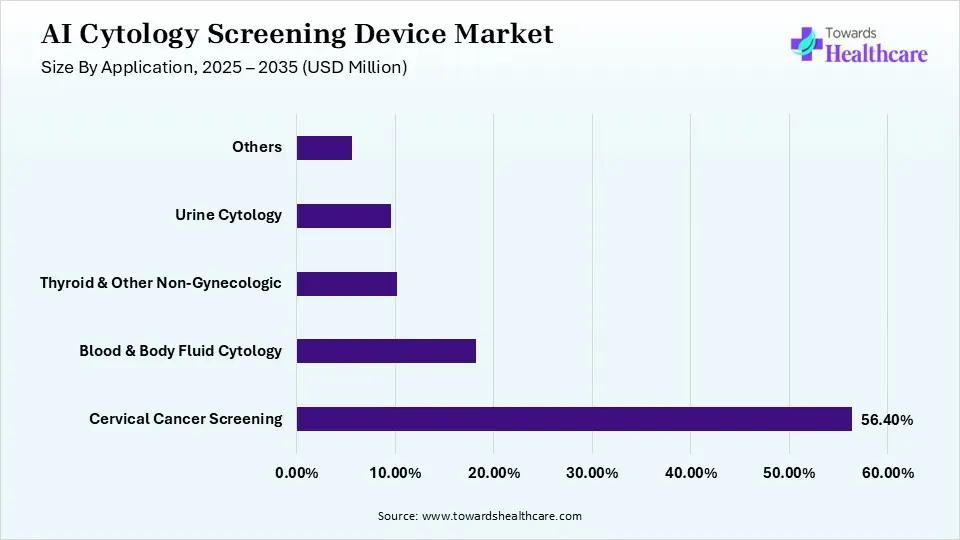
Cervical Cancer Screening: This segment accounted for 56.40% (USD 304.56 million) of the AI cytology screening device market in 2025 and is projected to reach USD 1,350.24 million by 2035, expanding at a CAGR of 16.06% from 2026 to 2035. Cervical cancer screening is the largest application because Pap and liquid-based cytology tests are performed in very large numbers worldwide. AI-assisted systems such as Hologic's FDA-cleared Genius Digital Diagnostics System highlight the most relevant cells for review, and studies have linked them to fewer false negatives. Large AI cervical screening programmes in China also drives volume.
Blood & Body Fluid Cytology: Adoption is gaining momentum as hospitals increasingly incorporate digital morphology analyzers to automate the classification of red and white blood cells, platelets, and bone marrow cells. Commercial solutions from CellaVision, Sysmex, and Scopio Labs are supporting this transition by improving laboratory efficiency, standardizing cell analysis, and reducing manual microscopy workloads. Advancements in digital imaging and regulatory progress are further strengthening commercial opportunities.
Thyroid & Other Non-Gynecologic: Thyroid and other non-gynecologic cytology include AI for thyroid fine-needle aspirates, pleural effusions, lung and lymph node samples, mostly at earlier stages of commercialization.
Note: 2025 is the base year; 2035 values are forecasts.
Sources: Expert interviews, secondary sources, Towards Healthcare database and Towards Healthcare analysts.
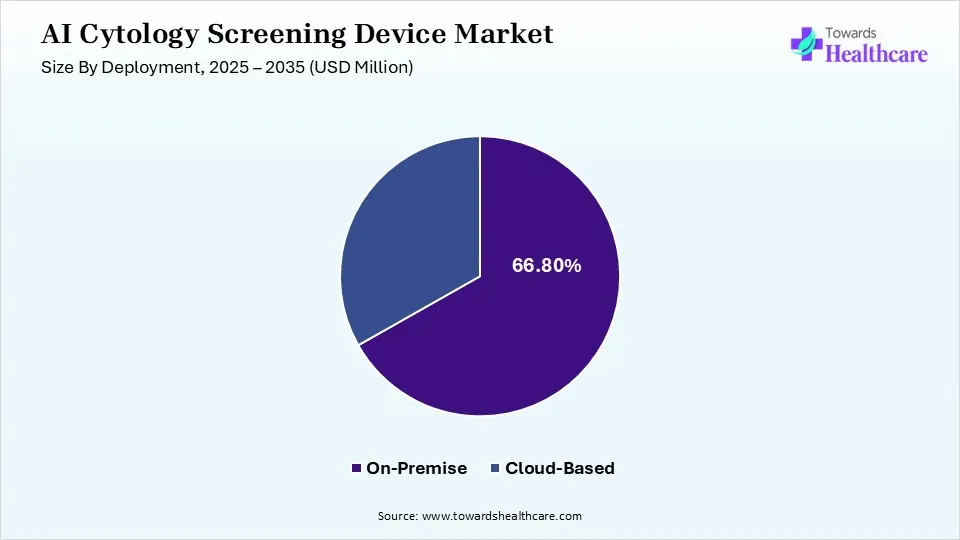
On-Premise: This segment accounted for 66.80% (USD 360.72 million) of the AI cytology screening device market in 2025 and is projected to reach USD 1,493.91 million by 2035, expanding at a CAGR of 15.27% from 2026 to 2035. On-premise deployment keeps images and AI processing within the laboratory, which suits large images, data privacy rules, and validated workflows. It leads in the hospital and reference laboratories domain.
Cloud-Based: Cloud-based deployment allows for remote review, central AI processing, and access for smaller laboratories and screening programmes. It is growing fastest because it lowers upfront costs and supports networked screening.
Note: 2025 is the base year; 2035 values are forecasts.
Sources: Expert interviews, secondary sources, Towards Healthcare database and Towards Healthcare analysts.
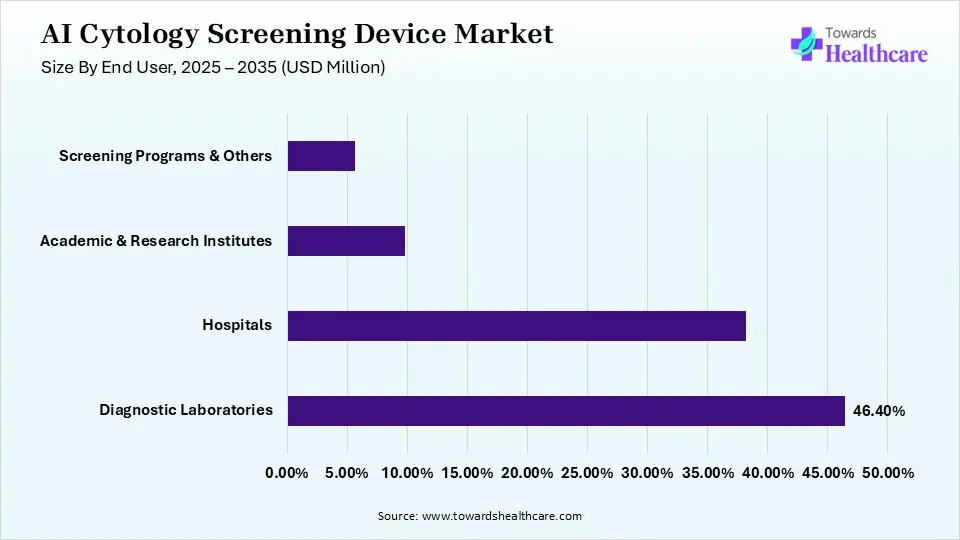
Diagnostic Laboratories: Holding the largest end-user share of 46.40% (USD 250.56 million) in 2025, this category is projected to reach USD 1,120.85 million by 2035, registering a CAGR of 16.16% during 2026–2035. Demand is primarily driven by the high volume of cervical cytology samples processed by independent diagnostic centres and large reference laboratory networks. Increasing investments in high-throughput digital imaging, automated slide analysis, and AI-assisted screening solutions are enabling these facilities to improve testing capacity, reduce manual workloads, and standardize diagnostic processes.
Hospitals: Hospitals use AI cytology systems in pathology and hematology laboratories, especially digital morphology analyzers for blood smears.
Analyst View: Segment values were allocated by matching installations, software fees and service revenue to components, applications, deployment and end users, using supplier portfolios and laboratory data. Hardware, cervical screening, on-premises deployment, and diagnostic laboratories lead. We expect software, urine cytology, cloud deployment, and screening programmes to gain share.
| Region | 2025 Share | 2025 Value (USD Million) | 2035 Value (USD Million) | CAGR 2026–2035 |
| North America | 34.60% | 186.84 | 792.07 | 15.54% |
| Asia Pacific | 32.80% | 177.12 | 922.26 | 17.94% |
| Europe | 24.20% | 130.68 | 573.48 | 15.94% |
| Latin America | 4.80% | 25.92 | 113.75 | 15.94% |
| Middle East & Africa | 3.60% | 19.44 | 85.31 | 15.94% |
Note: 2025 is the base year; 2035 values are forecasts.
Sources: Expert interviews, secondary sources, Towards Healthcare database and Towards Healthcare analysts.
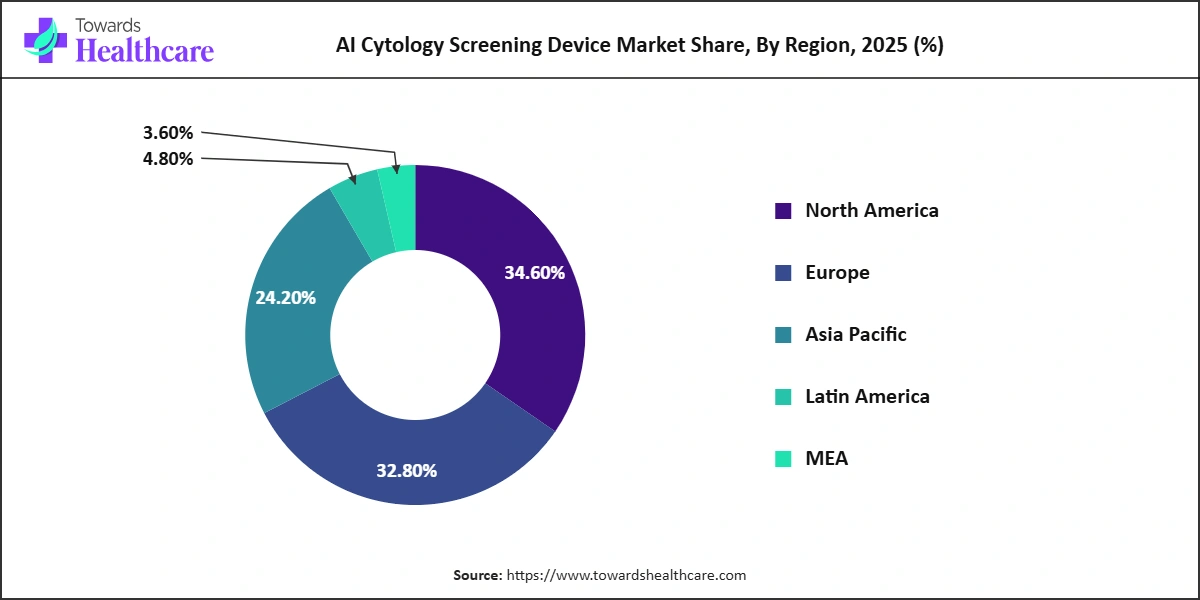
North America: This region accounted for 34.60% (USD 186.84 million) of the AI cytology screening device market in 2025 and is projected to reach USD 792.07 million by 2035, expanding at a CAGR of 15.54% from 2026 to 2035. The United States has FDA-cleared AI cervical screening systems from Hologic, a large network of reference laboratories, high hematology testing volumes and a serious shortage of cytotechnologists, which encourages laboratories to adopt AI-assisted review.
Asia Pacific: Representing 32.80% (USD 177.12 million) of the market in 2025, this region is expected to reach USD 922.26 million by 2035, registering the fastest CAGR of 17.94%. Expansion is driven by large-scale cervical cancer screening initiatives in China, increasing deployment of AI-assisted liquid-based cytology, and growing adoption across Japan, South Korea, and India. Regional technology providers, including Landing Med, KFBIO, and Noul, are contributing to product development and commercialization, while rising healthcare investments are creating additional growth opportunities.
Europe: This region accounted for 24.20% (USD 130.68 million) of the AI cytology screening device market in 2025 and is projected to reach USD 573.48 million by 2035, expanding at a CAGR of 15.94% from 2026 to 2035. Europe has organized cervical screening programmes, although many are moving to primary HPV testing with cytology triage, and strong adoption of digital morphology in hematology. CellaVision in Sweden is a leader, and EU IVDR certification is shaping market access.
Latin America: Contributing 4.80% (USD 25.92 million) to the market in 2025, this region is projected to reach USD 113.75 million by 2035, growing at a CAGR of 15.94%. Expansion is primarily supported by substantial cervical cancer screening requirements in Brazil, Mexico, and other countries, alongside limited availability of trained cytologists. Increasing investments in diagnostic laboratory infrastructure, growing awareness of early cancer detection, and demand for automated screening technologies are creating opportunities for AI-enabled cytology solutions.
Middle East & Africa: This region accounted for 3.60% (USD 19.44 million) of the AI cytology screening device market in 2025 and is projected to reach USD 85.31 million by 2035, expanding at a CAGR of 15.94% from 2026 to 2035. The Middle East and Africa are supported by screening programmes and laboratory modernization in Gulf countries and pilot AI screening projects in Africa.
Analyst View: Regional shares were built from screening volumes, laboratory installations, and regulatory status in each region. North America leads because of clear systems and pricing. We assign Asia Pacific the highest growth premium because large screening programmes are adopting AI fastest there.
| Rank | Company Name | Market-Specific Revenue (USD Million) | 2025 Share | Key Products / Business | Headquarters |
| 1 | Hologic | 120.00 | 22.22% | Genius Digital Diagnostics and ThinPrep Imaging | United States |
| 2 | CellaVision | 75.00 | 13.89% | Digital cell morphology analysers | Sweden |
| 3 | BD Diagnostic Solutions (Waters) | 70.00 | 12.96% | FocalPoint GS and BD-Techcyte digital cytology | United States |
| 4 | Sysmex | 30.00 | 5.56% | DI-60 digital morphology | Japan |
| 5 | Landing Med | 25.00 | 4.63% | AI cervical cytology systems | China |
| 6 | KFBIO | 20.00 | 3.70% | Digital scanners and AI cytology | China |
| 7 | Scopio Labs | 12.00 | 2.22% | Full-field digital morphology | Israel |
| 8 | Techcyte | 10.00 | 1.85% | AI cytology software | United States |
| 9 | Roche | 10.00 | 1.85% | Digital pathology and cytology AI | Switzerland |
| 10 | Noul | 6.00 | 1.11% | miLab AI blood and cytology platform | South Korea |
Note: Company revenues and shares are 2025 estimates.
Sources: Company press releases, expert interviews, secondary sources, Towards Healthcare database and Towards Healthcare analysts.
Hologic led the AI cytology screening device market with an estimated 22.22% (USD 120.00 million) of 2025 revenue, followed by CellaVision at 13.89% (USD 75.00 million) and BD Diagnostic Solutions (Waters) at 12.96% (USD 70.00 million). Hologic leads with its ThinPrep Imaging System and FDA-cleared Genius Digital Diagnostics System for AI-assisted cervical screening. CellaVision leads digital cell morphology in hematology, and BD Diagnostic Solutions, combined with Waters in February 2026, offers FocalPoint GS imaging and a digital cervical cytology system developed with Techcyte. Sysmex, Landing Med, KFBIO, Scopio Labs, Techcyte, Roche and Noul compete through digital morphology, AI cervical cytology, digital scanners, full-field morphology, AI software, digital pathology and compact AI blood and cytology platforms.
The top 10 companies accounted for an estimated 70.00% (USD 378.00 million) of 2025 revenue, while the remaining 30.00% (USD 162.00 million) was shared among digital pathology start-ups, regional imaging companies and research-stage AI developers. The AI cytology screening device market is moderately concentrated, and competition focuses on regulatory clearance, algorithm accuracy, throughput, workflow integration, image quality, cloud capabilities, and total cost. Chinese vendors compete strongly in domestic screening programmes, while regulatory clearance shapes Western markets.
The AI cytology screening device ecosystem links slide preparation and imaging hardware makers with AI developers, cloud providers, regulators, laboratories and screening programmes.
| Ecosystem Stage | Role in the Market | Key Companies |
| Slide Preparation | Supply liquid-based cytology and staining systems | Hologic, BD, Roche |
| Imaging Hardware | Supply digital imagers and scanners | Hologic, CellaVision, Sysmex, Scopio Labs, KFBIO |
| AI Software | Develop cell detection and classification algorithms | Techcyte, Landing Med, Noul, in-house teams |
| Regulators & Payers | Clear devices and set reimbursement | FDA, EU notified bodies, NMPA, insurers |
| End Users | Screen and diagnose samples | Reference labs, hospitals, screening programmes |
Sources: Company press releases, expert interviews, secondary sources, Towards Healthcare database and Towards Healthcare analysts.
The Towards Healthcare Companies Quadrant positions key participants in the AI cytology screening device market by market strength, reflecting revenue scale, market share and geographic reach, and by innovation and growth strategy, reflecting product portfolio breadth, R&D intensity and partnerships. Positions reflect each company's estimated 2025 AI cytology screening revenue and our assessment of its algorithms, regulatory clearances and partnerships.
Sources: Company press releases, expert interviews, secondary sources, Towards Healthcare database and Towards Healthcare analysts.
Leaders: Hologic, CellaVision, BD Diagnostic Solutions (Waters) and Sysmex combine the largest revenue with cleared AI systems and large installed bases.
Innovators: Landing Med, KFBIO, Scopio Labs, Techcyte and Noul bring full-field morphology, AI software and regional AI screening platforms.
Niche Players: Roche serve narrower cytology segments.
By Component
By Application
By Deployment
By End User
By Region
The AI cytology screening device market was defined as AI-enabled digital cytology imaging systems, algorithms, software, and services for cervical, blood, body fluid, urine and other cytology screening, worldwide. The 2025 base year was built bottom-up from AI cytology system installations by component, application, deployment, end user and region, prices, software fees and service revenue, and checked top-down against the cytology and digital morphology revenues of leading suppliers and published AI cytology estimates. Segment, regional, and company values were allocated from components, applications, deployment types, end users, and regional demand. Key estimates were verified by cross-checking company disclosures, regulatory and industry data, and published third-party estimates, and inputs that could not be reconciled were excluded. All segment, regional and company figures were reconciled to the same 2025 base year, and the 2026–2035 forecast, which applies a constant CAGR from the 2025 base, was recalculated and validated.
Analyst View: The AI cytology screening device market is at an early but fast-growing stage, as laboratories digitize cytology and regulators to clear AI-assisted systems. Our estimate links demand to installations, software fees and services, so the forecast follows screening volumes, regulatory progress and digital adoption. The main upside comes from Asian screening programmes and new applications, while the main risks are cost, reimbursement and the shift to HPV-based screening.