


The global AI virtual companions market size was estimated at USD 18.6 billion in 2025 and is predicted to increase from USD 23.88 billion in 2026 to approximately USD 226.55 billion by 2035, expanding at a CAGR of 28.4% from 2026 to 2035. The growth in technological advancements is increasing the adoption of AI virtual companions for a wide range of applications. Increasing mental health disorders, training programs, e-commerce platforms, smartphone penetration, and the launch of new solutions are also enhancing the market growth.
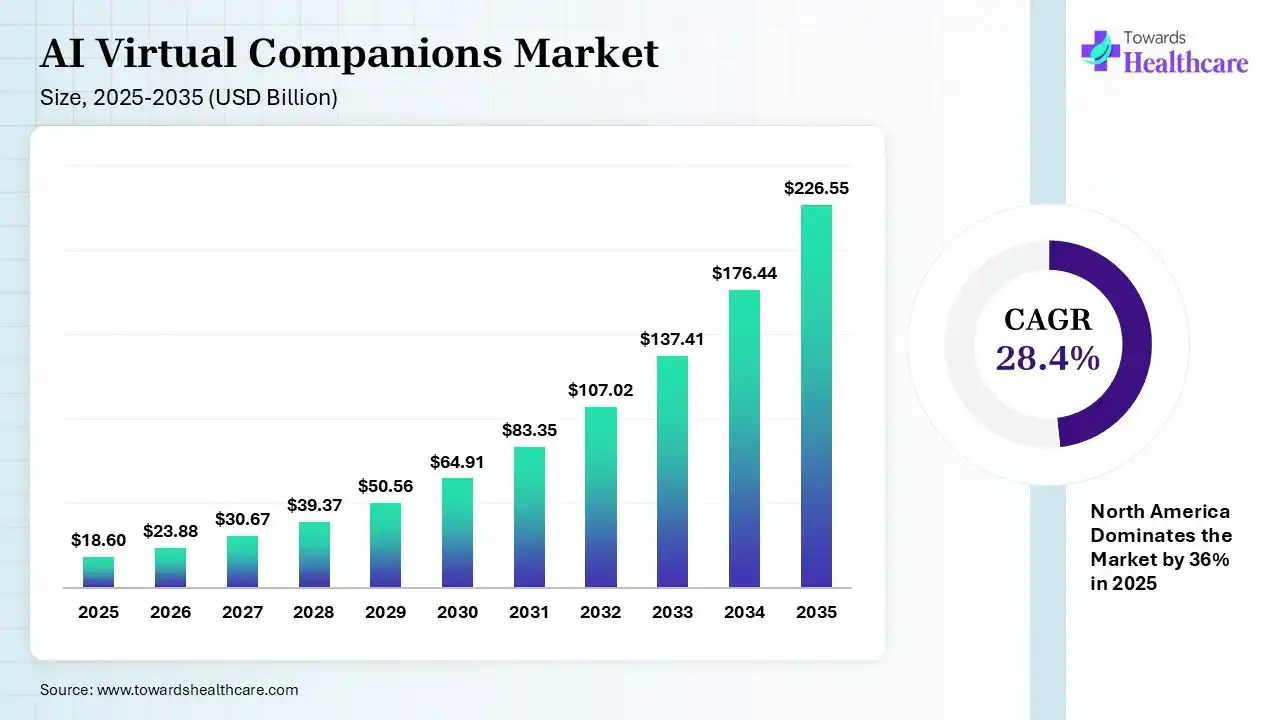
The AI virtual companions market is driven by growing technological breakthroughs, expanding sector-specific needs, and social shifts. The AI virtual companions refer to the AI-based software systems developed to integrate, assist, and offer emotional support to users. They are used for communication, reducing loneliness, emotional support, healthcare assistance, customer service, education support, entertainment, information access, and task management.
AI virtual companions are intelligent software applications designed to simulate human-like conversation, provide personalized interactions, offer entertainment, and deliver emotional or social support through text, voice, and virtual avatars. The market is growing as consumers increasingly seek convenient, personalized, and always-available digital interaction. Include emotionally responsive chatbots, AI-generated avatars, inclusion-based companionships, multilingual capabilities, and integration across smartphones and wearable devices. Technological advancements in generative AI, natural language processing, machine learning, smartphone penetration, loneliness and social isolation, demand for personalized digital experiences, and rapid adoption of conversational AI. Future opportunities are emerging in elderly companionship, education, gaming, wellness, entertainment, and virtual social communities. Privacy controls and emotionally intelligent AI are expected to further expand adoption across consumer and enterprise applications.
Flourishing Features
Increasing adoption of AI virtual companions is driving the development of new features to offer customized, unique to each user, experiences along with natural and human-like interactions. This is promoting the development of hyper-personalization and memory-based AI to remember user preferences, build long-term relationships, and adapt personality.
Demand for Emotionally Intelligent Companions
The growing mental health disorders are increasing the adoption of AI virtual companions to offer emotional support. They are combining text, voice, and gesture recognition to provide mental health support, relationship simulation, and loneliness reduction.
Expanding Applications
A rise in the AI virtual companion applications is increasing their adoption across healthcare, education, customer service, and business sectors. They are being used for patient monitoring, therapy management, health tracking, personalized tutoring, home automations, workplace assistance, and to develop meeting summaries.
| Table | Scope |
| Market Size in 2026 | USD 23.88 Billion |
| Projected Market Size in 2035 | USD 226.55 Billion |
| CAGR (2026 - 2035) | 28.4% |
| Leading Region | North America by 36% |
| Key Applications | Emotional companionship, mental wellness support, social interaction, virtual relationships, coaching, lifestyle assistance, gaming companions, elderly companionship, learning assistance |
| Primary End Users | Consumers, Gen Z users, Millennials, elderly individuals, digital wellness users, gaming communities, education users |
| Key Challenges | Privacy concerns, AI safety risks, regulatory scrutiny, emotional dependency concerns, content moderation, long-term user retention |
| Measurable Values | USD Millions/Units/Volume |
| Market Segmentation | By Type, By Application, By Technology, By End User, By Deployment Mode, By Revenue Model, By Region |
| Top Key Players | Luka, Inc., Amazon, Microsoft Corporation, Inflection AI, OpenAI, Nomi AI, Character.ai, Wysa, Google, Anthropic |
| Segment | Share 2025 (%) |
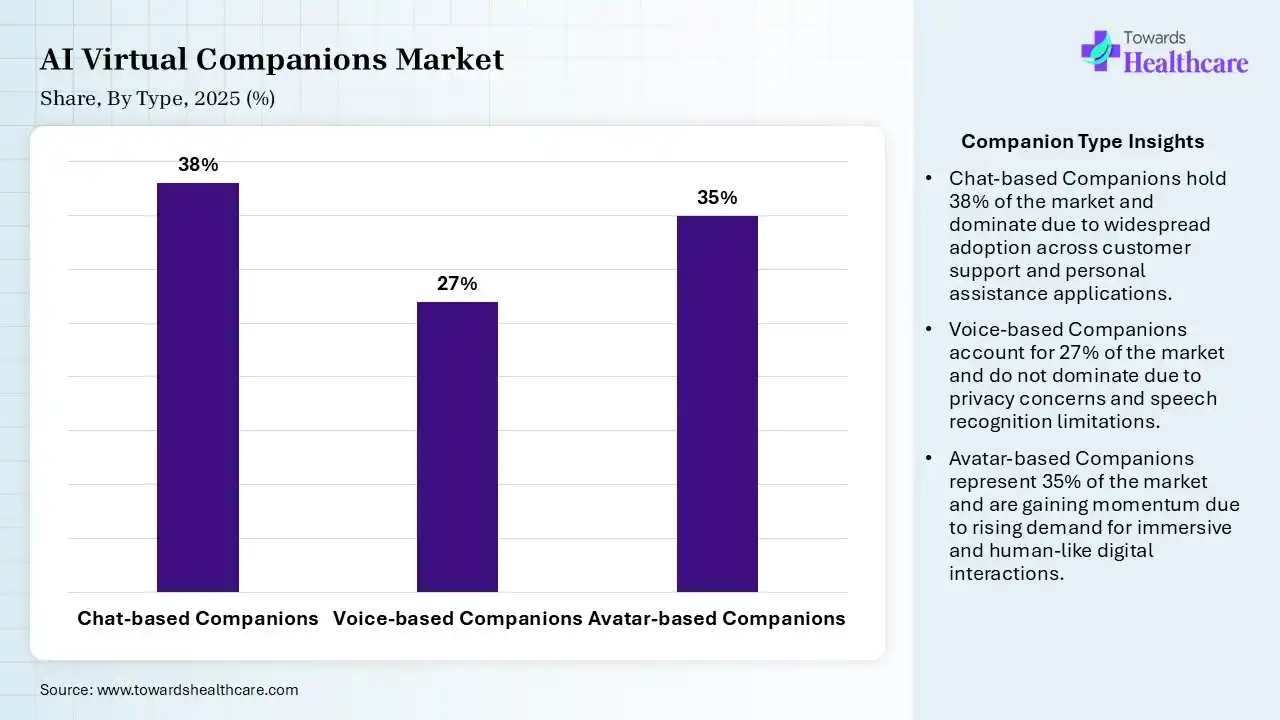
| Chat-based Companions | 38% |
| Voice-based Companions | 27% |
| Avatar-based Companions | 35% |
The Chat-based Companions Segment Dominated the Market With 38% in 2025
The chat-based companions segment held the largest revenue share of 38% of the AI virtual companions market in 2025, due to growth in the adoption of messaging platforms, which drives engagement. Strong demand for low-cost AI companions with enhanced accessibility has also increased their use. Continuous NLP improvements enhanced conversation realism, which promoted their adoption rates.
The avatar-based companions segment held the second-largest share of 35% of the market in 2025 and is expected to witness the fastest growth during the forecast period, due to increasing advancements in AR/VR enabling immersive experiences. Gaming and metaverse integration are also fueling their demand. Visual realism enhances emotional connection with users, promoting their use.
The voice-based companions segment held 27% of the AI virtual companions market share in 2025, due to a growth in smart speaker usage, which boosts their adoption. Voice interfaces also improve accessibility for elderly users. Integration with IoT ecosystems also expands utility.
| Segment | Share 2025 (%) |
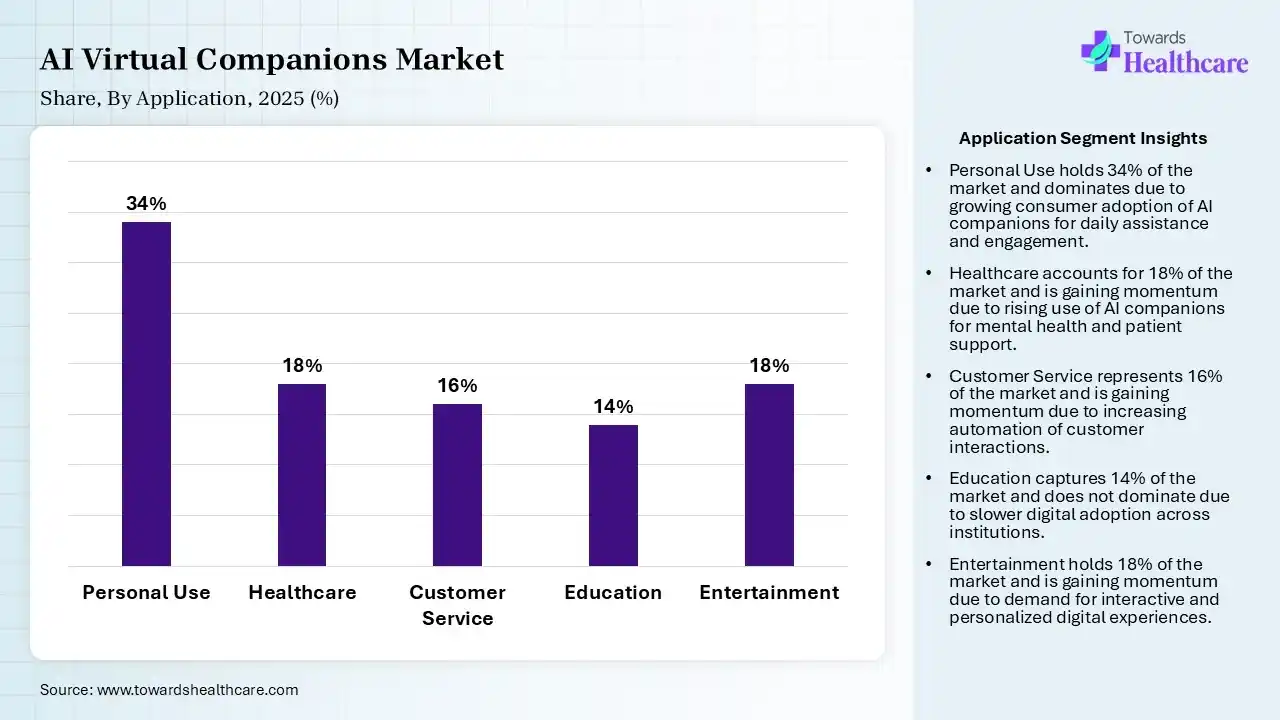
| Personal Use | 34% |
| Healthcare | 18% |
| Customer Service | 16% |
| Education | 14% |
| Entertainment | 18% |
The Personal Use Segment Dominated the Market With 34% in 2025
The personal use segment accounted for the highest revenue share of 34% of the AI virtual companions market in 2025, due to growth in loneliness and social isolation, which increased the demand for AI virtual companions. AI personalization also enhanced user retention. Mobile-first usage also increased their daily interaction frequency.
The entertainment segment held the second-largest share of 18% of the market in 2025 and is expected to show the highest growth during the forecast period, due to gaming industry integration, which accelerates its demand. Interactive storytelling enhances engagement, promoting its use. Virtual influencers and digital companions are also gaining popularity.
The healthcare segment held 18% of the AI virtual companions market share in 2025, due to rising mental health awareness, which accelerates the adoption of AI virtual companions. AI also helps in reducing the burden on healthcare professionals. Remote patient support expands their accessibility, driving their demand.
The customer service segment held 16% of the market share in 2025, due to the increasing use of AI virtual companions by businesses to automate interactions and reduce costs. AI also helps in improving response time and scalability, increasing its demand. Omnichannel integration also strengthens customer experience.
| Segment | Share 2025 (%) |
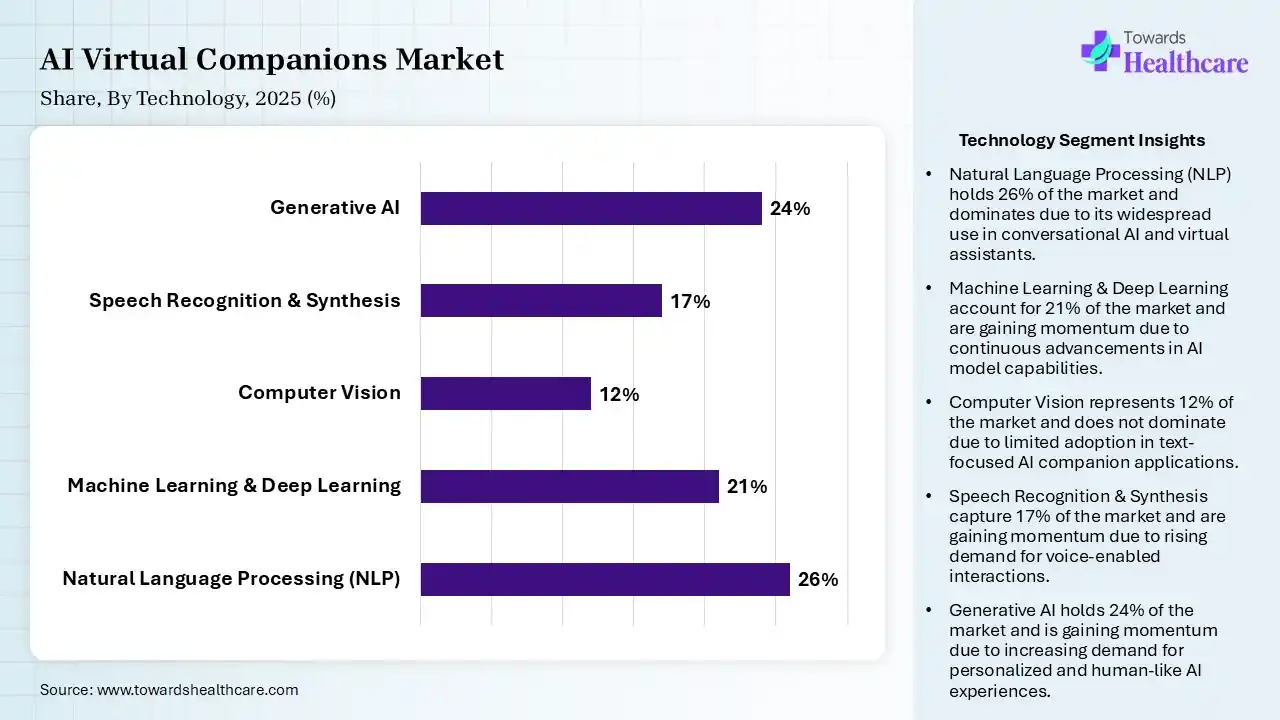
| Natural Language Processing (NLP) | 26% |
| Machine Learning & Deep Learning | 21% |
| Computer Vision | 12% |
| Speech Recognition & Synthesis | 17% |
| Generative AI | 24% |
The Natural Language Processing (NLP) Segment Dominated the Market With 26% in 2025
The natural language processing (NLP) segment held a major revenue share of 26% of the AI virtual companions market in 2025, due to advanced language understanding, which improved interactions. Multilingual capabilities also expanded their global reach. Continuous model training enhanced accuracy, which increased its use.
The generative AI segment held the second-largest share of 24% of the market in 2025 and is expected to expand rapidly with a CAGR during the forecast period, due to large language models enabling human-like responses. Multimodal capabilities also expand functionality, increasing their use. Continuous innovation also drives rapid adoption.
The machine learning & deep learning segment held 21% of the AI virtual companions market share in 2025, due to adaptive learning, which improves personalization. Behavioral insights also enhance engagement. Predictive analytics supports proactive interactions, promoting their use.
The speech recognition & synthesis segment held 17% of the market share in 2025, driven by voice interfaces that improve accessibility. Realistic voice synthesis also enhances engagement. Integration with smart devices also drives their adoption.
| Segment | Share 2025 (%) |
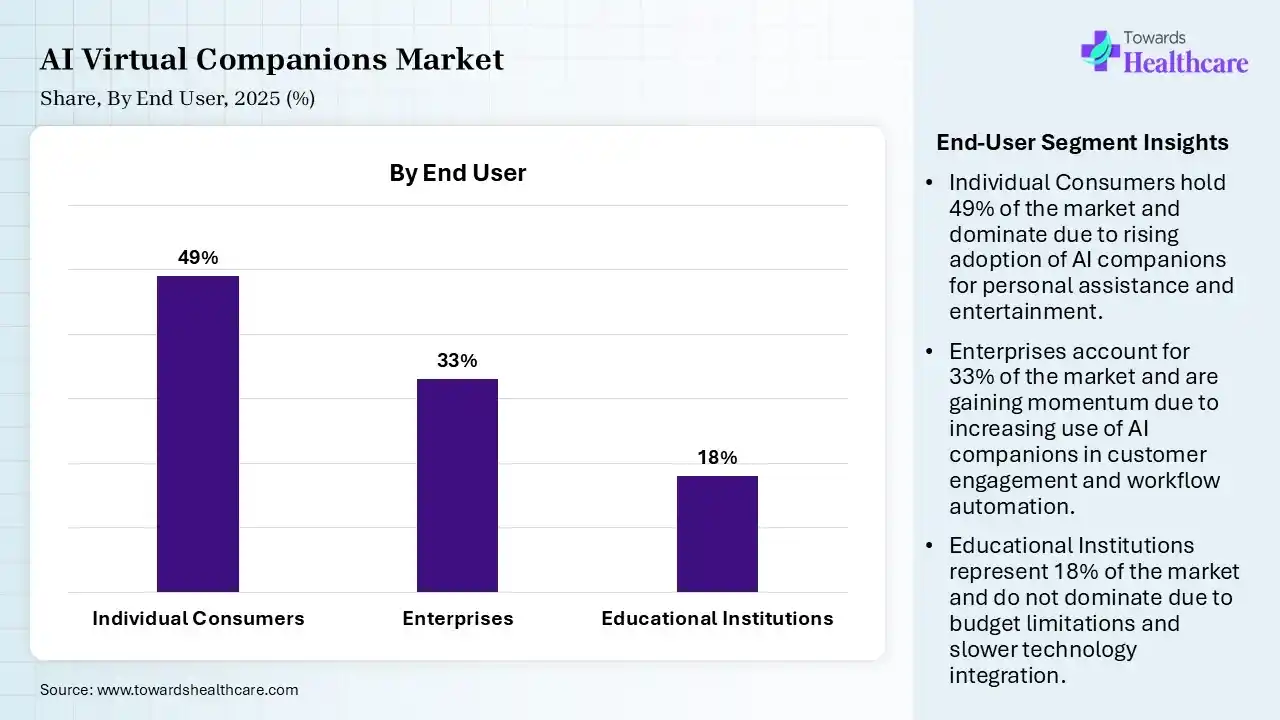
| Individual Consumers | 49% |
| Enterprises | 33% |
| Educational Institutions | 18% |
The Individual Consumers Segment Dominated the Market With 49% in 2025
The individual consumers segment contributed the biggest revenue share of 49% of the AI virtual companions market in 2025, due to a rise in smartphone penetration, which boosts the adoption of AI virtual companions. Social companionship needs have also increased their usage. Freemium models also attracted large user bases.
The enterprises segment held the second-largest share of 33% of the market in 2025, due to a rise in businesses adopting AI for automation and efficiency. Improving customer engagement with AI companions is also increasing their use. Integration with CRM systems enhances value, driving their adoption.
The educational institutions segment held 18% of the AI virtual companions market share in 2025 and is expected to gain the highest share during the forecast period, due to the digital learning transformation, which is accelerating the adoption of AI virtual companions. AI tutors are also enhancing personalized education. Remote learning trends also sustain their growth.
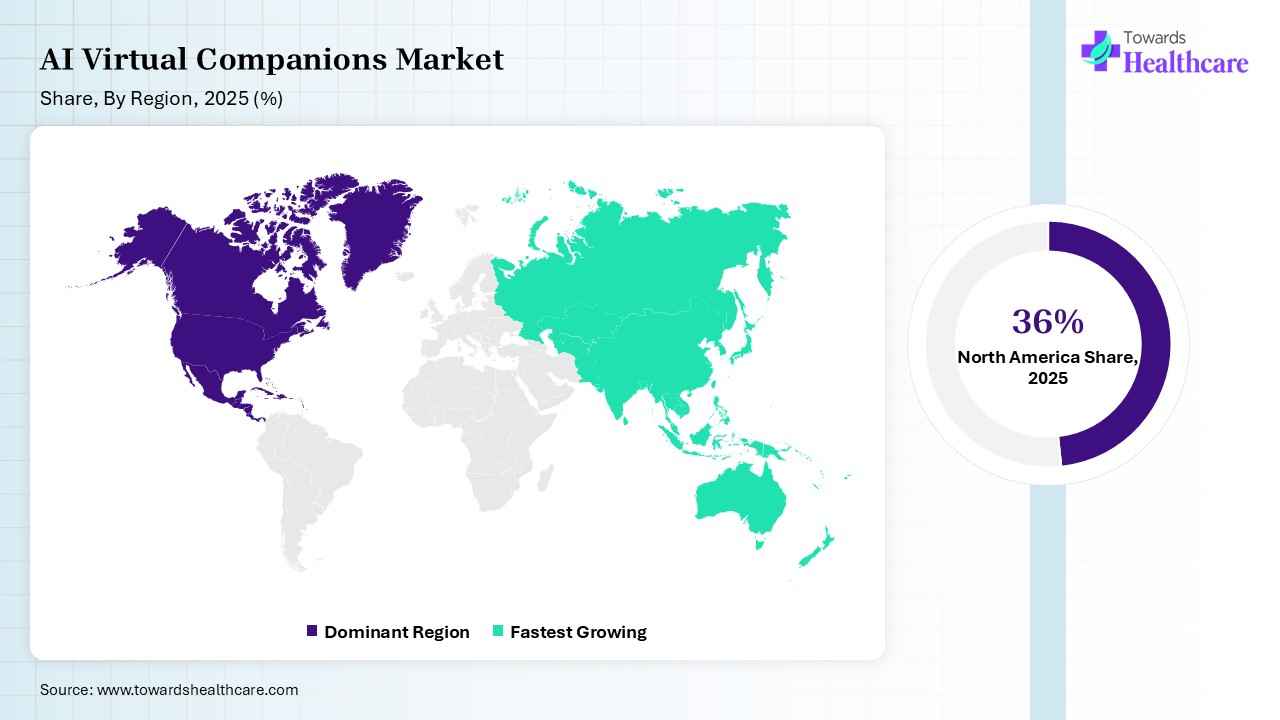
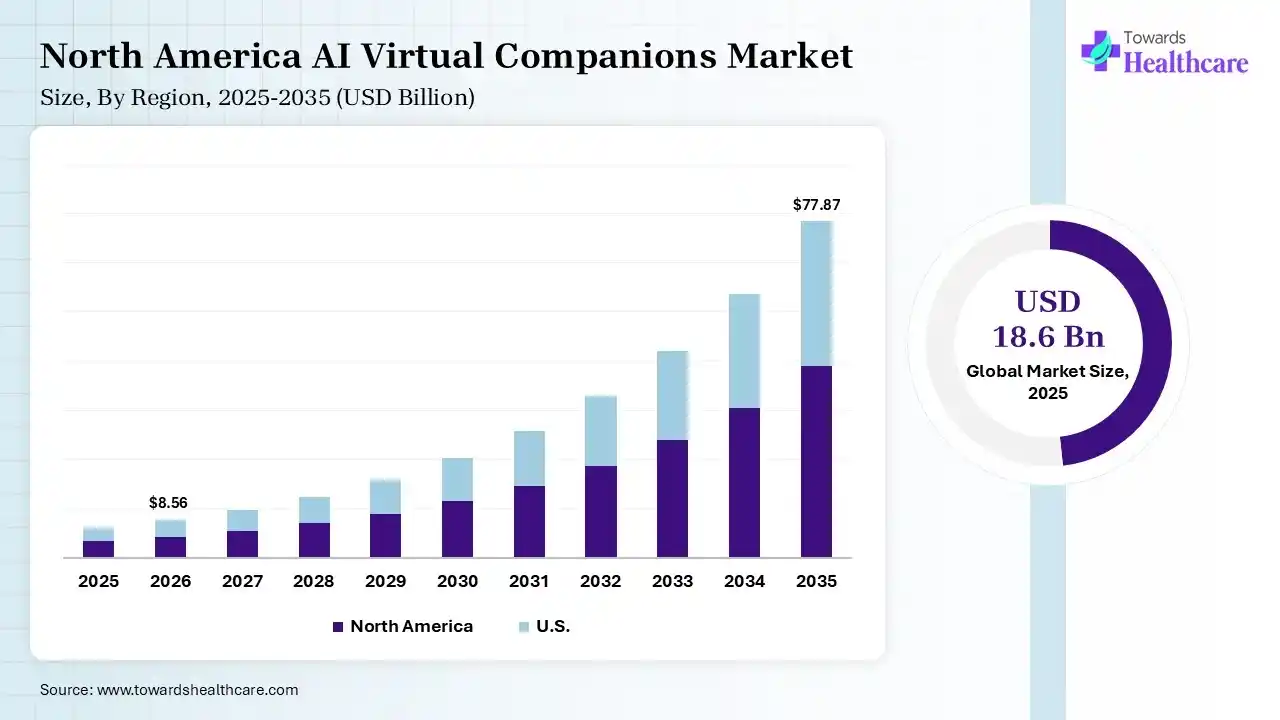
North America dominated the AI virtual companions market with 36% in 2025, due to a strong AI ecosystem that drives innovation. High consumer adoption and the presence of major tech companies also accelerated their growth. Growth in the investment and rise in the demand for mental wellness solutions also increased their use, which contributed to the market growth.
U.S. Market Trends
The presence of a large user base in the U.S. is supporting the adoption of the AI virtual companions. Additionally, the presence of major AI companies and startups is also contributing to continuous AI innovations, which is driving their demand. High spending power, accelerating monetization, and expanding applications are also increasing their adoption rates.
Canada’s Strong AI Ecosystem Drives Virtual Companion Growth
Canada is significantly growing in the AI virtual companions market due to rising adoption of artificial intelligence, advanced digital infrastructure, and increasing consumer interest in personalized virtual interactions. Growing demand for conversational AI, voice-enabled assistants, and emotionally responsive digital platforms is encouraging innovation. The country’s expanding technology sector and focus on AI development are also creating opportunities for virtual companions across entertainment, education, customer engagement, and personalized assistance.
Asia Pacific held 28% share of the AI virtual companions market in 2025 and is expected to grow at the fastest CAGR during the forecast period, due to a large population base, which drives the adoption of AI virtual companions. Rapid digitalization and the rising gaming and mobile ecosystem also boost their growth. Growing urban lifestyle and government support are also increasing their adoption, enhancing the market growth.
China Market Trends
China is experiencing a growth in AI investments, which is propelling the AI virtual companion innovations. Large user base, increasing demand for emotional support, and government support are also accelerating their adoption as well as innovations. The presence of large tech companies is also increasing the development of new products and models, attracting users.
India’s Digital Growth Accelerates AI Virtual Companions
India is notably expanding in the AI virtual companion market due to rapid smartphone adoption, widespread internet connectivity, and growing interest in AI-powered digital services. Increasing demand for personalized conversations, entertainment, virtual assistance, and social interaction is encouraging adoption. A large digitally active population, expanding AI capabilities, and growing availability of AI virtual companions across consumer and lifestyle applications.
Europe held 24% AI virtual companions market share and is expected to grow significantly during the forecast period, due to the presence of regulatory frameworks that shape AI deployment. Growing enterprise adoption and increasing focus on ethical AI also support their growth. Increasing R&D activities and funding support are also increasing their innovations, promoting market growth.
UK Market Trends
The expanding AI startups in the UK are accelerating the market growth. A growth in the digital transformation is also driving the adoption of AI virtual companions. Strong fintech integration also supports their demand, where their expanding applications are also increasing their use for educational purposes.
Germany’s Advanced AI Ecosystem Supports Expansion
Germany is significantly expanding in the AI virtual companions market due to accelerating AI adoption, advanced digital infrastructure, and growing demand for conversational technologies. Increasing use of generative AI, chatbots, and virtual assistants is supporting innovation in personalized digital experiences. Strong research capabilities, expanding AI investments, and growing interest in secure and trustworthy AI are creating opportunities for virtual companions across entertainment, customer engagement, education, and personal assistance.
| Ecosystem Segment | Key Participants | Description |
| Technology Providers | OpenAI, Anthropic, Google, Microsoft, Meta | Provide foundation models, LLM infrastructure, speech and multimodal AI capabilities. |
| Product Manufacturers | Luka (Replika), Character.AI, Nomi AI, Kindroid, EVA AI | Develop consumer-facing AI companion applications. |
| Service Providers | Soul Machines, Inflection AI, Microsoft | Deliver AI engagement and conversational services. |
| Platform Providers | Character.AI, OpenAI, Google, Microsoft | Offer scalable AI interaction platforms and APIs. |
| Software Vendors | OpenAI, Google, Microsoft, IBM | Supply AI development and deployment software. |
| Research Institutions | Stanford University, MIT Media Lab, Carnegie Mellon University, Oxford Internet Institute | Conduct AI behavior, safety, and human-AI interaction research. |
| Avatar & Digital Human Providers | Soul Machines, Inworld AI, D-ID | Create human-like virtual companions and digital avatars. |
| End-User Industries | Consumer Technology, Healthcare, Mental Wellness, Education, Gaming, Elder Care | Primary industries adopting AI companion technologies. |
| Tier 1 | Tier 2 | Tier 3 | |
| Typical Market Influence | 68% | 22% | 10% |
| Tier 1 | ||||
| Company Name | Headquarters | Country | Why Relevant to This Market | Key Products/Services |
| Character.AI | Palo Alto, California, USA | USA | Largest dedicated AI companion platform by user scale | Character AI Companion Platform |
| Luka, Inc. | San Francisco, California, USA | USA | Pioneer and one of the most recognized AI companion providers | Replika |
| OpenAI | San Francisco, California, USA | USA | Core technology provider enabling advanced AI companionship experiences | ChatGPT, GPT Models |
| Tier 2 | ||||
| Company Name | Headquarters | Country | Why Relevant to This Market | Key Products/Services |
| Nomi AI | New York, New York, USA | USA | Fast-growing premium AI companion provider | Nomi AI |
| Soul Machines | Auckland, New Zealand | New Zealand | Leading digital human and avatar-based companionship provider | Digital Humans Platform |
| Inflection AI | Palo Alto, California, USA | USA | Developed personal AI assistant technology focused on human interaction | Pi AI |
| Tier 3 | ||||
| Company Name | Headquarters | Country | Why Relevant to This Market | Key Products/Services |
| Kindroid AI | San Francisco, California, USA | USA | Rapidly growing premium companion platform with advanced memory features | Kindroid |
| D-ID | Tel Aviv, Israel | Israel | AI avatars increasingly used in companion applications | AI Avatars |
| Candy AI | Valletta, Malta | Malta | One of the fastest-growing AI companion applications | Candy AI |
In August 2026, "We often, or increasingly, trust LLM outputs so easily that we stop bringing our own creativity or critical thinking into the responses we receive, and over time that weakens our ability to be fully-functioning, sovereign human beings in the world," "I thought it would be fun or interesting to create an experience that looks like the LLMs we trust a lot that I, at least, have fallen prey to the trap of over-trusting at times”, said, Bryant Former Google product engineer.
Strengths
Weaknesses
Opportunities
Threats
By Type
By Application
By Technology
By End User
By Deployment Mode
By Revenue Model
By Region









Principal Consultant
Payal Rabde is a Healthcare Market Research Analyst at Towards Healthcare Research & Consulting with 4+ years of experience in pharmaceuticals, biotechnology, medical devices, and life sciences.
Learn more about Payal Rabde

Reviewed By
Aditi Shivarkar is a seasoned professional with over 14 years of experience in healthcare market research. As a content reviewer, Aditi ensures the quality and accuracy of all market insights and data presented by the research team.
Learn more about Aditi Shivarkar









