

The Animal Blood Bank Market Report 2027 analyzes market size, key trends, regional insights, market segmentation, and competitive landscape. It highlights major segments, leading companies, market share estimates, and growth opportunities driven by rising pet ownership and increasing demand for veterinary transfusions. The report also examines industry challenges, emerging markets, and strategic opportunities for stakeholders.
The animal blood bank market involves the procurement, processing, storage, and distribution of blood or its components for use during blood transfusion in animals. These centers provide treatment to animals that suffer from wounds, surgical procedures, anemia, and blood disorders. The increasing adoption of pets, increasing awareness about animal healthcare, and advancements in the field of veterinary medicine are some of the factors driving the growth of this market.
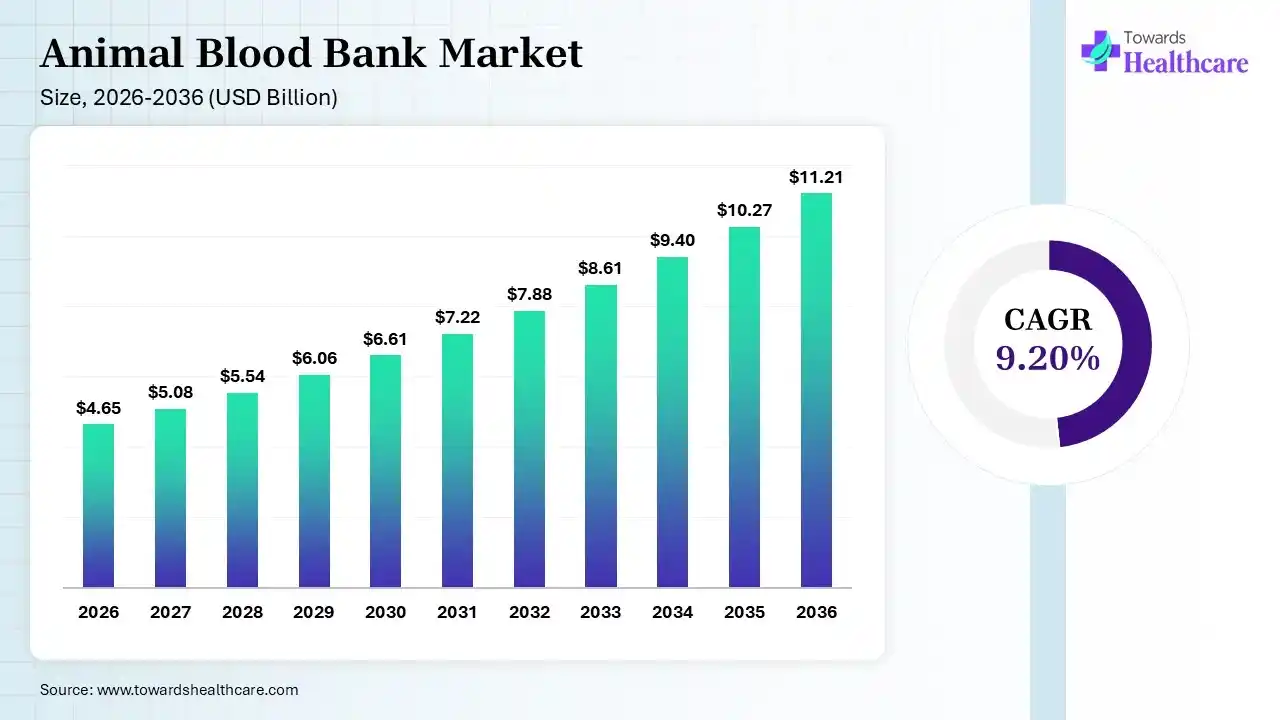
Market Size & Growth Outlook
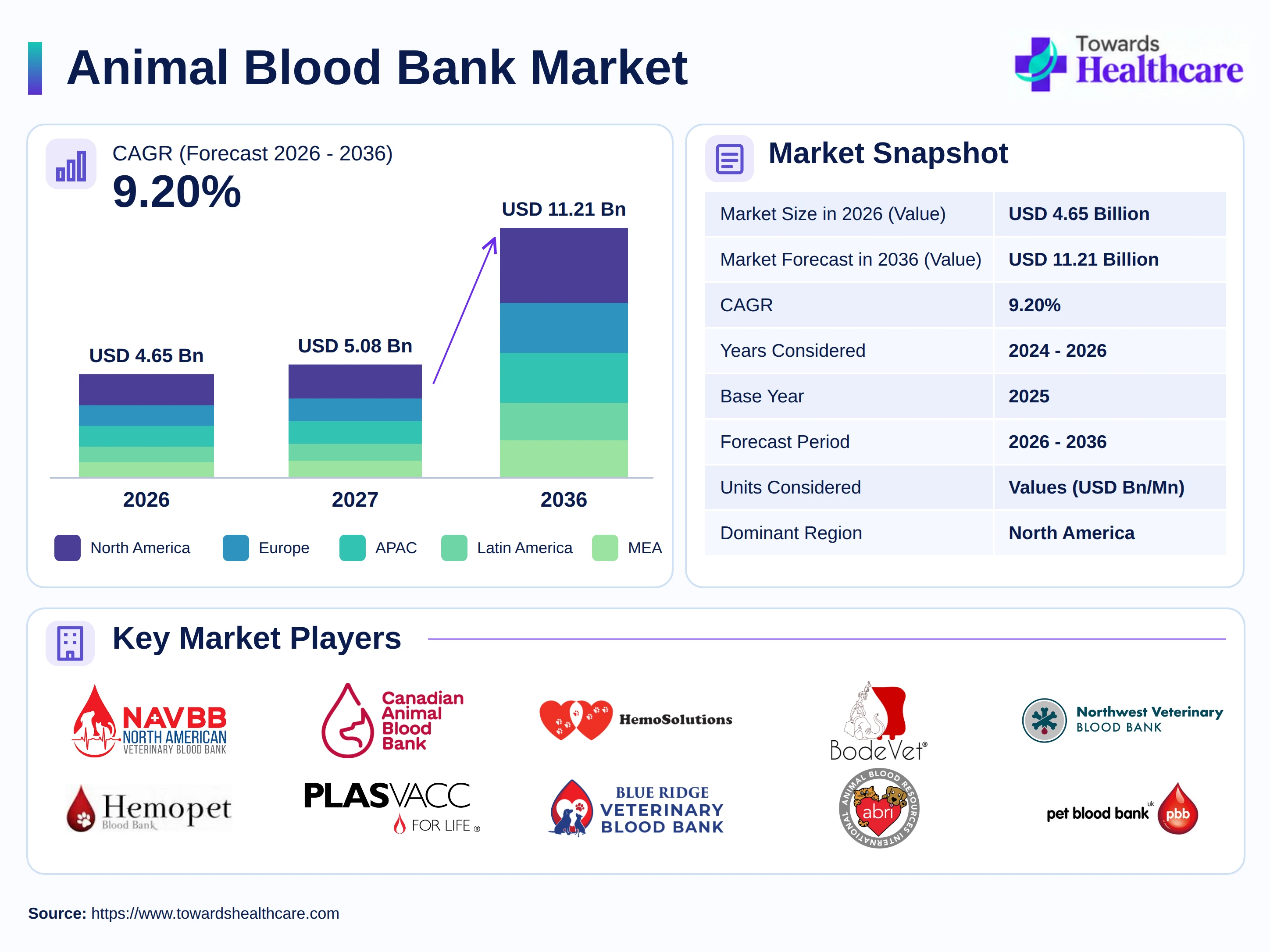
Market size in 2026: USD 4.65 Billion
Estimated market size in 2027: USD 5.08 Billion
Projected market size by 2036: USD 11.21 Billion
CAGR (2027–2036): 9.20%
Regional Market Spotlight
Segmental Spotlight
Growing Demand for Veterinary Transfusions: Rising pet ownership and greater awareness of animal healthcare are increasing the need for blood transfusions. Veterinary hospitals are increasingly using blood products to treat animals with severe injuries, anemia, and complications during surgery.
Expansion of Organized Blood Banking: Veterinary clinics and animal hospitals are developing better systems for blood collection, testing, and storage. These efforts are helping improve blood availability and safety during emergency treatments.
Increasing Opportunities for Market Growth: The animal blood bank market is likely to benefit from improved veterinary facilities, wider donor programs, and growing investment in specialized animal healthcare services.
Growing pet ownership and increasing spending on animal healthcare are driving demand in the animal blood bank market. Veterinary hospitals increasingly require blood transfusions to treat injuries, anemia, surgical complications, and other serious conditions, supporting the need for reliable blood supplies.
The market faces challenges due to limited donor availability, high storage costs, and difficulties in maintaining blood quality. Establishing proper testing facilities and meeting specific blood requirements across animal species can also increase operational expenses for veterinary service providers.
The animal blood bank market offers opportunities through partnerships between veterinary hospitals, animal shelters, and blood donor programs. Developing organized donor networks, improving storage facilities, and increasing awareness among pet owners can help expand blood availability and support better emergency treatment for animals.
Packed Red Blood Cells (pRBCs) Led the Animal Blood Bank Market with 33.50% Share in 2026
| Segment | Share 2026 (%) | Market Value 2026 |
| Packed Red Blood Cells (pRBCs) | 33.50% | USD 1.5578 billion |
| Whole Blood | 24.00% | USD 1.1160 billion |
| Plasma Products | 22.50% | USD 1.0463 billion |
| Platelet Concentrates | 7.00% | USD 325.50 million |
| Serum and Immunoglobulins | 6.00% | USD 279.00 million |
| Other Blood Products | 7.00% | USD 325.50 million |
| Total | 100.00% | USD 4.6500 billion |
Packed red blood cells held the largest share of 33.50% in the global market of animal blood banks with a value of USD 1.5578 billion in 2026 due to the significance of packed red blood cells in treating conditions like anemia, blood loss, and trauma in animals. Whole blood holds the second-largest share of 24.00% with a value of USD 1.1160 billion in the animal blood bank industry, followed by plasma products holding a share of 22.50% with a value of USD 1.0463 billion due to their application in emergencies and treatment of clotting disorders. Platelet concentrates, and other blood products and serum and immunoglobulins hold shares of 7.00% each.
Analyst View: Packed red blood cells are likely to be the most important type of product in the animal blood banks due to their application in the treatment of anemia and blood loss. Increasing knowledge about component-based transfusions, advanced veterinary facilities, and effective methods of storing blood may drive demand for plasma products, platelet concentrates, and other blood products in the future.
Canine Dominated the Market in 2026 with 58.00% Share
| Segment | Share 2026 (%) | Market Value 2026 |
| Canine | 58.00% | USD 2.6970 billion |
| Feline | 23.00% | USD 1.0695 billion |
| Equine | 8.00% | USD 372.00 million |
| Livestock and Bovine | 6.00% | USD 279.00 million |
| Other Species | 5.00% | USD 232.50 million |
| Total | 100.00% | USD 4.6500 billion |
The canine segment held the major share of 58.00% of the animal blood bank market in 2026, worth USD 2.6970 billion, owing to the increase in pet ownership along with demand for emergency veterinary care services. Dogs need blood transfusions for the management of trauma, anemia, surgical cases, and blood disorders. The Feline segment held a 23.00% market share worth USD 1.0695 billion, fueled by a rising cat population and advanced veterinary care services. The Equine segment held an 8.00% share of the market worth USD 372 million due to demand for blood for treating injuries, surgeries, and advanced veterinary care services. Livestock and bovine represented a 6.00% market share, while other animal species contributed 5.00% to the overall market.
Analyst View: Canine segment will continue to dominate the animal species segment of the animal blood bank market owing to rising healthcare expenditure on pets along with the demand for timely transfusions. Increasing awareness about the transfusion medicine of Feline along with advanced equine veterinary services may fuel the demand for blood products in other animals as well.
Institution-Attached Blood Banks Led the Market with 55.00% Share in 2026
| Segment | Share 2026 (%) | Market Value 2026 |
| Institution-Attached Blood Banks | 55.00% | USD 2.5575 billion |
| Standalone Animal Blood Banks | 45.00% | USD 2.0925 billion |
| Total | 100.00% | USD 4.6500 billion |
Institution-attached blood banks represent the largest segment with a 55.00% share in the animal blood bank market, which is USD 2.5575 billion. This is attributed to their proximity to veterinary hospitals, access to trained professionals and diagnostic facilities, and emergency treatment services. This allows veterinary professionals to acquire blood products and transfuse patients in the most efficient manner. As standalone entities, animal blood banks account for the rest of the market, which is 45.00%, i.e., USD 2.0925 billion. This segment is supported by their collection, testing, storage, and distribution services for veterinary clinics and hospitals.
Analyst View: While institution-attached blood banks are set to retain an edge in the animal blood bank market through their integration with veterinary care facilities and emergency case access, standalone animal blood banks have the potential to gain ground by diversifying their donor base, enhancing blood storage technologies, and distributing blood products to multiple veterinary hospitals and clinics.
Emergency and Trauma Care Led the Market with 31.00% Share in 2026
| Segment | Share 2026 (%) | Market Value 2026 |
| Emergency and Trauma Care | 31.00% | USD 1.4415 billion |
| Surgical Procedures | 25.00% | USD 1.1625 billion |
| Chronic Disease and Anemia Management | 19.00% | USD 883.50 million |
| Infectious Disease Treatment | 11.00% | USD 511.50 million |
| Coagulation Disorders | 9.00% | USD 418.50 million |
| Other Applications | 5.00% | USD 232.50 million |
| Total | 100.00% | USD 4.6500 billion |
The emergency and trauma care segment accounted for the largest revenue contribution in the animal blood bank market in 2026, in terms of value, i.e., USD 1.4415 billion. The application dominates on account of the growing need for blood transfusion in animals involved in road accidents, serious injuries, internal bleeding, and blood loss. Surgery follows with 25.00%, i.e., USD 1.1625 billion, due to the use of blood products in complicated procedures. Next is chronic disease and anemia management with 19.00%, which is worth USD 883.50 million. This can be attributed to the fact that animals suffering from chronic illness often require blood transfusion. Infectious disease treatment accounts for 11.00%, while coagulation disorders comprise 9.00%. Other applications contribute 5.00%.
Analyst View: Emergency and trauma care is expected to remain a major application in the animal blood bank market because of the need for blood transfusion in critical conditions. Moreover, an increase in sophisticated surgeries and better diagnosis of chronic diseases will augment the demand for blood products in other applications as well.
Veterinary Hospitals and Specialty Clinics Led the Market in 2026 with 57.00% Share
| Segment | Share 2026 (%) | Market Value 2026 |
| Veterinary Hospitals and Specialty Clinics | 57.00% | USD 2.6505 billion |
| General Veterinary Clinics | 18.00% | USD 837.00 million |
| Academic and Veterinary Research Institutions | 10.00% | USD 465.00 million |
| Commercial Veterinary Laboratories | 8.00% | USD 372.00 million |
| Animal Rescue Organizations and Other Buyers | 7.00% | USD 325.50 million |
| Total | 100.00% | USD 4.6500 billion |
Veterinary hospitals and specialty clinics held a 57.00% share, with a market value of USD 2.6505 billion in 2026. This is attributable to the presence of sophisticated diagnostic tools and skilled professionals, as well as emergency treatment units. They deal with complex surgeries and serious injuries requiring blood transfusion regularly. The second largest segment is general veterinary clinics, which held a market valuation of USD 837 million, which equals 18.00%. This market valuation can be attributed to increasing need for healthcare of animals and availability of transfusion services. Other end-user segments include academic and veterinary research institutes with 10.00% and commercial veterinary laboratories with 8.00%. Animal rescue organizations and other buyers will occupy 7.00%.
Analyst View: The dominance of the veterinary hospitals and specialty clinics is set to continue in the animal blood bank market owing to the capability to handle complex cases and emergency transfusions. There could be increased demand for animal blood among other end-user segments because of expanded veterinary services, research, and animal rescue programs.
| Segment | Share 2026 (%) | Market Value 2026 |
| Blood Collection and Donor Programs | 19.00% | USD 883.50 million |
| Blood Typing and Compatibility Testing | 15.00% | USD 697.50 million |
| Infectious-Disease Screening and Testing | 18.00% | USD 837.00 million |
| Component Separation and Processing | 17.00% | USD 790.50 million |
| Storage and Inventory Management | 12.00% | USD 558.00 million |
| Distribution and Transfusion Support | 19.00% | USD 883.50 million |
| Total | 100.00% | USD 4.6500 billion |
Blood collection and donor program services held a 19.00% share of the animal blood bank market in 2026, worth USD 883.50 million, owing to the need for animal donors and proper blood supply. On the other hand, distribution and transfusion support held a 19.00% share of the market worth USD 883.50 million owing to the requirement of proper delivery of blood products along with the assistance of veterinarians during transfusions. The infectious disease screening and testing segment occupied an 18.00% share of the market worth USD 837 million due to the importance of blood safety.
Analyst View: Blood collection and donor program services, along with the distribution and transfusion support, are likely to continue to be important services in the animal blood bank market. Increased emphasis on blood safety, compatibility tests, and storage can also increase demand for other special services in veterinary transfusion.
| Segment | Share 2026 (%) | Market Value 2026 |
| North America | 50.00% | USD 2.3250 billion |
| Europe | 23.00% | USD 1.0695 billion |
| Asia Pacific | 18.00% | USD 837.00 million |
| Latin America | 5.00% | USD 232.50 million |
| Middle East and Africa | 4.00% | USD 186.00 million |
| Total | 100.00% | USD 4.6500 billion |
North America held a dominant market share of 50.00%, valued at USD 2.3250 billion in 2026. Advantages such as the presence of modern healthcare facilities for animals, a high number of pets, the existence of blood donation systems, and increasing demand for emergency care among animals in the region have been the major growth factors. In the U.S., there is leadership in regional expansion due to specialized hospitals and efficient blood banking systems. In Canada, the expansion of the blood collection and distribution system will aid in market development. In Mexico, there are opportunities for growth due to increasing awareness of specialized animal care.
Europe held the second-largest market share of 23.00%, valued at USD 1.0695 billion in 2026, and is expected to grow significantly during the forecast period. The region benefits from a well-developed system of veterinary health care, an increased number of pets, and the increasing need for urgent treatment of animals. The United Kingdom helps through its organized system of animal blood donation and veterinary transfusion centers. Germany helps by developing the market through highly developed veterinary hospitals and specialized care of animals. France provides opportunities through increased veterinary care and increasing awareness about animal blood transfusion.
Asia Pacific held a significant share of the market at 18.00%, USD 837.00 million in 2026. Asia Pacific is an emerging region in the market, supported by rising pet ownership, improving veterinary healthcare facilities, and growing awareness of animal transfusion services. Increasing demand for emergency treatments, surgical procedures, and specialized veterinary care is creating opportunities for market expansion. The region's growing investment in animal healthcare is also encouraging the development of better blood collection, testing, and storage facilities. China is a key market, supported by expanding veterinary services and growing demand for advanced animal healthcare. India offers strong growth potential as veterinary transfusion practices become more organized, supported by national guidelines for animal blood banking. Japan and Australia contribute through established veterinary care systems and specialized treatment facilities.
Latin America held a significant share of the animal blood bank market at 5.00%, USD 232.50 million in 2026. The market in Latin America is emerging due to increased pet ownership and veterinary services, along with increasing awareness about animal health care. Veterinary hospitals are meeting the requirement of performing blood transfusions on the occasions of emergencies, surgery, and disease conditions. Brazil is providing opportunities to this market through its large animal base and the veterinary care industry. On the other hand, Mexico is contributing in the industry through advanced treatments of pets, whereas Argentina is providing opportunities through its veterinary facilities.
Middle East and Africa held a significant share of the animal blood bank market at 4.00%, USD 186.00 million in 2026. The market is driven by improvements in veterinary facilities, an increased number of pets, and increased awareness of specialized animal care. Increasing demands for transfusions arise due to the development of emergency and surgery services in veterinary hospitals. Investments in advanced veterinary care and specialized animal care in the UAE and Saudi Arabia present good prospects. South Africa is contributing to the market through improved veterinary facilities and increased demand for companion animal care.
Packaging and serialization help maintain the safety, traceability, and quality of animal blood products during storage and transport. Proper labeling, temperature control, and identification support reliable veterinary transfusion practices.
Companies involved: Animal Blood Resources International, PLASVACC, Pet Blood Bank UK, Hemopet, Blue Ridge Veterinary Blood Bank, Canadian Animal Blood Bank, HemoSolutions.
Distribution networks connect animal blood banks with veterinary hospitals and clinics, ensuring timely delivery of compatible blood products under controlled temperatures. Reliable logistics reduce delays during transfusion procedures for animals.
Companies involved: Animal Blood Resources International, Pet Blood Bank UK, PLASVACC, Blue Ridge Veterinary Blood Bank, Canadian Animal Blood Bank, Hemopet, Midwest Animal Blood Services.
Patient support includes veterinary guidance, transfusion monitoring, blood compatibility assistance, and emergency support. These services help veterinarians manage transfusions safely, address complications promptly, and improve treatment outcomes for animals.
Companies involved: Animal Blood Resources International, HemoSolutions, Hemopet, Pet Blood Bank UK, PLASVACC, Blue Ridge Veterinary Blood Bank, Nine Lives Blood Services.
| Ecosystem Stage | Relevant Companies / Participants | Role in the Market |
| Raw Materials / Inputs | Terumo; Fresenius Kabi; Macopharma | Blood collection bags, transfusion consumables, and collection systems |
| Components / Technology | Alvedia Laboratories; Teviot Technologies; Haemonetics | Veterinary blood typing, diagnostic technologies, and blood-processing equipment |
| Manufacturing / Production | Animal Blood Resources International; PLASVACC; Hemopet; Pet Blood Bank UK | Collection, screening, processing, and supply of veterinary blood products |
| Processing / Integration | North American Veterinary Blood Bank; Blue Ridge Veterinary Blood Bank; Canadian Animal Blood Bank | Component preparation, compatibility testing, storage, and inventory management |
| Distribution / Sales | HemoSolutions; BodeVet; Northwest Veterinary Blood Bank; Animal Transfusion Services | Blood-product distribution, veterinary supply coordination, and transfusion support |
| End Users / Buyers | VEG Emergency & Specialty; Tufts University Cummings School of Veterinary Medicine; DoveLewis; GADVASU Veterinary Blood Bank; veterinary hospitals and specialty clinics | Transfusion treatment, emergency care, veterinary research, and clinical services |
| Company | Estimated Market Share (%) | Estimated Market Value 2026 |
| Animal Blood Resources International | 6.50% | USD 302.25 million |
| PLASVACC | 5.50% | USD 255.75 million |
| Hemopet | 4.50% | USD 209.25 million |
| North American Veterinary Blood Bank (NAVBB) | 3.50% | USD 162.75 million |
| Pet Blood Bank UK | 2.50% | USD 116.25 million |
| Combined Top 5 | 22.50% | USD 1.0463 billion |
| Other Players | 77.50% | USD 3.6038 billion |
The animal blood bank market remains fragmented, with the top five companies collectively accounting for 22.50% of the market in 2026, valued at USD 1.0463 billion. Animal Blood Resources International leads with a 6.50% share, followed by PLASVACC at 5.50% and Hemopet at 4.50%. NAVBB and Pet Blood Bank UK hold smaller shares. Other players represent 77.50%, indicating strong competition and opportunities for regional providers to expand services, strengthen donor networks, and improve veterinary blood product availability across markets.
| Leaders | Strong Challengers |
| Ecolab Inc. | LANXESS AG |
| Kersia Group | Neogen Corporation |
| DeLaval Group | GEA Group AG |
| DuPont Animal Health | Kemin Industries, Inc. |
| Specialists | Emerging / Regional Players |
| Evans Vanodine International plc | Veesure Animal Health |
| Sanosil AG | Sunways Bioscience LLP |
| FINK TEC GmbH | G Shepherd Animal Health |
| Virox Technologies Inc. | Kilco International Ltd. |
Animal Blood Bank Industry comprises firms with different levels of specialization, market penetration, and growth potential. The industry leaders, such as Ecolab Inc., Kersia Group, DeLaval Group, and DuPont Animal Health, display their expertise in the field of animal health and hygiene solutions. Some of the prominent competitors, like LANXESS AG, Neogen Corporation, GEA Group AG, and Kemin Industries, use their existing competencies and product development to gain a competitive advantage. Specialists address the specific requirements related to animal health care, while emerging and regional players like Veesure Animal Health and Sunways Bioscience LLP provide chances for growth.
In May 2026, "We rely on pet blood donations to be able to provide lifesaving and lifegiving care in our hospitals when pets need us most," Richard Stone, DVM, DACVIM (SAIM), chief medical officer at BluePearl, said in an earlier news release. "Our goal is to ensure that the BluePearl Blood Bank is fully self-sufficient, allowing us to use blood products that are received from our volunteer donors to save the lives of others. I encourage all pet owners to learn more about our blood banking program and sign up to help other pets in need."
https://www.dvm360.com/view/blood-drives-aim-to-improve-pet-and-human-health
In July 2026, the VMD has accredited a farm veterinary clinic based in Chelmsford as a Non-Food Animal Blood Bank with the beginning of the camelid birth season. The accreditation allows Westpoint Farm Vets to provide blood bank services, including plasma collection, processing, and storage.
https://www.vettimes.com/news/vets/exotic/farm-practice-launches-camelid-blood-bank-service
In June 2026, the RVC Charity, RVC Animal Care Trust, presented a special award to both a dog and a cat each year as outstanding blood donors among the voluntary donors of the RVC. These blood donors have saved the lives of many pets by giving their blood at the RVC Queen Mother Hospital for Animals.
There would be an increase in the animal blood bank market owing to the rising number of pets, increased demand for advanced veterinary treatment, and increased knowledge about animal blood transfusion. The veterinary hospitals and specialty clinics would continue to contribute to the growth of the market because of their requirement for blood in case of any emergency or surgery. Blood donor initiatives, enhanced screening, and storage facilities would drive the market forward. Lack of donor base, higher operational costs, and blood compatibility would hinder the growth of the industry. The North American region leads in the industry while the Asia-Pacific region provides potential.
By Product Type
By Animal Species
By Operational Structure
By Application
By End User
By Service Type
By Region



Principal Consultant
Payal Rabde is a Healthcare Market Research Analyst at Towards Healthcare Research & Consulting with 4+ years of experience in pharmaceuticals, biotechnology, medical devices, and life sciences.
Learn more about Payal Rabde

Reviewed By
Aditi Shivarkar is a seasoned professional with over 14 years of experience in healthcare market research. As a content reviewer, Aditi ensures the quality and accuracy of all market insights and data presented by the research team.
Learn more about Aditi Shivarkar