
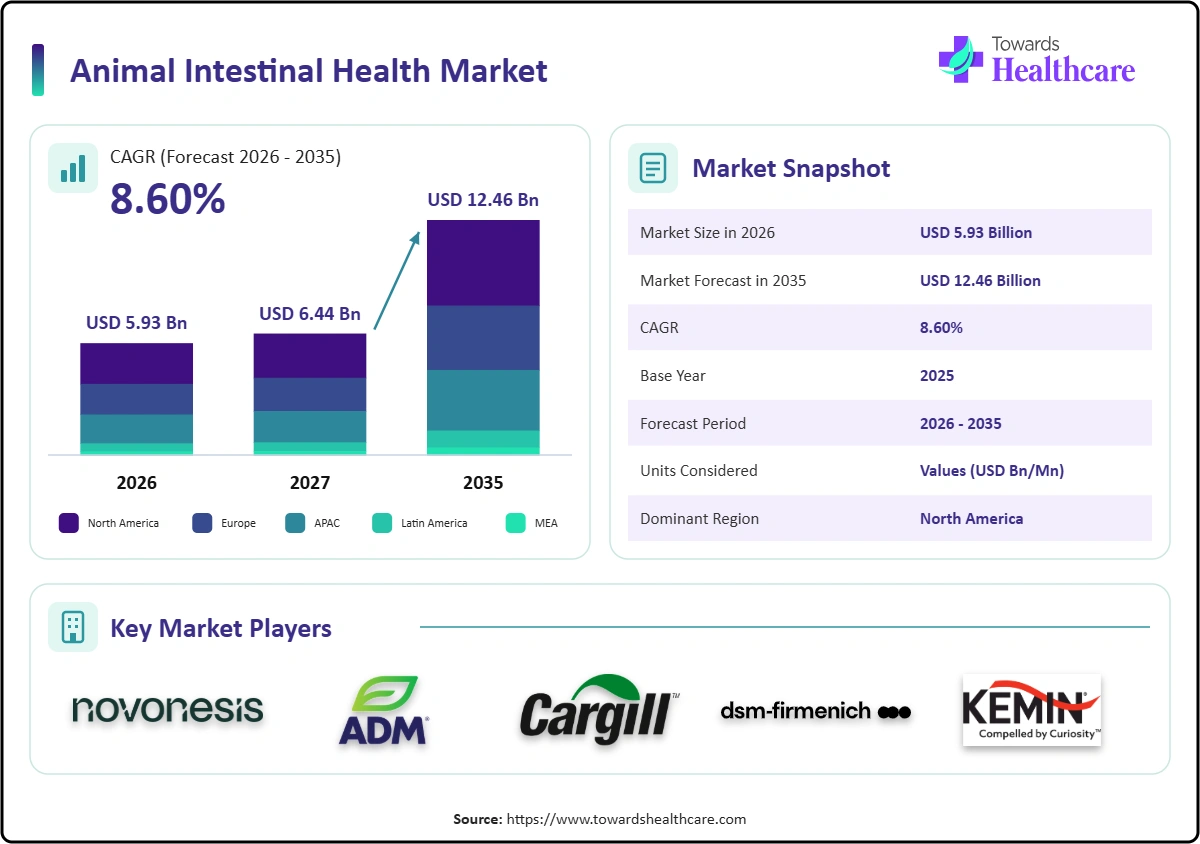
The animal intestinal health market is growing from USD 5.46 billion in 2025 to USD 12.46 billion by 2035 as livestock producers must keep animals healthy and productive without routine antibiotics, and gut health additives improve feed conversion, reduce disease, and support antibiotic-free claims. In addition, aquaculture growth, rebuilding of swine herds in Asia Pacific, regulatory approvals of new phytogenic and microbial products, and premium pet diets expand demand, lifting the market to USD 8.25 billion by 2030 and sustaining a CAGR of 8.60% from 2026 to 2035.
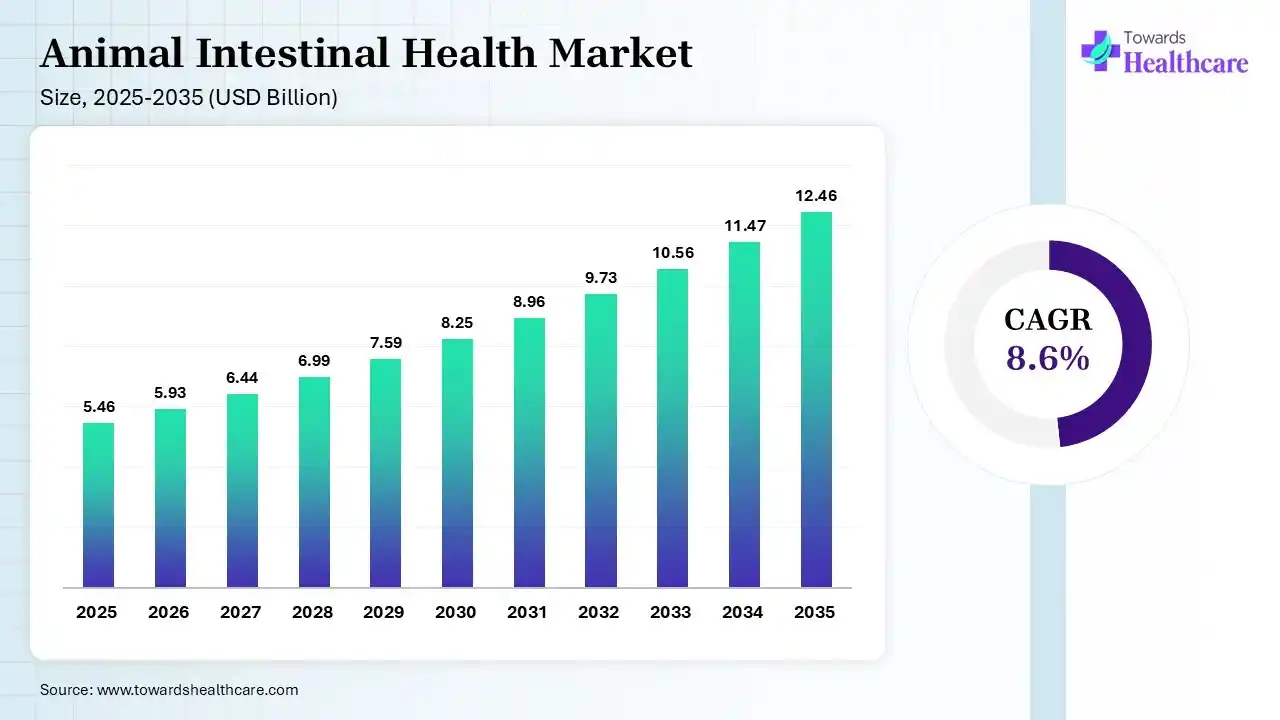
Analyst View: The market is gaining traction as producers increasingly focus on animal health, productivity, and reducing reliance on antibiotics. Growing aquaculture, recovering livestock populations in Asia Pacific, and rising demand for natural gut health solutions and premium pet nutrition are further strengthening market opportunities. The growth rate reflects steady adoption of antibiotic alternatives and growth in animal protein output, moderated by feed cost pressure and long approval timelines.
Driver: The restriction of antibiotic growth promoters across major markets, coupled with rising consumer demand for antibiotic-free meat, is driving producers to adopt gut health solutions that improve feed efficiency. Growing aquaculture and swine production across Asia, along with increasing demand for premium digestive health products for pets, further drives the market growth.
Restraint: Despite growing demand, feed cost pressures can limit spending on additives, while inconsistent product performance across farm conditions makes adoption challenging. Lengthy and costly approval processes, difficulties in proving return on investment, and intense price-based competition also constrain the growth.
Opportunity: Emerging postbiotics and next-generation probiotics offer opportunities for premium product development, while farm-level diagnostics can help producers target additive use more effectively. Expanding aquaculture in Asia Pacific and Latin America, the potential for methane reduction and environmental benefits, and growing demand for pet and equine digestive health products create additional growth opportunities.
| Segments | 2025 Share | 2025 Value (USD Billion) | 2035 Value (USD Billion) | CAGR 2026-2035 |
| Prebiotics | 27.20% | 1.49 | 3.23 | 8.09% |
| Probiotics | 25.60% | 1.40 | 3.16 | 8.49% |
| Phytogenics | 17.40% | 0.95 | 2.40 | 9.69% |
| Immunostimulants | 12.60% | 0.69 | 1.55 | 8.49% |
| Others (Enzymes, Organic Acids, Postbiotics) | 17.20% | 0.94 | 2.12 | 8.49% |
Note: 2025 is the base year; 2035 values are forecasts.
Sources: Expert interviews, secondary sources, Towards Healthcare database, and Towards Healthcare analysts.
By additive, prebiotics accounted for the largest share of 27.20% and valued at USD 1.49 billion in 2025; probiotics held 25.60% share and generated USD 1.40 billion, phytogenics captured 17.40% share, with a market size of USD 0.95 billion, immunostimulants account 12.60% share (USD 0.69 billion), and others at 17.20% share (USD 0.94 billion) in 2025. Prebiotics and probiotics lead because they are the main microbiome tools used to replace antibiotic growth promoters, while phytogenics are growing fastest.
Prebiotics: This segment was valued at USD 1.49 billion in 2025 and is projected to reach USD 3.23 billion by 2035, at a CAGR of 8.09% from 2026 to 2035. Prebiotics include yeast cell wall products, mannan-oligosaccharides, beta-glucans, fructo-oligosaccharides, and specialty fibers that feed beneficial gut bacteria and bind pathogens. They are widely used because they are stable in feed processing, inexpensive per ton of feed, and suitable for every species. Poultry and swine starter diets and premium pet foods are the largest users. Growth is steady as producers combine prebiotics with probiotics in synbiotic programs.
Probiotics: This segment captured USD 1.40 billion in 2025 and is expected to reach USD 3.16 billion by 2035, growing at a CAGR of 8.49% from 2026 to 2035. Probiotics, also called direct-fed microbials, include Bacillus, Lactobacillus, Enterococcus, and yeast strains that colonize the gut and compete with harmful bacteria. They are a leading alternative to antibiotic growth promoters and are used to control necrotic enteritis in broilers, diarrhea in piglets and calves, and digestive disorders in dairy cows. Spore-forming Bacillus strains are popular because they survive pelleting. Multi-strain products and strains selected for specific functions are supporting premium pricing.
Phytogenics: This segment reached USD 0.95 billion in 2025 and is projected to reach USD 2.40 billion by 2035, expanding at a CAGR of 9.69% from 2026 to 2035. Phytogenics include essential oils, herbs, spices, and plant extracts such as thymol, carvacrol, cinnamaldehyde, and capsaicin that support digestion, gut integrity, and antioxidant status. They are the fastest-growing additive because producers seek natural, residue-free solutions, and regulators in the EU and Brazil have started approving specific phytogenic molecules. Standardized formulations and microencapsulation improve consistency. Acquisitions such as Cargill's purchase of Delacon show the strategic importance of this category.
Immunostimulants: This segment holds USD 0.69 billion in 2025 and is projected to reach USD 1.55 billion by 2035, exhibiting a CAGR of 8.49% from 2026 to 2035. Immunostimulants include beta-glucans, nucleotides, and other compounds that strengthen the gut-associated immune system. They are used in young animals, during stress such as weaning, transport, and vaccination, and widely in aquaculture to improve disease resistance. Their use is growing in shrimp and fish farming in Asia Pacific.
Others (Enzymes, Organic Acids, Postbiotics): This segment accounted for USD 0.94 billion in 2025 and is expected to reach USD 2.12 billion by 2035, at a CAGR of 8.49% from 2026 to 2035. Other products include feed enzymes that improve nutrient digestibility and reduce undigested substrate for harmful bacteria, organic acids that lower gut pH and control Salmonella, and postbiotics made from fermented microbial products. Postbiotics are an emerging category supported by acquisitions such as DSM-Firmenich's purchase of Adare Biome.
| Segments | 2025 Share | 2025 Value (USD Billion) | 2035 Value (USD Billion) | CAGR 2026-2035 |
| Poultry | 33.40% | 1.82 | 3.98 | 8.11% |
| Swine | 28.60% | 1.56 | 3.53 | 8.51% |
| Ruminants | 18.20% | 0.99 | 2.25 | 8.51% |
| Aquaculture | 11.40% | 0.62 | 1.66 | 10.31% |
| Pets & Others | 8.40% | 0.46 | 1.04 | 8.51% |
Note: 2025 is the base year; 2035 values are forecasts.
Sources: Expert interviews, secondary sources, Towards Healthcare database, and Towards Healthcare analysts.
The poultry segment dominates at a 33.40% share, generating USD 1.82 billion in 2025; swine at a 28.60% share with a market size of USD 1.56 billion; ruminants held an 18.20% share, reaching USD 0.99 billion; aquaculture accounted for an 11.40% share and generated USD 0.62 billion; and pets and others accounted for an 8.40% share (USD 0.46 billion). Poultry and swine lead because of their large feed volumes and gut disease pressures, while aquaculture is the fastest-growing segment.
Poultry: This segment captured USD 1.82 billion in 2025 and is projected to reach USD 3.98 billion by 2035, at a CAGR of 8.11% from 2026 to 2035. Poultry is the largest species segment because broilers and layers consume large volumes of compound feed and face gut challenges such as necrotic enteritis and coccidiosis. Major poultry companies in the U.S., Brazil, Europe, and Asia Pacific have moved to antibiotic-free or reduced-antibiotic production, relying on probiotics, prebiotics, phytogenics, and organic acids.
Swine: The swine segment accounted for USD 1.56 billion of the animal intestinal health market in 2025 and is projected to reach USD 3.53 billion by 2035, registering a CAGR of 8.51% during 2026–2035. Swine represents the second-largest segment, with gut health products widely used in sow, piglet, and nursery diets to manage post-weaning diarrhea following the withdrawal of in-feed antibiotics and the EU ban on therapeutic zinc oxide. China's swine herd recovery following African swine fever, along with stricter antibiotic regulations, has further increased demand for intestinal health solutions across Asia Pacific.
Ruminants: The ruminants segment generated USD 0.99 billion in 2025 and is projected to reach USD 2.25 billion by 2035, registering a CAGR of 8.51% during 2026–2035. This segment includes dairy and beef cattle, sheep, and goats. Yeast cultures, direct-fed microbials, and phytogenic additives support rumen function, improve feed efficiency and milk yield, and help manage conditions such as acidosis and calf scours. Dairy farms represent the primary users of these products, as improvements in milk production and animal productivity support investment in gut health solutions.
Aquaculture: This segment was valued at USD 0.62 billion of the animal intestinal health market in 2025 and is estimated to reach USD 1.66 billion by 2035, expanding at a CAGR of 10.31% from 2026 to 2035. Aquaculture is the fastest-growing species segment as global fish and shrimp production expands, particularly in China, India, Vietnam, Indonesia, Ecuador, and Norway. Shrimp growers in Vietnam and India can spend a notable share of feed budgets on gut additives, using probiotics, immunostimulants, and phytogenics to manage disease in intensive ponds where antibiotic use is restricted.
Pets & Others: This segment reached USD 0.46 billion in 2025 and is projected to reach USD 1.04 billion by 2035, at a CAGR of 8.51% from 2026 to 2035. Pets and others include dogs, cats, and horses. Premium pet foods increasingly contain prebiotic fibers, probiotics, and postbiotics, and veterinary probiotic supplements are used for digestive upsets. Pet humanization supports high value per kilogram, although volumes are smaller than livestock.
| Segments | 2025 Share | 2025 Value (USD Billion) | 2035 Value (USD Billion) | CAGR 2026-2035 |
| Dry | 72.80% | 3.97 | 8.79 | 8.26% |
| Liquid | 27.20% | 1.49 | 3.67 | 9.46% |
Note: 2025 is the base year; 2035 values are forecasts.
Sources: Expert interviews, secondary sources, Towards Healthcare database, and Towards Healthcare analysts.
By form, the dry products accounted for a 72.80% share and were valued at USD 3.97 billion in 2025, and the liquid segment captured a 27.20% share and generated USD 1.49 billion. Dry forms dominate premixes and compound feed, while liquids are growing for drinking-water administration.
Dry: This segment held the market size of USD 3.97 billion in 2025 and is expected to reach USD 8.79 billion by 2035, at a CAGR of 8.26% from 2026 to 2035. Dry products, including powders, granules, and encapsulated forms, are added to premixes and compound feed at feed mills. They dominate because most livestock feed is manufactured as mash or pellets, and dry products are easy to store, transport, and dose. Heat-stable formulations allow inclusion in pelleted feed.
Liquid: The liquid segment generated USD 1.49 billion in 2025 and is projected to reach USD 3.67 billion by 2035, registering a CAGR of 9.46% during 2026–2035. Liquid formulations are administered through drinking water or applied to feed after pelleting. This segment is growing faster than other product forms because water-based delivery enables rapid and targeted supplementation during disease challenges, periods of stress, and early animal development. Liquid formulations also avoid heat-related degradation of active ingredients during feed processing, supporting their adoption across livestock production systems.
| Segments | 2025 Share | 2025 Value (USD Billion) | 2035 Value (USD Billion) | CAGR 2026-2035 |
| Microbial | 58.40% | 3.19 | 6.94 | 8.09% |
| Plant-Based | 41.60% | 2.27 | 5.52 | 9.29% |
Note: 2025 is the base year; 2035 values are forecasts.
Sources: Expert interviews, secondary sources, Towards Healthcare database, and Towards Healthcare analysts.
Microbial accounted for a 58.40% share, with a market size of USD 3.19 billion in 2025, and plant-based registered a 41.60% share and reached USD 2.27 billion in 2025. Microbial products include probiotics, yeast derivatives, and postbiotics, while plant-based products include phytogenic, fibers, and plant-derived prebiotics.
Microbial: This segment generates USD 3.19 billion of the animal intestinal health market in 2025 and is projected to reach USD 6.94 billion by 2035, growing at a CAGR of 8.09% from 2026 to 2035. Microbial products include live probiotics, yeast and yeast derivatives, fermentation products, and postbiotics. They lead because of strong scientific evidence for microbiome modulation, wide species use, and continuous innovation in strain selection.
Plant-Based: The plant-based segment was valued at USD 2.27 billion in 2025 and is projected to reach USD 5.52 billion by 2035, registering a CAGR of 9.29% during 2026–2035. Plant-based products include phytogenics, essential oils, plant extracts, dietary fibres, and plant-derived prebiotics. Segment growth is driven by increasing demand for natural alternatives to antibiotic growth promoters and broader regulatory acceptance of botanical feed additives. Growing adoption of natural ingredients to support digestion, gut microbiota balance, and overall animal health further supports market expansion.
Analyst View: The market is driven by demand for antibiotic alternatives, with prebiotics and probiotics remaining key choices due to their established use across livestock. Phytogenics and aquaculture are gaining attention as producers look for natural, effective ways to improve gut health and disease resistance. Poultry and swine continue to anchor demand, while premium pet nutrition creates opportunities for higher-value products. Dry formulations remain widely used for their convenience. Overall, innovation in microbial and plant-based solutions is expected to shape the market growth.
| Region | 2025 Share | 2025 Value (USD Billion) | 2035 Value (USD Billion) | CAGR 2026-2035 |
| North America | 36.40% | 1.99 | 4.26 | 7.91% |
| Asia Pacific | 27.40% | 1.50 | 3.81 | 9.81% |
| Europe | 25.80% | 1.41 | 3.13 | 8.31% |
| Latin America | 7.20% | 0.39 | 0.87 | 8.31% |
| Middle East & Africa | 3.20% | 0.17 | 0.39 | 8.31% |
Note: 2025 is the base year; 2035 values are forecasts.
Sources: Expert interviews, secondary sources, Towards Healthcare database, and Towards Healthcare analysts.
North America: This region was valued at USD 1.99 billion in 2025 and is projected to reach USD 4.26 billion by 2035, at a CAGR of 7.91% from 2026 to 2035. The U.S. has one of the largest poultry, swine, and cattle industries in the world and a strong consumer market for antibiotic-free and No Antibiotics Ever meat. Major feed additive companies such as Cargill, ADM, Kemin, and Phibro are headquartered in the region, and the large pet food industry adds demand for gut health ingredients.
Asia Pacific: This region reached a market size of USD 1.50 billion in 2025 and is expected to reach USD 3.81 billion by 2035, expanding at a CAGR of 9.81% from 2026 to 2035. Asia Pacific is the fastest-growing region. China banned antibiotic growth promoters in feed in 2020 and is rebuilding its swine herd after African swine fever, increasing the use of gut health additives. Aquaculture in China, India, Vietnam, and Indonesia is expanding rapidly, and India's poultry sector is modernizing.
Europe: This region generated USD 1.41 billion of the animal intestinal health market in 2025 and is projected to reach USD 3.13 billion by 2035, at a CAGR of 8.31% from 2026 to 2035. Europe banned antibiotic growth promoters in 2006 and ended the use of therapeutic zinc oxide in piglet feed in 2022, making it a mature market for antibiotic alternatives. EU feed additive authorization is strict, but approvals of new probiotics and phytogenic substances support innovation. Germany, Spain, France, and the Netherlands are the largest markets, with leading suppliers such as DSM-Firmenich, Evonik, Lallemand, and Delacon based in the region.
Latin America: The Latin American animal intestinal health market was valued at USD 0.39 billion in 2025 and is projected to reach USD 0.87 billion by 2035, registering a CAGR of 8.31% during 2026–2035. Regional growth is supported by Brazil's position as a major exporter of poultry and pork, along with expanding aquaculture production in Ecuador and Chile. Export market requirements for responsible antibiotic use are encouraging livestock producers to adopt alternative gut health solutions. Brazil's approval of new phytogenic molecules further supports product development and adoption. Expanding distribution partnerships are also improving access to intestinal health products across northern Brazil and other regional markets.
Middle East & Africa: This region registered USD 0.17 billion of the market in 2025 and is estimated to reach USD 0.39 billion by 2035, growing at a CAGR of 8.31% from 2026 to 2035. The Middle East & Africa are supported by growing poultry production in Saudi Arabia, Egypt, Iran, and South Africa as countries pursue food security. Hot climates and disease pressures increase the need for gut health support, while modern integrated poultry companies in the Gulf are adopting antibiotic alternatives.
Analyst View: North America remains a well-established market, supported by strong livestock production, antibiotic-free meat demand, and a mature pet food industry. Asia Pacific is emerging as a key growth engine, driven by expanding aquaculture, swine herd recovery, and modernization of poultry farming. Europe continues to benefit from strict antibiotic regulations and established adoption of alternative feed additives. Overall, regional growth will depend on regulatory support, livestock modernization, and wider adoption of antibiotic alternatives.
| Rank | Company Name | Market-Specific Revenue (USD Billion) | 2025 Share | Key Products / Business | Headquarters |
| 1 | DSM-Firmenich | 0.52 | 9.52% | Probiotics, eubiotics and gut health solutions | Switzerland |
| 2 | Cargill | 0.48 | 8.79% | Delacon phytogenics, Diamond V yeast fermentates | United States |
| 3 | ADM | 0.36 | 6.59% | Probiotics, postbiotics and gut health additives | United States |
| 4 | Novonesis | 0.30 | 5.49% | Probiotics and feed enzymes | Denmark |
| 5 | Kemin Industries | 0.24 | 4.40% | Probiotics and gut health additives | United States |
| 6 | Evonik | 0.22 | 4.03% | Ecobiol probiotics and Gutcare | Germany |
| 7 | Alltech | 0.22 | 4.03% | Yeast-based prebiotics and gut health | United States |
| 8 | Adisseo | 0.20 | 3.66% | Gut health and enzyme additives | France |
| 9 | Lallemand Animal Nutrition | 0.18 | 3.30% | Yeast and bacterial probiotics | Canada |
| 10 | Phibro Animal Health | 0.16 | 2.93% | Gut health and nutritional specialty products | United States |
Note: Company revenues and shares are 2025 estimates.
Sources: Company press releases, expert interviews, secondary sources, Towards Healthcare database, and Towards Healthcare analysts.
DSM-Firmenich led the animal intestinal health market with a 9.52% share and reached USD 0.52 billion in 2025 revenue, followed by Cargill at 8.79% (USD 0.48 billion) and ADM at 6.59% (USD 0.36 billion). DSM-Firmenich leads through its probiotics, eubiotics and gut health solutions sold to feed producers worldwide. Cargill offers Delacon phytogenics, Diamond V yeast fermentation products and other gut health solutions, and ADM provides probiotics, postbiotics and other additives through its animal nutrition business. Novonesis, Kemin Industries, Evonik, Alltech, Adisseo, Lallemand Animal Nutrition and Phibro Animal Health compete through probiotic strains, enzymes, specialty additives, yeast products and nutritional specialty products.
The top 10 companies accounted for an estimated 52.75% (USD 2.88 billion) of 2025 revenue, while the remaining 47.25% (USD 2.58 billion) was shared among regional additive makers, probiotic producers and phytogenic specialists. The animal intestinal health market is moderately fragmented, and competition centers on scientific evidence and trial data, strain and formulation innovation, regulatory approvals, heat stability, technical service to integrators, and price per ton of feed. Acquisitions are common as large companies add phytogenic, probiotic, and postbiotic capabilities.
The animal intestinal health ecosystem links fermentation and botanical raw material suppliers with additive manufacturers, premix and feed producers, integrators and farmers, veterinarians and regulators.
| Ecosystem Stage | Role in the Market | Key Companies |
| Raw Materials | Supply microbial strains, yeast, botanicals and fibers | Fermentation producers, essential oil and botanical suppliers |
| Additive Manufacturers | Develop probiotics, prebiotics, phytogenics and immunostimulants | DSM-Firmenich, Cargill, ADM, Novonesis, Kemin, Evonik, Alltech |
| Premix & Feed Producers | Formulate and manufacture feed | Nutreco, Cargill, ForFarmers, New Hope, CP Group |
| Integrators & Farmers | Raise animals and use gut health programs | Poultry, swine, dairy and aquaculture producers |
| Veterinarians & Regulators | Advise on use and approve products | Veterinarians, nutritionists, FDA, EFSA, MAPA |
Sources: Company press releases, expert interviews, secondary sources, Towards Healthcare database, and Towards Healthcare analysts.
The Towards Healthcare Companies Quadrant positions key participants in the animal intestinal health market by market strength, reflecting revenue scale, market share and geographic reach, and by innovation and growth strategy, reflecting product portfolio breadth, R&D intensity and partnerships. Positions reflect each company's estimated 2025 animal intestinal health revenue and our assessment of its product innovation, scientific support, and partnerships.
Sources: Company press releases, expert interviews, secondary sources, Towards Healthcare database, and Towards Healthcare analysts.
Leaders: DSM-Firmenich, Cargill, ADM, Novonesis, Kemin Industries, and Evonik combine significant gut health revenue with broad additive portfolios, research programs, and global feed industry relationships.
Innovators: Adisseo and Lallemand Animal Nutrition bring specialized probiotic strains, yeast technology, and enzyme-based gut solutions.
Niche Players: Alltech and Phibro Animal Health serve specific species and product segments.
The animal intestinal health market was defined as prebiotics, probiotics, phytogenics, immunostimulants, enzymes, organic acids, and postbiotics for intestinal health in livestock, aquaculture, and companion animals, worldwide. The 2025 base year was built bottom-up from compound feed and pet food production by species and region, additive inclusion rates and prices, and checked top-down against the gut health revenue of leading feed additive companies. Segment, regional and company values were allocated from additives, livestock species, forms, sources and regional demand. Key estimates were verified by cross-checking company disclosures, regulatory and industry data, and published third-party estimates, and inputs that could not be reconciled were excluded. All segment, regional and company figures were reconciled to the same 2025 base year, and the 2026-2035 forecast, which applies a constant CAGR from the 2025 base, was recalculated and validated.
Analyst View: The animal intestinal health market is growing steadily as livestock production moves away from routine antibiotics and toward microbiome-based nutrition. Our estimate links demand to feed production, inclusion rates, and prices, so the forecast follows animal protein output, antibiotic policies, and additive innovation. The main upside comes from aquaculture and phytogenics, while the main risks are feed cost pressure and regulatory delays.