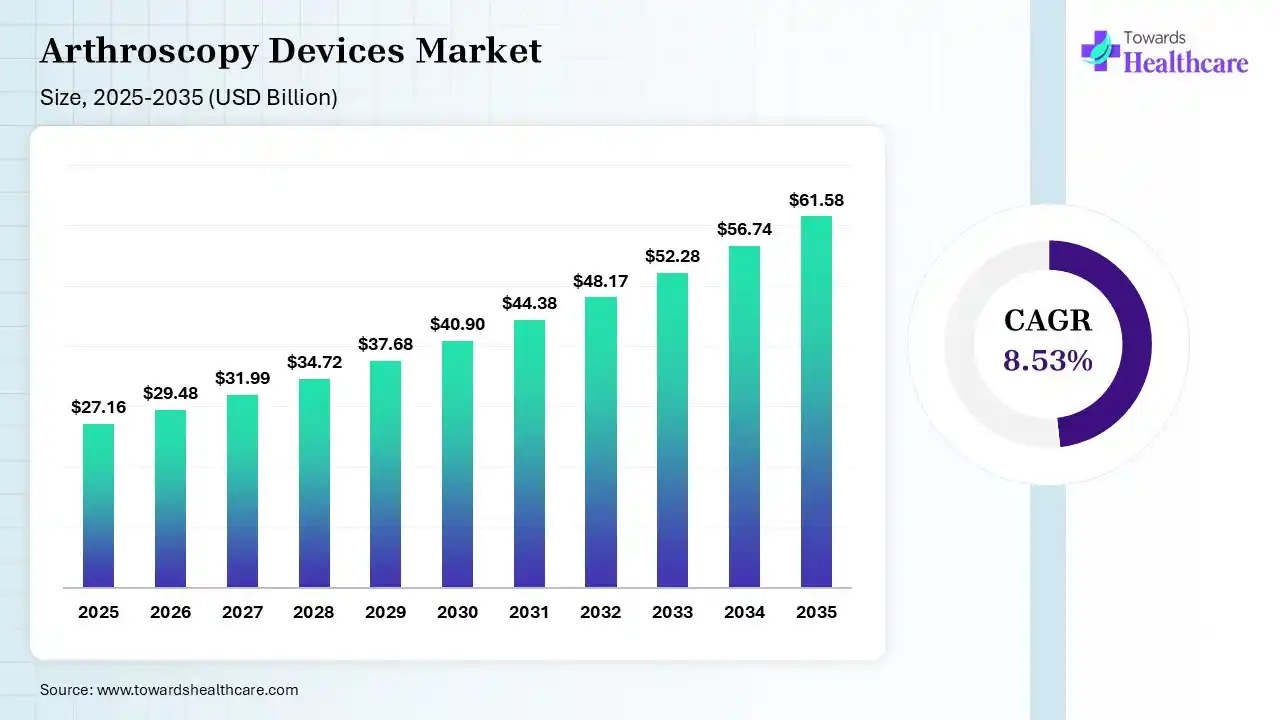
The global arthroscopy devices market size is calculated at USD 27.16 billion in 2025, grew to USD 29.48 billion in 2026, and is projected to reach around USD 56.75 billion by 2035. The market is expanding at a CAGR of 8.53% between 2026 and 2035.
Arthroscopy is a procedure for diagnosing and treating various joint conditions that often cause pain, instability, or other dysfunction. Some common arthroscopic devices include portal establishment, camera video system, monitor and printer, motorized instruments, irrigation and suction system, probe, biters/forceps, graspers, etc. These arthroscopic devices are used to diagnose and treat joint conditions related to the knee, shoulder, elbow, hips, wrist, and ankle. The different conditions that can be treated using arthroscopic devices include loose bone fragments, damaged or torn cartilage, inflamed joint linings, torn ligaments, and scarring within joints.
The increasing incidences of joint disorders lead to an increasing number of surgical procedures and treatments, driving the market. The rising geriatric population results in higher chances of joint-related disorders and increases sports-related injuries, which boosts market growth. In 2023, approximately 3.7 million people were treated for injuries involving sports and recreational equipment associated with exercise, cycling, and basketball. Recent advancements in the medical device sector and increasing investments by several government and private organizations support the development of arthroscopic devices. Furthermore, the rapidly expanding healthcare infrastructure globally potentiates market growth.
Artificial intelligence (AI) has revolutionized the healthcare sector, and its applications in orthopedic surgeries are promising. Several researchers are investigating the role of AI and machine learning (ML) to stimulate the outcomes of arthroscopic surgeries. AI can use the visual signals a camera generates for diagnostics and decision-making in arthroscopic surgeries. It can be used in effective decision-making by analyzing imaging data of arthroscopic procedures, thereby minimizing manual errors. Additionally, AI has the potential to predict postoperative outcomes and complications automatically and augment postoperative rehabilitation. Robotic-assisted arthroscopy paves new waves in the market, enabling surgeons to enhance precision and dexterity. AI can also help in training healthcare professionals and aid in surgical accuracy. In hospital settings, AI can improve documentation and billing, reducing the burdensome tasks on hospital staff. Hence, implementing AI in orthopedic arthroscopy has immense potential. However, more research is required.
Arthroscopic devices are specialized medical instruments and equipment used to examine, diagnose, and treat conditions affecting, joints through small incisions. These devices enable surgeons to visualize internal joint structure and perform procedures with reduced tissue disruption. The arthroscopic devices market is growing as patients and healthcare providers increasingly favor minimally invasive approaches that can support faster recovery and shorter hospital stays. Key drivers include the rising prevalence of sports injuries, osteoarthritis, and other musculoskeletal disorders, along with increasing arthroscopic surgical procedures.
Current trends include disposable instruments, advanced visualization systems, and wider adoption of minimally invasive techniques. Technological advancements such as high-definition cameras, improved scopes, robotic assistance, and enhanced surgical instruments are improving procedure precision. Future opportunities include smart arthroscopy systems, AI-assisted visualization, outpatient procedures, and development of specialized devices for complex joints, supporting continued market expansion.
Driver
Demand for Minimally Invasive Surgery
The fear of undergoing a surgical procedure restricts several patients from receiving effective treatments, potentiating the demand for minimally invasive surgeries. These procedures can result in similar outcomes, thereby increasing popularity and accessibility. Patients prefer these procedures due to small incisions and the fact that they require less time to recover. The demand for minimally invasive procedures increases due to technological advancements, including laser and radiofrequency. Additionally, AI can transform these procedures, enabling surgeons to achieve more effective treatment outcomes. Hence, the growing interest in minimally invasive techniques sets the stage for future orthopedic therapies, prioritizing procedural speed and patient comfort, thereby potentiating the arthroscopy devices market growth.
Restraint
High Cost and Lack of Skilled Professionals
The major restraint of the arthroscopy devices market is the high cost of arthroscopic devices. The average price of arthroscopic devices is thousands of dollars, limiting the affordability of several hospitals and other healthcare settings in low- and middle-income countries. Another major restraint of the market is the lack of skilled professionals. Lack of trained professionals results in restricted use of arthroscopic devices. New product launches due to technological advancements require the training of professionals.
Opportunity
Latest Innovations
Innovations are made to advance every aspect of arthroscopy, enabling healthcare professionals to simplify surgical procedures. Recent innovations are continuously made to refine imaging technologies. High-definition cameras are developed to provide surgeons with unparalleled clarity and navigate intricate joint structures with precision. Smart instruments are also devised with sensors providing real-time feedback on tissue health, pressure points, and overall joint conditions. The future of arthroscopy is driven by emerging technologies such as nanotechnology, advanced biomaterials, and telemedicine. The nano arthroscopy method is a type of minimally invasive surgery used to perform procedures in joints such as the wrist, ankle, elbow, knees, and shoulder. Arthroscopic devices combined with regenerative medicines are being explored to promote healing and regenerate damaged cartilage.
For instance,
| Table | Scope |
| Market Size in 2026 | USD 29.48 Billion |
| Projected Market Size in 2035 | USD 61.58 Billion |
| CAGR (2026 - 2035) | 8.53% |
| Leading Region | North America |
| Historical Data | 2020 - 2023 |
| Base Year | 2025 |
| Forecast Period | 2026 - 2035 |
| Measurable Values | USD Millions/Units/Volume |
| Market Segmentation | By type, By application, By region |
| Top Key Players | Arthrex, B. Braun, CONMED Corporation, DePuy Synthes, Endomed Systems, Fiegert Endotech, Karl Storz GmbH, Lepu Medical, Medtronic plc, Pioneer Healthcare Technologies, Richard Wolf, Smith & Nephew, Stryker Corporation, Wellcare Medical Systems, Zimmer Biomet |
By type, the arthroscope segment dominated the arthroscopy devices market in 2025. It is a predominant requirement for arthroscopic surgeries. The growing preference for minimally invasive surgeries and technological advancements leading to the latest innovations potentiate the segment. The rising sports-related injuries, the increasing geriatric population, and increasing incidences of joint disorders promote the segment’s growth.
By type, the arthroscopic implants segment is predicted to witness significant growth in the arthroscopy devices market over the forecast period. Arthroscopic implants include suture anchors, interference screws, and endo-buttons. These implants can be either absorbable or non-absorbable. Traditional implants were made of metals or inerts, which are non-absorbable, leading to complications that affect treatment outcomes. Hence, absorbable implants are widely used due to their excellent mechanical properties, good compatibility, and controlled degradation rates. They are made of absorbable polymers, absorbable bioceramics, and absorbable metals. The growing research and development and increasing patient preference toward absorbable implants augment the segment’s growth.
By application, the knee arthroscopy segment led the global arthroscopy devices market in 2025. Knee arthroscopy is a surgical procedure that allows the knee joint to be viewed without making a large incision. The rising incidences of osteoarthritis, osteoporosis, and other knee injuries necessitate knee arthroscopy procedures. Osteoarthritis is the most prevalent orthopedic disorder globally. It affects around 32.5 million individuals in the US annually.
By application, the hip arthroscopy segment is predicted to hold a notable share of the arthroscopy devices market over the coming years. Hip arthroscopy is a procedure that involves making small cuts in the hips and looking inside using a tiny camera. It can help people who are having trouble moving properly because of an issue inside their hip joint. Hip arthroscopy is used to treat conditions such as femoroacetabular impingement (FAI), labral tears, removing pieces of bone or cartilage, dysplasia, tendon tears, and tendon releases.
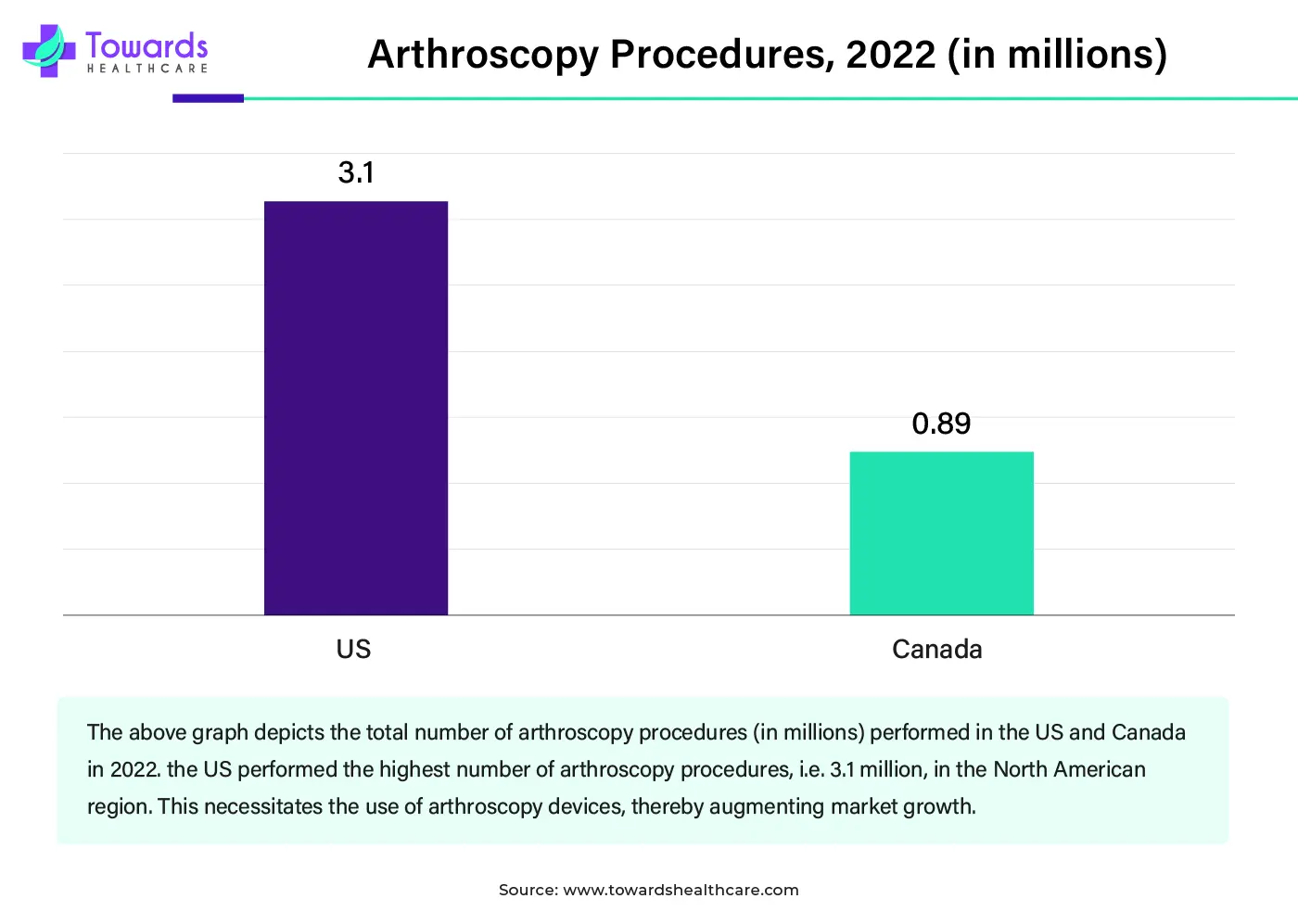
North America held the largest share of the arthroscopy devices market in 2025. The rising geriatric population, advanced healthcare infrastructure, technological advancements, and the presence of key players drive the market. In the US, 31.9 million women and 25.9 million men were 65 or older in 2022, representing 17.3% of the total population. It is estimated to increase to 82 million by 2050. According to the American Joint Replacement Registry, around 194,695 primary total knee arthroplasty were performed in the US in 2022. The market is also driven by the increasing number of orthopedic surgeries and suitable regulatory frameworks in the region. The US Food and Drug Administration actively supports the development and regulatory approval of AI/ML-based medical devices. According to the Centers for Disease Control and Prevention, about 53 million individuals in the US have arthritis.
Why the U.S. Arthroscopic Devices Market is Significantly Growing
The U.S. arthroscopic devices market is significantly growing due to the increasing prevalence of osteoarthritis, sports injuries, and other joint disorders. Growing preference for minimally invasive orthopedic procedures is encouraging device adoption. Advanced healthcare facilities, high surgical volumes, and rapid development of visualization technologies are supporting market expansion. Rising outpatient procedures and demand for faster recovery are further strengthening the use of arthroscopic devices.
Why Canada is Notably Growing in the Arthroscopic Devices Market
Canada’s arthroscopic devices market is notably growing due to increasing orthopedic procedures and rising demand for minimally invasive joint treatments. The growing prevalence of osteoarthritis and sports-related injuries is supporting procedure volumes. Improved healthcare infrastructure, greater adoption of advanced surgical equipment, and increasing preference for shorter recovery periods are encouraging market development. Technological improvements in orthoscopes and surgical instruments are further supporting adoption across Canadian healthcare facilities.
Asia-Pacific is anticipated to grow at the fastest rate in the arthroscopy devices market during the forecast period. The rising geriatric population, increasing incidences of joint disorders, growing research and development, and increasing investments & collaborations drive the market. The Chinese government has taken several steps to boost the medical device industry through encouraging international cooperation and providing funding.
In 2022, the Chinese State Council announced a loan incentive policy of $29 billion to encourage hospitals to upgrade medical facilities. The Idian Government focuses on the local production of medical devices, including orthopedic devices such as knee implants. It provides financial incentives worth $400 million to boost domestic production. The changing patient preferences, growing population, and rising non-communicable disease cases in the Asia-Pacific boost market growth. In China, India, and Japan, approximately 1.02 million, 0.68 million, and 0.49 million arthroscopy procedures were performed in 2022.
Why China is Significantly Expanding in the Arthroscopic Devices Market
China’s arthroscopic devices market is significantly expanding due to the rising burden of joint disorders, increasing arthroscopic surgeries, and growing preference for minimally invasive procedures. Healthcare infrastructure development and expanding access to specialized orthopedic care are supporting adoption. Rising investments in medical technology, increasing use of advanced visualization systems, and improvements in domestic device manufacturing are further strengthening the availability and utilization of arthroscopic equipment.
Why India has a Notable Share in the Arthroscopic Devices Market
India holds a notable share in the arthroscopic devices market due to the rising prevalence of joint disorders and sports-related injuries. Increasing preference for minimally invasive procedures, expanding hospitals and orthopedic centers, and improving access to advanced surgical technologies are supporting demand. Growing medical tourism, healthcare investment, and adoption of modern visualization systems are further strengthening India’s position in the market.
Brad Sharp, CEO of Integrated Endoscopy, commented on the release of two new versions of NUVIS Single-Use Arthroscope, saying that the device will become the standard of care with a total of three versions. He also added that the device can eliminate operating room downtime and produce outstanding image quality case after case.
By Type
By Application
By Region




Principal Consultant
Payal Rabde is a Healthcare Market Research Analyst at Towards Healthcare Research & Consulting with 4+ years of experience in pharmaceuticals, biotechnology, medical devices, and life sciences.
Learn more about Payal Rabde

Reviewed By
Aditi Shivarkar is a seasoned professional with over 14 years of experience in healthcare market research. As a content reviewer, Aditi ensures the quality and accuracy of all market insights and data presented by the research team.
Learn more about Aditi Shivarkar