Pipeline Programs

CGT Companies Tracked

Manufacturing Facilities


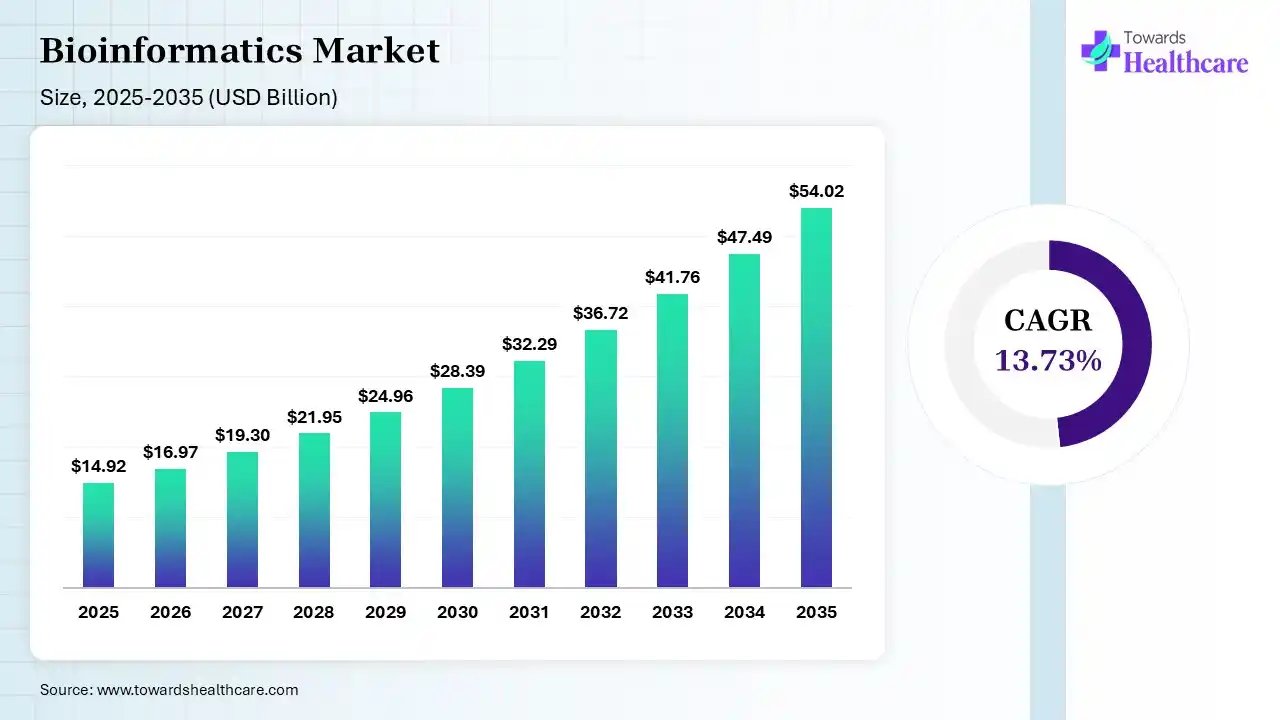
The bioinformatics market was estimated at USD 11.53 billion in 2025, with expectations of climbing to USD 16.97 billion in 2026 and hitting USD 54.02 billion by 2035, driven by a CAGR of 13.73% over the forecast period. The increasing genomic and proteomic research, novel drug discovery & development, and technological advancements drive the market.
Bioinformatics is a field involving computational technology that collects, stores, analyzes, and disseminates biological data and information. It uses various fields of science and technology to analyze and interpret biological data. It plays a crucial role in the expression and regulation of genes and proteins and in understanding the evolutionary aspects of molecular biology. In structural biology, it aids in the simulation and modeling of DNA, RNA, proteins, and biomolecular interactions. One of the main achievements of bioinformatics is the analysis of genome sequence data, especially the analysis of the human genome project.
The novel drug discovery research and identification of novel drug targets increase the demand for bioinformatics. Advances in reading DNA sequences and expanding research to develop practical insights about human health and biology with its complexity potentiate the market. Additionally, favorable government policies support omics (genomics, proteomics, metabolomics, and transcriptomics) research, further leading to market growth.
The advent of artificial intelligence (AI) and machine learning (ML) has transformed the entire bioinformatics field. The widespread applications of genomics and proteomics in the healthcare sector rapidly increased the demand for bioinformatics. Natural language processing (NLP) aids in searching through volumes of biology research, aggregating information, and translating research findings from one language to another. Artificial neural networks can classify gene expression profiles, predict protein structure, and aid in DNA sequencing. These technologies have a synergistic effect of converting complex genomic and proteomic data into simple, readable data. Hence, they can accelerate the drug discovery and development process, thereby reducing the overall time and cost of the experiment.
The major challenge of the market is the computational complexity. The complex process and the large-scale datasets require heavy computational systems to handle such large-scale data. These systems require suitable infrastructure and are highly expensive, limiting their use by several developing and underdeveloped countries. Another major challenge is the lack of trained professionals. Scientists and engineers in certain LMICs lack relevant knowledge and skills in bioinformatics, thereby restricting its usage.
| Table | Scope |
| Market Size in 2026 | USD 16.97 Billion |
| Projected Market Size in 2035 | USD 54.02 Billion |
| CAGR (2026 - 2035) | 13.73% |
| Leading Region | North America |
| Historical Data | 2020 - 2023 |
| Base Year | 2025 |
| Forecast Period | 2026 - 2035 |
| Measurable Values | USD Millions/Units/Volume |
| Market Segmentation | By product, By application, By region |
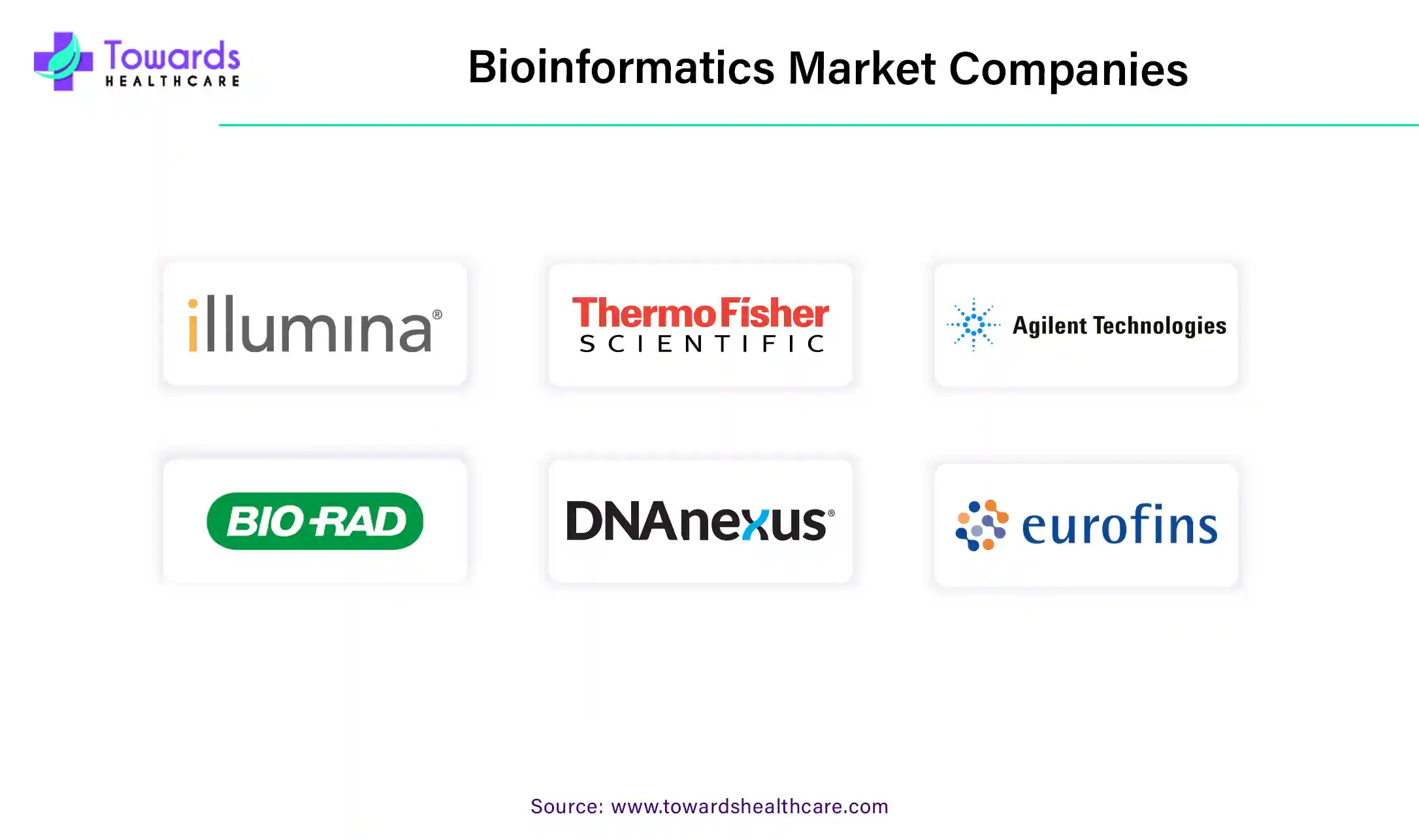
| Top Key Players | Illumina, Inc., Thermo Fisher Scientific, Agilent Technologies, Inc., Qiagen, Verge Genomics, Bio-Rad Laboratories, Inc., Biomax Informatics, DNAnexus, Geneva Bioinformatics, Waters Corporation, Perkin Elmer, Inc., Fios Genomics, Eurofins Scientific |
By product, the biocontent management segment registered its dominance over the global bioinformatics market in 2025. Content management in biomedical research refers to the process of generating, storing, accessing, delivering, and refining biological data through a unified platform. The increasing use of web servers and software for obtaining and retrieving complex biological data potentiates the segment’s growth.
By product, the bioinformatics services segment is anticipated to grow with the highest CAGR in the market during the studied years. The bioinformatics services cover entire bioinformatics data lifecycles, including managing and monitoring the intake, integrity, and use of diverse bioinformatics data types. These services can save the time and resources of numerous scientists, leading to precise and accurate data through experienced bioinformaticians.
By application, the genomics segment held a significant share of the bioinformatics market in 2025. The increasing demand for genomics and favorable government policies augment the segment’s growth. The increasing need for genome sequencing and the human genome project to identify potential genetic biomarkers and gene sequences to predict the disease also boosts the segment’s growth.
By application, the chemoinformatics & drug designing segment is predicted to witness significant growth in the market over the forecast period. Chemoinformatics is a field that systematizes the practice of computers in chemistry. Bioinformatics and chemoinformatics are complementary to each other in the drug discovery process, where target identification is the first step. Novel drug discovery research and technological advancements promote the segment’s growth.
North America dominated the global bioinformatics market in 2025. The rising prevalence of chronic disorders, novel drug discovery research, technological advancements, and the presence of key players. Several US government organizations, such as the National Institute of Standards and Technology (NIST), the National Center for Toxicological Research (NICT), and the National Cancer Informatics Program (NCIP), play a crucial role in supporting and funding bioinformatics research in the region. Additionally, the Canadian government actively supports bioinformatics research. In October 2023, the Canadian Minister of Health announced a $15 million investment to create a Pan-Canadian Genome Library to harness the potential of genomic medicine. The market is also driven by suitable infrastructure, capital investments, and the presence of skilled professionals.
Asia-Pacific is projected to host the fastest-growing bioinformatics market in the coming years. The favorable government policies, growing research & development, and increasing investments & collaborations drive the market. Countries like China, India, and Japan are at the forefront of boosting the bioinformatics market in the region. China is the world’s second-largest biopharmaceutical market and continues to grow at a fast pace due to developments in gene therapy and genome editing. Several multinational companies around the world are investing in India and Japan owing to their rapidly changing demographics and expanding healthcare infrastructure. In 2022, the Japanese government initiated a project titled “Strengthening Drug Discovery Venture Ecosystem Project” with a budget of 300 billion yen.
Li Qing, Senior Vice President and General Manager in Greater China, commented that genomics is a rapidly evolving field as DNA sequencing is playing a vital role when it comes to human health and the planet. He also stated that in the future, the role of genomics will be pushed forward from ‘sick care’ to ‘health care’ to improve human health more broadly.
By Product
By Application
By Region



Principal Consultant
Payal Rabde is a Healthcare Market Research Analyst at Towards Healthcare Research & Consulting with 4+ years of experience in pharmaceuticals, biotechnology, medical devices, and life sciences.
Learn more about Payal Rabde

Reviewed By
Aditi Shivarkar is a seasoned professional with over 14 years of experience in healthcare market research. As a content reviewer, Aditi ensures the quality and accuracy of all market insights and data presented by the research team.
Learn more about Aditi Shivarkar