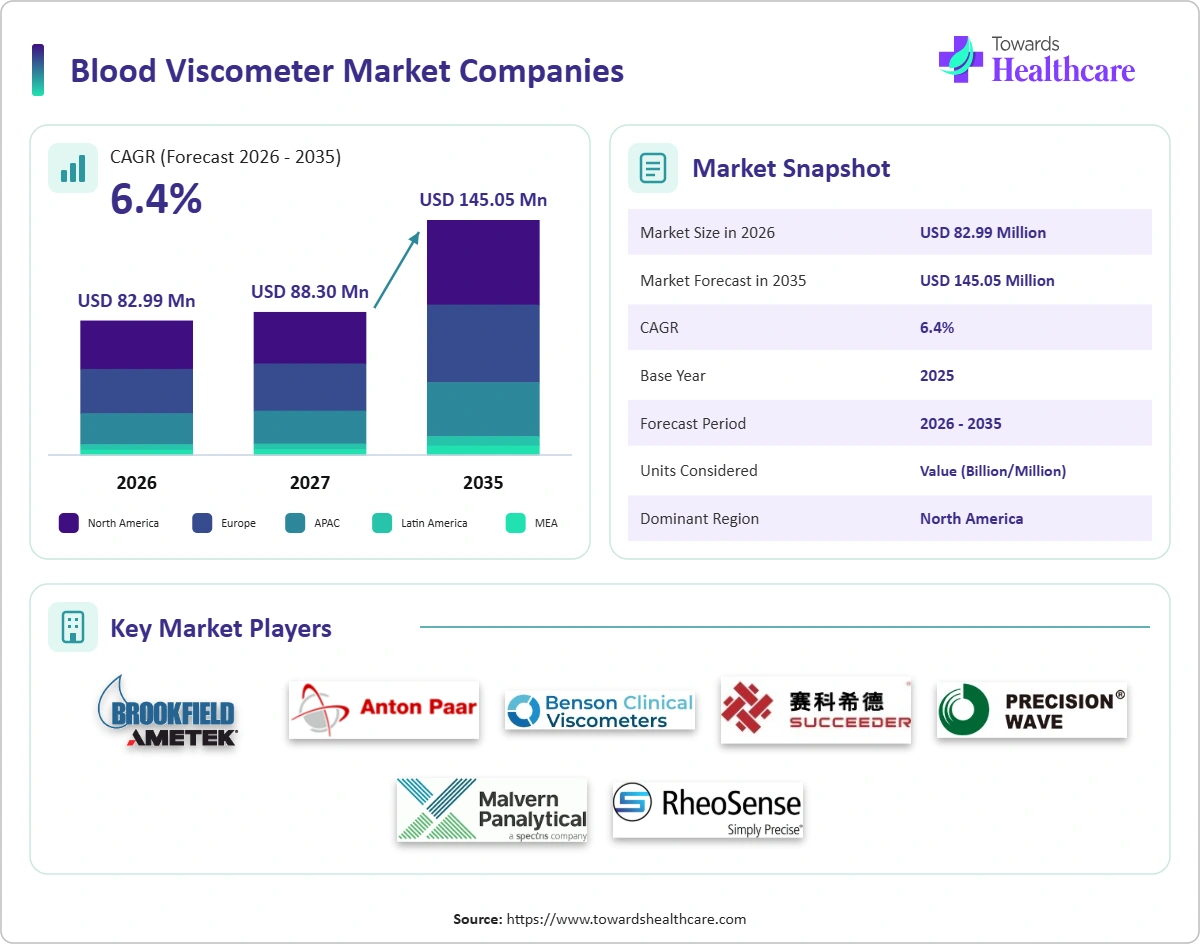
The global blood viscometer market is projected to grow from USD 78 million in 2025 to USD 145.05 million by 2035, driven by increasing demand for accurate blood viscosity assessment across haematology, cardiovascular research, and critical care settings. Blood viscosity is a key haemorheological parameter affecting blood flow and microcirculation, crucial for evaluating hyperviscosity, plasma abnormalities, and related clinical disorders. Increased research in haematological cancers, cardiovascular diseases, sickle cell disease, and sepsis drives demand for specialized viscosity measurement technologies.
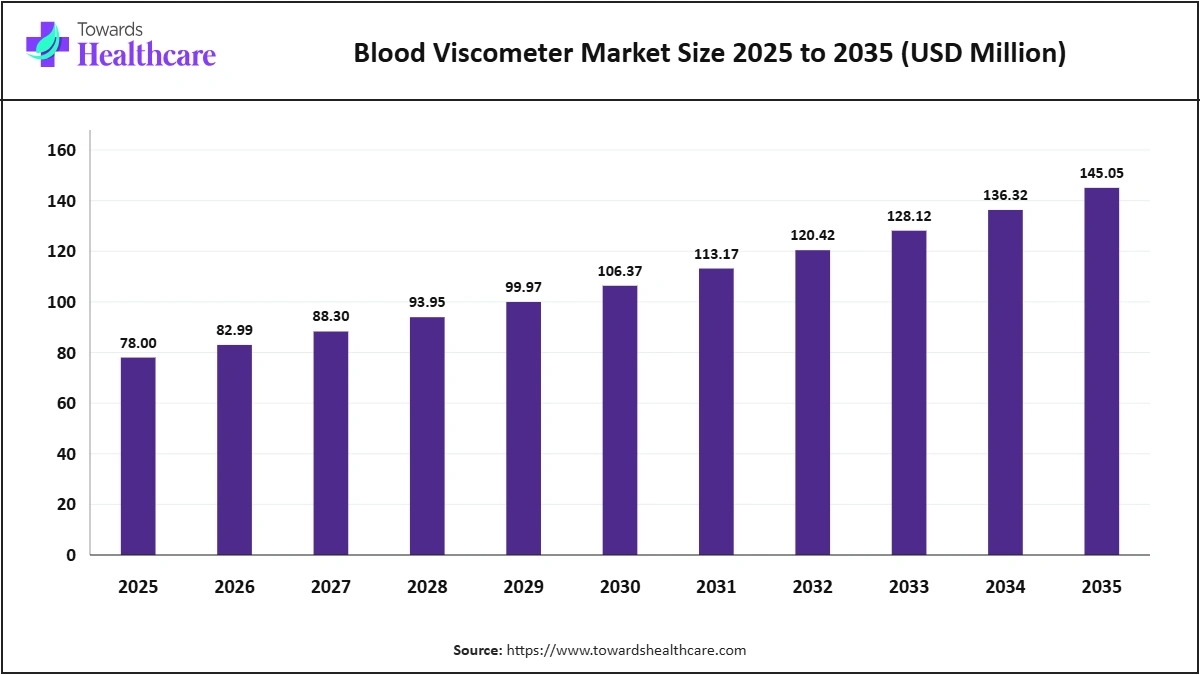
Conventional instruments remain vital for laboratory applications, while microfluidic devices enhance testing efficiency with smaller sample sizes and quicker measurements. The market is projected to reach USD 106.37 million by 2030, supported by continued demand across specialist laboratory and research applications, with a CAGR of 6.4% from 2026 to 2035. The growing integration of haemorheological measurements into precision medicine and blood product research is creating additional opportunities for specialised instrument manufacturers.
Analyst View: Our assessment includes rotational, capillary, scanning capillary, microfluidic, and point-of-care blood viscosity measurement instruments, together with associated consumables and services. The market estimate was developed using installed instrument bases, new equipment placements, average selling prices, and regional demand patterns. We cross-checked these estimates against supplier portfolios, company activity, and expert interviews. As published estimates for this specialized market are limited, our assessment focuses on instrument-level demand and related commercial activity rather than broader rheology equipment revenues.
| Driver | Impact | ≈ CAGR Contribution | Time Horizon | Key Regions |
| Haematological cancers need monitoring | High | +2.50 pp | Short to long term | Global, strongest in North America |
| Cardiovascular research grows | Medium | +2.11 pp | Medium to long term | Global, fastest uptake in Asia Pacific |
| Sepsis studies explore viscosity | Medium | +1.80 pp | Short to medium term | Global |
| Microfluidics improve ease of use | Low | +1.41 pp | Long term | Developed and emerging markets |
Note: Contributions are indicative estimates of each factor's effect on annual growth.
Sources: Expert interviews, secondary sources, Towards Healthcare database and Towards Healthcare analysts.
The identified growth drivers contribute around 7.81 percentage points to annual growth in the blood viscometer market, with requirements for haematological cancer monitoring representing the largest contribution. Cardiovascular research and critical care investigations support demand for specialized viscosity measurement instruments. Microfluidic advancements are expected to strengthen adoption by making testing more efficient and accessible. North America is particularly influenced by established clinical research and specialist laboratory demand, while Asia Pacific is expected to experience faster adoption as home healthcare and research infrastructure expands.
| Restraint | Impact | ≈ Negative CAGR Contribution | Time Horizon | Key Regions |
| Limited routine use | High | -0.63 pp | Short to medium term | Global |
| Few reimbursement codes | High | -0.46 pp | Medium term | Price-sensitive and emerging markets |
| Competition from other inflammation markers | Medium | -0.31 pp | Short term | North America and other mature markets |
Note: Contributions are indicative estimates of each factor's effect on annual growth.
Sources: Expert interviews, secondary sources, Towards Healthcare database and Towards Healthcare analysts.
Limited routine clinical use, reimbursement constraints, and competition from established diagnostic markers are expected to reduce annual growth of the blood viscometer market by roughly 1.41 percentage points. The specialized nature of blood viscosity testing limits its use across general diagnostic workflows, while the lack of dedicated reimbursement pathways can affect purchasing decisions. However, growing clinical research, technological improvements, and the expansion of specialized applications could gradually reduce these barriers. Consequently, the market is projected to maintain a net CAGR of 6.4% from 2026 to 2035.
The development of microfluidic, portable, and point-of-care blood viscosity measurement systems offers considerable opportunities for market participants. Smaller sample requirements and faster testing capabilities can expand the use of viscosity measurement beyond specialized laboratories into emergency care and selected critical care environments.
Growing interest in sickle cell disease management, sepsis monitoring, and personalized haematological assessment is creating additional opportunities. Asia Pacific also presents considerable growth potential because of expanding hospital infrastructure, increasing investment in laboratory research, and the development of specialized diagnostic facilities in China, Japan, South Korea, and India. Manufacturers can strengthen their market positions through partnerships with research institutions, clinical validation initiatives, and the development of integrated blood rheology testing platforms.
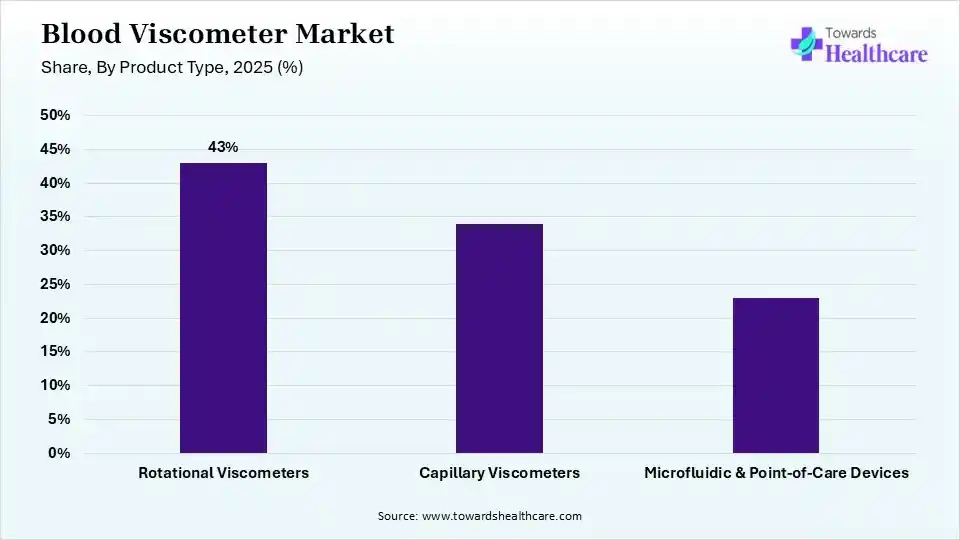
Note: 2025 is the base year; 2035 shares and CAGRs are forecasts.
Sources: Expert interviews, secondary sources, Towards Healthcare database and Towards Healthcare analysts.
Rotational Viscometers accounted for 43% of the market in 2025 and are projected to expand at a CAGR of 5.54% from 2026 to 2035. These instruments, used for haemorheological research, particularly cone-plate and coaxial systems, are essential for assessing blood viscosity across various shear conditions. Their established use in laboratories ensures ongoing demand for detailed rheological measurements. Nonetheless, growth in this segment is anticipated to be slower than the overall market due to the emergence of newer microfluidic technologies.
Capillary Viscometers measure plasma viscosity and are essential in hospital and diagnostic laboratories. Their established role in haematological investigations ensures their continued market presence, with growth expected alongside traditional laboratory testing demand.
Microfluidic and Point-of-Care Devices These devices are projected to grow rapidly because they can operate with smaller sample volumes and support faster measurements, fostering advancements in point-of-care testing, critical care research, and portable blood viscosity assessments. Ongoing technological improvements and clinical validation will likely enhance this segment's expansion.
Segment Outlook: Through 2035, rotational viscometers are expected to remain the largest product type segment, retaining approximately 39.64% of the market. However, microfluidic and point-of-care devices are projected to record the highest CAGR of 8.44%, supported by demand for portable measurement technologies and small-volume testing. The gradual shift toward decentralized and faster viscosity assessment is expected to strengthen the position of microfluidic technologies.
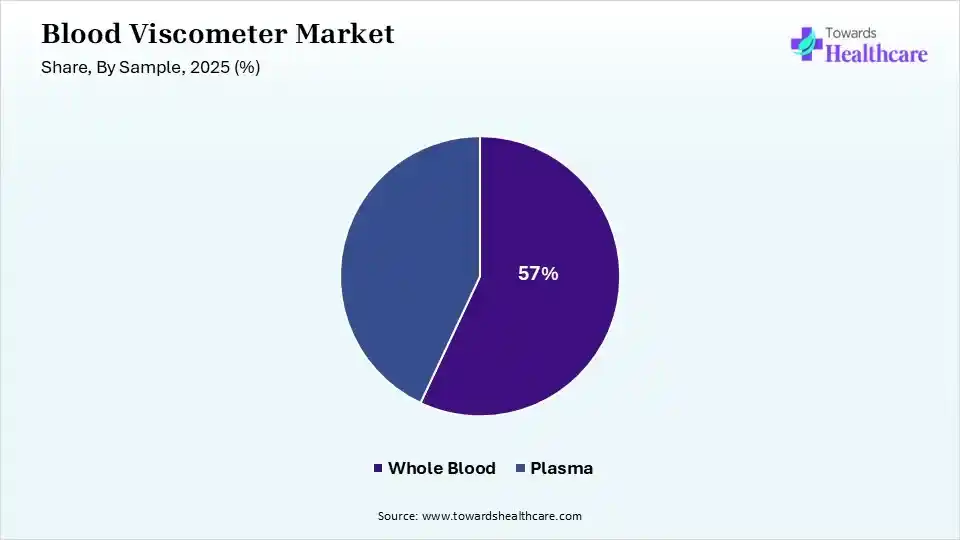
Note: 2025 is the base year; 2035 shares and CAGRs are forecasts.
Sources: Expert interviews, secondary sources, Towards Healthcare database and Towards Healthcare analysts.
Whole Blood viscosity measurement is essential for analyzing the influence of red blood cells, plasma, and other components on blood flow. It is important in haemorheological research, cardiovascular studies, sickle cell disease, and assessing hyperviscosity conditions. The increasing focus on microcirculation and blood flow abnormalities is expected to heighten the demand for these measurement devices.
Plasma viscosity testing supports the evaluation of abnormalities associated with increased plasma protein concentrations, paraproteinaemia, and inflammatory conditions. Hospital and diagnostic laboratories use plasma viscosity measurements as part of specialized haematological investigations. Continued demand for plasma testing in clinical laboratories is expected to support steady segment growth.
Segment Outlook: During the forecast period, whole blood is expected to remain the largest sample segment, accounting for around 57.92% of the market. It is also projected to register the highest CAGR of 6.57%. Plasma testing will continue to represent an important component of specialized haematological assessment, while research into whole blood flow characteristics is expected to strengthen demand for whole blood viscosity measurement technologies.
Note: 2025 is the base year; 2035 shares and CAGRs are forecasts.
Sources: Expert interviews, secondary sources, Towards Healthcare database and Towards Healthcare analysts.
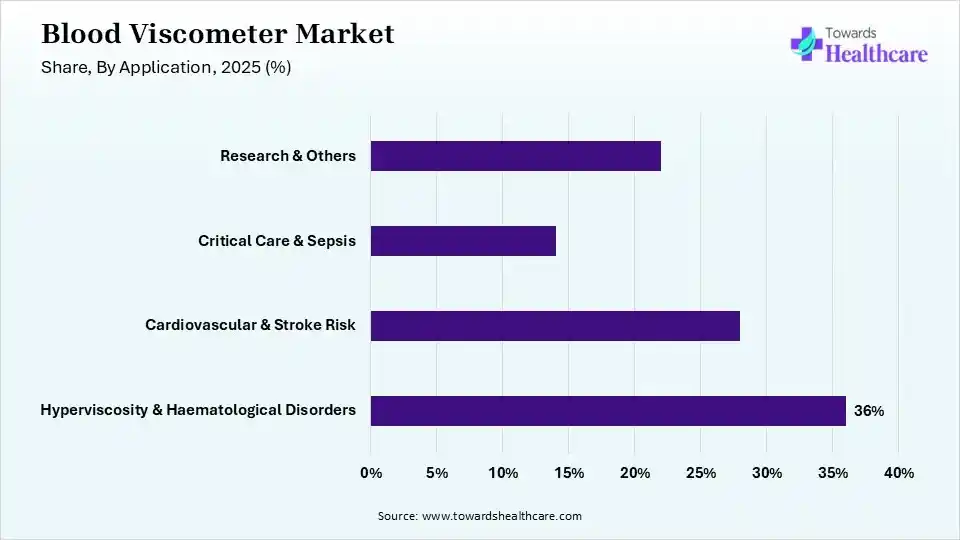
Hyperviscosity and Haematological Disorders accounted for 36% of the market in 2025 and are projected to expand at a CAGR of 5.84% from 2026 to 2035. Blood viscosity measurement is important for evaluating conditions such as multiple myeloma, Waldenström macroglobulinaemia, and polycythaemia, which affect blood or plasma viscosity and need specialized laboratory tests. While viscosity testing plays a recognized role in certain haematological investigations, its market growth is anticipated to be slower than that of the overall market.
Cardiovascular and Stroke Risk during the forecast period. Cardiovascular research highlights blood viscosity's role in vascular resistance and microcirculation, linking it to stroke risk and vascular abnormalities. The adoption of specialized blood rheology instruments is supported by this research, with ongoing investment projected to maintain demand.
Critical Care and Sepsis This application is anticipated to be the fastest-growing category, as researchers study blood viscosity changes during conditions like sepsis, trauma, and haemorrhagic shock. Research into viscosity measurement improve understanding of microcirculatory dysfunction, paving the way for advanced testing technologies. Additionally, innovations in portable and wearable sensors could bolster this segment.
Research and Others This category includes academic research, pharmaceutical development, sickle cell studies, blood product evaluation, and other specialized applications. Increasing interest in haemorheology and the influence of blood flow characteristics on therapeutic outcomes is expected to support continued growth.
Segment Outlook: Hyperviscosity and haematological disorders are expected to remain the largest application segment by 2035, accounting for approximately 34.14% of the market. However, critical care and sepsis are projected to register the highest CAGR of 8.24%. Increasing research into blood viscosity as a potential indicator of microcirculatory changes is expected to support faster adoption in critical care-related applications.
Note: 2025 is the base year; 2035 shares and CAGRs are forecasts.
Sources: Expert interviews, secondary sources, Towards Healthcare database and Towards Healthcare analysts.
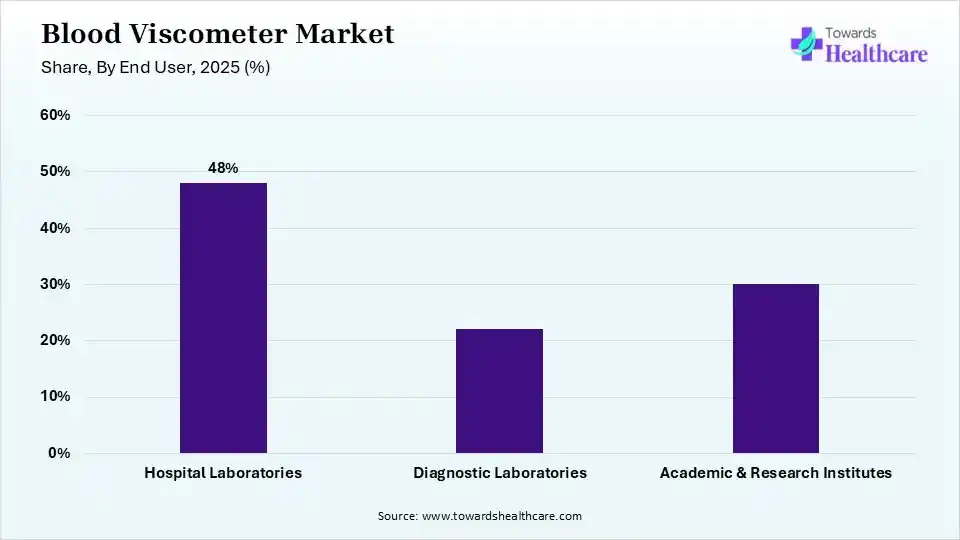
Hospital Laboratories accounted for 48% of the market in 2025 and are projected to expand at a CAGR of 5.81% from 2026 to 2035. Hospital laboratories rely on blood viscosity instruments for testing haematological disorders, supported by established diagnostic infrastructure and specialist relationships. However, the growth of this segment is expected to be moderated due to limited routine testing applications.
Diagnostic Laboratories enhance blood viscosity assessment by offering specialized testing services, accommodating samples from various healthcare facilities. The growing interest in specialized haematological testing is anticipated to drive segment expansion.
Academic and Research Institutes These institutions utilize advanced rotational, microfluidic, and rheological measurement technologies for research in cardiovascular studies, sickle cell disease, and blood flow abnormalities, while supporting the development of new diagnostic and measurement methods. Investments in microfluidic technologies and haemorheological research are anticipated to promote above-average growth.
Segment Outlook: Hospital laboratories are expected to remain the largest end-user segment through 2035, accounting for around 45.41% of the market. Academic and research institutes are projected to register the highest CAGR of 7.41%, supported by increasing research activity and technological innovation. Diagnostic laboratories will continue to play an important role through specialized referral testing and established laboratory services.
Analyst View: In our analysis, segment shares were allocated using instrument demand, product portfolios, installed equipment, testing applications, and average selling prices across each category. Rotational viscometers, whole blood, hyperviscosity and haematological disorders, and hospital laboratories lead their respective segments because they address established measurement and testing requirements. However, microfluidic and point-of-care devices, critical care and sepsis applications, and academic and research institutes are expected to gain market share as advanced technologies and specialized applications expand over the forecast period.
Note: 2025 is the base year; 2035 shares and CAGRs are forecasts.
Sources: Expert interviews, secondary sources, Towards Healthcare database and Towards Healthcare analysts.
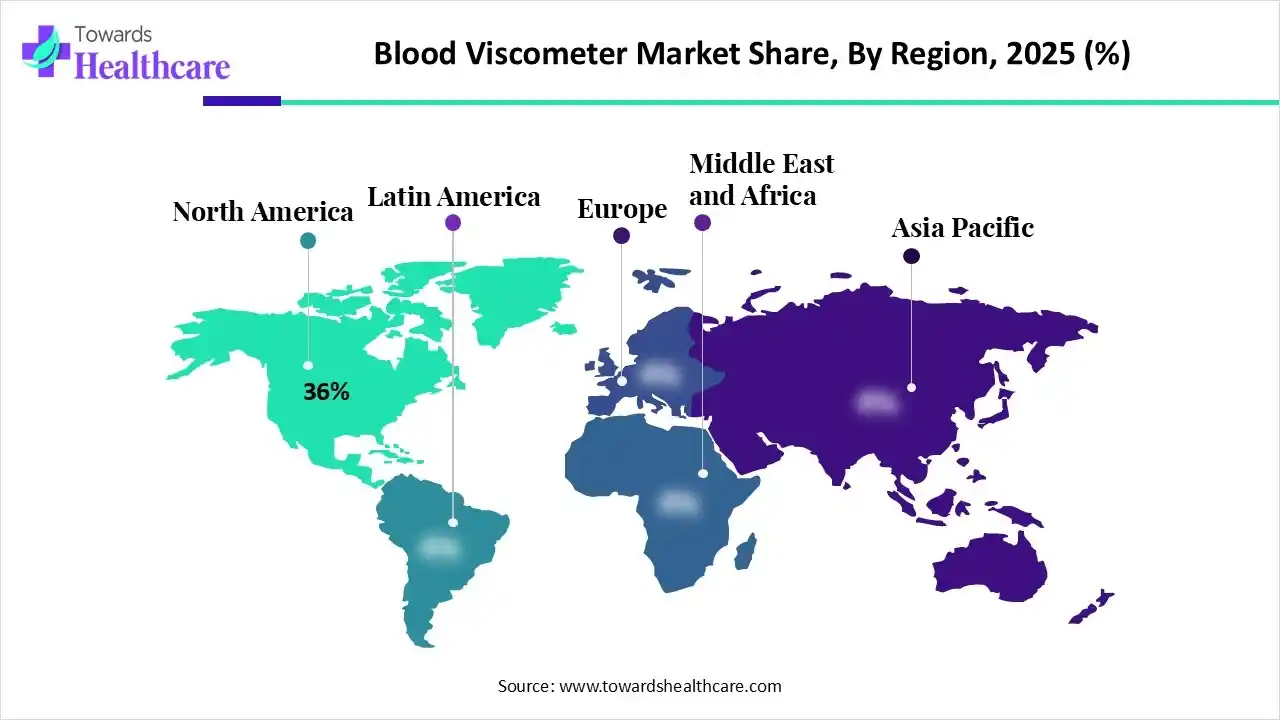
North America accounted for 36% of the blood viscometer market in 2025 and is projected to expand at a CAGR of 5.85% from 2026 to 2035. The region leads due to robust haematological research, cardiovascular studies, and specialist laboratory networks. The U.S. contributes with its advanced research infrastructure and instrument manufacturers. Demand from academic institutions and hospitals fosters market growth, although North America is projected to grow slower than the overall market during the forecast period.
Europe growth in the haematological investigation sector is bolstered by established hospital laboratory infrastructure and plasma viscosity testing. Key contributors to regional demand include the United Kingdom, Germany, France, and Italy, driven by clinical laboratories and research institutions. Ongoing investment in laboratory automation and haemorheological research is anticipated to foster market expansion.
Asia Pacific regional healthcare growth in China, Japan, South Korea, and India is driven by expanding hospital infrastructure, increased investment in diagnostic laboratories, and rising research activities. Local blood rheology instrument manufacturers and interest in microfluidic testing technologies are expected to support this expansion, alongside growing healthcare expenditures and specialized research investments.
Latin America growth in advanced laboratory technologies is supported by improvements in diagnostic infrastructure and increased availability of specialized services, especially in Brazil and Argentina. However, inconsistent healthcare spending, limited reimbursement, and uneven access to diagnostic equipment may hinder adoption in some areas.
The Middle East and Africa market development is supported by investments in hospital infrastructure, the expansion of specialized diagnostic laboratories, and access to advanced laboratory technologies in GCC countries and South Africa. The development of specialty healthcare facilities and research infrastructure is expected to create opportunities for blood viscosity instrument suppliers.
Analyst View: Our analysis indicates that North America will retain its leading position, supported by established specialist laboratories, research infrastructure, and demand for advanced blood rheology testing. Asia Pacific is expected to record the fastest growth as laboratory infrastructure and investment in haematological research expand. Europe's established clinical testing base should support steady demand, while Latin America and the Middle East and Africa are expected to develop more gradually. Regional forecasts reflect differences in installed equipment, specialist testing capacity, supplier presence, and healthcare investment.
| Rank | Company Name | 2025 Share (%) | Key Products / Business | Headquarters |
| 1 | Brookfield (AMETEK) | 17.95% | Rotational and cone-plate viscometers | United States |
| 2 | Anton Paar | 16.67% | Rheometers and viscometers | Austria |
| 3 | Benson Viscometers | 11.54% | Plasma viscometers for clinical labs | United Kingdom |
| 4 | Beijing Succeeder | 10.26% | Blood rheology analyzers | China |
| 5 | RheoSense | 8.97% | Microfluidic VROC viscometers | United States |
| 6 | Health Onvector | 7.69% | Scanning capillary blood viscometers | United States |
| 7 | Thermo Fisher Scientific | 7.69% | HAAKE rheometers | United States |
| 8 | TA Instruments (Waters) | 7.69% | Rheometers for research | United States |
| 9 | Beijing Precil Instrument | 6.41% | LBY-series blood viscometers | China |
| 10 | Malvern Panalytical (Spectris) | 5.13% | Rheology instruments | United Kingdom |
Note: Company shares are 2025 estimates.
Sources: Company press releases, expert interviews, secondary sources, Towards Healthcare database and Towards Healthcare analysts.
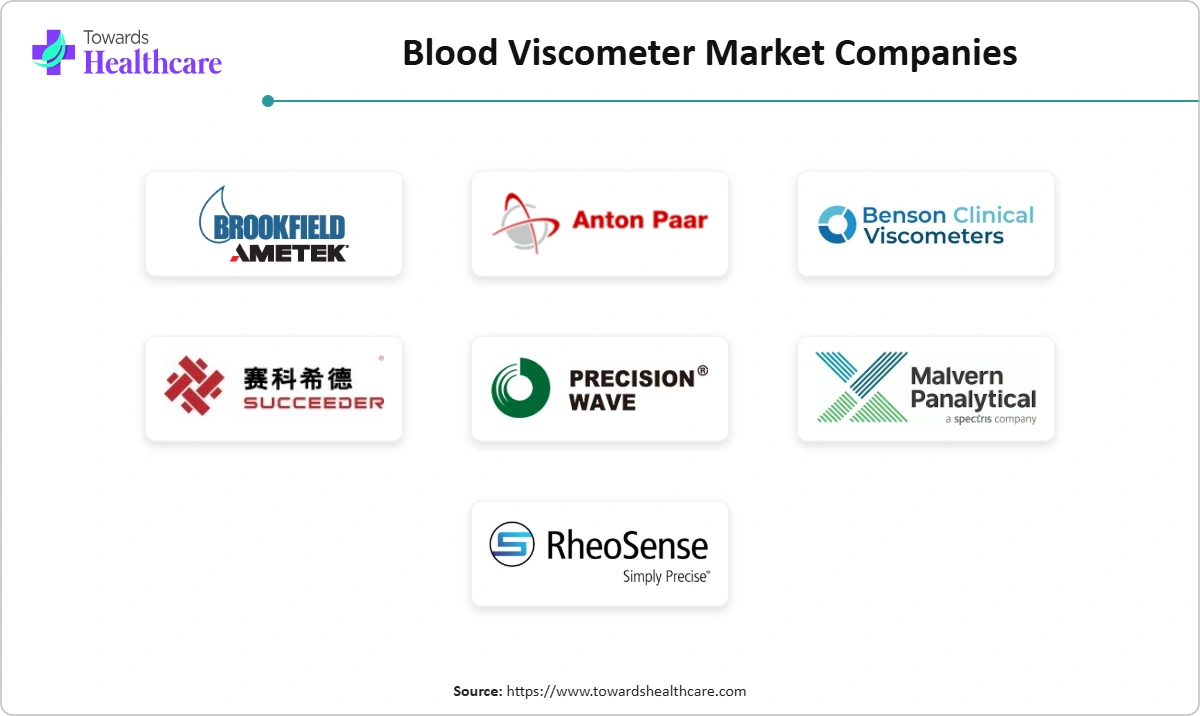
Brookfield (AMETEK), Anton Paar, and Benson Viscometers are among the major participants in the global blood viscometer market, supported by their established instrument portfolios and specialized measurement capabilities. Brookfield (AMETEK) competes through rotational and cone-plate viscometers, while Anton Paar offers rheometers and viscometers for advanced laboratory applications. Benson Viscometers focuses on plasma viscosity instruments designed for clinical laboratory testing.
Other important participants include Beijing Succeeder, RheoSense, Health Onvector, Thermo Fisher Scientific, TA Instruments (Waters), Beijing Precil Instrument, and Malvern Panalytical (Spectris). These companies compete through blood rheology analyzers, microfluidic viscosity measurement technologies, scanning capillary systems, and advanced rheometers.
The competitive landscape includes established rheology instrument manufacturers and specialized companies focusing on clinical blood viscosity measurement. Established manufacturers benefit from broader instrument portfolios, global distribution networks, and established laboratory relationships. Specialized participants compete through clinical applications, smaller sample requirements, and dedicated blood viscosity testing capabilities. Competition is increasingly influenced by measurement accuracy, shear-rate performance, automation, instrument reliability, clinical validation, and service support.
Brookfield (AMETEK): Brookfield, part of AMETEK, is headquartered in the United States. It held an estimated 17.95% share of the blood viscometer market in 2025. Its offering centres on rotational and cone-plate viscometers used for viscosity measurement and rheological analysis. Its established instrument portfolio and laboratory presence support its competitive position. In the Towards Healthcare Companies Quadrant, it is positioned as a Leader.
Anton Paar: Anton Paar is headquartered in Austria. It held an estimated 16.67% share of the market in 2025. Its portfolio includes rheometers and viscometers for specialized research and laboratory applications. Its measurement technologies and established presence in advanced laboratory instrumentation support its market position. The company is classified as a Leader in the Towards Healthcare Companies Quadrant.
Benson Viscometers: Benson Viscometers is headquartered in the United Kingdom. It accounted for an estimated 11.54% share of the market in 2025. The company specializes in plasma viscometers designed for clinical laboratories and haematological investigations. Its specialized product portfolio supports its position in clinical blood viscosity testing. It is categorized as a Leader.
Beijing Succeeder: Beijing Succeeder is headquartered in China. It held an estimated 10.26% share of the market in 2025. Its offering includes blood rheology analyzers designed for specialized laboratory testing. The company's presence in blood rheology instrumentation supports its participation in the expanding Asian market. It is positioned as a Leader.
RheoSense: RheoSense is headquartered in the United States. It accounted for an estimated 8.97% share of the market in 2025. Its offering includes microfluidic VROC viscometers, which support advanced viscosity measurement using small sample volumes. Its focus on microfluidic measurement technologies supports its position in the innovation-driven product category. The company is classified as a Leader.
Health Onvector: Health Onvector is headquartered in the United States. It held an estimated 7.69% share of the market in 2025. Its portfolio includes scanning capillary blood viscometers designed for specialized blood viscosity assessment. Its focus on blood-specific measurement technologies supports its participation in the clinical instrument market. It is positioned as a Leader.
Thermo Fisher Scientific: Thermo Fisher Scientific is headquartered in the United States. It accounted for an estimated 7.69% share of the market in 2025. Its participation in the market is supported by HAAKE rheometers and broader laboratory instrumentation capabilities. Its established laboratory customer base and global distribution network support its competitive position. In the Towards Healthcare Companies Quadrant, it is categorized as an Innovator.
TA Instruments (Waters): TA Instruments, part of Waters Corporation, is headquartered in the United States. It held an estimated 7.69% share of the market in 2025. Its portfolio includes rheometers used in advanced research and material characterization. Its established position in laboratory research instrumentation supports its market participation. It is classified as an Innovator.
Beijing Precil Instrument: Beijing Precil Instrument is headquartered in China. It accounted for an estimated 6.41% share of the market in 2025. Its portfolio includes LBY-series blood viscometers designed for blood rheology assessment. Its specialized instrument offerings and presence in the Chinese market support its competitive position. It is categorized as an Innovator.
Malvern Panalytical (Spectris): Malvern Panalytical, part of Spectris, is headquartered in the United Kingdom. It held an estimated 5.13% share of the market in 2025. Its portfolio includes rheology instruments used in research and advanced laboratory applications. Its technological capabilities and established presence in analytical instrumentation support its participation in the market. It is positioned as an Innovator.
The blood viscometer ecosystem links component suppliers, instrument makers, distributors, users, and regulators & standards, with each stage adding value before products reach end users.
| Ecosystem Stage | Role in the Market | Key Companies |
| Component Suppliers | Supply sensors, motors and microfluidic chips | Precision component makers |
| Instrument Makers | Make viscometers and rheometers | Brookfield, Anton Paar, Benson, RheoSense |
| Distributors | Sell to labs | Lab distributors |
| Users | Measure viscosity | Hospital labs, referral labs, research institutes |
| Regulators & Standards | Set methods and clear devices | FDA, ICSH guidelines, EU IVDR |
Sources: Company press releases, expert interviews, secondary sources, Towards Healthcare database and Towards Healthcare analysts.
Component Suppliers: Component suppliers are crucial in blood viscometer manufacturing, providing necessary technologies such as sensors, precision motors, measurement components, electronic systems, and microfluidic chips. Their capabilities affect the performance, accuracy, and reliability of the instruments.
Instrument Makers: Instrument manufacturers such as Brookfield, Anton Paar, Benson Viscometers, and RheoSense develop rotational viscometers, capillary systems, microfluidic devices, and advanced rheometers, highlighting measurement precision, product reliability, sample handling, and application-specific design.
Distributors: Distributors connect manufacturers with hospitals, research institutions, and diagnostic laboratories. They support instrument procurement, installation, training, maintenance, and after-sales services. Their regional networks are important for suppliers seeking to expand into emerging markets.
Users: Blood viscosity measurement technologies are utilized by hospital laboratories, diagnostic laboratories, and academic research institutes for haematological investigations, cardiovascular research, blood flow analysis, and critical care studies.
Regulators and Standards: Regulatory authorities and standards organizations play a crucial role in shaping blood viscosity measurement technologies. Key frameworks include FDA requirements and European Union In Vitro Diagnostic Regulation (IVDR) standards, along with pertinent haematology testing guidance.
The value chain in the global blood viscometer market begins with the supply of precision components and measurement technologies, followed by instrument development, manufacturing, distribution, and end-user adoption. Service providers and distributors add value through installation, calibration, maintenance, and technical support. Manufacturers that combine measurement accuracy, application-specific instrument design, and strong laboratory relationships are well-positioned to capture greater value across the ecosystem.
The Towards Healthcare Companies Quadrant positions key participants in the blood viscometer market by market strength, reflecting revenue scale, market share and geographic reach, and by innovation and growth strategy, reflecting product portfolio breadth, R&D intensity, and partnerships. Positions reflect each company's estimated 2025 share of the blood viscometer market and our assessment of its product innovation, portfolio breadth, and partnerships.
Sources: Company press releases, expert interviews, secondary sources, Towards Healthcare database and Towards Healthcare analysts.
Leaders: Brookfield (AMETEK), Anton Paar, Benson Viscometers, Beijing Succeeder, RheoSense, and Health Onvector include specialized blood-viscosity suppliers and broader rheology equipment companies with relevant measurement capabilities.
Innovators: Thermo Fisher Scientific, TA Instruments (Waters), Beijing Precil Instrument, and Malvern Panalytical (Spectris) bring newer technologies and specialised products.
By Product Type
By Sample
By Application
By End User
By Region
The global blood viscometer market encompasses instruments used to measure the viscosity of whole blood and plasma, including rotational, capillary, scanning capillary, microfluidic, and point-of-care viscosity measurement systems, along with associated consumables and services. These technologies are used in the assessment of hyperviscosity syndromes, haematological disorders, cardiovascular and stroke risk, critical care conditions, and research applications. The market serves hospital laboratories, diagnostic laboratories, academic institutions, and specialized research facilities.
The 2025 market estimate was developed through a bottom-up assessment of installed viscometer volumes, new instrument placements, average selling prices, and associated consumable and service revenues across product types and regions. Demand was evaluated according to sample type, application, and end-user category. Instrument revenues were allocated across rotational, capillary, microfluidic, and point-of-care technologies, while whole blood and plasma applications were assessed separately to avoid overlapping revenue attribution.
The resulting estimates were cross-checked against supplier product portfolios, company disclosures, instrument availability, expert interviews, and published industry information. Regional market values were evaluated using installed equipment bases, laboratory infrastructure, research activity, and supplier presence. Company market shares were estimated using the identified competitive landscape and the allocation of market revenue across major suppliers.
The 2026-2035 forecast incorporates anticipated changes in instrument adoption, microfluidic technology development, clinical and research applications, regional healthcare infrastructure, and average selling prices. All segment, regional, and company estimates were reconciled against the 2025 base-year market value, with forecast calculations validated against the overall market growth trajectory.
Analyst View: The global blood viscometer market is poised for steady growth due to increasing demand in haematology, cardiovascular research, and critical care. Traditional rotational and capillary viscometers will remain central, while microfluidic and point-of-care technologies offer new opportunities with smaller sample requirements and quicker measurements. North America will lead the market, supported by robust research infrastructure, while the Asia Pacific region is expected to grow fastest amid rising healthcare investments. Despite promising prospects in critical care and advanced technologies, challenges such as limited clinical adoption and competition from established markers may hinder broader market penetration. Overall, continued demand and emerging technologies are anticipated to drive market growth through 2035.