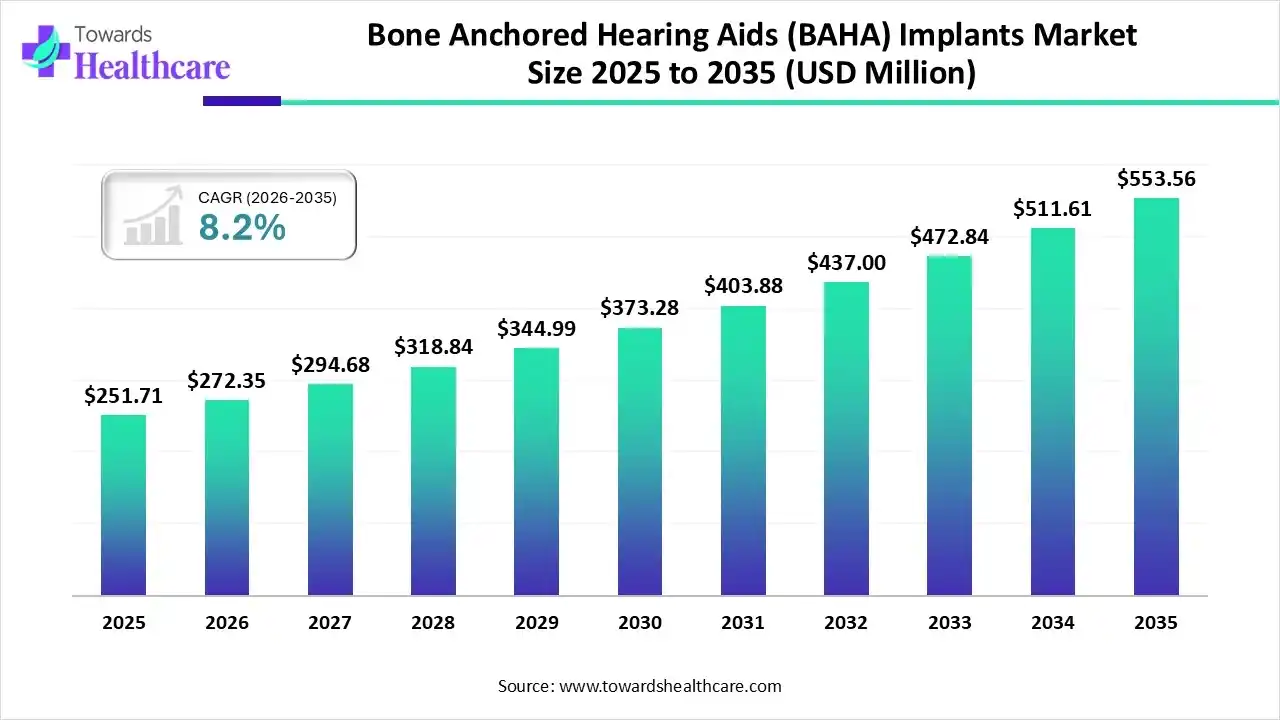
The bone anchored hearing aids (BAHA) implants market size was estimated at US$ 251.71 million in 2025 and is projected to grow to US$ 553.56 million by 2035, rising at a compound annual growth rate (CAGR) of 8.2% from 2026 to 2035. The rising incidences of hearing aid problems and the latest innovations in the medical device sector drive the market.
| Key Elements | Scope |
| Market Size in 2026 | USD 272.35 Million |
| Projected Market Size in 2035 | USD 553.56 Million |
| CAGR (2026 - 2035) | 8.2% |
| Leading Region | North America |
| Market Segmentation | By Type, By Application, By Region |
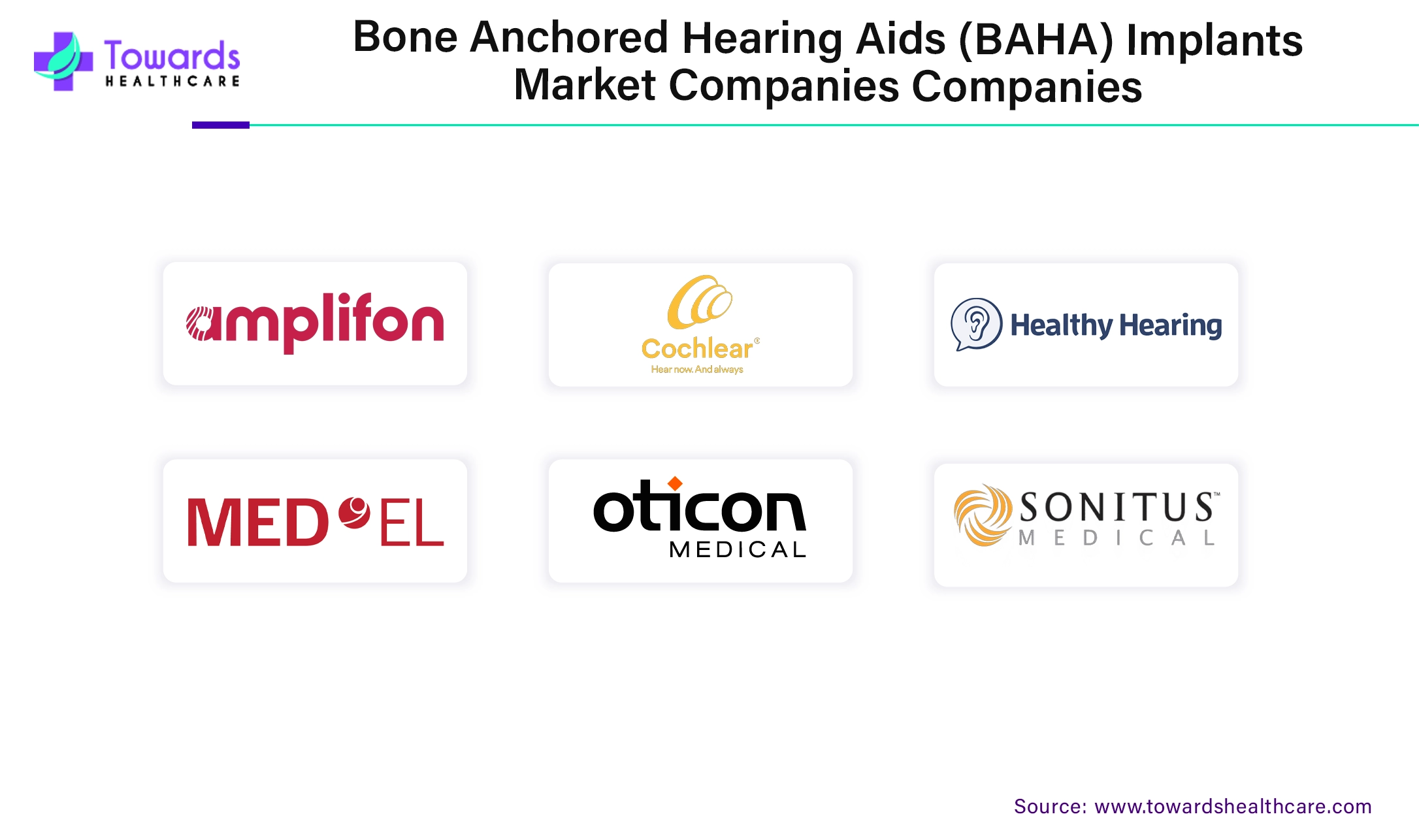
| Top Key Players | Amplifon SpA, Best Hearing Solutions, Cochlear Implants, Ear Associates, Healthy Hearing, MED-EL, Nurotron Biotechnology, Oticon Medical, Sonitus Medical, Sonova International, Starkey Laboratories Pvt. Ltd. |
Bone-anchored hearing aids (BAHA) are surgically implantable devices for people having outer or middle ear problems but at least one functioning inner ear (cochlea). BAHA sends sound waves through the bones of the skull directly into the cochlea. It consists of three parts: titanium implant, external connector, and sound processor. They are most widely used in patients with chronic otitis media, mastoiditis, and single-sided deafness. BAHA is usually suggested for children with underdeveloped ear canal or outside parts of the ear. It offers several advantages, such as better comfort, optimal sound quality, and better prediction of results.
The rising incidences of hearing aid problems, such as conductive or mixed hearing loss and single-sided deafness, potentiate the use of BAHA. According to the WHO, approximately 2.5 billion people globally are estimated to require some degree of hearing loss by 2050. The growing research and development activities and the latest innovations in the medical device sector promote the market.
The sales revenue of Cochlear Limited for the half year ended December 2023 increased by 25% to $1,113 million, with strong growth in cochlear implants and sound processor upgrades. The statutory net profit of the company increased 35% to $191 million.
Novel innovations in the BAHA system can improve patient adherence and enhance user experience. The growing research and development activities globally are evolving with the changing needs of patients and designing more effective hearing aids at lower prices. The most general trend in hearing devices is to make them aesthetically appealing or to make them as invisible as possible. The transcutaneous hearing aids have lesser visibility than the percutaneous ones. Improvements in the screw and abutment design and the introduction of less invasive surgical techniques can reduce or eliminate the complications associated with skin penetration. Hence, the demand for minimally invasive surgical techniques promotes innovations.
The major disadvantage of the market is the high cost of the device. The average cost of a BAHA ranges from $10,000 to $17,000. The device also needs an external sound processor, which costs around $5,000 to $8,000. This restricts many patients from using BAHA, especially in low- and middle-income countries.
What Made Children Type the Dominant Segment in the Market?
By type, the children type segment led the global bone anchored hearing aids (BAHA) implants market. The incidences of conductive and mixed hearing loss and single-sided deafness are higher in children compared to the adult population. It is estimated that more than 34 million children globally suffer from deafness or hearing loss. Children under 5 years or less are more likely to require BAHA implants.
The adult type segment is predicted to witness notable growth in the market over the forecast period. The rising incidences of hearing loss cases in adults, especially in the geriatric population, potentiate the segment growth.
Which Application Type Segment Held the Dominating Share of the Market?
By application, the perceptual hearing loss segment accounted for a considerable share of the bone anchored hearing aids (BAHA) implants market. Perceptual hearing loss or sensorineural hearing loss is a condition in which the inner ear is damaged. BAHA implants are predominantly used in sensorineural hearing loss. BAHA implants directly send sound waves to the inner ear, where the bones in the skull vibrate to aid hearing.
The behavioral hearing maintenance segment will gain a significant share of the market over the studied period. The behavioral hearing test involves observing how a child responds to sounds of varying intensities. BAHA implants help children to adapt to changing sound intensities.
North America dominated the bone anchored hearing aids (BAHA) implants market. The rising incidences of hearing impairment, technological advancements, the presence of key players, and the advanced research & development facilities. Hearing loss is rising in the US and is expected to double by the year 2060.
U.S. Market Trends
According to the National Institute on Deafness and Other Communication Disorders, approximately 615,000 individuals have Meniere’s disease, and around 45,000 new cases are diagnosed annually in the US. It is estimated that around 7% of the US adult population has unilateral hearing loss. According to a 2022 report by the Hearing Review, approximately 60,000 to 65,000 new cases of sudden sensorineural hearing loss (SSHL) are documented in the US annually. Cochlear Limited was the first company to market BAHA in the US.
Asia-Pacific is expected to grow at the fastest rate in the bone anchored hearing aids (BAHA) implants market during the forecast period. The rising incidences of hearing loss, growing research and development, increasing investments & collaborations, and favorable government policies drive the market.
China Market Trends
There are approximately 27 million people affected by hearing loss in China. The Chinese local governments are incorporating cochlear implants into their public health insurance schemes to reduce the cost of healthcare for residents. In August 2024, the southern island province of Hainan became the latest region to extend coverage to cochlear implant surgery. Under the ADIP scheme by the Indian Government, free cochlear implants, post-operative therapy, and rehabilitation for children with hearing impairment. In 2022-23, 1,151 cochlear implant surgeries were performed in India under the scheme. In July 2024, the Australian Government funded 6.5 million Australian dollars ($4.4 million) for the Japanese hearing implant program for children.
Europe is expected to grow significantly in the bone anchored hearing aids (BAHA) implants market during the forecast period, due to growth in the geriatric population. The presence of a well-developed healthcare system is also increasing its adoption, where the reimbursement policies are increasing its acceptance rates.
UK Market Trends
The UK consists of a robust healthcare infrastructure, which is increasing the adoption of hearing implants. Moreover, the adherence to the clinical guidelines is increasing their acceptance rates, which is replacing the traditional hearing aids and promoting patient outcomes and satisfaction.
South America is expected to grow significantly in the bone anchored hearing aids (BAHA) implants market during the forecast period, due to increasing health awareness, which is driving the adoption of advanced hearing solutions. Additionally, the expanding healthcare and innovations of affordable BAHA implants are promoting the market growth.
Brazil Market Trends
The expanding ENT clinics across Brazil are increasing the use of BAHA implants. At the same time, the growing health awareness is also increasing their use and innovations, leading to a growth in collaborations among the companies for the development of advanced audiology implants.
The Middle East & Africa are expected to grow at a considerable CAGR in the upcoming period. The rising prevalence of hearing disorders and advancements in medical technologies boost the market. Government bodies launch initiatives and provide funding to expedite the indigenous development of innovative medical devices. Evolving regulatory landscapes and the availability of reimbursement policies contribute to market growth. The burgeoning healthcare sector and growing research activities promote the development of BAHA implants.
UAE Market Trends
The geriatric population is at a high risk of suffering from hearing loss and related disorders. Currently, approximately 6% of the total UAE population is above 65 years of age. The UAE healthcare professionals encourage the elderly to use hearing aids to prevent future chronic diseases like dementia or Alzheimer’s. Regulatory health authorities offer free treatment at public hospitals for patients with hearing loss.
By Type
By Application
By Region




Principal Consultant
Shivani Zoting is a dedicated research analyst specializing in the healthcare industry. With a strong academic foundation, a B.Sc. in Biotechnology and an MBA in Pharmabiotechnology, she brings a unique blend of scientific understanding and strategy.
Learn more about Shivani Zoting
Reviewed By
Aditi Shivarkar is a seasoned professional with over 14 years of experience in healthcare market research. As a content reviewer, Aditi ensures the quality and accuracy of all market insights and data presented by the research team.
Learn more about Aditi Shivarkar