
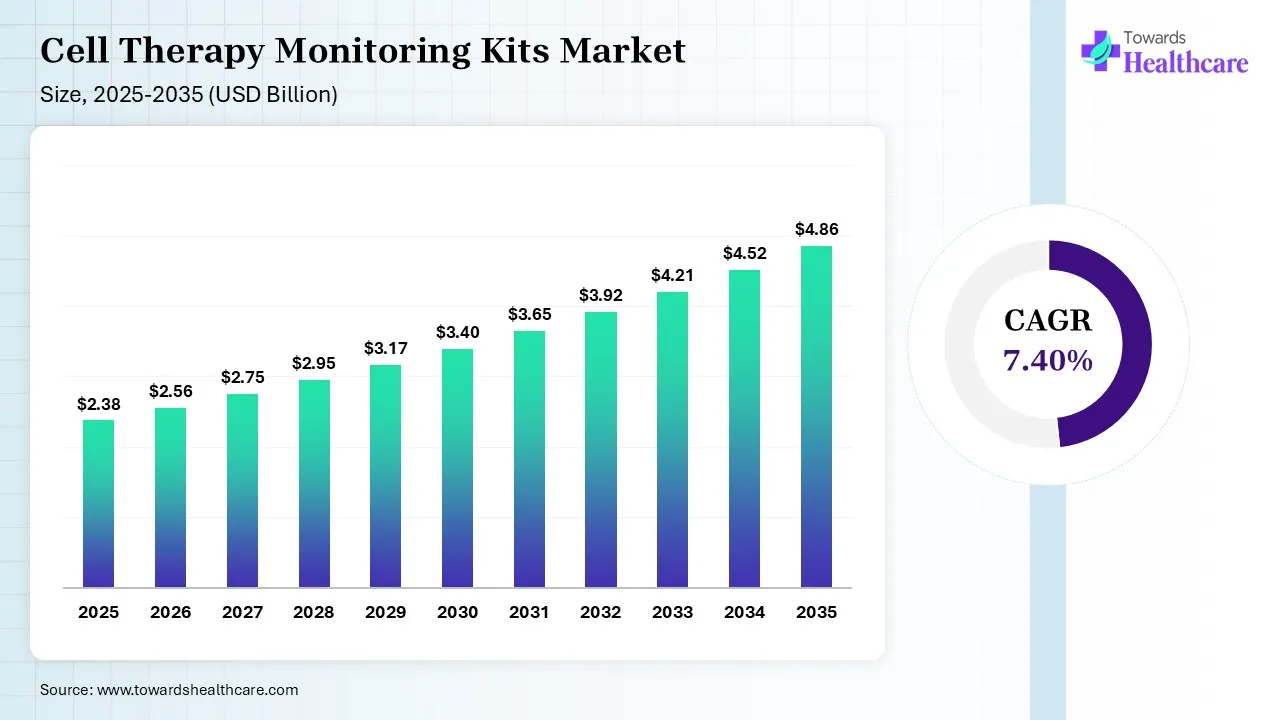
The cell therapy monitoring kits market is projected to grow from USD 2.38 billion in 2025 to USD 4.86 billion by 2035 because cell therapy developers run more trials and commercial batches that need activation, expansion, and quality control kits, and treated patients need regular monitoring. New approvals and applications for CAR-Ts in autoimmune diseases drive the growth of manufacturing and patient testing, and hence the market grows to USD 3.40 billion by 2030 with a CAGR of 7.40% from 2026 to 2035.
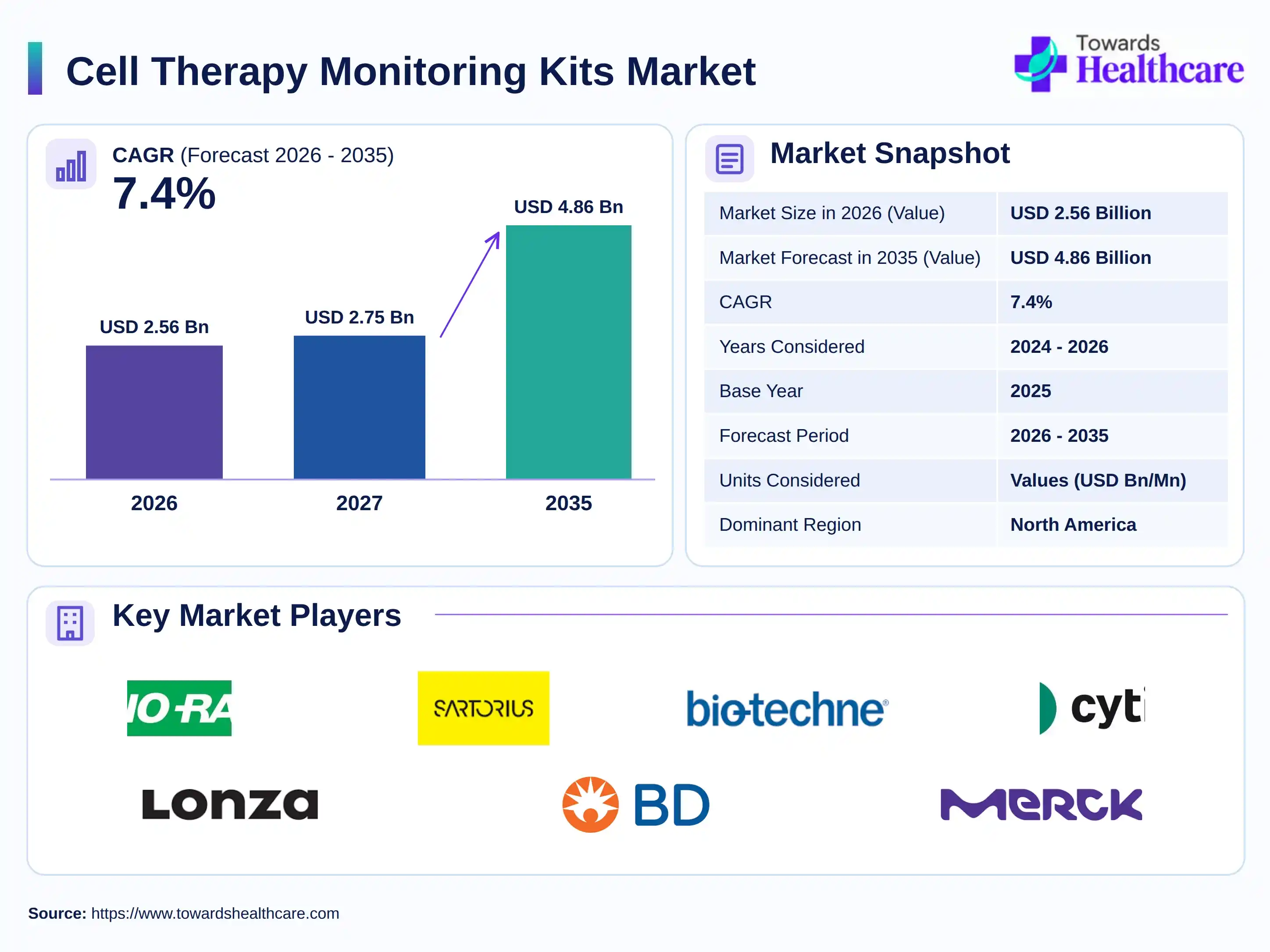
Analyst View: We built the estimate from the number of cell therapy clinical trials, commercial manufacturing batches, and treated patients, multiplied by kit and assay use per batch and per patient and by average kit prices for each product type. Manufacturing demand reflects approved CAR-T and stem cell products and trial activity, while monitoring demand reflects post-infusion persistence, expansion, and safety testing. The total was cross-checked against the cell therapy reagent and testing revenue of leading life science companies and against published estimates, which places our base year slightly above the comparable figures. The growth rate is underpinned by rapid patient growth, tempered by cost considerations in manufacturing of cell therapies.
Market Size & Growth Outlook
Regional Market Spotlight
Segmental Spotlight
Sources: Expert interviews, secondary sources, Towards Healthcare database and Towards Healthcare analysts.
The number of approved cell therapies and clinical trials keeps rising, especially CAR-T therapies for blood cancers and new trials in autoimmune and solid tumors. Activation, expansion, and characterization kits are required for each batch of manufactured cells. Regulatory agencies demand extensive characterization and potency testing. Monitored cell expansion, maintenance, and safety must be ensured for treated individuals. These needs increase kit and assay use per patient and per batch.
The number of patients who can get cell-based therapies is limited due to their high cost. It is challenging to standardize the kits and assays since different developers use different manufacturing techniques. GMP-grade reagents are costly. Reimbursement for post-infusion monitoring tests is limited. High costs limit some smaller developers to produce cell therapy monitoring kits.
Autoimmune and solid tumor cell therapies could greatly expand patient numbers. Automated, closed manufacturing systems create demand for integrated reagent kits. Standardized assays for monitoring can facilitate long-term follow-up as needed by regulatory authorities. Allogeneic and NK-cell therapies need new characterization tools. Rapid growth in China and other Asian markets offers volume expansion.
| Segments | 2025 Share | 2025 Market Value |
| Cell Activation Kits | 31.00% | USD 0.74 billion |
| Immune Cell Differentiation & Expansion Kits | 27.40% | USD 0.65 billion |
| Stem Cell Kits | 22.60% | USD 0.54 billion |
| Monitoring & QC Assays | 19.00% | USD 0.45 billion |
Sources: Expert interviews, secondary sources, Towards Healthcare database and Towards Healthcare analysts.
Cell activation kits accounted for 31.00% (USD 0.74 billion) in 2025 because CAR-T, TCR-T, and NK-cell manufacturing begins with activating immune cells using antibody beads, nano-matrices, or cytokines. Consistent activation is essential for product quality. Immune cell differentiation and expansion kits, at 27.40% (USD 0.65 billion), support growth of cells to therapeutic doses, while stem cell kits, at 22.60% (USD 0.54 billion), are the fastest-growing product, used for isolation, culture, and characterization of mesenchymal, hematopoietic, and induced pluripotent stem cells. Monitoring and quality control assays account for 19.00% (USD 0.45 billion), covering flow cytometry panels, ddPCR vector copy assays, potency tests, and patient persistence tests.
| Segments | 2025 Share | 2025 Market Value |
| Oncology | 42.00% | USD 1.00 billion |
| Autoimmune Diseases | 14.60% | USD 0.35 billion |
| Others | 12.40% | USD 0.30 billion |
| Musculoskeletal Disorders | 11.40% | USD 0.27 billion |
| Cardiovascular Diseases | 10.40% | USD 0.25 billion |
| Neurological Disorders | 9.20% | USD 0.22 billion |
Sources: Expert interviews, secondary sources, Towards Healthcare database and Towards Healthcare analysts.
Oncology accounted for 42.00% (USD 1.00 billion) in 2025 because approved CAR-T therapies for leukemia, lymphoma, and myeloma drive most commercial manufacturing and patient monitoring. Autoimmune diseases, at 14.60% (USD 0.35 billion), are a fast-growing area as CAR-T and other cell therapies are tested in lupus and other conditions. Other applications account for 12.40% (USD 0.30 billion), musculoskeletal disorders for 11.40% (USD 0.27 billion), cardiovascular diseases for 10.40% (USD 0.25 billion), and neurological disorders for 9.20% (USD 0.22 billion), the fastest-growing application as stem cell therapies for Parkinson's disease and other conditions advance.
| Segments | 2025 Share | 2025 Market Value |
| Stem Cell Therapies | 37.00% | USD 0.88 billion |
| CAR-T Cell Therapies | 33.60% | USD 0.80 billion |
| Others | 18.60% | USD 0.44 billion |
| NK Cell Therapies | 10.80% | USD 0.26 billion |
Sources: Expert interviews, secondary sources, Towards Healthcare database and Towards Healthcare analysts.
Stem cell therapies accounted for 37.00% (USD 0.88 billion) in 2025 because many trials and approved products use mesenchymal and hematopoietic stem cells, which require isolation, expansion, and characterization kits. CAR-T cell therapies, at 33.60% (USD 0.80 billion), carry high kit and monitoring use per patient, including activation, expansion, release testing, and post-infusion persistence tests. Other therapies, such as TCR-T, TIL, and regulatory T-cell therapies, account for 18.60% (USD 0.44 billion), and NK cell therapies account for 10.80% (USD 0.26 billion) and are the fastest-growing therapy type.
| Segments | 2025 Share | 2025 Market Value |
| Hospitals & Clinics | 34.00% | USD 0.81 billion |
| Biotechnology & Pharmaceutical Companies | 31.20% | USD 0.74 billion |
| Research Institutes | 22.40% | USD 0.53 billion |
| Contract Research Organizations | 12.40% | USD 0.30 billion |
Sources: Expert interviews, secondary sources, Towards Healthcare database and Towards Healthcare analysts.
Hospitals and clinics accounted for 34.00% (USD 0.81 billion) in 2025, covering treatment centers that monitor patients and academic hospitals that manufacture cell therapies. Biotechnology and pharmaceutical companies, at 31.20% (USD 0.74 billion), are the fastest-growing end users as commercial manufacturing scales; research institutes account for 22.40% (USD 0.53 billion); and contract research organizations account for 12.40% (USD 0.30 billion).
Analyst View: We allocated segment values by mapping trials, manufacturing batches, and treated patients by therapy type and application to kit and assay use, using average prices. Activation and expansion kits come first since every batch of immune cell therapy requires them, whereas monitoring assays are of high value per individual. We expect stem cell kits, NK-cell therapies, autoimmune applications, and biopharma users to gain share.
| Region | 2025 Share | 2025 Market Value |
| North America | 38.50% | USD 0.92 billion |
| Europe | 27.40% | USD 0.65 billion |
| Asia Pacific | 25.60% | USD 0.61 billion |
| Latin America | 4.80% | USD 0.11 billion |
| Middle East & Africa | 3.70% | USD 0.09 billion |
Sources: Expert interviews, secondary sources, Towards Healthcare database and Towards Healthcare analysts.
North America accounted for 38.50% (USD 0.92 billion) in 2025. The largest cell therapy pipeline and many approved CAR-T products drive kit demand. Patient testing services are provided by specialized laboratories. The trials benefit from good funding.
Europe accounted for 27.40% (USD 0.65 billion) in 2025. Academic and hospital-based manufacturing is expanding. Approved CAR-T products are used across major countries. Regulators focus on potency and quality testing.
Asia Pacific accounted for 25.60% (USD 0.61 billion) in 2025 and is the fastest-growing region. China runs many CAR-T and stem cell trials and has approved several products. Japan's regenerative medicine law supports stem cell therapies. South Korea's biotech sector adds demand.
Latin America accounted for 4.80% (USD 0.11 billion) in 2025. Brazil is building cell therapy capacity. Academic centers lead early trials.
The Middle East and Africa accounted for 3.70% (USD 0.09 billion) in 2025. Gulf states are investing in cell therapy centers. Access remains limited elsewhere.
Analyst View: Regional shares were based on trials, manufacturing, and patients treated in each region, weighted based on the price of kits per region. North America leads because of its large pipeline and number of approved therapies. We assign Asia Pacific the highest growth premium because China's trial and approval activity is growing fastest.
| Rank | Company Name | Market-Specific Revenue (USD Billion) | 2025 Share | Key Products/Business | Headquarters |
| 1 | Thermo Fisher Scientific | 0.34 | 14.29% | Dynabeads activation, media and analytics | United States |
| 2 | Miltenyi Biotec | 0.22 | 9.24% | MACS cell isolation, activation and flow cytometry reagents | Germany |
| 3 | STEMCELL Technologies | 0.18 | 7.56% | Cell isolation, expansion and stem cell kits | Canada |
| 4 | BD | 0.16 | 6.72% | Flow cytometry reagents and analyzers | United States |
| 5 | Merck KGaA | 0.14 | 5.88% | Cell culture media and reagents | Germany |
| 6 | Lonza | 0.12 | 5.04% | Cell therapy media and testing | Switzerland |
| 7 | Sartorius | 0.10 | 4.20% | Cell culture and analytics tools | Germany |
| 8 | Bio-Techne | 0.10 | 4.20% | Cytokines, activation reagents and potency assays | United States |
| 9 | Cytiva | 0.09 | 3.78% | Cell therapy media and processing | United States |
| 10 | Bio-Rad Laboratories | 0.06 | 2.52% | ddPCR assays for vector copy and persistence | United States |
Sources: Company press releases, expert interviews, secondary sources, Towards Healthcare database and Towards Healthcare analysts.
Thermo Fisher Scientific led the cell therapy monitoring kits market with an estimated 14.29% (USD 0.34 billion) of 2025 revenue, followed by Miltenyi Biotec at 9.24% (USD 0.22 billion) and STEMCELL Technologies at 7.56% (USD 0.18 billion). For CAR-T manufacturing, Thermo Fisher Scientific is the industry leader with Dynabeads activation reagents, cell culture media, and analytical instruments. Miltenyi Biotec is one of the strongest competitors with MACS cell isolation and activation reagents, automated manufacturing systems, and flow cytometry panels for manufacturing and patient monitoring. STEMCELL Technologies leads in stem cell and immune cell isolation and culture kits for research and clinical use, while BD, Merck KGaA, Lonza, Sartorius, Bio-Techne and Cytiva supply reagents, media and analytics.
Specialist laboratories such as Eurofins Viracor and assay makers such as Bio-Rad add therapy-specific monitoring tests. In 2025, the top 10 companies contributed approximately 63.45% (USD 1.51 billion) of total sales, whereas the other 36.55% (USD 0.87 billion) belonged to testing labs, startups that produce reagents, flow cytometry controls producers, and regional suppliers. The cell therapy monitoring kits market is moderately concentrated among large life science suppliers, and competition centers on GMP-grade quality, regulatory documentation, consistency between batches, assay sensitivity, and integration with automated manufacturing systems. Treatment-specific monitoring tests, as well as easier controls, are leaving room for specialist labs and new reagent manufacturers.
By Product
By Application
By Therapy Type
By End Use
By Region
The cell therapy monitoring kits market was defined as cell activation, immune cell differentiation and expansion, stem cell and monitoring, and quality control kits and assays used in cell therapy development, manufacturing, and patient monitoring worldwide. The 2025 base year was built bottom-up from cell therapy trials, manufacturing batches and treated patients, kit and assay use and average prices, and checked top-down against the cell therapy reagent and testing revenue of leading life science companies. Segment, regional and company values were allocated from products, applications, therapy types, end users and regional cell therapy activity. Key estimates were verified by cross-checking company disclosures, regulatory and industry data and published third-party estimates, and inputs that could not be reconciled were excluded. All segment, regional and company figures were reconciled to the same 2025 base year, and the 2026-2035 forecast, which applies a constant CAGR from the 2025 base, was recalculated and validated.
Analyst View: Overall Market - The cell therapy monitoring kits market is growing with the expansion of CAR-T, stem cell and NK-cell therapies from trials into commercial use. The estimate connects the demand with trials, production batches, and treated patients; hence, the forecast is dependent on approvals, trial activity, and monitoring. The main upside comes from autoimmune and allogeneic therapies and standardized monitoring, while the main risks are high therapy costs and funding pressure on developers.