
The exocrine pancreatic insufficiency diagnostics market is expected to expand from USD 430.00 million in 2025 to USD 838.00 million by 2035. Growth is supported by the high prevalence of EPI among patients with pancreatitis, those undergoing pancreatic surgery, and individuals with cystic fibrosis, despite limited testing among at-risk populations. Persistent underdiagnosis, rising cases of pancreatitis and diabetes, guideline recommendations, and increasing adoption of non-invasive diagnostic methods are expected to drive market expansion. The market is projected to reach USD 600.28 million by 2030, registering a CAGR of 6.90% from 2026 to 2035. EPI management is also gaining relevance in precision medicine, alongside growing research into the human microbiome and probiotics.
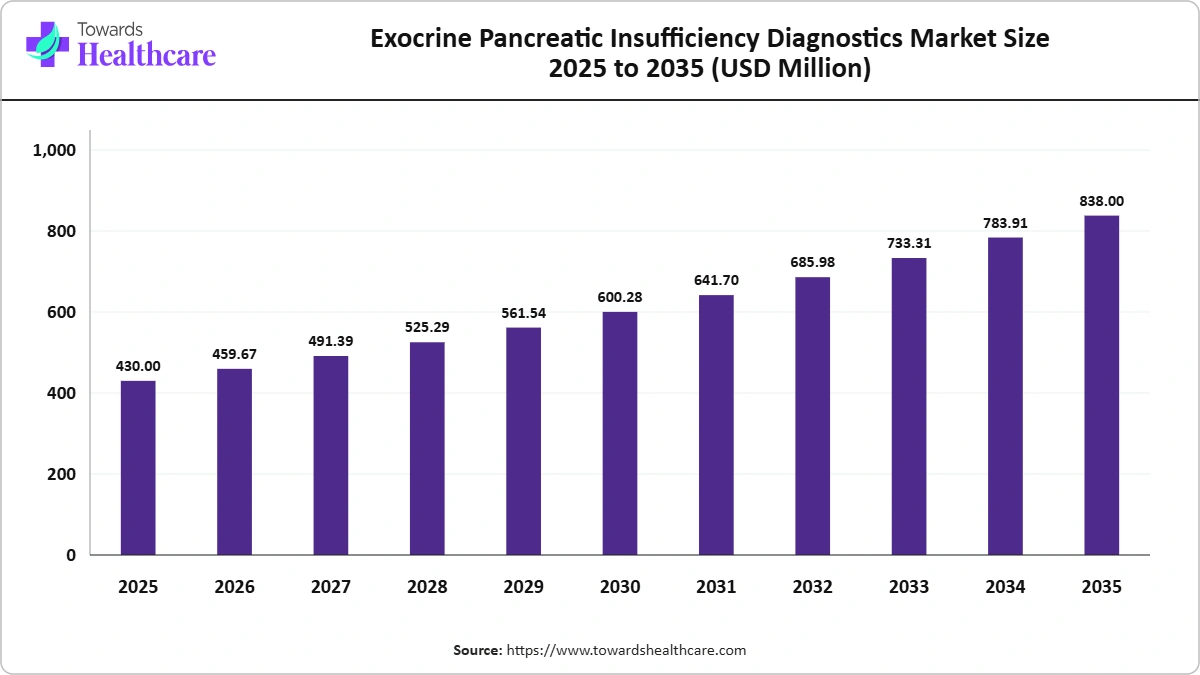
Analyst View: We estimated the market using EPI test volumes across different test types and regions, average testing prices, and the estimated contribution of pancreatic imaging. The estimates were cross-validated against the activities of relevant diagnostic suppliers. As published data covering this specific market scope remain limited, the valuation is based on available industry evidence and demand indicators.
| Driver | Impact | ≈ CAGR Contribution | Time Horizon | Key Regions |
| EPI is underdiagnosed | High | +2.69 pp | Short to long term | Global, strongest in North America |
| Pancreatitis and diabetes rise | Medium | +2.27 pp | Medium to long term | Global, fastest uptake in Asia Pacific |
| Guidelines recommend testing | Medium | +1.94 pp | Short to medium term | Global |
| Enzyme therapy needs diagnosis | Low | +1.52 pp | Long term | Developed and emerging markets |
Note: Contributions are indicative estimates of each factor's effect on annual growth.
Sources: Expert interviews, secondary sources, Towards Healthcare database and Towards Healthcare analysts.
Taken together, these drivers add about 8.42 percentage points to the annual growth of the exocrine pancreatic insufficiency diagnostics market, with EPI being underdiagnosed having the largest effect. Their influence is strongest in North America, while uptake grows fastest in Asia Pacific.
| Restraint | Impact | ≈ Negative CAGR Contribution | Time Horizon | Key Regions |
| False positives with watery stool | High | -0.68 pp | Short to medium term | Global |
| Low awareness | High | -0.50 pp | Medium term | Price-sensitive and emerging markets |
| Limited reimbursement for breath tests | Medium | -0.33 pp | Short term | North America and other mature markets |
Note: Contributions are indicative estimates of each factor's effect on annual growth.
Sources: Expert interviews, secondary sources, Towards Healthcare database and Towards Healthcare analysts.
These restraints are expected to reduce annual growth of the exocrine pancreatic insufficiency diagnostics market by about 1.52 percentage points, led by false positives with watery stool. Their effect eases over the forecast period as suppliers, buyers and regulators adapt, leaving a net CAGR of 6.90% from 2026 to 2035.
Expanding EPI screening among patients with diabetes presents an important growth opportunity, particularly as awareness of pancreatic dysfunction increases. Routine testing following pancreatic surgery can support early detection and timely treatment. Growing gastroenterology services and improved diagnostic infrastructure across Asia are expected to widen access to EPI testing. The development of rapid fecal elastase tests and broader adoption of breath-based diagnostic methods may further improve testing convenience and strengthen market penetration.
Note: 2025 is the base year; 2035 shares and CAGRs are forecasts.
Sources: Expert interviews, secondary sources, Towards Healthcare database, and Towards Healthcare analysts.
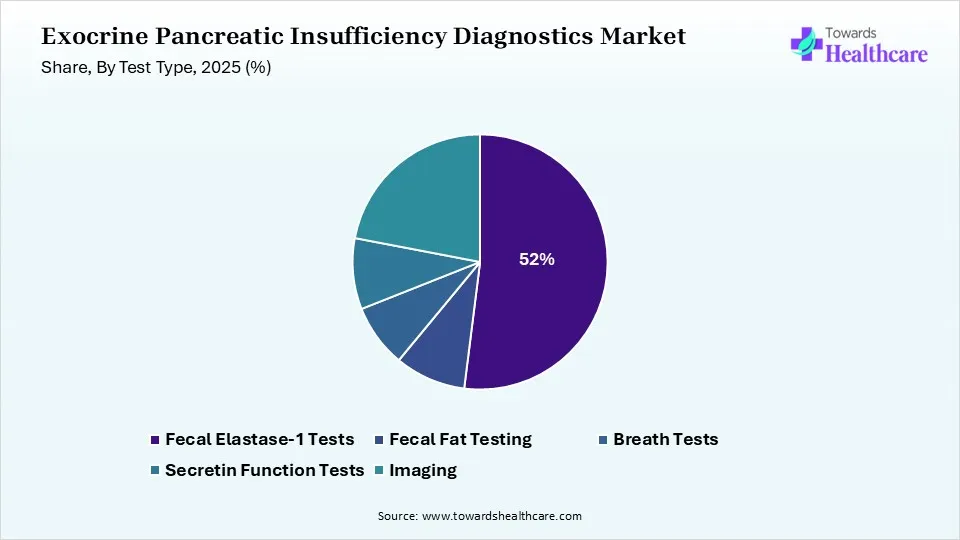
The Fecal Elastase-1 Tests segment held the leading position in the exocrine pancreatic insufficiency diagnostics market, capturing 52.00% of revenue in 2025. It is expected to grow at a CAGR of 6.48% from 2026 to 2035. Its dominance is attributed to the non-invasive nature, affordability, and widespread clinical recommendation of these tests as an initial diagnostic approach for EPI.
Fecal Fat Testing these tests help identify fat malabsorption by measuring the amount of fat present in stool samples, supporting the assessment of pancreatic digestive function. The segment is expected to maintain a growth trajectory broadly in line with the overall market throughout the forecast period.
Breath Tests increasing preference for non-invasive pancreatic function assessments and the ability of breath tests to evaluate digestive function are supporting segment expansion.
Secretin Function Tests provide a direct assessment of pancreatic secretory function but involve invasive procedures, which can limit their routine use. The segment is expected to record growth broadly in line with the overall market during the forecast period.
Imaging techniques, including magnetic resonance cholangiopancreatography (MRCP) and endoscopic ultrasound, help identify structural abnormalities in the pancreas and support the evaluation of underlying conditions associated with EPI.
Note: 2025 is the base year; 2035 shares and CAGRs are forecasts.
Sources: Expert interviews, secondary sources, Towards Healthcare database, and Towards Healthcare analysts.
Chronic Pancreatitis segment held the largest application share in the exocrine pancreatic insufficiency diagnostics market, accounting for 32.00% of revenue in 2025. It is projected to grow at a CAGR of 6.31% from 2026 to 2035. Its leading position reflects the strong association between chronic pancreatitis and EPI, as progressive pancreatic damage can impair digestive enzyme production and increase the need for diagnostic testing.
Cystic Fibrosis the need for regular pancreatic function assessments among individuals with cystic fibrosis supports demand for EPI diagnostic tests, enabling early identification of pancreatic insufficiency and timely treatment. The segment is expected to grow broadly in line with the overall market throughout the forecast period.
Pancreatic Cancer & Surgery increasing recognition of pancreatic insufficiency following pancreatic cancer and surgical procedures is driving demand for diagnostic testing. Greater emphasis on post-surgical monitoring and early identification of digestive complications is expected to support segment expansion over the forecast period.
Diabetes & Others conditions complete demand.
Note: 2025 is the base year; 2035 shares and CAGRs are forecasts.
Sources: Expert interviews, secondary sources, Towards Healthcare database and Towards Healthcare analysts.
Hospitals segment accounted for 42.00% of the exocrine pancreatic insufficiency diagnostics market in 2025 and is projected to expand at a CAGR of 6.44% from 2026 to 2035. Hospitals lead because they diagnose complex pancreatic disease. The hospitals segment is expected to grow slower than the overall market over the forecast period.
Diagnostic Laboratories play an important role in EPI detection by conducting fecal elastase-1 tests and other stool-based assessments. Their established testing capabilities, specialized equipment, and ability to process high volumes of samples support segment demand.
Gastroenterology Clinics grow fastest with rapid tests.
Analyst View: Segment shares were estimated based on demand patterns, product offerings, and pricing across individual categories. Fecal Elastase-1 Tests, Chronic Pancreatitis and Hospitals maintain leading positions in their respective categories, reflecting their importance in current diagnostic practices and patient care. Meanwhile, Breath Tests, Pancreatic Cancer & Surgery and Gastroenterology Clinics are expected to gain market share as technological advancements, expanding patient populations and broader clinical applications accelerate demand.
Note: 2025 is the base year; 2035 shares and CAGRs are forecasts.
Sources: Expert interviews, secondary sources, Towards Healthcare database, and Towards Healthcare analysts.
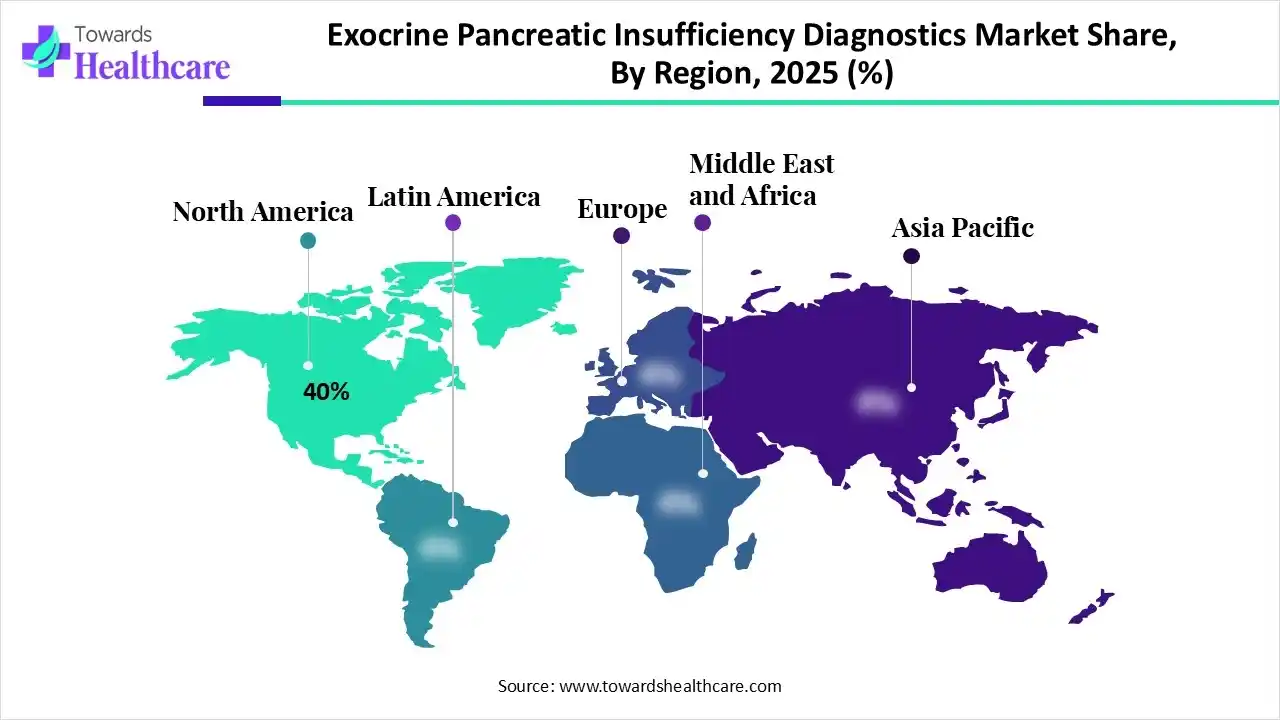
North America held the largest regional share of the exocrine pancreatic insufficiency diagnostics market, accounting for 40.00% of revenue in 2025. The region is projected to grow at a CAGR of 6.41% from 2026 to 2035. Its leading position is supported by widespread gastroenterology testing, established cystic fibrosis care, advanced diagnostic infrastructure, and growing recognition of the underdiagnosis of EPI.
Europe regional demand is supported by the widespread use of fecal elastase-1 testing, established pancreatic care centres, and growing clinical recognition of EPI.
Asia Pacific grows fastest with rising pancreatitis and diabetes and expanding gastroenterology. Asia Pacific is expected to grow faster than the overall market between 2026 and 2035.
Latin America has growing testing.
Middle East & Africa market development remains constrained by limited access to specialized diagnostic facilities, low awareness of EPI, and gaps in testing infrastructure. However, gradual improvements in healthcare services and diagnostic capabilities are expected to support regional expansion.
Analyst View: Regional market shares were estimated using demand patterns, installed diagnostic capacity, healthcare spending, and supplier presence across individual markets. North America maintains the leading position, supported by an established demand base, advanced healthcare infrastructure and a strong supplier network. Asia Pacific is expected to record the fastest growth, driven by rising healthcare investments, increasing adoption of diagnostic technologies, and expanding testing capacity across the region.
| Rank | Company Name | 2025 Share (%) | Key Products / Business | Headquarters |
| 1 | ScheBo Biotech | 16.00% | Pancreatic Elastase 1 ELISA and Quick tests | Germany |
| 2 | R-Biopharm | 8.00% | Elastase and stool tests | Germany |
| 3 | DiaSorin | 8.00% | LIAISON elastase assay | Italy |
| 4 | Labcorp | 8.00% | Fecal elastase testing | United States |
| 5 | Quest Diagnostics | 8.00% | Fecal elastase and fat testing | United States |
| 6 | BIOHIT HealthCare | 6.00% | Gastrointestinal diagnostics | Finland |
| 7 | BÜHLMANN Laboratories | 4.00% | Stool biomarker assays | Switzerland |
| 8 | Immundiagnostik | 4.00% | Elastase ELISA | Germany |
| 9 | Kibion | 2.00% | Breath test diagnostics | Sweden |
| 10 | ChiRhoClin | 2.00% | Secretin for pancreatic function testing | United States |
Note: Company shares are 2025 estimates.
Sources: Company press releases, expert interviews, secondary sources, Towards Healthcare database, and Towards Healthcare analysts.
ScheBo Biotech led the exocrine pancreatic insufficiency diagnostics market with an estimated 16.00% share of 2025 revenue, followed by R-Biopharm at 8.00% share and DiaSorin at 8.00% share. ScheBo Biotech leads with pancreatic Elastase 1 ELISA and Quick tests, R-Biopharm competes with elastase and stool tests, and DiaSorin offers LIAISON elastase assay. Labcorp, Quest Diagnostics, BIOHIT HealthCare, BÜHLMANN Laboratories, Immundiagnostik, Kibion and ChiRhoClin compete through fecal elastase testing, fecal elastase and fat testing, gastrointestinal diagnostics, stool biomarker assays, elastase ELISA, breath test diagnostics and secretin for pancreatic function testing.
The top 10 companies accounted for an estimated 66.00% of 2025 revenue, while the remaining 34.00% was shared among many regional stool test makers and imaging providers. The exocrine pancreatic insufficiency diagnostics market is fragmented, and competition centres on test accuracy, automation, sample handling, guideline support, lab menu integration, and price.
ScheBo Biotech, headquartered in Germany, ScheBo Biotech held an estimated 16.00% share of the exocrine pancreatic insufficiency diagnostics market in 2025. The company focuses on pancreatic diagnostic solutions, particularly its Pancreatic Elastase 1 ELISA and Quick test offerings. Based on its market presence and product portfolio, ScheBo Biotech is classified as a Leader in the Towards Healthcare Companies Quadrant.
Based in Germany, R-Biopharm captured an estimated 8.00% of the exocrine pancreatic insufficiency diagnostics market in 2025. Its diagnostic portfolio includes elastase assays and stool-based testing solutions designed to support gastrointestinal assessments. The company holds a Leader position in the Towards Healthcare Companies Quadrant.
Italy-based DiaSorin accounted for an estimated 8.00% market share in 2025. Its presence in the EPI diagnostics space is supported by the LIAISON elastase assay, which strengthens its portfolio of laboratory-based diagnostic solutions. DiaSorin is positioned as a Leader in the Towards Healthcare Companies Quadrant.
Labcorp, headquartered in the United States and part of Laboratory Corporation of America Holdings, secured an estimated 8.00% share of the market in 2025. The company supports EPI diagnosis through its fecal elastase testing services, which help assess pancreatic exocrine function. Its established diagnostic service capabilities place it among the Leaders in the Towards Healthcare Companies Quadrant.
Quest Diagnostics, based in the United States, represented an estimated 8.00% of the exocrine pancreatic insufficiency diagnostics market in 2025. Its testing portfolio covers fecal elastase and fecal fat assessments, providing diagnostic support for identifying pancreatic insufficiency and fat malabsorption. The company is categorized as a Leader in the Towards Healthcare Companies Quadrant.
BIOHIT HealthCare, part of Finland-based Biohit Oyj, accounted for an estimated 6.00% market share in 2025. Its portfolio encompasses gastrointestinal diagnostic solutions, supporting the broader assessment of digestive health and related disorders. The company is recognized as a Leader in the Towards Healthcare Companies Quadrant.
Swiss-based BÜHLMANN Laboratories held an estimated 4.00% share of the market in 2025. The company specializes in stool biomarker assays, contributing to laboratory-based gastrointestinal diagnostics and disease assessment. Its specialized product focus places it in the Innovator category of the Towards Healthcare Companies Quadrant.
Immundiagnostik, headquartered in Germany, represented an estimated 4.00% of the exocrine pancreatic insufficiency diagnostics market in 2025. Its product portfolio includes elastase ELISA solutions used in the laboratory evaluation of pancreatic function. The company is positioned as an Innovator in the Towards Healthcare Companies Quadrant.
Sweden-based Kibion held an estimated 2.00% market share in 2025, with a focus on breath-based diagnostic technologies. Its breath test solutions contribute to the development of non-invasive approaches for assessing gastrointestinal and pancreatic function. Kibion is classified as an Innovator in the Towards Healthcare Companies Quadrant.
ChiRhoClin, headquartered in the United States, accounted for an estimated 2.00% of the market in 2025. The company specializes in secretin-based solutions used in pancreatic function testing, supporting the assessment of pancreatic exocrine activity. Its specialized diagnostic offering places ChiRhoClin in the Innovator category of the Towards Healthcare Companies Quadrant.
The exocrine pancreatic insufficiency diagnostics ecosystem links reagent & kit makers, laboratories, imaging providers, clinicians and regulators & guidelines, with each stage adding value before products reach end users.
| Ecosystem Stage | Role in the Market | Key Companies |
| Reagent & Kit Makers | Make elastase and breath tests | ScheBo, R-Biopharm, DiaSorin |
| Laboratories | Run tests | Labcorp, Quest, hospital labs |
| Imaging Providers | Image the pancreas | Radiology and endoscopy centres |
| Clinicians | Order tests and treat | Gastroenterologists, CF centres |
| Regulators & Guidelines | Clear tests and guide use | FDA, AGA, EU IVDR |
Sources: Company press releases, expert interviews, secondary sources, Towards Healthcare database and Towards Healthcare analysts.
Reagent & Kit Makers: Make elastase and breath tests. Key participants include ScheBo, R-Biopharm, DiaSorin.
Laboratories: Run tests. Key participants include Labcorp, Quest, hospital labs.
Imaging Providers: Image the pancreas. Key participants include Radiology and endoscopy centres.
Clinicians: Order tests and treat. Key participants include Gastroenterologists, CF centres.
Regulators & Guidelines: Clear tests and guide use. Key participants include FDA, AGA, EU IVDR.
Value in the exocrine pancreatic insufficiency diagnostics market flows from upstream material and technology suppliers to manufacturers and service providers, then through distribution partners to end users. Companies that integrate several stages or build long-term relationships with end users capture a larger share of this value.
The Towards Healthcare Companies Quadrant positions key participants in the exocrine pancreatic insufficiency diagnostics market by market strength, reflecting revenue scale, market share and geographic reach, and by innovation and growth strategy, reflecting product portfolio breadth, R&D intensity and partnerships. Positions reflect each company's estimated 2025 share of the exocrine pancreatic insufficiency diagnostics market and our assessment of its product innovation, portfolio breadth and partnerships.
Sources: Company press releases, expert interviews, secondary sources, Towards Healthcare database and Towards Healthcare analysts.
Leaders: ScheBo Biotech, R-Biopharm, DiaSorin, Labcorp, Quest Diagnostics and BIOHIT HealthCare combine high market share with broad portfolios and strong innovation.
Innovators: BÜHLMANN Laboratories, Immundiagnostik, Kibion and ChiRhoClin bring newer technologies and specialised products.
By Test Type
By Indication
By End User
By Region
The exocrine pancreatic insufficiency diagnostics market was defined as tests used to diagnose exocrine pancreatic insufficiency (EPI), including fecal elastase-1 tests (ELISA and rapid), fecal fat testing, 13C-mixed triglyceride breath tests, secretin pancreatic function tests, and imaging such as secretin-enhanced MRCP and endoscopic ultrasound, for patients with chronic pancreatitis, cystic fibrosis, pancreatic cancer and surgery, diabetes and other conditions, in hospitals, diagnostic laboratories and gastroenterology clinics. The 2025 base year was built bottom-up from demand volumes and average prices by test type, indication, end user and region, and checked top-down against the market-specific revenues of leading companies and published estimates. Segment, regional and company values were allocated from test type, indication and end user and region demand.
Key estimates were verified by cross-checking company disclosures, regulatory and industry data, and published third-party estimates, and inputs that could not be reconciled were excluded. All segment, regional and company figures were reconciled to the same 2025 base year, and the 2026-2035 forecast, which applies a constant CAGR from the 2025 base, was recalculated and validated.
Analyst View: The exocrine pancreatic insufficiency diagnostics market is set for steady expansion as underdiagnosis and related demand keep growing. Our estimate links value to underlying demand, installed base and pricing, so the forecast follows real adoption rather than headline hype. The main upside comes from screening in diabetes and post-surgery testing, while the main risks are false positives and low awareness.