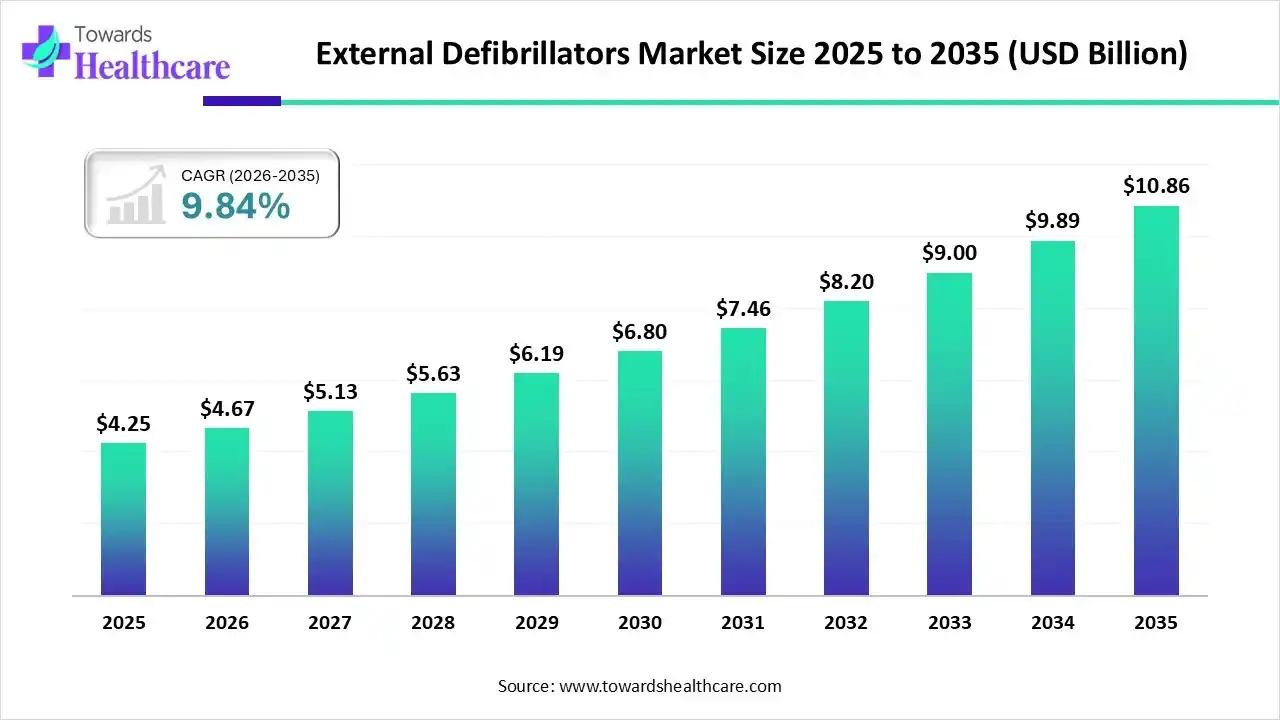
The global external defibrillators market is predicted to increase from USD 4.67 billion in 2026 to approximately USD 10.86 billion by 2035, expanding at a CAGR of 9.84% from 2026 to 2035. The worldwide surging cases of CVDs, sudden cardiac arrests, are fueling the need for advanced external defibrillators to gain normal heart rhythm. Furthermore, several leading companies are implementing AI algorithms in AEDs to achieve real-time monitoring, expanded connectivity, and extensive remote settings.
Mainly, the global external defibrillators market covers portable, user-friendly medical devices to treat sudden cardiac arrest, & analyze heart rhythms by transferring an electrical shock to restore a normal heartbeat. Nowadays, the leading firms are putting efforts into innovative solutions, such as the integration of Unmanned Aerial Systems with emergency responses, specifically in rural areas. These kinds of developments are propelled by a rise in cases of sudden cardiac arrest (SCA), a geriatric population, & raised public access to Automated External Defibrillators (AEDs).
Modern external defibrillators are rapidly changing to save more lives. Many new models now include smart internet connectivity. This feature automatically alerts nearby hospital staff during emergencies. Some devices can even talk to the user. Clear voice prompts guide people through each step of the rescue process. This helps untrained bystanders act quickly and without fear. In addition, battery technology is improving fast. Newer units stay charged for much longer periods. They require almost zero maintenance from building owners. Small, lightweight designs mean people can carry them anywhere. These portable lifesavers fit easily into small bags or backpacks. Every small technical update makes heart care faster, safer, and much more accessible. These modern tools ensure help is always fully ready.
AI algorithms are playing a vital role in the respective market, as the broader adoption of deep learning, such as Convolutional Neural Networks (CNNs), is enabling the analysis of ECG signals with greater sensitivity & specificity. Besides this, the latest sophisticated AEDs, like the Cardiac Science Powerheart G5 is leveraging Intellisense CPR technology to track chest compressions and facilitate live, audible & visual feedback on the quality, rate, and depth of CPR.
Emphasizing Wearable Defibrillators
The market is focusing on rolling out patch-based, wearable cardioverter defibrillators, which provide a non-invasive, lightweight option for patients at high risk of sudden cardiac arrest.
Unveiling Smart & Connected Technology
Advanced smart AEDs are characterising IoT connectivity and cloud-based systems for real-time monitoring of battery, pad expiration, & site, & also confirming they are always ready for use.
Continuous research activities are fostering public willingness and competence in utilizing AEDs, especially aiming at underserved areas & marginalized communities.
| Table | Scope |
| Market Size in 2026 | USD 4.67 Billion |
| Projected Market Size in 2035 | USD 10.86 Billion |
| CAGR (2026 - 2035) | 9.84% |
| Leading Region | North America by 43% |
| Key Applications | Sudden cardiac arrest response, emergency medical services (EMS), hospitals, cardiac care units, public access defibrillation programs, home healthcare, sports facilities, aviation, military, and workplace safety. |
| Primary End Users | Hospitals, ambulances, emergency responders, clinics, airports, schools, corporate offices, sports organizations, military and defense organizations. |
| Key Challenges | High device cost, maintenance requirements, regulatory approvals, limited public awareness in developing regions, training requirements for AED usage. |
| Measurable Values | USD Millions/Units/Volume |
| Market Segmentation | By Product, By End Use, By Region |
| Top Key Players | Koninklijke Philips N.V., Stryker Corporation, ZOLL Medical Corporation, Nihon Kohden Corporation, Progetti Srl, Schiller AG, MS Westfalia GmbH, AMI Italia, Bexen Cardio, Silverline Meditech Pvt. Ltd. |
| Segments | Shares % |
| Automated External Defibrillators (AEDs) | 52% |
| Manual External Defibrillators | 28% |
| Wearable Cardioverter Defibrillators | 20% |
Which Product Led the External Defibrillators Market in 2025?
In 2025, the automated external defibrillators segment captured the dominant share of 52% of the market. A prominent catalyst is the ongoing enforcement by government and regulatory bodies for the mandatory installation of these products in public areas, like airports, schools, gyms, and corporate offices. Also, they offer extensive real-time CPR coaching, rapid charging, AI-enabled, & IoT connectivity for remote monitoring, which increases usability for non-medical personnel.
Manual External Defibrillators
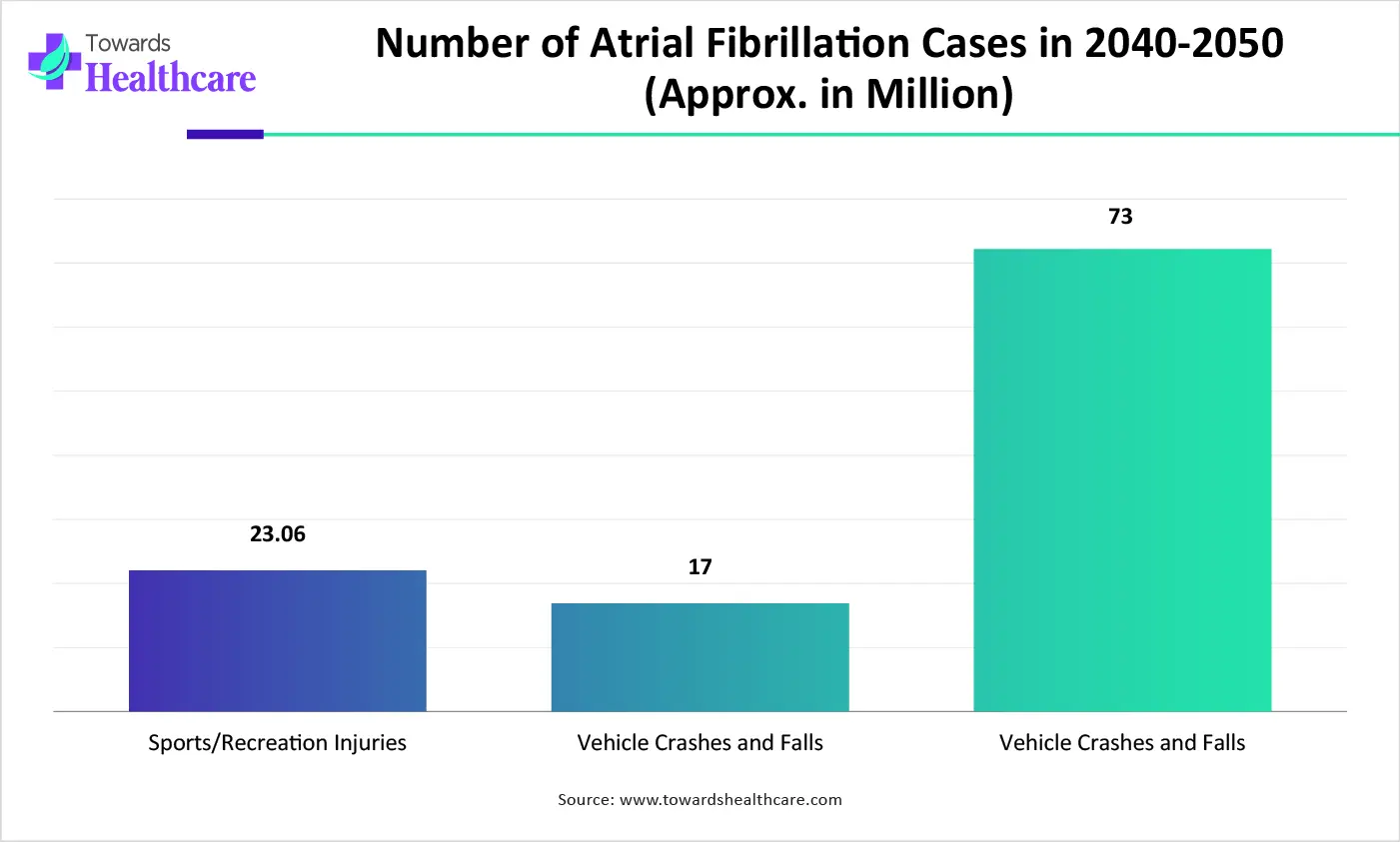
In the coming era, the manual external defibrillators segment is predicted to expand at a notable CAGR. Globally rising cardiac arrhythmias, bradycardia, and sudden cardiac arrest (SCA) cases, and surging preference by hospitals for complex cardiac rhythms for these devices enable medical professionals to manually adjust energy levels and shock, which is impacting their overall adoption. Emerging trends include weight reduction, AI-enhanced resuscitation guidance, strengthened connectivity for real-time data sharing, and raised ruggedness.
| Segments | Shares % |
| Hospital | 45% |
| Pre-Hospital | 20% |
| Public Access Market | 16% |
| Alternate Care Market | 11% |
| Home Healthcare | 8% |
How did the Hospital Segment Dominate the Market in 2025?
The hospital segment captured the biggest share of the external defibrillators market by 45% in 2025. The worldwide accelerating instances of ageing population, sudden cardiac arrest (SCA), and cardiovascular diseases are driving the need for external defibrillators in well-developed and developing hospitals. Specifically, hospital wards and areas are increasingly implementing AEDs, which ensures a faster response time, which is crucial for patient outcomes.
Public Access Market
During 2026-2035, the public access market segment is estimated to show rapid expansion. The progression is fueled by the emerging stricter regulations, which need the installation of Automated External Defibrillators (AEDs) in public, private, and government buildings, as well as surging funding for these initiatives. Ongoing trials are promoting the deployment of AEDs via drones, with early 2026 results showing significantly quicker response times as compared to ground EMS.
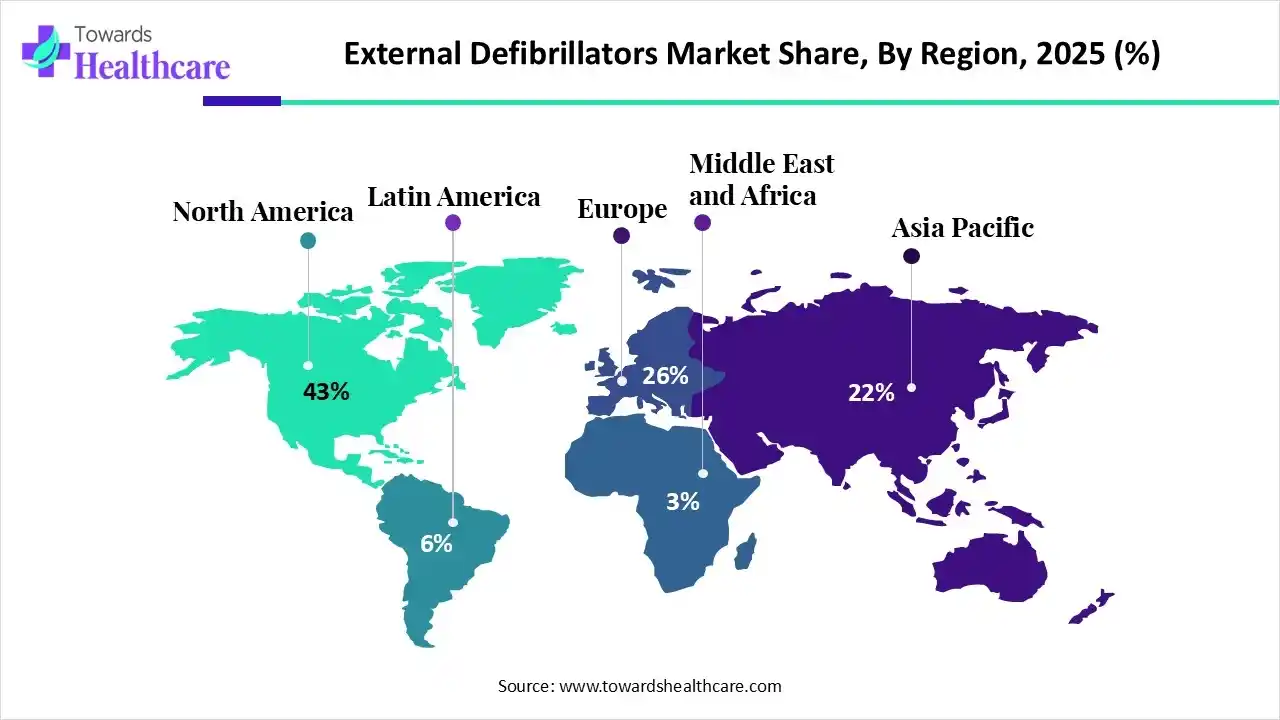
| Regions | Shares 2025 (%) |
| North America | 43% |
| Europe | 26% |
| APAC | 22% |
| Latin America | 6% |
| Middle East and Africa | 3% |
In 2025, North America held a major revenue share of the external defibrillators market by 43%, due to the growing heart-related diseases and sudden cardiac arrests. Moreover, the regional dominance is impacted by the spurring technological breakthroughs, such as enhancements in automated features, smaller designs, & Subcutaneous Implantable Cardioverter-Defibrillators (S-ICDs). Whereas, rigorous studies in rural Ontario have demonstrated that drone delivery of AEDs can arrive at the scene of a cardiac arrest 1.8 to 8.0 minutes quicker than ambulances.
U.S. Market Trends
However, the U.S. market captured the largest share of this region, as it is involved in updating the AHA Guidelines. Recently, the American Heart Association (AHA) released guidelines emphasizing the ‘Universal Chain of Survival’ for both in-hospital & out-of-hospital scenarios, with updated suggestions for pediatric AED use.
Canada Market Trends
Canada is focusing heavily on placing automated external defibrillators in public spaces. Government mandates now require these lifesaving devices in schools and sports arenas. Public transit systems are also getting new installations. Emergency response teams are updating their older models. Increased awareness about sudden cardiac arrest is pushing workplaces to buy units. This widespread access keeps driving consistent regional demand.
Asia Pacific is predicted to expand fastest in the external defibrillators market by 22%, due to the increasing instances of sedentary lifestyles, stress, and dietary changes, which result in increased rates of coronary artery disease, mainly in India and China. Alongside, the region is pushing awareness and CPR & AED training programs, which optimize emergency readiness among the general public.
China Market Trends
China is quickly expanding its public defibrillator network across major cities. New policies push for devices in subways, shopping malls, and tourist spots. Local manufacturing is booming, which helps lower production costs. Domestic companies are designing smaller, smarter models with mobile connectivity. An aging population is creating a massive need for emergency heart care. Government backing speeds up final safety approvals.
India Market Trends
Moreover, India is estimated to grow at a rapid CAGR, as it is actively stepping towards Public Access Defibrillation (PAD) programs, especially in transportation hubs. One of the substantial initiatives encompasses an AED installed at Mumbai's Marine Lines station to save a life. Additionally, India is widely reinforcing real-time CPR feedback, voice prompts, and connectivity to digital health platforms.
In this era, Europe is experiencing a significant expansion in the external defibrillators market by 26% share. Specifically, Sweden and Germany are actively testing and locating AED-equipped drones to reach victims more rapidly than traditional ambulances, primarily in rural or high-traffic urban areas.
UK Market Trends
The UK is heavily investing in smart, connected defibrillator systems. The National Health Service is working to map every public device. This helps emergency dispatchers guide bystanders during a crisis. Schools and local community hubs are receiving newly funded units. Regular training programs encourage everyday citizens to use them. Strict European safety guidelines ensure these new models are incredibly reliable.
German Market Trends
Whereas German researchers are increasingly utilizing machine learning and data-driven models to find the most efficient, high-risk locations for public AEDs, with emerging studies showing these methods can bolster coverage from 21.6% to 42.4%. Increasing incidence of cardiovascular disease is driving the demand for external defibrillators in Germany. The presence of robust healthcare infrastructure also increases their adoption rates. The growing government support and increasing healthcare awareness are also driving the demand, increasing their acceptance rates.
South America is expected to show considerable growth in the external defibrillators market during the forecast period due to increasing cases of heart disease. Growing cardiac arrest awareness is also increasing their use in emergency cases. Expanding healthcare infrastructure is also increasing their adoption rates.
Brazil Market Trends
Brazil is experiencing rapid expansion in the healthcare infrastructure, which increases the adoption of external defibrillators. The growing cases of cardiac diseases are also driving their demand, and increasing government initiatives are also encouraging their usage. At the same time, rising health awareness is also promoting their use.
Argentina Market Trends
Increasing cardiovascular diseases in Argentina are promoting the adoption of external defibrillators. The expanding healthcare facilities and emergency response services are also increasing their adoption rates. Furthermore, the growing CPR training and private clinics are also increasing the adoption of external defibrillators.
MEA is expected to show lucrative growth in the external defibrillators market during the forecast period due to growing government healthcare initiatives. Rapid expansion of healthcare infrastructure is also increasing the adoption of external defibrillators. The growing cardiovascular diseases and medical tourism are also increasing their adoption rates.
GCC Countries Market Trends
Increasing incidence of heart disease is driving the demand for external defibrillators in GCC countries. The growing government healthcare investments and AED initiatives are also encouraging the installation of automated external defibrillators. Additionally, expanding medical tourism and healthcare infrastructure are also increasing their usage.
Saudi Arabia Market Trends
The growing healthcare initiatives in Saudi Arabia are increasing the adoption of external defibrillators. The growing cardiovascular disease is also driving their demand. The expanding emergency and specialized departments are also increasing their adoption. At the same time, growing medical tourism is also increasing their utilization.
| Ecosystem Category | Key Participants / Explanation |
| Technology Providers | Companies developing defibrillation technology, ECG algorithms, battery systems, electrodes, connectivity solutions, and AI-based rhythm detection. |
| Product Manufacturers | Medical device companies manufacturing AEDs, manual defibrillators, wearable defibrillators, and hospital cardiac resuscitation systems. |
| Service Providers | Device maintenance providers, emergency response training organizations, AED management companies, and healthcare equipment service firms. |
| Platform Providers | Connected AED management platforms enabling device tracking, remote monitoring, compliance management, and emergency response coordination. |
| CROs/CDMOs | Limited relevance. Medical device contract manufacturers support component manufacturing, electronics assembly, and regulatory production activities. |
| Software Vendors | Digital health companies providing monitoring software, cloud-based AED management systems, and analytics platforms. |
| Research Institutions | Cardiovascular research centers and medical universities studying cardiac arrest response, resuscitation protocols, and device improvements. |
| End-User Industries | Healthcare, emergency medical services, public safety, education, transportation, corporate safety, sports, and government sectors. |
| Tier 1 | Tier 2 | Tier 3 | |
| Typical Market Influence | 68% | 24% | 8% |
| Tier 1 | ||||
| Company Name | Headquarters | Country | Why Relevant to This Market | Key Products/Services |
| Philips | Amsterdam, Netherlands | Netherlands | One of the largest global emergency care device providers with strong hospital and EMS presence. | HeartStart AED series, defibrillator/monitor systems, emergency care solutions |
| Stryker | Kalamazoo, Michigan, USA | United States | Major player through its emergency care business and strong EMS/hospital customer base. | LIFEPAK AEDs, LIFEPAK defibrillator-monitor systems |
| ZOLL Medical Corporation | Chelmsford, Massachusetts, USA | United States | Specialized leader in resuscitation technology and cardiac emergency solutions. | AED Plus, AED 3, R Series, wearable defibrillator systems |
| Tier 2 | ||||
| Company Name | Headquarters | Country | Why Relevant to This Market | Key Products/Services |
| Schiller | Baar, Switzerland | Switzerland | Established cardiovascular diagnostics and emergency care equipment supplier. | FRED AEDs, defibrillator-monitor systems |
| Mindray | Shenzhen, China | China | Major medical device manufacturer expanding globally in emergency care. | BeneHeart AEDs, cardiac monitoring systems |
| Defibtech | Guilford, Connecticut, USA | United States | Specialized AED manufacturer focused on public access defibrillation. | Lifeline AED, Lifeline VIEW AED |
| Tier 3 | ||||
| Company Name | Headquarters | Country | Why Relevant to This Market | Key Products/Services |
| Progetti | Saronno, Italy | Italy | Specialized emergency medical equipment manufacturer. | Rescue Sam AED systems |
| AMI Italia | Milan, Italy | Italy | Focuses on AED solutions and emergency cardiac response devices. | Saver One AED family |
| METsis Medikal | Ankara, Turkey | Turkey | Regional medical equipment producer active in AED systems. | AED devices and emergency equipment |
In July 2026, "Council is proud to support a program that is designed to help make our communities safer," Mayor Tracey Bailey said. "Increasing the number of publicly available AEDs means more people can respond during a cardiac emergency when every second counts."
By Product
By End Use
By Region





Principal Consultant
Payal Rabde is a Healthcare Market Research Analyst at Towards Healthcare Research & Consulting with 4+ years of experience in pharmaceuticals, biotechnology, medical devices, and life sciences.
Learn more about Payal Rabde

Reviewed By
Aditi Shivarkar is a seasoned professional with over 14 years of experience in healthcare market research. As a content reviewer, Aditi ensures the quality and accuracy of all market insights and data presented by the research team.
Learn more about Aditi Shivarkar