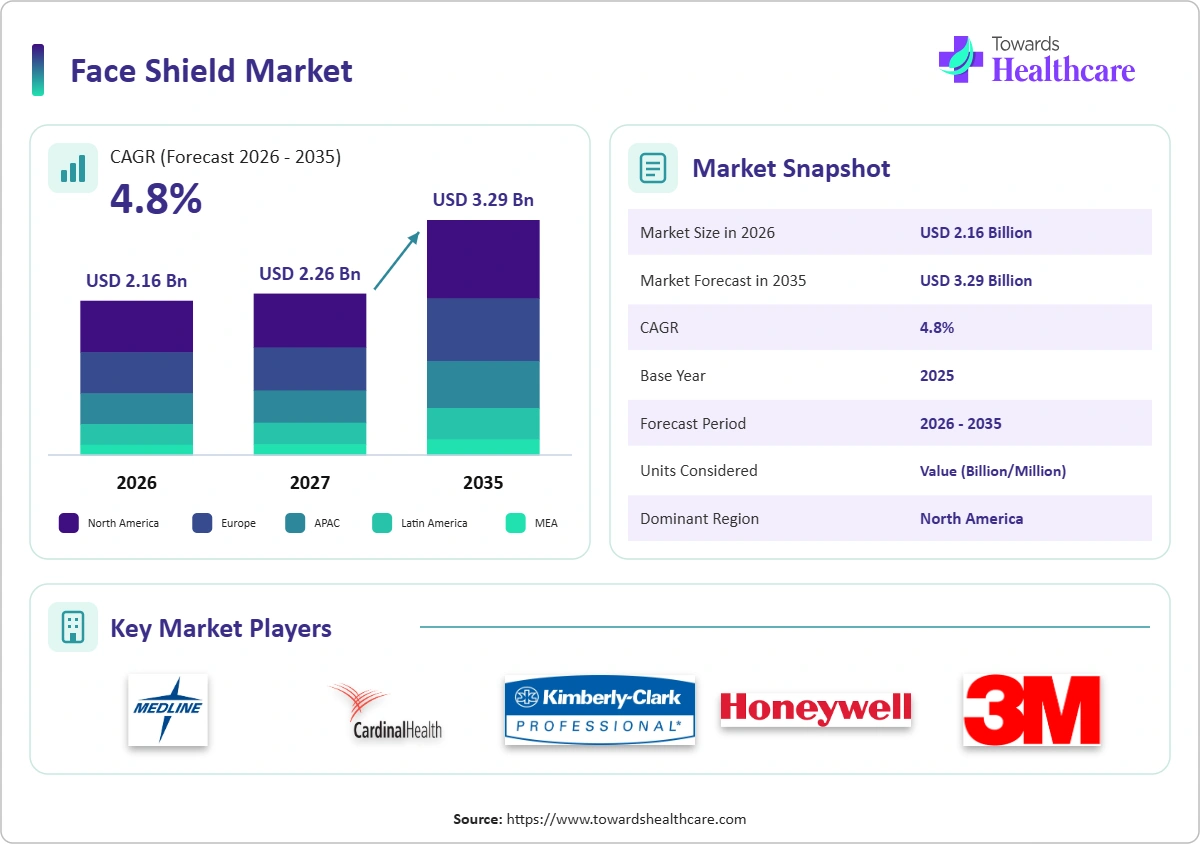
The global face shield market is projected to grow from USD 2.06 billion in 2025 to USD 3.29 billion by 2035. Growth is supported by continued demand for face protection among healthcare and industrial workers, particularly against splashes, droplets, and debris. Infection control requirements, industrial safety regulations, dental applications, and preparedness stockpiles are expected to sustain market demand beyond the pandemic-driven peak.
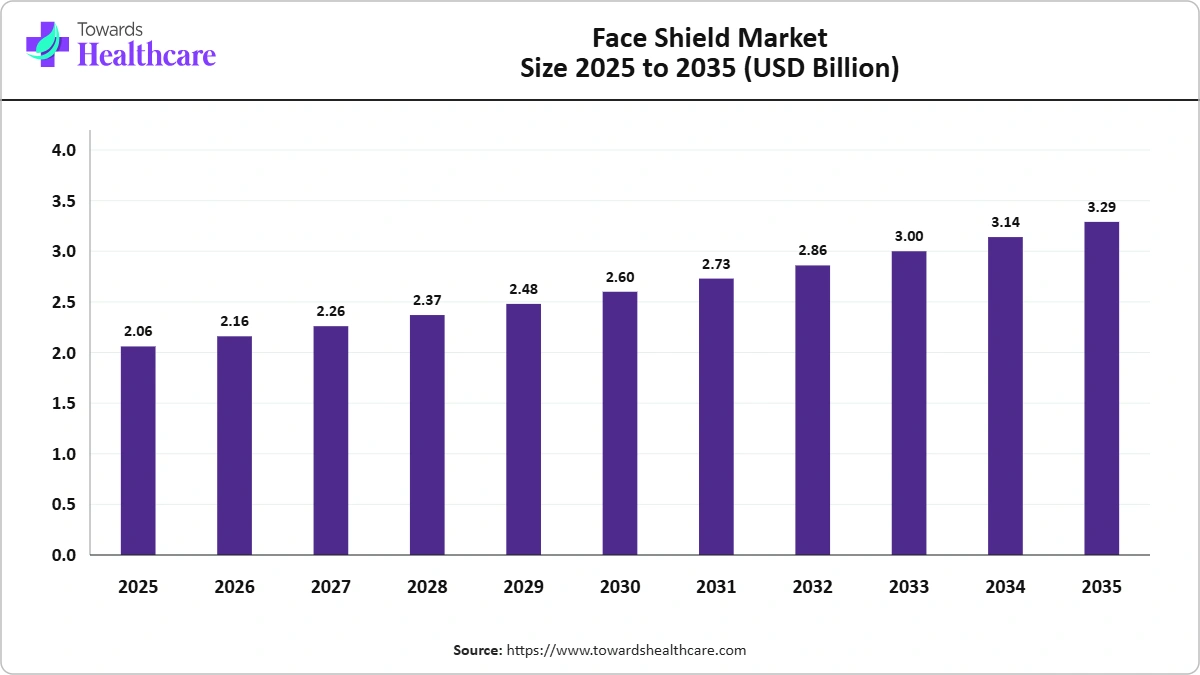
Increasing demand for reusable face protection products, specialised dental products, and improved protective designs is creating additional growth opportunities. The market is projected to reach USD 2.60 billion by 2030 and sustain a CAGR of 4.8% through 2035.
Analyst View: Our market assessment considers face shield consumption by end user and region, along with average selling prices. These estimates are cross-checked against PPE supplier activity and market conditions. The valuation reflects post-pandemic demand normalisation and comparable published market estimates.
| Driver | Impact | ≈ CAGR Contribution | Time Horizon | Key Regions |
| Infection control rules | High | +1.87 pp | Short to long term | Global, strongest in North America |
| Industrial safety regulations | Medium | +1.58 pp | Medium to long term | Global, fastest uptake in Asia Pacific |
| Dental and lab use | Medium | +1.35 pp | Short to medium term | Global |
| Pandemic preparedness stockpiles | Low | +1.05 pp | Long term | Developed and emerging markets |
Note: Contributions are indicative estimates of each factor's effect on annual growth.
Sources: Expert interviews, secondary sources, Towards Healthcare database and Towards Healthcare analysts.
The identified growth drivers are estimated to contribute around 5.86 percentage points to annual market growth. Infection control requirements represent the largest contributor, followed by industrial safety regulations and dental and laboratory applications. Pandemic preparedness stockpiles provide additional long-term support. North America is expected to benefit strongly from established demand, while Asia Pacific is anticipated to record faster adoption.
| Restraint | Impact | ≈ Negative CAGR Contribution | Time Horizon | Key Regions |
| Post-pandemic demand drop | High | -0.48 pp | Short to medium term | Global |
| Price competition | High | -0.35 pp | Medium term | Price-sensitive and emerging markets |
| Low switching costs | Medium | -0.23 pp | Short term | North America and other mature markets |
Note: Contributions are indicative estimates of each factor's effect on annual growth.
Sources: Expert interviews, secondary sources, Towards Healthcare database and Towards Healthcare analysts.
The identified restraints are estimated to offset roughly 1.06 percentage points of annual market growth. The key issue following the pandemic is a decrease in demand, alongside price competition and minimal switching costs, potentially affecting procurement volumes and pricing in established, price-sensitive markets. Their influence is expected to ease as suppliers, buyers, and regulators adapt, supporting a CAGR of 4.8% from 2026 to 2035.
The demand for reusable face shields presents an opportunity for manufacturers. Durable products can address sustainability concerns while supporting repeated use across healthcare and industrial applications.
Dental-specific premium products, industrial automation safety, and demand across Asia Pacific are creating growth opportunities. The development of sustainable materials and specialised face protection products is expected to support market expansion. These emerging opportunities are expected to drive innovation, strengthen product adoption, and create sustained growth prospects during the forecast period.
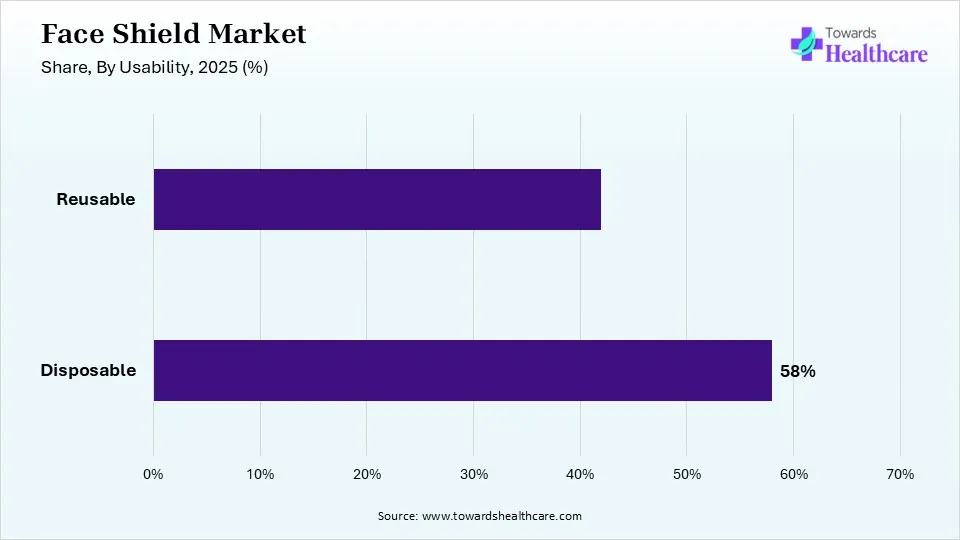
Note: 2025 is the base year; 2035 shares and CAGRs are forecasts.
Sources: Expert interviews, secondary sources, Towards Healthcare database and Towards Healthcare analysts.
The Disposable segment accounted for 58% of the market in 2025 and is projected to expand at a CAGR of 4.10% from 2026 to 2035. Its leading position is supported using single-use face shields in hospitals and other healthcare settings. However, the segment is expected to grow more slowly than the overall market during the forecast period.
The Reusable growth is supported by increasing sustainability goals and demand for durable, premium face shield designs. The segment is expected to grow faster than the global market.
Segment Outlook: Disposable face shields are expected to maintain their leading position by 2035, although their share is projected to decline to around 54.10%. Reusable face shields are anticipated to record the highest CAGR of 5.70%, boosting their market share to 45.90% by 2035.
The PET segment accounted for 44% of the market in 2025 and is projected to expand at a CAGR of 4.28% from 2026 to 2035. Its lead in the market is supported by its clarity and cost-effectiveness. However, the segment is expected to grow slower than the global market through 2035.
Polycarbonate use of polycarbonate in impact-rated industrial face shields is supporting demand. The segment is expected to grow faster than the market across the forecast period.
Acetate and Others materials provide additional options, including anti-fog applications. The segment is expected to grow at a rate broadly in line with the overall market.
Segment Outlook: During the forecast period, PET is expected to remain the largest material segment, although its share is projected to decline to approximately 41.95%. Polycarbonate is anticipated to record the fastest CAGR of 5.48%, increasing its share to 38.30%. Acetate and others will continue to serve more specialised requirements.
The Healthcare segment held the largest market share, at 46% in 2025. The segment is anticipated to grow at a CAGR of 4.30% from 2026 to 2035. Its dominance is driven by stringent infection prevention and control requirements across hospitals, clinics, and dental facilities. However, the segment is projected to experience slower growth than the market.
The Industrial and Manufacturing growth is driven by the adoption of impact-resistant face shields across industrial and manufacturing environments. The segment is projected to outperform the overall market in terms of growth.
The Laboratories and Others expansion is supported by the need for protective face shields in laboratory settings and other specialized applications. The segment is expected to grow at a pace broadly consistent with the global market.
Segment Outlook: Through 2035, the healthcare segment is expected to remain the largest end-user, although its share is projected to decline to around 43.77%. Industrial and manufacturing is anticipated to register the highest CAGR of 5.50%, increasing its share to 36.47% by 2035. Laboratories and others will continue to serve specialised applications.
Analyst View: In our analysis, Disposable, PET, and Healthcare are the leading categories across their respective segments because they address the core requirements of current buyers. However, Reusable, Polycarbonate, and Industrial and Manufacturing are envisioned to gain market share as demand for sustainable products, impact protection, and specialised applications increases.
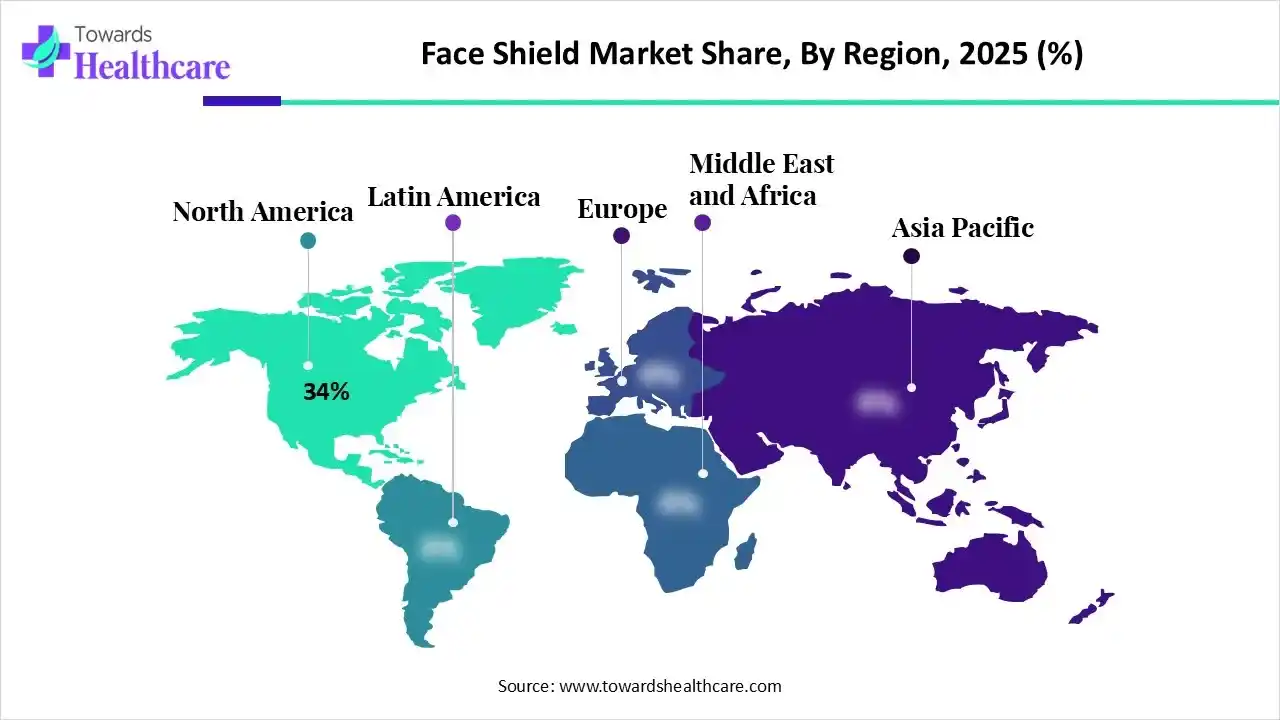
Note: 2025 is the base year; 2035 shares and CAGRs are forecasts.
Sources: Expert interviews, secondary sources, Towards Healthcare database and Towards Healthcare analysts.
North America held the largest share of the global market in 2025, accounting for 34%, and is anticipated to grow at a CAGR of 4.13% from 2026 to 2035. North America’s dominance is driven by stringent OSHA regulations and the strong presence of major healthcare and industrial end users. However, regional growth is expected to remain below the global market average throughout the forecast period.
Asia Pacific growth is driven by the region's well-established manufacturing base in China and India, along with rising demand from healthcare and industrial sectors. Consequently, Asia Pacific's market share is projected to increase to approximately 34.95% by 2035.
Europe stringent PPE regulations and the presence of established industrial end users continue to drive regional demand. The market is projected to grow at a pace largely consistent with the global average.
Latin America increasing demand from industrial applications is expected to contribute to the region's market growth during the forecast period.
The Middle East and Africa expanding demand from the oil and gas and healthcare industries is expected to drive regional market development.
Analyst View: Based on our analysis, North America is expected to retain its strong market position, supported by mature demand conditions and the presence of established suppliers. Asia Pacific is projected to record the fastest growth, increasing its market share from 32% in 2025 to 34.95% by 2035. Europe will remain an important market, while Latin America and the Middle East and Africa are expected to experience gradual expansion.
| Rank | Company Name | 2025 Share (%) | Key Products / Business | Headquarters |
| 1 | 3M | 12.00% | Face shields and PPE | United States |
| 2 | Honeywell | 8.00% | Industrial face shields | United States |
| 3 | Medline Industries | 6.00% | Medical face shields | United States |
| 4 | Kimberly-Clark Professional | 5.00% | Protective face shields | United States |
| 5 | Owens & Minor (Halyard) | 5.00% | Medical face shields | United States |
| 6 | Cardinal Health | 4.00% | Medical PPE | United States |
| 7 | MSA Safety | 4.00% | Industrial face protection | United States |
| 8 | Uvex (Uvex Safety Group) | 4.00% | Face shields | Germany |
| 9 | Ansell | 3.00% | Protective equipment | Australia |
| 10 | Breezy Face | 1.00% | Fan-cooled dental face shields | United States |
Note: Company shares are 2025 estimates.
Sources: Company press releases, expert interviews, secondary sources, Towards Healthcare database and Towards Healthcare analysts.
In 2025, 3M led the global face shield market with an estimated revenue share of 12%, followed by Honeywell at 8% and Medline Industries at 6%. 3M maintains its lead through its face shield and PPE portfolio, while Honeywell focuses on industrial face protection and Medline Industries offers medical face shields.
Other major participants include Kimberly-Clark Professional, Owens & Minor (Halyard), Cardinal Health, MSA Safety, Uvex, Ansell, and Breezy Face. These companies compete through medical PPE, industrial face protection, protective equipment, and specialised dental face shields.
The top 10 companies accounted for an estimated 51.94% of 2025 revenue, while the remaining 48.06% was distributed among numerous Chinese and Indian PPE manufacturers. The market remains fragmented, with competition centred on optical clarity, anti-fog coatings, comfort, impact and splash protection, reusability, distribution, and pricing.
The face shield ecosystem connects material suppliers, PPE manufacturers, distributors, end users, and regulatory organisations. Each participant contributes to product development, manufacturing, distribution, workplace use, and safety compliance.
| Ecosystem Stage | Role in the Market | Key Companies |
| Material Suppliers | Supply PET and polycarbonate films | Film makers |
| PPE Makers | Make face shields | 3M, Honeywell, MSA, Medline |
| Distributors | Supply hospitals and industry | Medline, Grainger, Henry Schein |
| Users | Wear shields | Healthcare workers, industrial workers |
| Regulators | Set PPE standards | OSHA, ANSI Z87.1, FDA, EN 166 |
Sources: Company press releases, expert interviews, secondary sources, Precedence Research database and Precedence Research analysts.
Material Suppliers: Supply PET and polycarbonate films used to make face shields.
PPE Makers: Manufacture face shields for healthcare and industrial use, including 3M, Honeywell, MSA, and Medline.
Distributors: Supply face shields to hospitals and industries, including Medline, Grainger, and Henry Schein.
Users: Use face shields for protection in healthcare and industrial workplaces, including healthcare and industrial workers.
Regulators: Set and maintain safety standards for PPE, including OSHA, ANSI Z87.1, FDA, and EN 166.
The value chain begins with material suppliers and continues through PPE manufacturers and distribution partners before products reach end users. Companies with broader market coverage and established relationships with end users can capture a larger share of market value.
The Towards Healthcare Companies Quadrant positions key participants in the face shield market by market strength, reflecting revenue scale, market share, and geographic reach, and by innovation, and growth strategy, reflecting product portfolio breadth, R&D intensity, and partnerships. Positions reflect each company's estimated 2025 share of the face shield market and our assessment of its product innovation, portfolio breadth, and partnerships.
Sources: Company press releases, expert interviews, secondary sources, Towards Healthcare database and Towards Healthcare analysts.
Leaders: 3M, Honeywell, Medline Industries, Kimberly-Clark Professional, Owens & Minor (Halyard), and Cardinal Health combine high market share with broad portfolios and strong innovation.
Innovators: MSA Safety, Uvex (Uvex Safety Group), Ansell, and Breezy Face bring newer technologies and specialised products.
By Usability
By Material
By End User
By Region
The global face shield market is defined as disposable and reusable full- and half face shields designed to protect the face and eyes from splashes, droplets, and debris. The market includes products made from PET, polycarbonate, acetate, and other materials used across healthcare, dental, industrial, manufacturing, laboratory, and other settings. Products are sold through distributors, direct sales, and online channels.
The market assessment employs a bottom-up approach, analyzing face shield demand and average selling prices across various categories, including usability, material, and end-user sectors, with a base-year valuation of 2025 validated against leading companies' revenues. It covers both Disposable and Reusable products, with materials such as PET, Polycarbonate, and Acetate, and considers end users in Healthcare, Industrial and Manufacturing, and Laboratories. Estimates are refined based on product demand, market presence, supplier activity, and pricing.
Key estimates were verified using company disclosures, regulatory data, expert interviews, and third-party estimates. Unreconciled inputs were excluded, and figures were aligned with a 2025 base year. The 2026-2035 forecast incorporates infection control, safety regulations, dental applications, and stockpiles while considering post-pandemic demand normalization, price competition, and low switching costs. Forecast values utilize a consistent CAGR from the 2025 base and are validated against projected market valuation.
Analyst View: The global face shield market is expected to record moderate growth through 2035 as demand shifts from pandemic-driven procurement toward recurring healthcare, dental and industrial safety requirements. Disposable products are expected to retain the largest market share, supported by single-use applications and procurement convenience. However, reusable shields may gain share as buyers increasingly evaluate durability, cleaning requirements, and lifecycle costs. PET is expected to remain a leading visor material, while polycarbonate may benefit from demand for higher-impact protection in selected industrial applications. Healthcare will continue to represent the largest end-user category, although industrial and manufacturing demand is projected to grow faster. North America will remain a major market, while Asia Pacific is expected to record the highest regional growth. Competitive differentiation will increasingly depend on optical clarity, anti-fog performance, wearer comfort, product compliance, and distribution reach. Manufacturers should balance cost competitiveness with application-specific product performance while avoiding overdependence on pandemic-related demand.