The female infertility diagnosis market is projected to grow from USD 2.38 billion in 2025 to USD 5.43 billion by 2035 because more women are delaying pregnancy and seeking fertility care, and every fertility work-up starts with hormone tests and imaging. Delayed pregnancy, IVF growth, employer benefits, and home testing support strong growth, lifting the market to USD 3.60 billion by 2030 and sustaining a CAGR of 8.60% from 2026 to 2035. Fertility diagnosis uses genomics, telehealth consultations, and microscope-based assessments.
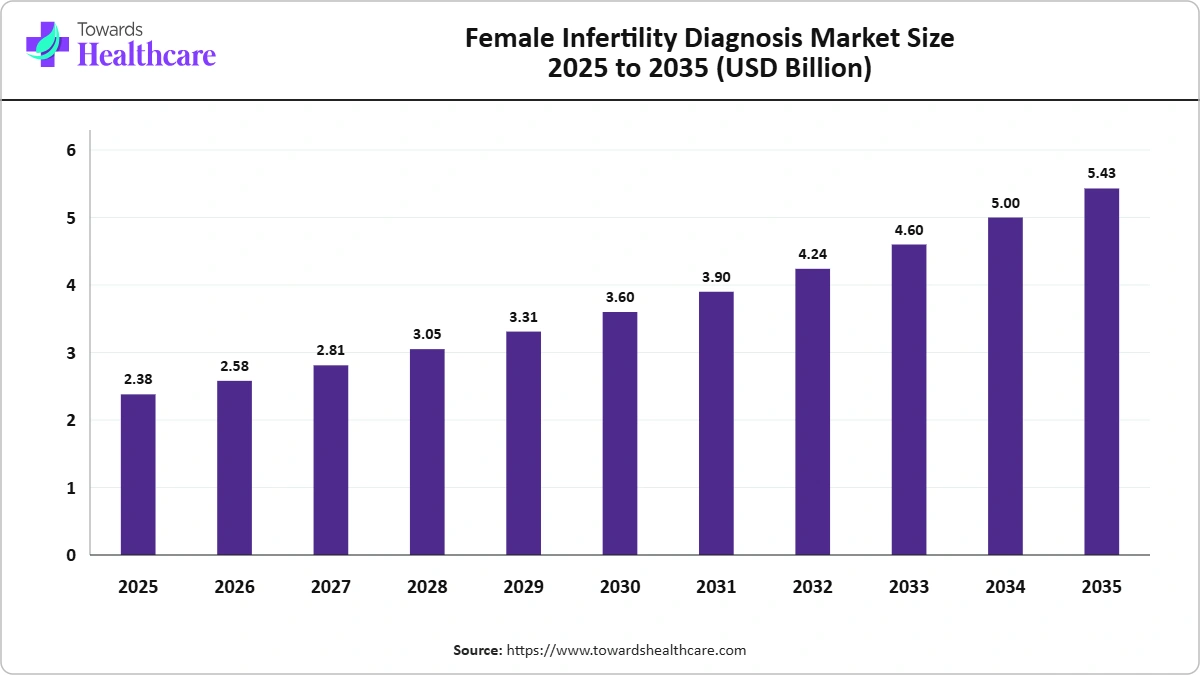
Analyst View: We built the estimate from fertility work-up volumes, tests per patient, and average test prices by region, cross-checked against fertility diagnostics revenues of leading suppliers. Our value sits just above published comparable estimates.
| Driver | Impact | ≈ CAGR Contribution | Time Horizon | Key Regions |
| Women delay pregnancy | High | +3.36 pp | Short to long term | Global, strongest in North America |
| Infertility awareness grows | Medium | +2.83 pp | Medium to long term | Global, fastest uptake in Asia Pacific |
| IVF use rises | Medium | +2.41 pp | Short to medium term | Global |
| Employer benefits expand | Low | +1.89 pp | Long term | Developed and emerging markets |
Note: Contributions are indicative estimates of each factor's effect on annual growth.
Sources: Expert interviews, secondary sources, Towards Healthcare database and Towards Healthcare analysts.
Taken together, these drivers add about 10.49 percentage points to the annual growth of the female infertility diagnosis market, with women delaying pregnancy having the largest effect. Their influence is strongest in North America, while uptake grows fastest in Asia Pacific.
| Restraint | Impact | ≈ Negative CAGR Contribution | Time Horizon | Key Regions |
| Cost and limited insurance coverage | High | -0.85 pp | Short to medium term | Global |
| Assay variation | High | -0.62 pp | Medium term | Price-sensitive and emerging markets |
| Social stigma in some regions | Medium | -0.42 pp | Short term | North America and other mature markets |
Note: Contributions are indicative estimates of each factor's effect on annual growth.
Sources: Expert interviews, secondary sources, Towards Healthcare database and Towards Healthcare analysts.
These restraints are expected to reduce annual growth of the female infertility diagnosis market by about 1.89 percentage points, led by cost and limited insurance coverage. Their effect eases over the forecast period as suppliers, buyers, and regulators adapt, leaving a net CAGR of 8.60% from 2026 to 2035.
Growing demand for home-based testing, expansion of fertility clinics across Asia, improved diagnosis of polycystic ovary syndrome (PCOS), integration of AI-powered imaging and wider adoption of genetic screening are creating new opportunities for market growth.
Note: 2025 is the base year; 2035 shares and CAGRs are forecasts.
Sources: Expert interviews, secondary sources, Towards Healthcare database, and Towards Healthcare analysts.
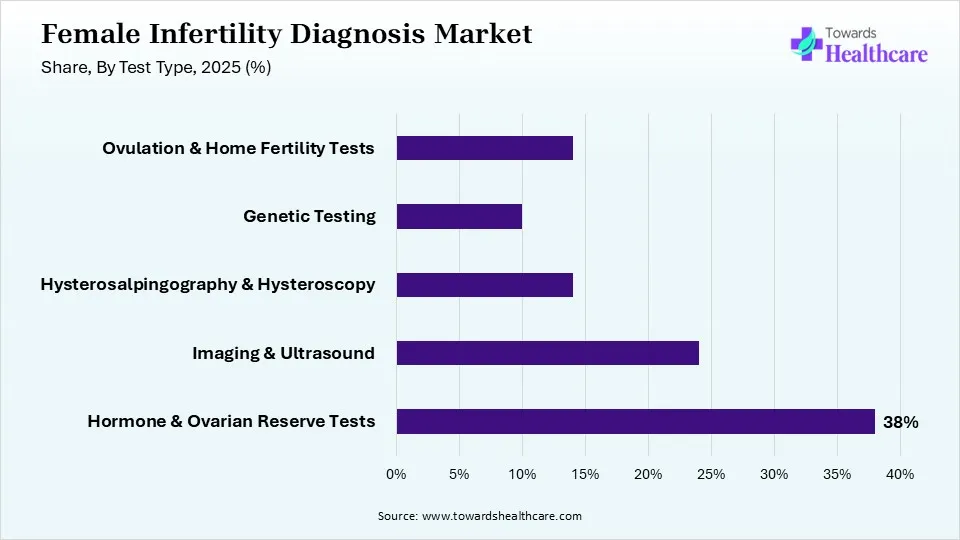
Hormone & Ovarian Reserve Tests segment dominated the female infertility diagnosis market in 2025, capturing 38.00% of the total share, and is projected to register a CAGR of 7.96% from 2026 to 2035. Its leading position is driven by the widespread use of anti-Müllerian hormone (AMH), follicle-stimulating hormone (FSH), and other hormonal assessments as initial steps in fertility evaluations.
Imaging & Ultrasound procedures play an important role in assessing ovarian follicle count, uterine structure, and other reproductive abnormalities.
Hysterosalpingography & Hysteroscopy demand is supported by the use of hysterosalpingography and hysteroscopy to evaluate fallopian tube patency and identify abnormalities within the uterine cavity. The segment is expected to maintain growth broadly in line with the overall market.
Genetic Testing increasing use of carrier screening and karyotype testing in fertility assessments is supporting segment demand by helping identify genetic factors associated with reproductive difficulties.
Ovulation & Home Fertility Tests rising consumer interest in fertility awareness, combined with the growing availability of home-based hormone and ovulation testing solutions, is driving adoption.
Note: 2025 is the base year; 2035 shares and CAGRs are forecasts.
Sources: Expert interviews, secondary sources, Towards Healthcare database, and Towards Healthcare analysts.
Ovulatory Disorders (including PCOS) segment held the largest share of the female infertility diagnosis market in 2025, at 36.00%, and is projected to register a CAGR of 7.99% from 2026 to 2035. Its leading position is attributed to the high prevalence of polycystic ovary syndrome (PCOS), a major contributor to female infertility.
Tubal Factors demand is supported by the need to assess fallopian tube abnormalities and blockages through diagnostic procedures such as hysterosalpingography and related imaging techniques.
Diminished Ovarian Reserve increasingly delayed pregnancy and age-related declines in ovarian function are driving demand for ovarian reserve assessments. The segment is expected to grow faster than the overall market during the forecast period.
Uterine & Other Factors demand is driven by the need to identify uterine abnormalities and other reproductive conditions that may affect fertility.
Note: 2025 is the base year; 2035 shares and CAGRs are forecasts.
Sources: Expert interviews, secondary sources, Towards Healthcare database, and Towards Healthcare analysts.
Fertility Clinics segment held the largest share of the female infertility diagnosis market in 2025, at 44.00%, and is projected to register a CAGR of 8.11% from 2026 to 2035. Its leading position reflects the comprehensive infertility evaluations offered by fertility clinics, including hormonal assessments, imaging, and other specialized diagnostic procedures. However, the segment is expected to grow at a slower pace than the overall market during the forecast period.
Hospitals based gynecology departments and imaging facilities play an important role in identifying reproductive abnormalities and supporting infertility assessments. The segment is expected to grow broadly in line with the overall market over the forecast period.
Diagnostic Laboratories its demand is supported by the growing use of laboratory-based hormonal assessments, including AMH, FSH, and other fertility-related tests. The segment is expected to maintain growth broadly in line with the overall market during the forecast period.
Home Care rising consumer preference for convenient fertility monitoring and the wider availability of at-home hormone and ovulation testing kits are supporting its expansion.
Analyst View: Segment shares were allocated from demand, product portfolios, and pricing in each category. Hormone & Ovarian Reserve Tests, Ovulatory Disorders (incl. PCOS) and Fertility Clinics lead their categories because they meet the core needs of today's buyers. We expect Ovulation & Home Fertility Tests, Diminished Ovarian Reserve and Home Care to gain share as newer technologies, users and applications grow faster.
Note: 2025 is the base year; 2035 shares and CAGRs are forecasts.
Sources: Expert interviews, secondary sources, Towards Healthcare database, and Towards Healthcare analysts.
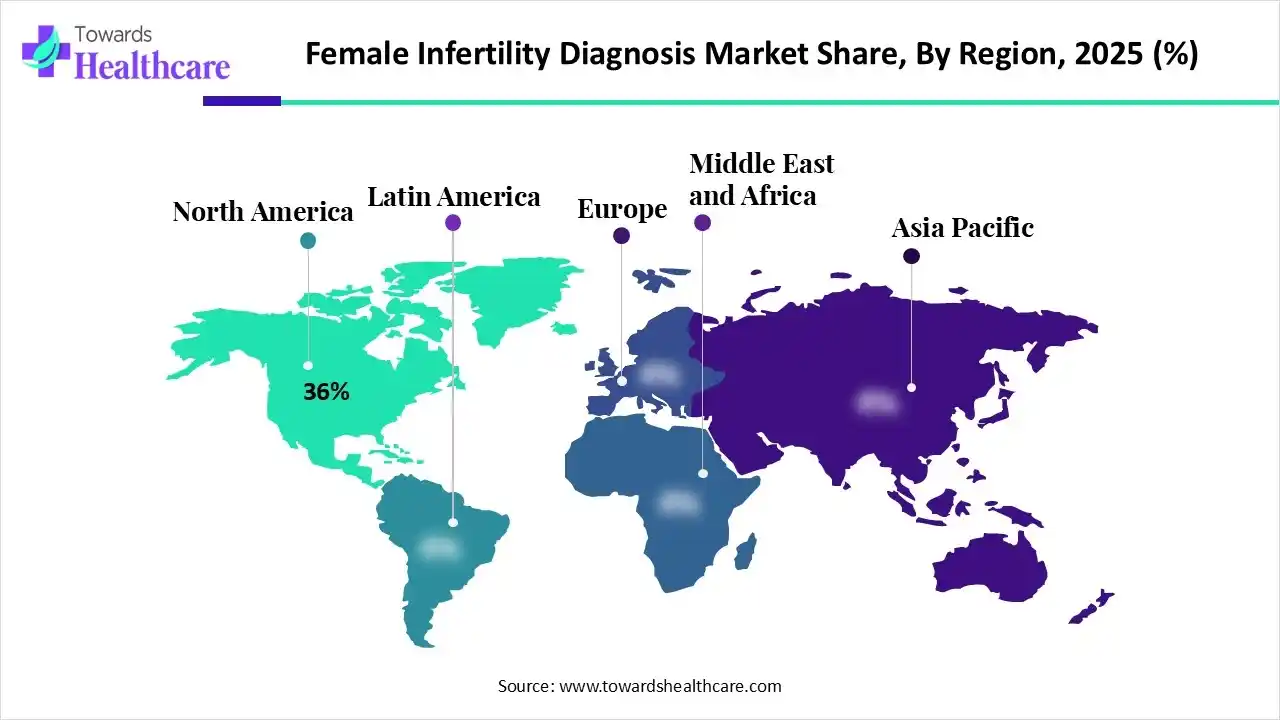
North America held the largest share of the female infertility diagnosis market in 2025, at 36.00%, and is projected to register a CAGR of 8.02% from 2026 to 2035. Its leading position is supported by widespread utilization of fertility clinics, increasing maternal age, and the availability of employer-sponsored fertility benefits. However, the region is expected to grow at a slower pace than the overall market during the forecast period.
Europe established public healthcare support and government-funded IVF programmes across several countries are contributing to regional demand for infertility diagnosis.
Asia Pacific rising infertility concerns, delayed marriages, and the expansion of fertility clinics across China, India, and Japan are strengthening demand for diagnostic services.
Latin America gradual expansion of fertility clinics and improving access to reproductive healthcare services are supporting regional market development.
The Middle East & Africa growing demand for fertility care and increasing investment in reproductive healthcare services are supporting market expansion across the region.
Analyst View: Regional shares were built from demand, installed base, spending and supplier presence in each region. North America leads because of its mature demand base and strong suppliers. We assign Asia Pacific the highest growth premium because investment, adoption and capacity are expanding fastest there.
| Rank | Company Name | 2025 Share (%) | Key Products / Business | Headquarters |
| 1 | Roche Diagnostics | 14.00% | Elecsys AMH and fertility hormones | Switzerland |
| 2 | Beckman Coulter (Danaher) | 9.00% | Access AMH and fertility assays | United States |
| 3 | Siemens Healthineers | 8.00% | Fertility hormone assays and imaging | Germany |
| 4 | GE HealthCare | 7.00% | Voluson ultrasound | United States |
| 5 | Abbott | 6.00% | Fertility hormone assays | United States |
| 6 | Quest Diagnostics | 5.00% | Fertility testing and consumer tests | United States |
| 7 | Labcorp | 5.00% | Fertility and genetic testing | United States |
| 8 | Clearblue (SPD) | 4.00% | Ovulation and fertility monitors | Switzerland |
| 9 | Natera | 2.00% | Carrier and reproductive genetic tests | United States |
| 10 | Proov | 1.00% | Home PdG ovulation confirmation tests | United States |
Note: Company shares are 2025 estimates.
Sources: Company press releases, expert interviews, secondary sources, Towards Healthcare database, and Towards Healthcare analysts.
Roche Diagnostics led the female infertility diagnosis market with an estimated 14.00% share of 2025 revenue, followed by Beckman Coulter (Danaher) at 9.00% share and Siemens Healthineers at 8.00% share. Roche Diagnostics leads with elecsys AMH and fertility hormones, Beckman Coulter (Danaher) competes with access AMH and fertility assays, and Siemens Healthineers offers fertility hormone assays and imaging. GE HealthCare, Abbott, Quest Diagnostics, Labcorp, Clearblue (SPD), Natera, and Proov compete through voluson ultrasound, fertility hormone assays, fertility testing and consumer tests, fertility and genetic testing, ovulation and fertility monitors, carrier and reproductive genetic tests, and home PdG ovulation confirmation tests.
The top 10 companies accounted for an estimated 60.92% of 2025 revenue, while the remaining 39.08% was shared among many fertility clinics, imaging providers and femtech brands. The female infertility diagnosis market is fragmented, and competition centres on assay accuracy, AMH standardisation, imaging quality, fertility clinic relationships, consumer access, genetic test menus and price.
Roche Diagnostics, part of F. Hoffmann-La Roche Ltd, is headquartered in Switzerland. It held an estimated 14.00% share of the female infertility diagnosis market in 2025. Its offering centres on Elecsys AMH and fertility hormones. It is positioned as a Leader.
Beckman Coulter (Danaher) is headquartered in the United States. It held an estimated 9.00% share of the female infertility diagnosis market in 2025. Its offering centres on Access AMH and fertility assays. It is positioned as a Leader.
Siemens Healthineers is headquartered in Germany. It held an estimated 8.00% share of the female infertility diagnosis market in 2025. Its offering centres on Fertility hormone assays and imaging.
GE HealthCare is based in the United States. It held an estimated 7.00% share of the female infertility diagnosis market in 2025. Its offering centres on Voluson ultrasound.
Abbott is headquartered in the United States. It held an estimated 6.00% share of the female infertility diagnosis market in 2025. Its offering centres on Fertility hormone assays. It is positioned as a Leader.
Quest Diagnostics is headquartered in the United States. It held an estimated 5.00% share of the female infertility diagnosis market in 2025. Its offering centres on Fertility testing and consumer tests. In the Towards Healthcare Companies Quadrant, it is positioned as a Leader.
Labcorp, part of Laboratory Corporation of America Holdings, is headquartered in the United States. It held an estimated 5.00% share of the female infertility diagnosis market in 2025. Its offering centres on Fertility and genetic testing. In the Towards Healthcare Companies Quadrant, it is positioned as an Innovator.
Clearblue (SPD) is headquartered in Switzerland. It held an estimated 4.00% share of the female infertility diagnosis market in 2025. Its offering centres on Ovulation and fertility monitors. In the Towards Healthcare Companies Quadrant, it is positioned as an Innovator.
Natera is headquartered in the United States. It held an estimated 2.00% share of the female infertility diagnosis market in 2025. Its offering centres on Carrier and reproductive genetic tests. In the Towards Healthcare Companies Quadrant, it is positioned as an Innovator.
Proov, part of MFB Fertility, Inc., is headquartered in the United States. It held an estimated 1.00% share of the female infertility diagnosis market in 2025. Its offering centres on Home PdG ovulation confirmation tests.
The female infertility diagnosis ecosystem links test & device makers, laboratories, fertility clinics, patients and regulators & payers, with each stage adding value before products reach end users.
| Ecosystem Stage | Role in the Market | Key Companies |
| Test & Device Makers | Make assays, ultrasound and home tests | Roche, Beckman Coulter, GE HealthCare, Clearblue |
| Laboratories | Run hormone and genetic tests | Quest, Labcorp, Natera |
| Fertility Clinics | Diagnose and treat | IVF and fertility clinics |
| Patients | Use tests | Women trying to conceive |
| Regulators & Payers | Clear tests and pay | FDA, insurers, employers |
Sources: Company press releases, expert interviews, secondary sources, Towards Healthcare database and Towards Healthcare analysts.
Test & Device Makers: Make assays, ultrasound and home tests. Key participants include Roche, Beckman Coulter, GE HealthCare, Clearblue.
Laboratories: Run hormone and genetic tests. Key participants include Quest, Labcorp, Natera.
Fertility Clinics: Diagnose and treat. Key participants include IVF and fertility clinics.
Patients: Use tests. Key participants include Women trying to conceive.
Regulators & Payers: Clear tests and pay. Key participants include FDA, insurers, employers.
Value in the female infertility diagnosis market flows from upstream material and technology suppliers to manufacturers and service providers, then through distribution partners to end users. Companies that integrate several stages or build long-term relationships with end users capture a larger share of this value.
The Towards Healthcare Companies Quadrant positions key participants in the female infertility diagnosis market by market strength, reflecting revenue scale, market share and geographic reach, and by innovation and growth strategy, reflecting product portfolio breadth, R&D intensity and partnerships. Positions reflect each company's estimated 2025 share of the female infertility diagnosis market and our assessment of its product innovation, portfolio breadth and partnerships.
Sources: Company press releases, expert interviews, secondary sources, Towards Healthcare database and Towards Healthcare analysts.
Leaders: Roche Diagnostics, Beckman Coulter (Danaher), Siemens Healthineers, GE HealthCare, Abbott and Quest Diagnostics combine high market share with broad portfolios and strong innovation.
Innovators: Labcorp, Clearblue (SPD), Natera and Proov bring newer technologies and specialised products.
By Test Type
By Cause
By End User
By Region
The female infertility diagnosis market was defined as tests and procedures used to diagnose female infertility, including hormone and ovarian reserve tests (AMH, FSH, LH, estradiol, progesterone), ultrasound and imaging, hysterosalpingography and hysteroscopy, genetic testing, and ovulation and home fertility tests, used by fertility clinics, hospitals, diagnostic laboratories and women at home. The 2025 base year was built bottom-up from demand volumes and average prices by test type, cause, end user and region, and checked top-down against the market-specific revenues of leading companies and published estimates. Segment, regional and company values were allocated from test type, cause and end user and region demand.
Key estimates were verified by cross-checking company disclosures, regulatory and industry data, and published third-party estimates, and inputs that could not be reconciled were excluded. All segment, regional and company figures were reconciled to the same 2025 base year, and the 2026-2035 forecast, which applies a constant CAGR from the 2025 base, was recalculated and validated.
Analyst View: The female infertility diagnosis market is set for steady expansion as delayed pregnancy and related demand keep growing. Our estimate links value to underlying demand, installed base and pricing, so the forecast follows real adoption rather than headline hype. The main upside comes from home tests and Asian fertility clinics, while the main risks are cost and limited insurance coverage.