

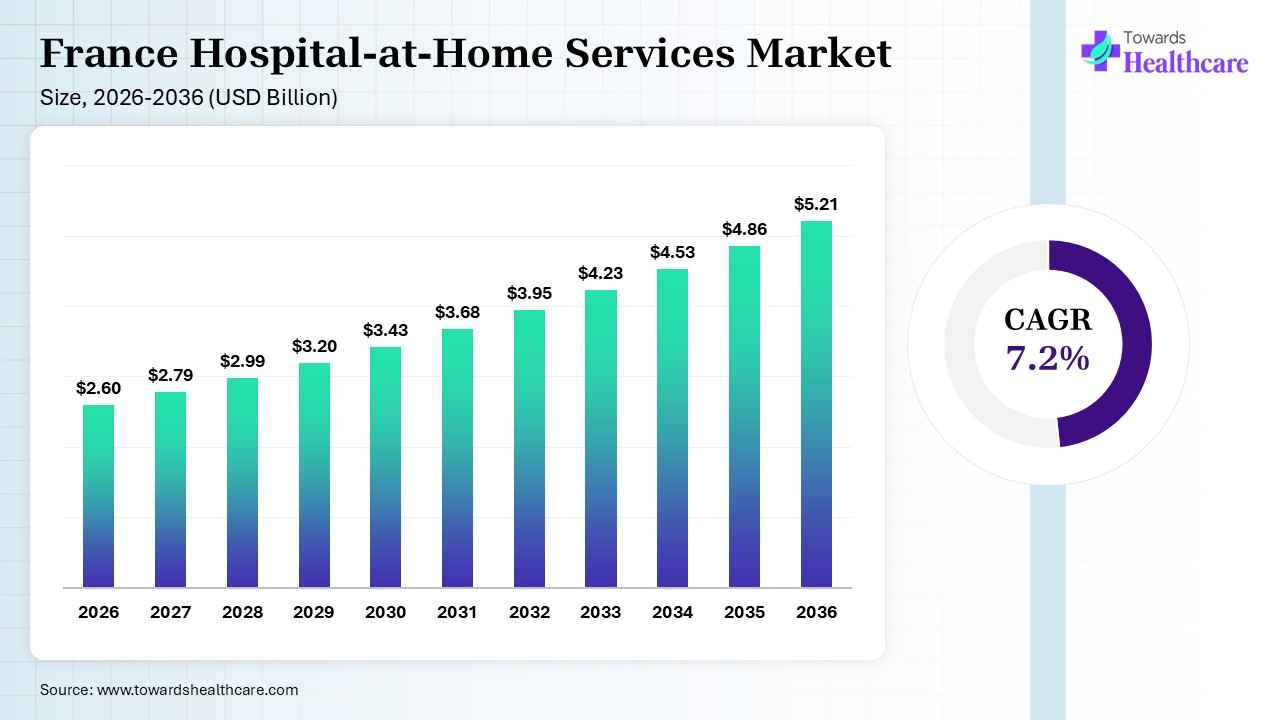
The France hospital-at-home services market size is calculated at US$ 2.6 billion in 2026, grows to US$ 2.79 billion in 2027, and is projected to reach around US$ 5.21 billion by 2036, expanding at a CAGR of 7.2% from 2026 to 2035. France’s hospital-at-home services market is expanding as healthcare providers shift more complex medical care from hospitals to patients’ homes. The country recorded 7.2 million hospitalization-at-home (HAD) patient-days in 2023 and 7.7 million in 2024, representing approximately 6.9% growth based on rounded figures. This increase reflects rising demand for home-based clinical services and the growing role of HAD in France’s healthcare delivery system.
Market sizing requires a clear distinction between reimbursable HAD activity and the broader economic activity of home-based clinical services. Revenue calculations depend on patient volumes, care intensity, reimbursement tariffs, case mix, supplementary payments, and financing arrangements. The forecasting model incorporates patient-days, revenue per patient-day, case mix, and provider capacity. At an annual growth rate of 5-8%, patient-days reach approximately 9.8-11.3 million by 2030, based on six years of compound growth from 2024.
Population aging, rising chronic disease prevalence, hospital capacity constraints, and advances in home-based medical procedures drive market expansion. France’s regulated, reimbursement-based healthcare system distinguishes HAD from conventional homecare and consumer health services. Providers compete on their ability to deliver complex clinical care safely, maintain hospital and physician referral networks, recruit qualified medical and paramedical staff, manage medicines and medical devices, and operate efficiently within regulated reimbursement frameworks.
French HAD delivers coordinated medical and paramedical care at home under medical prescription, with a level of clinical intensity comparable to hospital care over a defined period. It differs from routine home nursing, personal assistance, independent nursing visits, and non-medical support for older adults. Market performance therefore depends on patient volumes, patient-days, care intensity, reimbursement by case mix, provider economics, clinical outcomes, and regional service coverage. These indicators provide a more reliable assessment of market expansion than homecare visit numbers or total industry revenue alone.
The strongest growth opportunities in France’s hospital-at-home services market lie in infectious disease care, pediatric care, and services delivered through nursing homes and long-term care facilities (EHPAD). Short-term care lasting less than 15 days also represents a high-growth segment, reflecting the market’s focus on shorter treatment episodes. Digitally supported care with remote monitoring presents another growth opportunity by strengthening patient monitoring and coordination of home-based treatment.
In 2025, medical and nursing care were dominated by service type, while moderate-complexity clinical care was led by patient acuity and care complexity. Public hospitals and university hospital centers (CHUs) dominated as referral sources, and private nonprofit HAD providers held the leading position by provider type. Regulated HAD tariff-based reimbursement and electronic health records with digital care plans also dominated their respective segments.
Value-creation opportunities depend on expanding high-growth services while improving care coordination, staffing efficiency, and clinical outcomes. Providers that strengthen partnerships with hospitals, develop services for pediatric patients and EHPAD residents, and integrate remote monitoring into care delivery are well positioned to address evolving demand across France’s hospital-at-home market.
Demand for hospital-at-home (HAD) services is driven by population aging, multiple chronic conditions, shorter hospital stays, patient preference for care at home, and efforts to reduce avoidable hospital admissions. Medical and technological advances have expanded the range of treatments delivered safely in the home setting.
The main constraint is operational capacity. HAD providers need trained staff, broad geographic coverage, strong physician coordination, timely medication delivery, and rapid responses to patient deterioration. Staff shortages limit admissions and service expansion even when demand remains high.
Market growth also depends on referral networks. Hospitals, specialist departments, general practitioners, and residential care facilities need confidence in providers’ ability to admit patients promptly and maintain uninterrupted treatment. Differences in local clinical networks, referral practices, and service coverage create significant regional variations in growth potential, even where demographic demand is similar.
French hospital-at-home (HAD) services operate under a regulated hospital funding system in which reimbursement depends on the clinical episode, treatment category, and services delivered. Per-patient-day reimbursement is not a uniform rate. Clinical intensity, treatment duration, and funding adjustments influence revenue per episode.
Provider profitability depends on the relationship between reimbursement and the cost of delivering care. Major operating costs include clinical staff, medicines, medical equipment, transportation, logistics, and standby staffing. High-intensity cases often generate higher reimbursement but also require greater resources and incur higher treatment costs.
The report compares effective reimbursement per patient-day, revenue per episode, direct clinical costs, staffing costs per day, pharmacy and equipment expenses, and operating margins across treatment categories. It also assesses how changes in case mix, staff costs, and travel intensity affect provider profitability.
Demand for French hospital-at-home (HAD) services depends on patient eligibility, hospital discharge priorities, and the availability of providers equipped to deliver care at home. Expanding demand does not automatically translate into higher service volumes, as providers need sufficient clinical staff, geographic coverage, and operational resources to admit and treat patients safely.
Supply is constrained by the availability of clinical staff, physician prescribing relationships, and the ability to coordinate care beyond hospital settings. Long travel distances in rural areas increase costs per patient-day, while urban areas benefit from shorter travel routes but face greater demand and competition for healthcare professionals.
The analysis evaluates regional capacity and activity, patient-day productivity, staffing availability, and service coverage. It also identifies areas where limited adoption, workforce shortages, or weak referral coordination restrict service expansion despite underlying demand.
The hospital-at-home (HAD) value chain begins with patient referrals and eligibility assessments, followed by treatment planning, staff allocation, and medical equipment and medication delivery. Providers then deliver clinical care through home visits, telemonitoring, and direct medical assessments. The process concludes with escalation to higher levels of care when necessary and patient discharge after treatment completion.
Hospital-at-home services depend on locally coordinated care delivery. Value creation rests on reimbursement structures, treatment complexity, workforce productivity, medical supply availability, and coordination among hospitals, physicians, pharmacies, and care teams. Providers strengthen their competitive position through efficient resource allocation, continuity of care, and the ability to prevent avoidable readmissions and unnecessary hospital transfers.
Remote monitoring, electronic care plans, interoperable clinical records, digital scheduling, and clinical decision-support systems improve coordination and visibility across hospital-at-home (HAD) services. Their value depends on integration into clinical workflows and the ability to trigger timely interventions.
HAD providers operate under French healthcare requirements governing authorization, medical prescriptions, reimbursement, patient safety, data privacy, and care quality. Patient consent and clinical suitability are essential for treatment at home. HAD follows the applicable hospital funding framework, while routine home assistance does not automatically qualify as HAD.
Home-based care reduces inpatient stays and patient travel, but these savings must be weighed against staff travel, medication deliveries, equipment transport, and other operating costs. The study assesses digital maturity, system interoperability, cybersecurity, clinical governance, and operating conditions to identify where home-based care delivers measurable resource savings.
| Segments | 2026 Share | 2026 Market Value (USD Million) |
| Medical and Nursing Care | 25% | $650 |
| Palliative and End-of-Life Care | 12% | $312 |
| Cancer and Oncology Supportive Care | 11% | $286 |
| Complex Wound Care | 8% | $208 |
| Intravenous Therapy and Infusion Services | 9% | $234 |
| Post-Acute and Post-Surgical Care | 10% | $260 |
| Rehabilitation Services | 6% | $156 |
| Maternal and Perinatal Care | 4% | $104 |
| Infectious Disease Management | 5% | $130 |
| Chronic Disease Management | 7% | $182 |
| Other Specialized Clinical Services | 3% | $78 |
Medical and nursing care is estimated to remain the largest service category, reflecting its central role in hospital-at-home delivery. Palliative care, oncology support, infusion services, and post-surgical care also contribute significantly by enabling eligible patients to receive hospital-level treatment at home.
| Segments | 2026 Share | 2026 Market Value (USD Million) |
| Oncology | 20% | $520 |
| Palliative Care | 15% | $390 |
| Cardiovascular Diseases | 10% | $260 |
| Neurological Disorders | 9% | $234 |
| Respiratory Diseases | 11% | $286 |
| Infectious Diseases | 8% | $208 |
| Diabetes and Metabolic Disorders | 6% | $156 |
| Wound and Skin Conditions | 7% | $182 |
| Post-Surgical Recovery | 9% | $234 |
| Other Clinical Applications | 5% | $130 |
Oncology and palliative care are estimated to account for substantial shares because patients may require ongoing symptom management, complex treatment support, and coordinated clinical monitoring. Infectious disease management is positioned as a potential growth area as home-based care pathways expand for clinically appropriate patients.
| Segments | 2026 Share | 2026 Market Value (USD Million) |
| Pediatric Patients | 10% | $260 |
| Adult Patients (18–59 Years) | 48% | $1,248 |
| Older Adults (60 Years and Above) | 42% | $1,092 |
Adult patients are estimated to represent the largest share of current demand, supported by home-based treatment needs across acute and chronic conditions. Pediatric services may grow faster as care pathways for children requiring specialized monitoring and treatment at home develop.
| Segments | 2026 Share | 2026 Market Value (USD Million) |
| Private Residential Homes | 42% | $1,092 |
| Nursing Homes and Long-Term Care Facilities (EHPAD) | 30% | $780 |
| Assisted Living and Residential Care Facilities | 18% | $468 |
| Other Eligible Residential Settings | 10% | $260 |
Private residential homes are estimated to account for the largest share because hospital-at-home services are designed to deliver appropriate clinical care in patients’ own homes. EHPAD and other residential care settings are potential growth areas as providers coordinate more closely with healthcare professionals to manage complex care needs.
| Segments | 2026 Share | 2026 Market Value (USD Million) |
| Low-Complexity Clinical Care | 18% | $468 |
| Moderate-Complexity Clinical Care | 42% | $1,092 |
| High-Complexity Clinical Care | 27% | $702 |
| Intensive and Specialized Clinical Care | 13% | $338 |
Moderate-complexity clinical care is estimated to dominate the market, consistent with the need to provide hospital-level services at home while maintaining appropriate clinical oversight. High-complexity and specialized care also represent important segments where staffing, monitoring, and coordinated multidisciplinary support are essential.
| Segments | 2026 Share | 2026 Market Value (USD Million) |
| Short-Term Care (Less Than 15 Days) | 38% | $988 |
| Medium-Term Care (15–30 Days) | 32% | $832 |
| Long-Term Care (More Than 30 Days) | 30% | $780 |
Short-term care is estimated to be the largest duration segment, reflecting acute treatment episodes, recovery support, and care following hospital discharge. Medium- and long-term services remain important for patients needing extended monitoring, complex treatment, or ongoing clinical support at home.
| Segments | 2026 Share | 2026 Market Value (USD Million) |
| Public Hospitals and University Hospital Centers (CHUs) | 32% | $832 |
| Private Hospitals and Clinics | 20% | $520 |
| General Practitioners | 15% | $390 |
| Medical Specialists | 10% | $260 |
| Emergency and Acute Care Departments | 8% | $208 |
| Nursing Homes and Long-Term Care Facilities | 9% | $234 |
| Other Healthcare Providers | 6% | $156 |
Public hospitals and university hospital centers are estimated to be the leading referral source because they coordinate inpatient discharge and transitions to home-based clinical care. Private hospitals, general practitioners, and specialists also contribute by identifying suitable patients and supporting continuity of treatment.
| Segments | 2026 Share | 2026 Market Value (USD Million) |
| Public Hospital-Based HAD Providers | 30% | $780 |
| Private Nonprofit HAD Providers | 35% | $910 |
| Private For-Profit HAD Providers | 23% | $598 |
| Specialized Independent HAD Organizations | 12% | $312 |
Private nonprofit hospital-at-home providers are estimated to hold the largest share, reflecting the role of nonprofit organizations in France’s home hospitalization landscape. Public hospital-based and private for-profit providers also serve important needs, while independent specialist organizations contribute targeted services and delivery capacity.
| Segments | 2026 Share | 2026 Market Value (USD Million) |
| Regulated HAD Tariff-Based Reimbursement | 65% | $1,690 |
| Case-Mix-Based Reimbursement | 15% | $390 |
| Supplementary and Activity-Related Funding | 12% | $312 |
| Other Applicable Healthcare Funding Mechanisms | 8% | $208 |
Regulated HAD tariff-based reimbursement is estimated to dominate the market because hospital-at-home services operate within France’s regulated healthcare financing framework. Supplementary funding and activity-related mechanisms may support specific services, while reimbursement arrangements influence provider capacity and service mix.
| Segments | 2026 Share | 2026 Market Value (USD Million) |
| Remote Patient Monitoring | 22% | $572 |
| Teleconsultation and Telehealth | 15% | $390 |
| Electronic Health Records and Digital Care Plans | 25% | $650 |
| Clinical Scheduling and Coordination Software | 14% | $364 |
| Connected Medical Devices | 16% | $416 |
| Other Digital Healthcare Technologies | 8% | $208 |
Electronic health records and digital care plans are estimated to lead the technology segment because providers need coordinated documentation, treatment plans, and information sharing across care teams. Remote monitoring and connected devices are important supporting technologies that may enable earlier identification of clinical changes and more digitally supported care.
| Segments | 2026 Share | 2026 Market Value (USD Million) |
| Hospital-Integrated HAD Services | 25% | $650 |
| Independent Specialist HAD Services | 18% | $468 |
| Multidisciplinary Home-Based Clinical Care | 30% | $780 |
| Digitally Supported and Remote-Monitoring-Enabled Care | 27% | $702 |
Multidisciplinary home-based clinical care is estimated to account for the largest share because hospital-at-home services often require coordinated input from nurses, physicians, and other healthcare professionals. Digitally supported and remote-monitoring-enabled care may grow rapidly as providers integrate connected devices and digital coordination into home-based treatment.
The French hospital-at-home (HAD) market includes public hospitals, nonprofit specialist organizations, and private providers. Competitive positioning depends on reputation, geographic coverage, workforce capabilities, service range, and operational performance.
The market remains fragmented by geography and clinical partnerships. Large providers benefit from economies of scale across administration, technology, and purchasing. Local operators benefit from established referral relationships and a deeper understanding of regional healthcare needs. Neither model guarantees higher profitability. Broad geographic coverage increases travel and coordination costs, while a limited footprint restricts expansion opportunities.
Competitive benchmarking focuses on operational performance, including patient-days, annual admissions, average episode duration, capacity utilization, workforce productivity, revenue per patient-day, operating margins, and readmission rates. Provider-level financial analysis also separates HAD-specific revenue from total corporate revenue, particularly for organizations operating across multiple healthcare services.
| Company/organization | Headquarters | Market position | Core strength and relevant segments |
| Fondation Santé Service | Levallois-Perret, France | Specialist leader | Large-scale HAD, complex medical care |
| Santélys | Loos, France | Regional specialist | Chronic disease, technical home care |
| HAD France | France | Specialist provider | Hospital-at-home delivery; local operations to validate |
| Fondation Œuvre de la Croix-Saint-Simon | Paris, France | Nonprofit specialist | Home hospitalization and complex care |
| AP-HP | Paris, France | Public hospital network | Hospital-linked HAD and specialist pathways |
| Hospices Civils de Lyon | Lyon, France | Public hospital network | Hospital-integrated care |
| Assistance Publique-Hôpitaux de Marseille | Marseille, France | Public hospital network | Regional hospital-linked services |
| CHU de Bordeaux | Bordeaux, France | Public hospital network | Specialist referral and clinical integration |
| CHU de Lille | Lille, France | Public hospital network | Complex hospital-linked care |
| CHU de Toulouse | Toulouse, France | Public hospital network | Regional specialist pathways |
| CHU de Nantes | Nantes, France | Public hospital network | Integrated hospital and home care |
| CHU de Montpellier | Montpellier, France | Public hospital network | Regional clinical services |
| CHU de Rennes | Rennes, France | Public hospital network | Hospital-linked HAD |
| CHU de Strasbourg | Strasbourg, France | Public hospital network | Regional specialist care |
| CHU de Grenoble Alpes | Grenoble, France | Public hospital network | Complex clinical pathways |
| Groupe Hospitalier Diaconesses Croix Saint-Simon | Paris, France | Nonprofit hospital provider | Hospital-linked care and coordination |
| Croix-Rouge française | Montrouge, France | Nonprofit healthcare network | Health and social-care integration |
| Groupe SOS Santé | Paris, France | Nonprofit healthcare group | Regional healthcare delivery |
| LNA Santé | Vertou, France | Private healthcare group | Post-acute care and relevant home-care operations to validate |
| Vivalto Santé | Saint-Grégoire, France | Private hospital group | Hospital referral networks |
| Ramsay Santé | Paris, France | Private hospital group | Hospital integration and care pathways |
| ELSAN | Paris, France | Private hospital group | Clinical network and discharge pathways |
| Fondation Santé des Étudiants de France | Paris, France | Nonprofit specialist | Specialized healthcare pathways; HAD participation to validate |
| Santé Service Bayonne et Région | Bayonne, France | Regional specialist | Local HAD and clinical coordination |
| HAD 35 | Rennes, France | Regional specialist | Territorial home-hospitalization provision |
In the hospital-at-home (HAD) market, portfolio breadth reflects the range of clinical pathways a provider delivers safely and effectively. Benchmarking distinguishes generalist services from specialized care, including palliative care, oncology treatments, complex wound management, intravenous therapies, post-acute care, and support for patients with complex clinical needs.
A broader service portfolio strengthens referral opportunities and improves resource allocation across treatment pathways. However, specialized services require trained staff, dedicated equipment, effective medication management, and robust clinical governance. Portfolio expansion delivers value when local referral volumes, workforce capacity, and reimbursement levels support the additional operating costs.
Technology benchmarking evaluates digital scheduling, patient monitoring, clinical documentation, escalation procedures, and system integration. Geographic benchmarking assesses service coverage, population density, and access to hospitals, laboratories, and pharmacies. Capacity benchmarking measures concurrent patient capacity, annual admissions, workforce availability, and the ability to expand services without compromising clinical quality.
Customer and channel benchmarking examines relationships with hospital discharge teams, specialist departments, general practitioners, nursing homes, and other referral sources. Key performance indicators include referral volumes, referral acceptance rates, time from referral to admission, referral source concentration, and repeat referrals. Together, these measures reveal how effectively providers integrate clinical services, manage regional operations, and build reliable referral networks.
Strategic developments in the France Hospital-at-Home (HAD) market include new service launches, geographic expansion, hospital partnerships, digital investments, clinical specialization, and consolidation. Transaction analysis distinguishes acquisitions of dedicated HAD providers from broader healthcare acquisitions that include HAD operations.
The report examines strategic developments and transactions, separating completed deals from announced initiatives and HAD-specific transactions from wider healthcare sector activity. It also assesses how partnerships and consolidation strengthen technology integration, purchasing efficiency, workforce allocation, and referral networks to expand service capacity and improve operational performance.
The principal opportunity is not simply to increase the number of patients receiving home care. It is to expand the share of clinically eligible patients who can be treated at home through effective referrals, adequate staffing, and reliable service coverage.
Three opportunity pools stand out:
| Force | Assessment | Market-specific interpretation |
| Supplier power | High | Clinical workforce shortages and specialized pharmaceutical or equipment needs constrain delivery. |
| Buyer power | Medium-High | Patients have limited direct purchasing power, but hospitals, referrers and public reimbursement rules influence access and economics. |
| Threat of new entrants | Medium-Low | Authorization, clinical governance, staffing, infrastructure and referral relationships create entry barriers. |
| Threat of substitutes | Medium-High | Conventional hospitalization, outpatient treatment, community nursing and other care pathways compete for eligible patients. |
| Competitive rivalry | Medium-High | Local markets compete on referral access, clinical scope, responsiveness, quality, and operational efficiency. |
The report examines how these forces vary between densely populated urban territories and less densely served areas, and between generalist and clinically specialized providers.
| Opportunity area | Attractiveness | Principal condition |
| Regional capacity expansion | Attractive | Sufficient staff and referral demand |
| Complex clinical care | Highly attractive | Appropriate reimbursement and clinical expertise |
| Hospital partnerships | Highly attractive | Reliable admission and discharge coordination |
| Digital workflow integration | Attractive | Measurable productivity and quality benefits |
| Low-density geographic expansion | Moderate | Travel economics and sustainable staffing |
| Broad, undifferentiated expansion | Moderate | Local competitive and financial viability |
The outlook for the France Hospital-at-Home (HAD) market through 2035 depends on France’s ability to translate healthcare priorities into operational services, expand treatment capacity, and sustain funding.
The baseline scenario assumes steady patient-day growth driven by demographic changes and increased service capacity. The optimistic scenario reflects stronger referral conversion, higher workforce productivity, and broader adoption of clinically suitable treatments. The pessimistic scenario accounts for staff shortages, budget constraints, high service delivery costs, and delays in implementing new operating models.
Strategic priorities include strengthening referral networks, expanding clinically appropriate treatment categories, retaining qualified staff, improving digital integration, and monitoring financial performance at both patient-day and episode levels.
In September 2026, France-based health tech start-up Relaisanté has closed a seed round worth €6 million. The company was founded earlier this year by Etienne Boix and Pierre Godet, and provides a platform for connecting recently discharged patients with healthcare professionals within 18 minutes.
https://dealroom.co/news/156170-frances-relaisant-raises-6m-to-place-home-carers-in-18-minutes/
In May 2026, since 25 April 2026, the term “Maison France Autonomie” has been coined to refer to the elderly care industry in France. The term has been coined by Camille Galliard-Minier, the French Minister Delegate for Autonomy and People with Disabilities, and is destined to become an alternative to EHPAD before 2027.
https://www.familizz.com/en/maison-france-autonomie-ehpad/
By Service Type
By Clinical Application
By Patient Age Group
By Care Setting
By Patient Acuity and Care Complexity
By Duration of Care
By Referral Source
By Provider Type
By Payment and Reimbursement Structure
By Technology
By Care Delivery Model


Principal Consultant
Payal Rabde is a Healthcare Market Research Analyst at Towards Healthcare Research & Consulting with 4+ years of experience in pharmaceuticals, biotechnology, medical devices, and life sciences.
Learn more about Payal Rabde

Reviewed By
Aditi Shivarkar is a seasoned professional with over 14 years of experience in healthcare market research. As a content reviewer, Aditi ensures the quality and accuracy of all market insights and data presented by the research team.
Learn more about Aditi Shivarkar