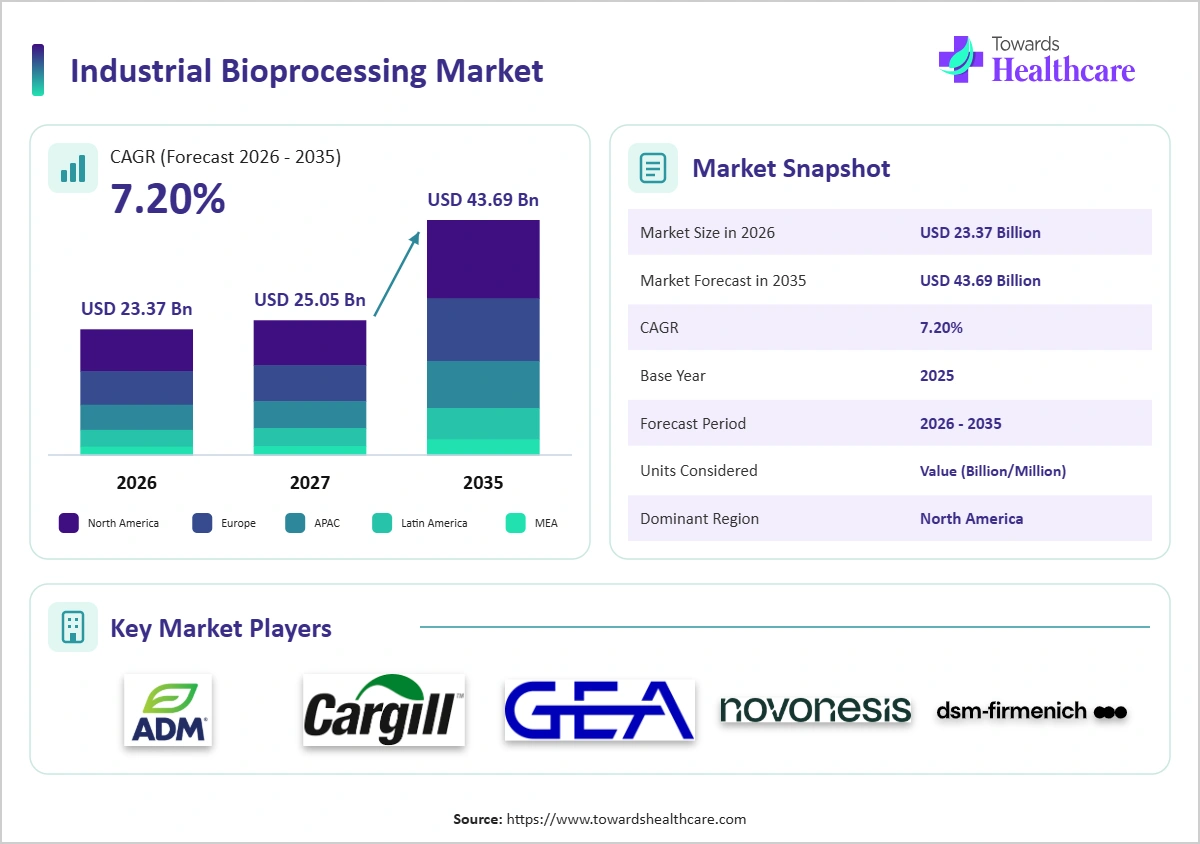
The industrial bioprocessing market is expected to expand from USD 21.80 billion in 2025 to USD 43.69 billion by 2035, driven by the transition of bioprocessing technologies from laboratory research to commercial-scale manufacturing. Government support for biomanufacturing and rising investment in production infrastructure are increasing spending on equipment and contract services. Capacity expansion and growing demand for bio-based products are expected to take the market to USD 30.86 billion by 2030, supporting a CAGR of 7.20% from 2026 to 2035.
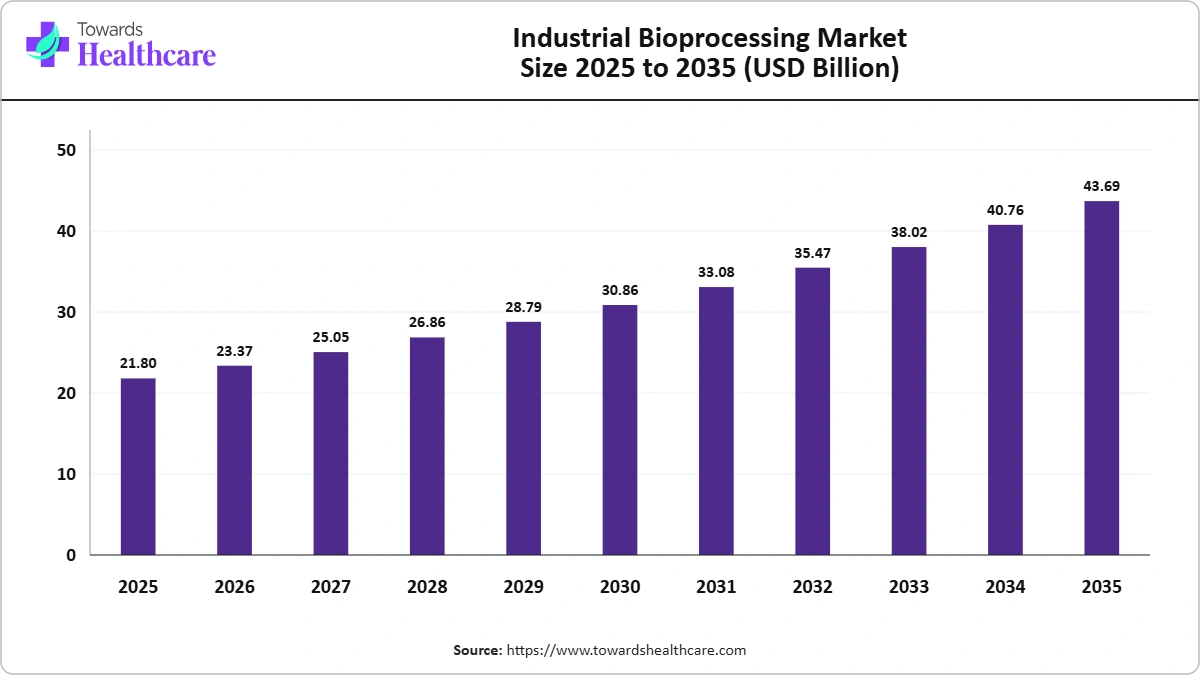
Analyst View: The market estimate was developed using fermentation capacity additions, equipment pricing, consumables consumption, and contract manufacturing fees. These estimates were cross-checked against company revenues to improve the reliability of the market assessment.
The industrial bioprocessing market is expanding as companies scale fermentation for enzymes, chemicals, food ingredients, and fuels. Lack of commercial-scale capacity is a key bottleneck, which CDMOs are addressing.
| Driver | Impact | ≈ CAGR Contribution | Time Horizon | Key Regions |
| Bio-based products | High | +2.81 pp | Short to long term | Global, strongest in North America |
| Precision fermentation | Medium | +2.37 pp | Medium to long term | Global, fastest uptake in Asia Pacific |
| Enzyme demand | Medium | +2.02 pp | Short to medium term | Global |
| Government support | Low | +1.58 pp | Long term | Developed and emerging markets |
Note: Contributions are indicative estimates of each factor's effect on annual growth.
Sources: Expert interviews, secondary sources, Towards Healthcare database and Towards Healthcare analysts.
Bio-based products, precision fermentation and government support drive most growth in the industrial bioprocessing market.
| Restraint | Impact | ≈ Negative CAGR Contribution | Time Horizon | Key Regions |
| High production cost | High | -0.71 pp | Short to medium term | Global |
| Capacity shortage | High | -0.52 pp | Medium term | Price-sensitive and emerging markets |
| Regulatory approval | Medium | -0.35 pp | Short term | North America and other mature markets |
Note: Contributions are indicative estimates of each factor's effect on annual growth.
Sources: Expert interviews, secondary sources, Towards Healthcare database and Towards Healthcare analysts.
High production cost is the main restraint, followed by capacity shortage and regulatory approval.
Contract Manufacturing
Start-ups and emerging biotechnology companies often rely on rented fermentation capacity to scale production without investing in their own manufacturing facilities. Contract manufacturing providers offer access to larger production infrastructure, helping these companies move from pilot-scale development to commercial manufacturing while managing capital expenditure.
Asian Manufacturing
China and India are expanding their industrial fermentation capabilities through investments in biomanufacturing infrastructure and production capacity. Growing demand for bio-based products and the development of large-scale fermentation facilities are strengthening Asia's role in the industrial bioprocessing market.
Waste Valorisation
The use of agricultural residues, food waste, and industrial side streams as fermentation feedstocks can help reduce production costs. These alternative raw materials lower dependence on conventional feedstocks while improving resource efficiency and supporting more sustainable bioprocessing operations.
Note: 2025 is the base year; 2035 shares and CAGRs are forecasts.
Sources: Expert interviews, secondary sources, Towards Healthcare database, and Towards Healthcare analysts.
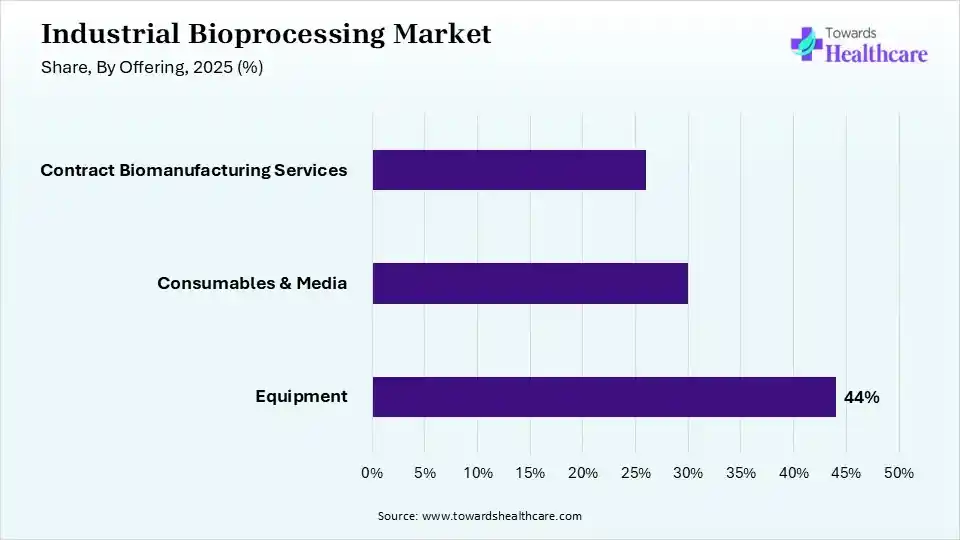
Equipment held the largest offering share at 44.00%. This segment includes fermenters ranging from 10 to 600 cubic metres, centrifuges, and filtration systems supplied by companies such as GEA, Alfa Laval, and Sartorius. Demand is supported by the need for reliable, large-scale production and downstream processing infrastructure.
Consumables & media recurring use in fermentation processes, including microbial growth, nutrient supply, and production scale-up, supports consistent demand across industrial bioprocessing facilities.
Contract biomanufacturing services driven by rising demand for outsourced production capacity. Companies such as Liberation Bioindustries, Laurus Bio, and Acies Bio are expanding precision fermentation capabilities, helping emerging businesses access commercial-scale manufacturing infrastructure.
Industrial enzymes accounted for 28.00% of the market, led by Novonesis. Their growing use in food processing, detergents, animal feed, and biofuel production supports demand, as manufacturers increasingly rely on enzymes to improve process efficiency and product performance.
The bio-based chemicals & materials driven by rising demand for sustainable alternatives to petroleum-based chemicals and conventional materials. Growing interest in renewable feedstocks and environmentally responsible manufacturing is encouraging the adoption of bio-based products.
The food & feed ingredients supported by increasing demand for alternative proteins and sustainable food ingredients. Precision fermentation-derived whey proteins and insect-free feed proteins, including those developed by MicroHarvest, are creating new opportunities for industrial bioprocessing.
Biofuels supported by growing demand for renewable energy and cleaner fuel alternatives. Government initiatives promoting biofuel adoption and efforts to reduce dependence on fossil fuels are encouraging investment in large-scale bioprocessing capacity.
Analyst View: Contract biomanufacturing services and food and feed ingredients are expected to gain market share at a faster pace, supported by growing demand for outsourced production and alternative proteins. Meanwhile, equipment and industrial enzymes are likely to remain the largest market segments, backed by their essential role in large-scale fermentation and industrial production processes.
Note: 2025 is the base year; 2035 shares and CAGRs are forecasts.
Sources: Expert interviews, secondary sources, Towards Healthcare database, and Towards Healthcare analysts.
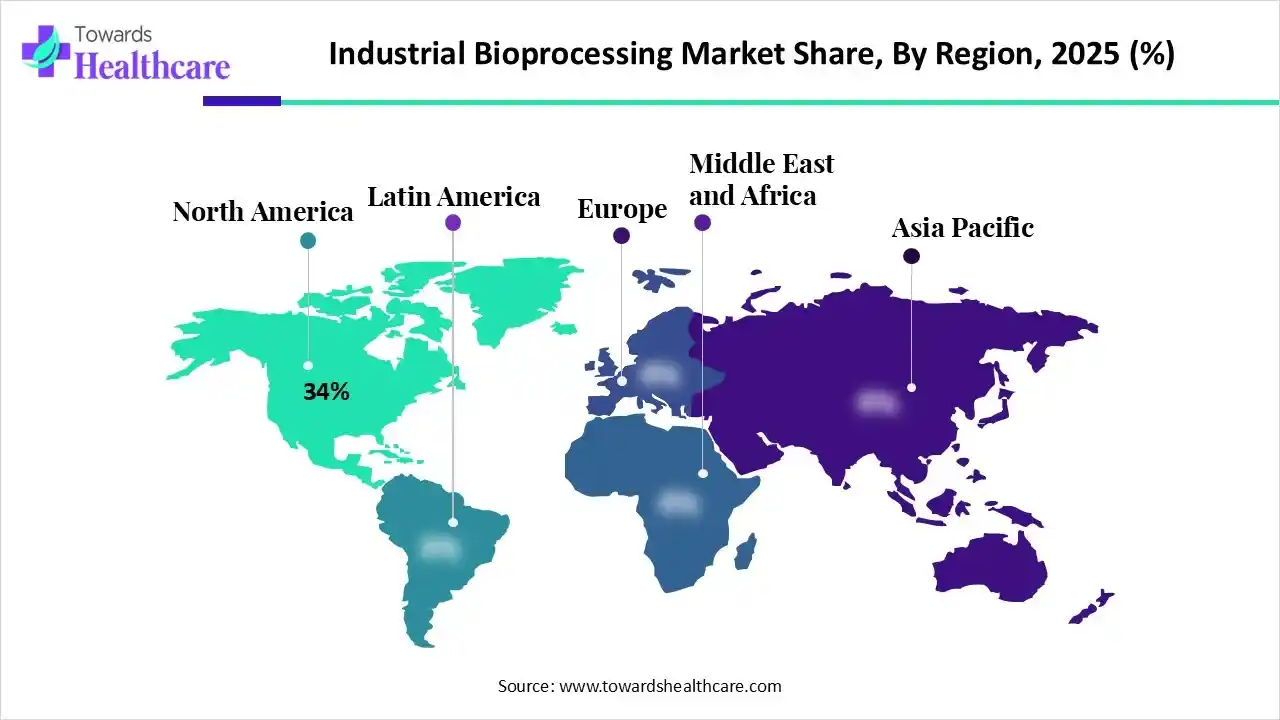
North America held the largest market share of 34.00% in 2025, driven by established ethanol and enzyme production in the U.S. Investments in new precision fermentation facilities, particularly in Indiana, are further strengthening regional capacity.
Europe accounted for 30.00% of the market in 2025, supported by its well-established industrial biotechnology sector. Denmark's Novonesis, developments in the Netherlands, and new facilities in Germany and Slovenia are driving biomanufacturing activity.
Asia Pacific China's established fermentation industry and India's supportive biomanufacturing policies are driving investments in production capacity.
Latin America with Brazil leading regional activity through its established sugarcane-based fermentation industry. The availability of sugarcane feedstock supports bioethanol production and other bio-based applications.
Middle East & Africa region with planned biomanufacturing facilities in Saudi Arabia creating opportunities for future growth. Investments in domestic production infrastructure are expected to support the gradual development of the regional industrial bioprocessing industry.
Analyst View: North America is expected to maintain its leading position, supported by established industrial biotechnology infrastructure and continued investment in ethanol, enzyme, and precision fermentation production. Meanwhile, Asia Pacific is projected to grow at the fastest pace, driven by expanding fermentation capacity in China and supportive biomanufacturing policies in India.
| Rank | Company Name | 2025 Share (%) | Key Products / Business | Headquarters |
| 1 | Novonesis | 9.00% | industrial enzymes and microbes | Denmark |
| 2 | DSM-Firmenich | 5.00% | fermentation ingredients | Switzerland |
| 3 | ADM | 4.00% | fermentation and bio-based products | United States |
| 4 | Cargill | 4.00% | fermentation ingredients | United States |
| 5 | GEA Group | 3.00% | fermentation and separation equipment | Germany |
| 6 | Alfa Laval | 3.00% | separation equipment | Sweden |
| 7 | Sartorius | 2.00% | bioprocess equipment | Germany |
| 8 | Cathay Biotech | 2.00% | bio-based polyamides | China |
| 9 | Amyris (Barra Bonita) | 1.00% | precision fermentation plant | Brazil |
| 10 | Liberation Bioindustries | 1.00% | contract precision fermentation | United States |
Note: Company shares are 2025 estimates.
Sources: Company press releases, expert interviews, secondary sources, Towards Healthcare database and Towards Healthcare analysts.
Novonesis led the industrial bioprocessing market with an estimated 9.00% revenue share in 2025, followed by DSM-Firmenich at 5.00% and ADM at 4.00%. Novonesis maintains its position through its industrial enzyme and microbial solutions, while DSM-Firmenich focuses on fermentation ingredients and ADM offers fermentation-based and bio-based products. Other key players include Cargill, GEA Group, Alfa Laval, Sartorius, Cathay Biotech, Amyris (Barra Bonita), and Liberation Bioindustries, competing across fermentation ingredients, bioprocessing equipment, separation systems, bio-based materials, and contract manufacturing services.
The top 10 companies collectively accounted for an estimated 33.99% of market revenue in 2025, while the remaining 66.01% was distributed among numerous fermentation CDMOs and equipment suppliers. The market remains fragmented, with competition centred on production scale, cost efficiency, downstream processing capabilities, feedstock availability, and access to manufacturing capacity.
Novonesis, headquartered in Denmark, held an estimated 9.00% share of the industrial bioprocessing market in 2025. Its strong position is supported by its portfolio of industrial enzymes and microbial solutions. The company is positioned as a Leader in the Towards Healthcare Companies Quadrant.
DSM-Firmenich, based in Switzerland, accounted for approximately 5.00% of market revenue in 2025. Its presence is primarily supported by fermentation-derived ingredients for various industrial applications.
Headquartered in the United States, ADM held an estimated 4.00% market share in 2025. Its portfolio includes fermentation-based and bio-based products, supporting its presence across industrial bioprocessing applications.
Cargill, headquartered in the United States, accounted for an estimated 4.00% market share in 2025. Its fermentation ingredient portfolio supports its participation in the industrial bioprocessing market.
Headquartered in Germany, GEA Group held an estimated 3.00% market share in 2025. Its position is supported by fermentation and separation equipment used in industrial processing operations.
Based in Sweden, Alfa Laval held an estimated 3.00% share of the industrial bioprocessing market in 2025. Its contribution is centred on separation equipment that supports efficient downstream processing.
Sartorius, headquartered in Germany, accounted for approximately 2.00% of market revenue in 2025. Its presence is primarily driven by bioprocess equipment used in fermentation and other biomanufacturing operations.
Cathay Biotech, based in China, held an estimated 2.00% market share in 2025. Its portfolio focuses on bio-based polyamides, supporting the development of bio-based materials through industrial biotechnology.
Amyris (Barra Bonita), operating from Brazil, held an estimated 1.00% market share in 2025. Its presence in the market is associated with precision fermentation infrastructure and production capabilities. The company is positioned as an Innovator.
Headquartered in the United States, Liberation Bioindustries accounted for approximately 1.00% of market revenue in 2025. Its business focuses on contract precision fermentation, providing production capabilities for companies developing bio-based products.
The industrial bioprocessing ecosystem links strain developers, equipment suppliers, biomanufacturers & CDMOs, feedstock suppliers and brands & industrial users, with each stage adding value before products reach end users. Bioprocessing uses cell culture media and probiotics strains in some food applications.
| Ecosystem Stage | Role in the Market | Key Companies |
| Strain Developers | Engineer microbes | Ginkgo, start-ups |
| Equipment Suppliers | Supply fermenters and DSP | GEA, Alfa Laval, Sartorius |
| Biomanufacturers & CDMOs | Run fermentation | Novonesis, Liberation, Laurus Bio |
| Feedstock Suppliers | Provide sugars | Sugar and starch processors |
| Brands & Industrial Users | Buy products | Food, chemical and fuel companies |
Sources: Company press releases, expert interviews, secondary sources, Towards Healthcare database, and Towards Healthcare analysts.
Strain Developers: Microbial strain performance plays a key role in production economics. Higher yields improve output, reduce input requirements, and lower the overall cost of fermentation.
Equipment Suppliers: Large stainless-steel tanks, fermenters, and downstream processing systems form the backbone of industrial bioprocessing facilities. Equipment suppliers support manufacturers in scaling production and improving process efficiency.
Biomanufacturers & CDMOs: Contract manufacturers provide production capacity to companies that lack their own facilities. However, limited access to large-scale fermentation infrastructure can delay commercialization, particularly for start-ups.
Feedstock Suppliers: Feedstock availability and pricing directly influence fermentation costs. Suppliers of sugars, agricultural residues, and other biological raw materials play an important role in maintaining cost-efficient production.
Brands & Industrial Users: Industrial users and consumer brands support market expansion through long-term offtake agreements. These commitments provide manufacturers with greater revenue visibility and help secure financing for new production facilities.
Value in the industrial bioprocessing market flows from upstream material and technology suppliers to manufacturers and service providers, then through distribution partners to end users. Companies that integrate several stages or build long-term relationships with end users capture a larger share of this value.
The Towards Healthcare Companies Quadrant positions key participants in the industrial bioprocessing market by market strength, reflecting revenue scale, market share and geographic reach, and by innovation and growth strategy, reflecting product portfolio breadth, R&D intensity and partnerships. Positions reflect each company's estimated 2025 share of the industrial bioprocessing market and our assessment of its product innovation, portfolio breadth and partnerships.
Sources: Company press releases, expert interviews, secondary sources, Towards Healthcare database and Towards Healthcare analysts.
Leaders: Novonesis, DSM-Firmenich, ADM, Cargill, GEA Group and Alfa Laval combine high market share with broad portfolios and strong innovation.
Innovators: Sartorius, Cathay Biotech, Amyris (Barra Bonita) and Liberation Bioindustries bring newer technologies and specialised products.
By Offering
By Product
By Region
The industrial bioprocessing market was defined as bioprocessing for industrial (non-pharmaceutical) products, including bioreactors and fermenters, downstream separation and purification equipment, consumables and media, and contract biomanufacturing services, used to make industrial enzymes, bio-based chemicals and materials, food and feed ingredients including precision fermentation proteins, and biofuels.
The 2025 base year was built bottom-up from demand volumes and average prices by offering, product, and region, and checked top-down against the market-specific revenues of leading companies and public industry data. Segment, regional and company values were allocated from offering and product and region demand. Key estimates were verified by cross-checking company disclosures, regulatory and industry data, and published third-party estimates, and inputs that could not be reconciled were excluded. All segment, regional and company figures were reconciled to the same 2025 base year, and the 2026-2035 forecast, which applies a constant CAGR from the 2025 base, was recalculated and validated.
Analyst View: We expect the industrial bioprocessing market to grow steadily. Precision fermentation economics remain challenging, and many start-ups depend on contract capacity, but government bioeconomy programmes support investment.