
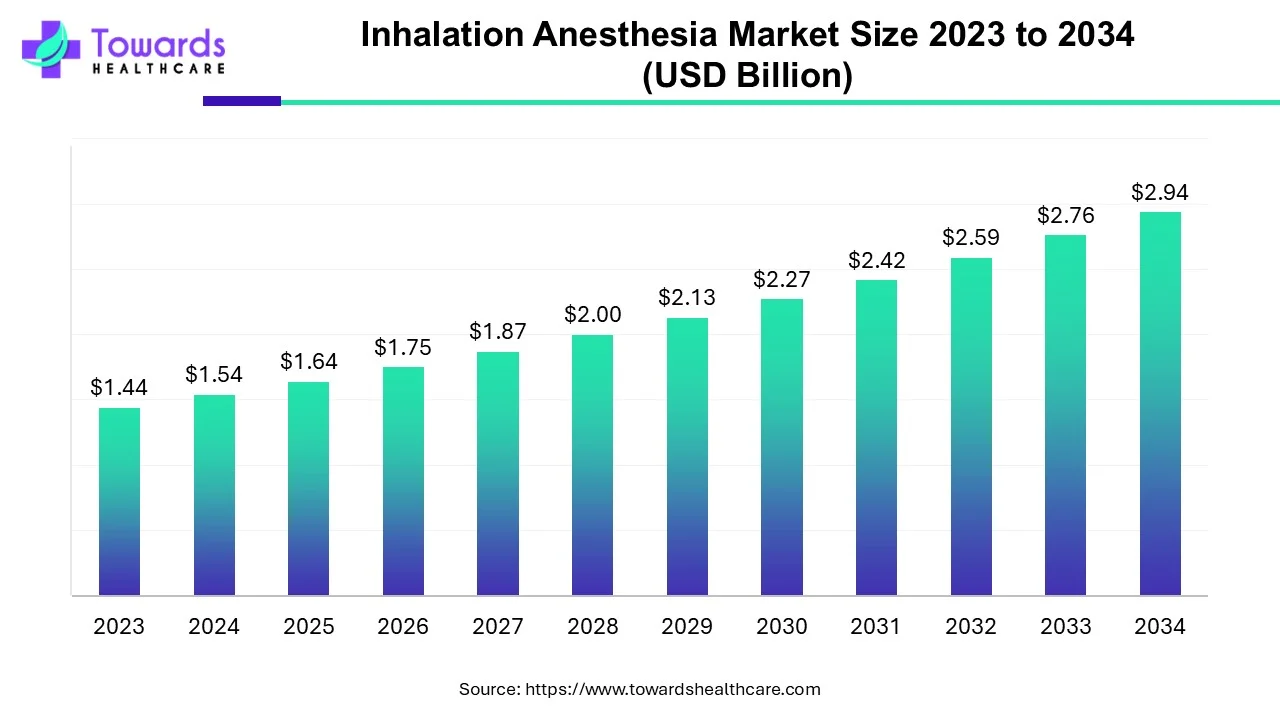
The global inhalation anesthesia market size was calculated at USD 1.64 billion in 2025, grew to USD 1.75 billion in 2026, and is projected to reach around USD 2.94 billion by 2034. The market is expanding at a CAGR of 6.69% between 2025 and 2034. The increasing number of surgeries, growing research and development activities, and favorable government policies drive the market.
Inhalation anesthesia refers to drugs used to induce or maintain general anesthesia in a patient. They are administered through a face mask, laryngeal mask airway, or tracheal tube connected to an anesthetic vaporizer and an anesthetic delivery system. Some common examples of currently used inhalation anesthesia include nitrous oxide, halothane, isoflurane, desflurane, and sevoflurane. They are called volatile anesthetics as they are liquid at room temperature and are administered using vaporizers. They are delivered to patients in an operating room or ICU for sedation, refractory bronchospasm, and control of status epilepticus unresponsive to anticonvulsant medications.
The increasing number of surgeries globally necessitates the use of inhalation anesthesia, and the demand for shorter hospital stays also increases the demand for it. The growing research and development of novel and advanced drug delivery systems boost the market. The advent of advanced technology also favors the development of novel drug delivery systems. Favorable government policies and increasing investments augment market growth.
Artificial intelligence (AI) has proved its potential in the healthcare sector. Hence, numerous healthcare professionals are investigating the role of AI in the field of anesthesia. AI can predict the outcomes of inhalation anesthesia in patients, thereby improving patient outcomes. AI can also suggest the type of inhalation anesthesia to be administered and the appropriate dosing regimen. Thus, AI can assist anesthesiologists in enhancing efficiency, making more informed decisions, and reducing costs. AI can also help to monitor a patient’s vital signs during surgery. Moreover, AI and machine learning (ML) aid in developing novel drug delivery systems for administering inhalation anesthetics. Digital displays and sensors can monitor the amount of anesthesia delivered to the patient. Hence, AI can revolutionize the market by providing better outcomes and reducing manual errors.
The inhalation anesthesia market comprises volatile anesthetic agents and delivery systems used to induce and maintain general anesthesia during surgical and medical procedures. The market is growing due to the rising volumes of surgeries, increasing demand for controlled anesthesia, and expansion of surgical care worldwide. A major trend is the adoption of low-flow anesthesia techniques that can reduce anesthetic consumption and improve operating-room efficiency. Technological advancements in anesthesia machines, vaporizers, monitoring systems, and automated gas-delivery technologies. Growing healthcare infrastructure, increasing adoption minimally invasive procedures, and the need for efficient perioperative care are key market drivers. Future opportunities include environmentally sustainable anesthetic technologies, advanced monitoring systems, and digitally connected anesthesia technologies, advanced monitoring systems, and digitally connected anesthesia platforms. Integration of real-time patient data, automated drug delivery, and decision-support technologies is expected to further improve anesthesia management while supporting safer and more efficient surgical workflows.
Driver
Increasing Number of Surgeries
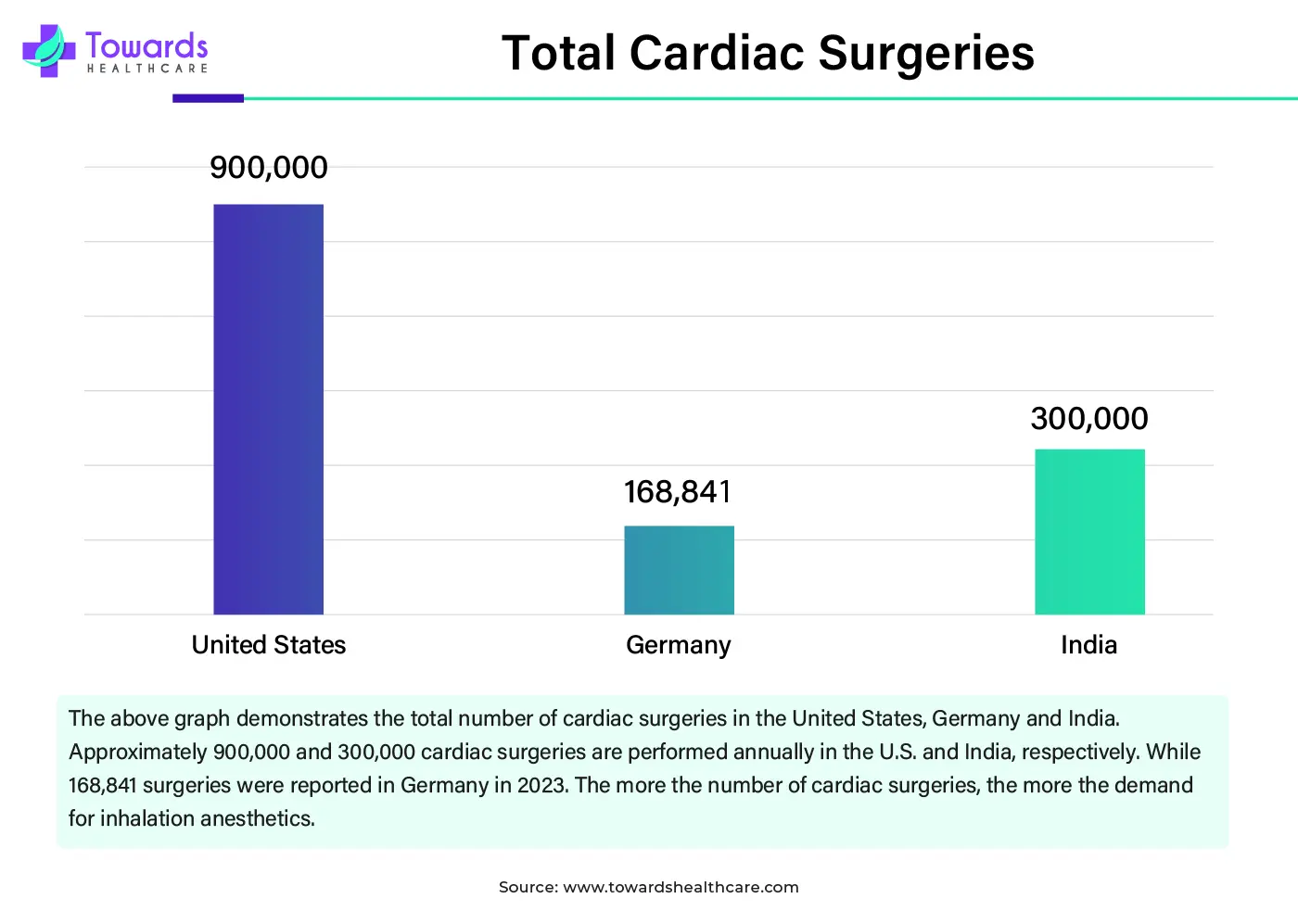
The major growth factor in the inhalation anesthesia market is the increasing number of surgeries leading to the growing demand for inhalation anesthesia. More than 320 million surgeries are estimated to be performed every year globally. The increasing number of surgeries is mainly due to the rising prevalence of chronic disorders such as cancer and cardiovascular disorders. Additionally, the growing geriatric population has led to an increasing number of surgeries. The geriatric population is more prone to numerous types of chronic disorders. The United Nations reported that the proportion of older people, i.e., 65 years and above, was 3.7% in the least developed countries, 9% in developing countries, and 20% in developed nations in 2023. The increasing number of road accidents also leads to several major and minor surgeries. According to the World Health Organization, around 20-50 million people suffer from road accidents with non-fatal injuries.
Restraint
Environmental Sustainability and Lack of Anesthesiologists
The major challenges of the market are environmental sustainability and lack of anesthesiologists. The growing demand for sustainability reduces the use of inhalation anesthesia (desflurane) as they are greenhouse gases. It is found that only 5% of inhalation anesthesia is absorbed by a patient’s body, while the rest is released into the atmosphere and can linger for years, warming the planet. On the other hand, several underdeveloped and developing countries lack skilled anesthesiologists, which hinders market growth.
Opportunity
Recent Advancements
The future of the inhalation anesthesia market is promising with the recent advancements in inhalation anesthesia delivery. Several researchers are currently developing novel drug delivery systems to automate the delivery of inhalation anesthesia. The growing environmental concern demands the development of novel devices that reduce the release of harmful inhalation anesthetics into the atmosphere, reducing the wastage of gases. These recent advancements are driven by the latest technological evolution. Integrating AI in virtual reality and augmented reality technologies enables the training of anesthesiologists. This helps them deal with complex procedures and emergency scenarios. Scientists are researching extended applications of traditional inhalation anesthetics in treating chronic disorders.
| Table | Scope |
| Market Size in 2025 | USD 1.64 Billion |
| Projected Market Size in 2034 | USD 2.94 Billion |
| CAGR (2025 - 2034) | 6.69% |
| Leading Region | North America by 53% |
| Historical Data | 2020 - 2023 |
| Base Year | 2024 |
| Forecast Period | 2025 - 2034 |
| Measurable Values | USD Millions/Units/Volume |
| Market Segmentation | By Drug Type, By Application, By End User, By Region |
| Top Key Players | AbbVie, Inc., Baxter International, Fresenius SE & Co., Halocarbon Products Corporation, Hikma Pharmaceuticals, Kent Scientific Corporation, Midmark Corporation, Novartis AG, Nysora, Piramal Pharma Ltd., Sandoz International, Sedana Medical AB, Vero Biotech |
By drug, the sevoflurane segment held a dominant presence in the inhalation anesthesia market in 2025. Sevoflurane is a nonflammable, sweet-smelling inhalation anesthetic used to induce and maintain general anesthesia. It is widely used for pediatric patients due to its rapid and pleasant anesthetic action. It also has a faster recovery time and response to commands. It is comparatively non-irritating to the airway. Hence, it is widely preferred over desflurane. Apart from these, its affordability makes it a suitable choice.
By drug, the desflurane segment is predicted to witness significant growth in the market over the forecast period. Desflurane is used as a maintenance anesthesia in adults and children after receiving other anesthetics. It is preferred because, compared to sevoflurane, it has a faster recovery time and is also well-tolerated as a maintenance anesthetic. Additionally, it has minimal postoperative sequelae, making it a valuable inhalation anesthetic. Desflurane offers faster wash-in and wash-out compared to sevoflurane in morbidly obese patients. All these benefits make desflurane a preferable anesthetic agent.
By application, the maintenance segment held the largest share of the inhalation anesthesia market in 2025. Maintaining an anesthesia state is essential for surgeries where the patient remains unconscious for a longer time while also maintaining respiratory and hemodynamic stability. Maintenance is generally performed by continuous inhalation of anesthetic gases. The increasing number of major surgeries and advancements in delivery systems potentiate the demand for maintenance anesthesia.
By application, the induction segment will gain a significant share of the market over the studied period. Inhalation anesthetics are also used to induce anesthesia in patients before surgery. Sevoflurane is the most commonly used inhalation anesthetic for induction. Inhalation anesthetics have reduced incidences of hypothermia and hypotension as well as lower costs compared to intravenous anesthesia, making it a preferable choice. The segmental growth is attributed to their ability to provide painless, incremental, and well-tolerated induction along with fewer adverse effects and better patient outcomes compared to intravenous anesthetics.
By end-use, the hospitals segment led the global inhalation anesthesia market in 2025. Hospitals possess favorable infrastructure to install anesthesia systems, suitable capital investments, and the presence of skilled anesthesiologists, augmenting the segment’s growth. The increasing number of hospitalizations due to favorable reimbursement policies also boosts the market.
By end-use, the ambulatory surgical centers segment is projected to expand rapidly in the market in the coming years. Ambulatory Surgical Centers (ASCs) are facilities that provide surgical solutions, including diagnostic and preventive solutions, to patients who do not require hospitalization. The increasing number of ASCs increases the demand for inhalation anesthesia. There are more than 9600 active ASCs in the U.S. ASCs are widely preferred as they are cost-effective, have lower infection risk, and the presence of trained professionals.
North America dominated the global inhalation anesthesia market share by 53% in 2025. The rising prevalence of chronic disorders, favorable government policies, and technological advancements drive the market. According to the American Cancer Society, approximately 30,300 stomach cancer cases are estimated in 2025 in the U.S. In Canada, 247,100 people were estimated to be diagnosed in 2024. The presence of key players also contributes to market growth. Key players such as AbbVie, Baxter International, and Vero Biotech hold a major market share in North America. The favorable regulatory frameworks promote the development of novel anesthetics or drug delivery systems. The Food and Drug Administration and Health Canada regulate product approvals in the U.S. and Canada, respectively.
U.S. Growth Supported by Advanced Surgical Care
The U.S. inhalation anesthesia market is significantly growing due to the high volume of surgical procedures, advanced hospital infrastructure, and increasing adoption of minimally invasive surgeries. Strong demand for modern anesthesia delivery and monitoring systems is supporting market expansion. Growing investments in operating-room technologies, improved perioperative care, and the adoption of low-flow anesthesia techniques are further contributing to the increasing use of inhalation anesthesia products.
Canada Expands Through Modern Surgical Care
Canada’s inhalation anesthesia market is notably expanding due to increasing surgical procedures, improving hospital infrastructure, and growing demand for advanced anesthesia management. Wider adoption of minimally invasive surgeries is supporting the need for precise and controlled anesthesia delivery. Investments in modern operating-room equipment, patient monitoring technologies, and improved perioperative care are further supporting market development and the adoption of advanced inhalation anesthesia systems.
Asia-Pacific is expected to grow at the fastest rate in the inhalation anesthesia market during the forecast period. The rising geriatric population, increasing investments, and growing research and development activities drive the market. Favorable government support in China, India, and Japan supports the market growth. Government agencies provide incentives and funding to promote the adoption of inhalation anesthetics. Numerous research institutions and government education bodies organize symposiums and workshops to train anesthesiologists, propelling the market growth. The rising adoption of advanced technologies in Asia-Pacific potentiates the development of advanced drug delivery systems for inhalation anesthetics. Moreover, the presence of suitable manufacturing infrastructure increases foreign direct investments in Asia-Pacific countries to set up manufacturing facilities.
India Grows Through Expanding Surgical Infrastructure
India’s inhalation anesthesia market is significantly growing due to the increasing number of surgical procedures, expansion of hospitals, and improving access to advanced healthcare services. Rising adoption of minimally invasive surgeries is creating greater demand for controlled anesthesia delivery. Investments in modern operating-room infrastructure, anesthesia machines, and patient-monitoring systems are further supporting market development, particularly as healthcare facilities expand their surgical capabilities.
China Expands Through Growing Surgical Capacity
China’s inhalation anesthesia market is notably expanding due to increasing surgical volumes, modernization of healthcare facilities, and broader access to advanced surgical services. Growing adoption of minimally invasive procedures is supporting demand for reliable anesthesia delivery systems. Investments in hospital infrastructure, operating-room equipment, and patient-monitoring technologies are further strengthening market development, while improvements in perioperative care are encouraging the adoption of modern anesthesia solutions.
Brent V. Furse, CEO and President of Vero Biotech, commented on the launch of the Genosyl system that it will provide benefits to the anesthesiology and surgical care communities whose patients require inhaled nitric oxide in the operation room. He also said that the company was successful in addressing unmet needs to facilitate rebreathing anesthesia and providing solutions to neonatal intensive care and the acute care hospital community.
By Drug
By Application
By End-Use
By Region