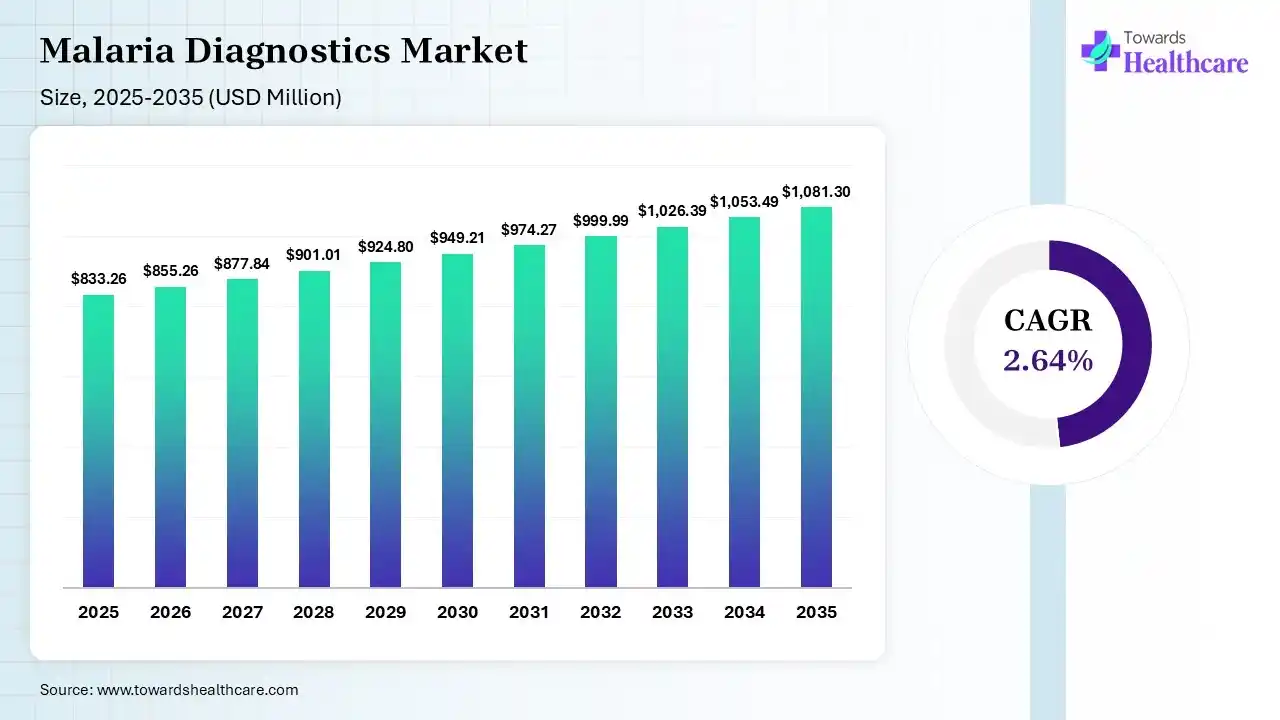
The global malaria diagnostics market size is calculated at USD 833.26 million in 2025, grow to USD 855.26 million in 2026, and is projected to reach around USD 1081.30 million by 2035, rising at a CAGR of 2.64% for the period 2026 to 2035.
Malaria diagnostics is a medical procedure and tool to detect the presence of plasmodium parasites, which cause malaria, in the human body. These diagnostics help confirm the infection and guide proper treatment. The malaria diagnostics market is growing due to the increasing prevalence of malaria in developing countries, which has heightened the need for accurate and timely diagnostics tools. Government and international health organizations are actively promoting awareness programs and initiatives to control the spread of the disease, further boosting demand for diagnostics. Additionally, continued advancements in technology have led to the development of faster and more reliable testing methods. Growing investment in research and development for improved diagnostics solutions also contributes to the market’s expansion. These combined factors are driving the steady growth of the malaria diagnostics market.
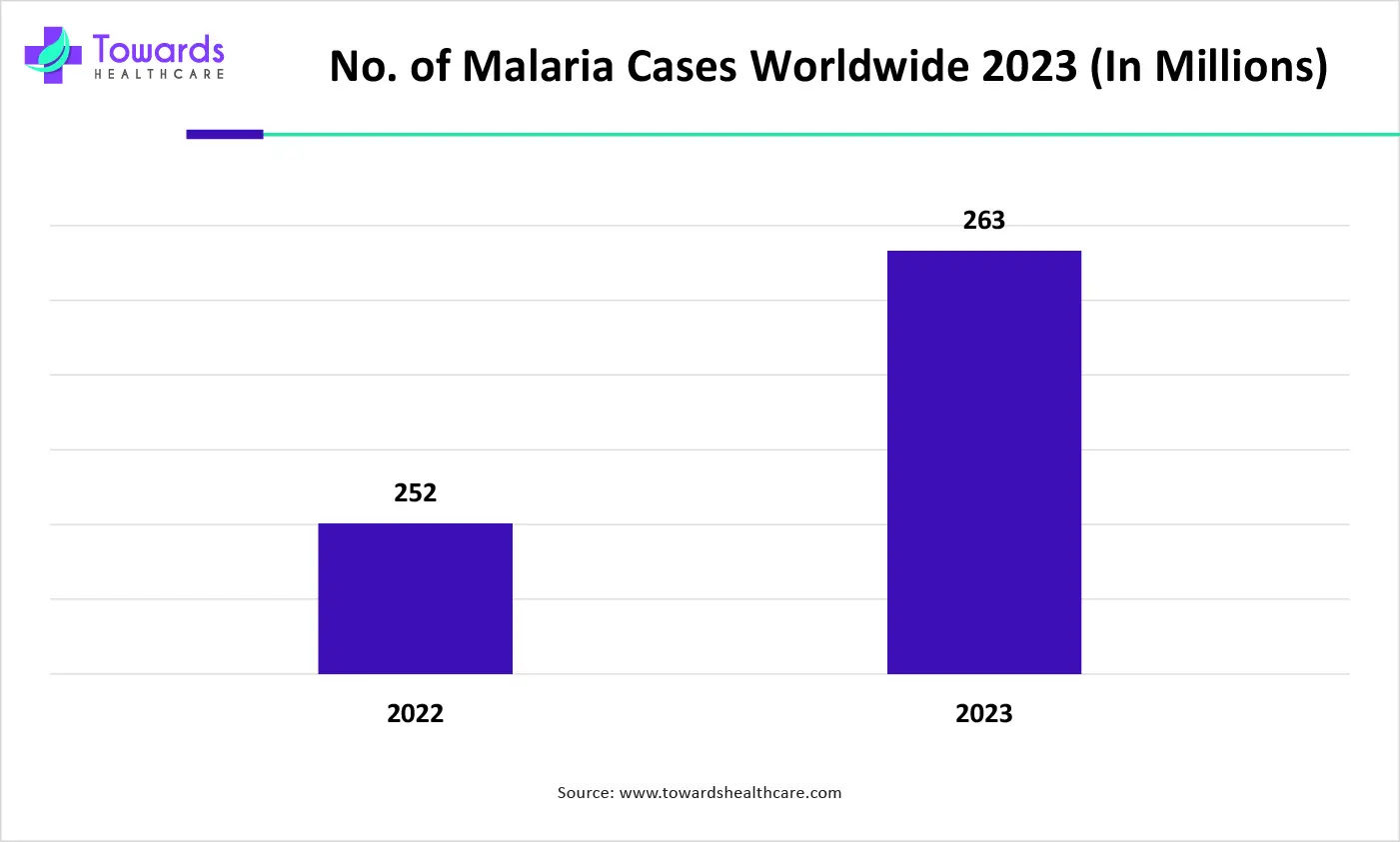
To determine the number of malaria cases and deaths worldwide World Health Organization gives estimates.
Malaria diagnostics refers to technologies and methods used to detect and confirm malaria infections, including microscopy, rapid diagnostic tests (RDTs), and molecular testing. The market is growing as healthcare systems increasingly prioritize early confirmation, appropriate treatments, and stronger disease surveillance. Key trends include greater use of point-of-care testing, improved species identification, and development of tests that address emerging diagnostic challenges. Technological advancements in molecular assays, antigen detection, portable testing platforms, and improved test targets are enhancing diagnostic capabilities. Future opportunities are emerging in remote and underserved regions, elimination programs, outbreak monitoring, and detection of low-density infections. Major growth drivers include the continuing malaria burden, the expansion of testing programs, the need for accessible diagnostics, and increasing focus on identifying infections that conventional tests may miss.
Internal factors such as test accuracy, affordability, product reliability, ease of use, manufacturing capacity, distribution efficiency, and availability of trained personnel influence market development. External factors include malaria prevalence, government disease-control initiatives, healthcare funding, diagnostic policies, climate-related changes in transmission, and access to medical services. Advances in portable, rapid, and molecular testing are creating new growth opportunities, while limited laboratory infrastructure, supply-chain disruptions, regulatory requirements, and differences in healthcare accessibility can restrict adoption. Together, these factors determine how quickly reliable malaria testing reaches patients, particularly in regions where timely diagnosis remains essential.
AI is set to transform malaria diagnostics by enabling faster, more accurate, and affordable detection. Using image recognition, AI can analyze blood samples with high precision, reducing human error and allowing large-scale testing. It also powers mobile-based diagnostic tools, making testing accessible in remote, resource-limited areas. AI-driven solutions lower costs by minimizing the need for specialized labs and staff. Moreover, AI can track real-time data to predict outbreaks and support targeted interventions. When integrated with telemedicine and portable devices, AI enhances diagnostic reach and efficiency, playing a vital role in improving malaria control and prevention worldwide.
Driver
Rising Prevalence of Malaria
The increasing prevalence of malaria, particularly in high-burden countries like Nigeria, the Democratic Republic of Congo, and India, is a key driver of the malaria diagnostics market. As the infection rate increases, there is a greater need for early and accurate diagnosis to ensure timely treatment and prevent the spread of the disease. For instance, India’s National Vector Borne Disease Control Programme promotes the use of rapid diagnostic tests in rural areas. Similarly, WHO-backed initiatives in Africa supply diagnostics kits to remote regions, significantly boosting the demand and growth of the malaria diagnostics market.
Restraint
Lack of Awareness and Healthcare Access
The lack of awareness and limited healthcare access in remote and low-income regions are major restraints in the market. In rural areas of countries like Chad and Myanmar, many people are unaware of the importance of early malaria diagnosis and cannot access healthcare services. Additionally, poor infrastructure, a shortage of trained medical professionals, and limited availability of diagnostic tools further hinder the effectiveness of malaria testing, slowing market growth despite rising infection rates.
Opportunity
Technological Advancement
Technological advancements such as rapid diagnostic tests (RDTs), Loop-Mediated Isothermal Amplification (LAMP), Nucleic acid amplification tests (NAATs), and PCR-based methods are improving detection accuracy, especially in low-resource areas. Additionally, integrated diagnostic tools with telemedicine platforms offer remote consultations and enhanced accessibility. Public-private partnerships, like those between organizations and technology providers, help distribute diagnostic tools to malaria-endemic regions. Furthermore, government initiatives, such as India’s goal to eliminate malaria by 2027, are driving demand for advanced diagnostic solutions, creating a positive outlook for the market.
| Table | Scope |
| Market Size in 2026 | USD 855.26 Million |
| Projected Market Size in 2035 | USD 1081.30 Million |
| CAGR (2026 - 2035) | 2.64% |
| Leading Region | Middle East and Africa |
| Historical Data | 2020 - 2023 |
| Base Year | 2025 |
| Forecast Period | 2026 - 2035 |
| Measurable Values | USD Millions/Units/Volume |
| Market Segmentation | By technology, By end use, By region |
| Top Key Players | Access Bio., Inc., Abbott Laboratories, Premier Medical Corporation Pvt. Ltd., Sysmex Partec GmbH, bioMérieux, Beckman Coulter, Inc., Siemens Healthineers, Leica Microsystems GmbH, Nikon Corporation, Olympus Corporation, Bio-Rad Laboratories, Inc. |
By technology, the rapid diagnostic tests segment held a dominant presence in the malaria diagnostics market in 2025. Rapid diagnostic tests (RDT) are highly portable, user-friendly, and provide quick results within 15-30 minutes, making them ideal for use in remote areas with limited healthcare infrastructure. Their affordability also ensures accessibility in low-resource settings, particularly in malaria-endemic regions. Additionally, RDTs do not require specialized training or laboratory equipment, further increasing their practicality. Support from global health organizations like WHO, which advocate for the widespread use of RDTs in malaria control programs, has significantly contributed to their market dominance.
By technology, the molecular diagnostics segment is anticipated to grow at a significant rate in the malaria diagnostics market during the studied years due to its high accuracy and ability to detect low levels of parasites, including asymptomatic and mixed-species infections. Techniques like PCR and LAMP offer early and precise detection, which is crucial for timely treatment and controlling the spread of the disease. Additionally, integration with emerging technologies such as AI is improving diagnostic efficiency. Support from the government and global health organizations is also promoting the adoption of these advanced methods, especially in regions aiming to eliminate malaria.
By end use, the hospitals and clinics segment held the highest share of the malaria diagnostics market in 2025. In hospitals and clinics, the facilities are well equipped with skilled healthcare professionals and advanced diagnostic tools such as rapid diagnostic tests (RDTs), microscopy, and molecular testing methods, ensuring accurate and timely detection of malaria. Moreover, hospitals and clinics often receive financial and logistical support from government and international health organizations, enabling them to implement effective malaria control programs. Their accessibility, reliability, and comprehensive care dominated the malaria diagnostics market.
By end use, the diagnostics centers segment grows lucratively during the forecast period due to its increasing role in providing specialized, high-accuracy testing. These centers are often equipped with advanced tools like PCR machines and automated analyzers, enabling them to detect even low-level malaria infections. For example, private labs like Thyrocare and SRL Diagnostics in India and Lancet Laboratories in Africa are expanding their presence in semi-urban and rural areas, improving accessibility. With rising health awareness, convenience-driven patient health awareness, and convenience-driven patient preferences, more individuals are opting for these dedicated centers over traditional hospital visits, fueling market growth.
Middle East and Africa held a significant share of the malaria diagnostics market in 2025. Africa is observed to sustain a notable growth rate in the upcoming period due to its significantly high disease burden, accounting for over 90% of global malaria cases and deaths. The widespread prevalence of Plasmodium falciparum, the most severe malaria parasite, created a strong demand for effective diagnostic tools. Rapid Diagnostic Tests (RDTs) gained popularity for their affordability, ease of use, and suitability in remote, resource-limited areas. Additionally, support from the government, international health agencies, and initiatives like the Zero Malaria Agenda played a crucial role in expanding diagnostic access. These factors collectively positioned Africa as the leading region in the global market.
South Africa Malaria Diagnostics Market Trend
South Africa’s market is growing, although the country has made notable progress in malaria control, certain provinces, particularly in the northeast, continue to report cases, creating a sustainable need for accurate diagnostic tools. Government efforts, in partnership with international health organizations, have led to expanded access to diagnostics and treatment. Tests (RDTs) that provide fair and reliable results in low-resource settings are also driving market expansion. Additionally, the integration of advanced molecular diagnostics like PCR and LAMP is enhancing detection accuracy and supporting national surveillance programs.
Saudi Arabia Malaria Diagnostics Market Trend
The market in Saudi Arabia is growing due to increased healthcare investment, government initiatives under Vision 2030, and the need to manage imported malaria cases. Although not malaria-endemic, the country faces risks from international travel and migration. This drives demand for accurate diagnostic tools like rapid diagnostics tests and molecular diagnostics. Technological advancements, improved disease surveillance, and the integration of guide health solutions further support growth. Saudi Arabia’s proactive health strategy and commitment to strengthening public health infrastructure continue to boost the market for malaria diagnostics.
Asia-Pacific is anticipated to grow at a significant rate in the market during the forecast period due to its high malaria burden, particularly in countries such as India, Indonesia, and Myanmar. The rising prevalence drives strong demand for effective and rapid diagnostic tools. Government initiatives aimed at malaria elimination, along with support from global health organizations like WHO, are further accelerating market growth. Additionally, increasing healthcare expenditure and growing awareness about early diagnostics technologies are enhancing the region's capacity to manage malaria.
The India Malaria Diagnostics Market Trends
India’s market is expanding due to a high disease burden, especially in rural and tribal regions where access to healthcare is limited. With around 95% of the population living in malaria-endemic areas, there is a strong need for effective and accessible diagnostic solutions. The Indian government has set a target to eliminate malaria by 2030 and is actively investing in improved diagnostic infrastructure and surveillance systems. Technological advancements like rapid diagnostic tests and molecular techniques such as PCR have enhanced early detection. Additionally, increased involvement from private sector players further supports market growth.
Strengths
Weaknesses
Opportunities
Threats
In December 2024, the World Health Organization (WHO) prequalified the first diagnostic test for detecting glucose-6-phosphate dehydrogenase (G6PD) deficiency, a key step in safely treating Plasmodium vivax malaria and preventing relapse. This milestone supports broader access to reliable diagnostic tools and highlights WHO’s commitment to global health equity. With around 500,000 malaria deaths annually—mostly among children—this approval can help countries provide safer, more effective care for P. vivax patients. WHO also encouraged the development and submission of more such tests to expand diagnostic options for malaria-endemic regions.
By Technology
By End Use
By Region




Principal Consultant
Payal Rabde is a Healthcare Market Research Analyst at Towards Healthcare Research & Consulting with 4+ years of experience in pharmaceuticals, biotechnology, medical devices, and life sciences.
Learn more about Payal Rabde

Reviewed By
Aditi Shivarkar is a seasoned professional with over 14 years of experience in healthcare market research. As a content reviewer, Aditi ensures the quality and accuracy of all market insights and data presented by the research team.
Learn more about Aditi Shivarkar