
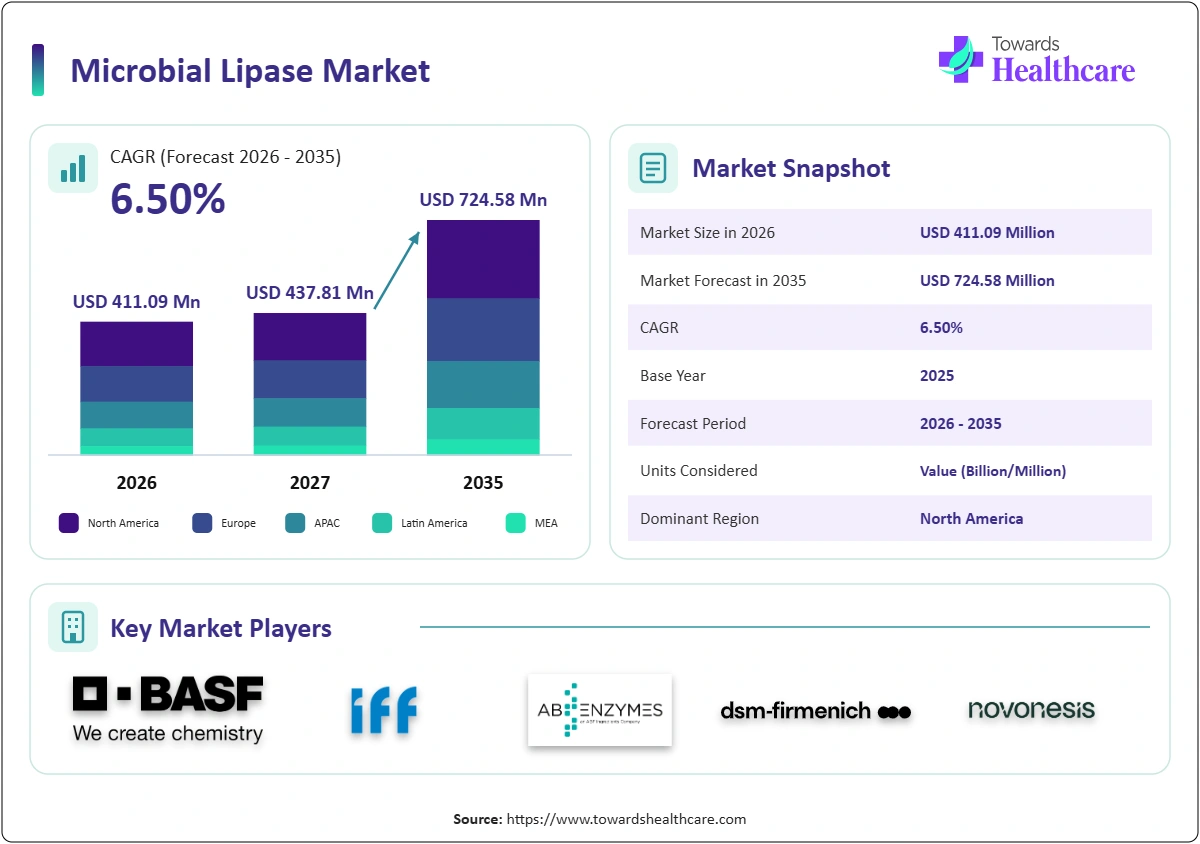
The microbial lipase market is projected to grow from USD 386.00 million in 2025 to USD 724.58 million by 2035 because food, detergent, feed, and oleochemical producers use enzymes instead of chemicals, high temperatures, or animal-derived inputs to process fats and oils. Cold-wash detergents, cheese and bakery processing, enzymatic fat splitting and biodiesel, feed enzymes, and better strains from precision fermentation support steady growth, boosting the market revenue to USD 528.85 million by 2030 and sustaining a CAGR of 6.50% from 2026 to 2035.
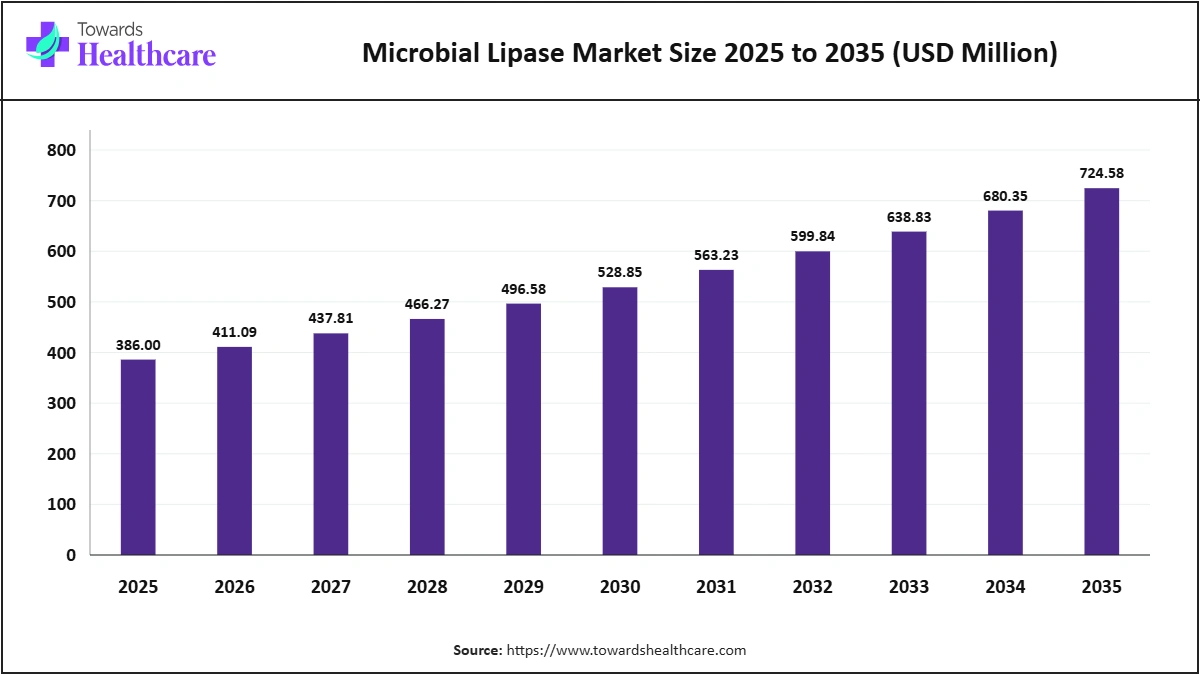 Analyst View: We estimated the market by multiplying microbial lipase volumes across sources, forms, applications, and regions by average enzyme prices, accounting for differences between bulk detergent enzymes and specialty food and pharmaceutical grades. Volume estimates reflect demand from detergent, food, feed, and oleochemical production, while pricing considers formulation and performance. We cross-checked the total against leading producers' enzyme revenues and published estimates, arriving at a base-year estimate slightly above comparable market estimates. The projected growth rate reflects expanding industrial applications and demand for cold-wash detergents, balanced by fermentation costs and price pressures in commodity segments.
The microbial lipase market is driven by growing demand for energy-saving detergents, particularly cold-wash formulations that enable effective grease removal at lower temperatures. Food manufacturers are increasingly adopting microbial enzymes as alternatives to animal-derived enzymes, while industrial processors are shifting toward enzymatic methods to reduce energy consumption. Additionally, rising demand for improved feed digestibility and advancements in microbial strain engineering are supporting enzyme efficiency and reducing production costs.
High fermentation, purification, and downstream processing costs remain key challenges for the microbial lipase market. Enzyme activity can also decline under harsh temperature and pH conditions, limiting performance across certain applications. Furthermore, application-specific performance variations, lengthy regulatory approval processes, and pricing pressure from commodity enzyme manufacturers constrain market expansion and profitability.
Growing applications in oleochemical processing and biodiesel production are creating new opportunities for microbial lipases. Rising demand for structured lipids and specialized ingredients for infant nutrition is further supporting the development of high-performance enzymes. Additionally, expanding pharmaceutical biocatalysis applications, increasing industrial enzyme adoption across Asia Pacific, and advancements in immobilized lipases that enable enzyme recovery and reuse are expected to create further growth opportunities.
Note: 2025 is the base year; 2035 values are forecasts.
Sources: Expert interviews, secondary sources, Towards Healthcare database and Towards Healthcare analysts.
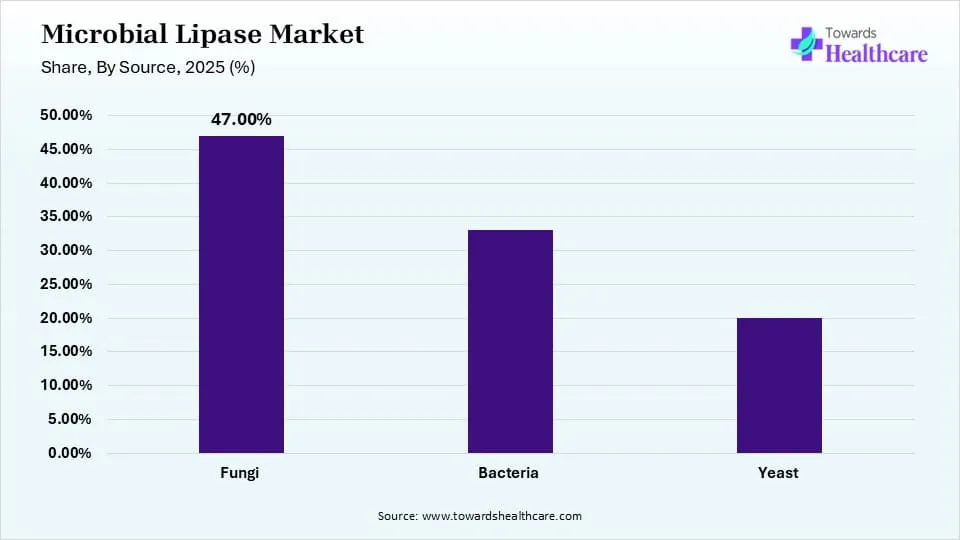
Fungi: This segment accounted for 47.00% (USD 181.42 million) of the microbial lipase market in 2025 and is projected to reach USD 325.90 million by 2035, expanding at a CAGR of 6.03% from 2026 to 2035. Fungal lipases, produced by molds such as Aspergillus, Rhizopus, and Thermomyces, are the largest source because they are made efficiently at an industrial scale and are widely approved for food, detergent, and feed use.
Bacterial lipases, from species such as Bacillus and Pseudomonas, are valued for stability at high temperatures and alkaline conditions, which suit detergents and industrial processes.
High selectivity in the production of structured fats, flavors, pharmaceutical intermediates, and biodiesel positions yeast lipases, particularly those derived from Candida species, as a fast-growing market segment.
Note: 2025 is the base year; 2035 values are forecasts.
Sources: Expert interviews, secondary sources, Towards Healthcare database and Towards Healthcare analysts.
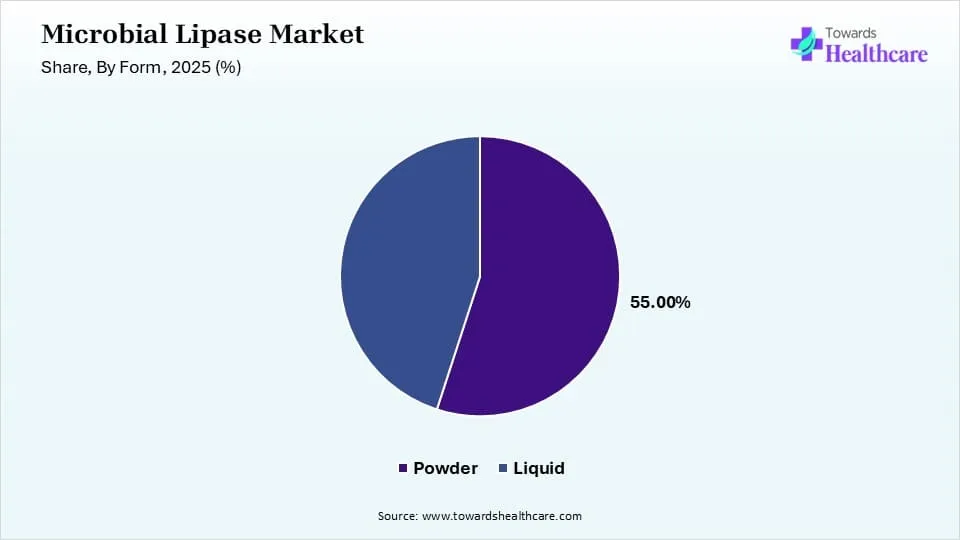
Powder: This segment accounted for 55.00% (USD 212.30 million) of the microbial lipase market in 2025 and is projected to reach USD 371.44 million by 2035, expanding at a CAGR of 5.75% from 2026 to 2035. Powder lipases lead because they are stable in storage, easy to ship, and widely used in powdered detergents, feed premixes, and baking.
Liquid lipases are growing faster because liquid laundry detergents, cold-wash formulations, and continuous food and oleochemical processes need easily dosed liquid enzymes.
Note: 2025 is the base year; 2035 values are forecasts.
Sources: Expert interviews, secondary sources, Towards Healthcare database, and Towards Healthcare analysts.
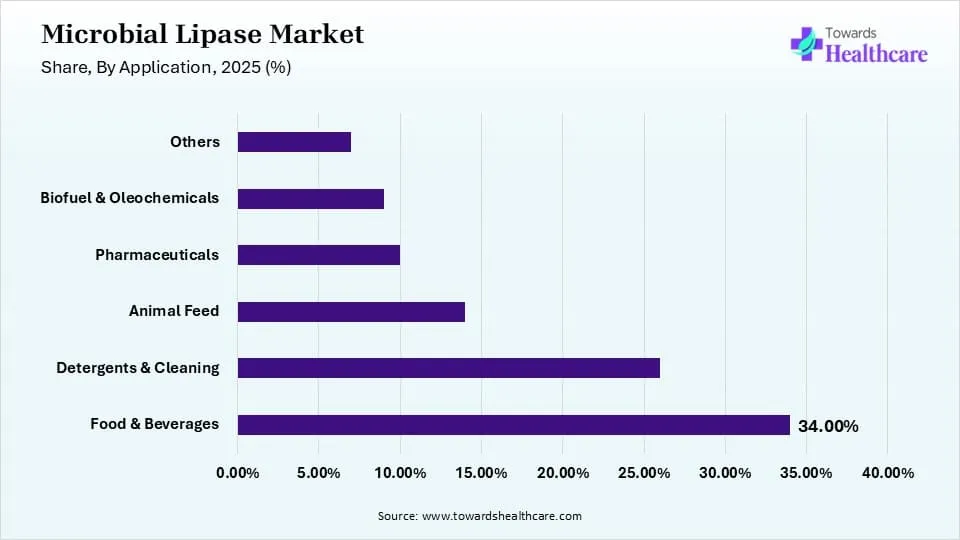
Food & Beverages: This segment accounted for 34.00% (USD 131.24 million) of the microbial lipase market in 2025 and is projected to reach USD 236.35 million by 2035, expanding at a CAGR of 6.06% from 2026 to 2035. Food and beverages are the largest application, covering cheese ripening and flavor, dairy flavors, bakery dough conditioning, oil and fat modification, and structured lipids for infant formula.
Detergents and cleaning use lipases to remove fat and oil stains at low washing temperatures, saving energy.
Biofuel and oleochemicals is the fastest-growing applications because enzymatic fat splitting and enzymatic biodiesel production use far less energy than conventional high-temperature processes.
Analyst View: Segment values were allocated by matching enzyme volumes and prices to sources, forms and applications, using producer portfolios and industry demand. Fungal lipases, powder, and food lead. We expect yeast lipases, liquid forms, and biofuel and oleochemical uses to gain share.
| Region | 2025 Share | 2025 Value (USD Million) | 2035 Value (USD Million) | CAGR 2026-2035 |
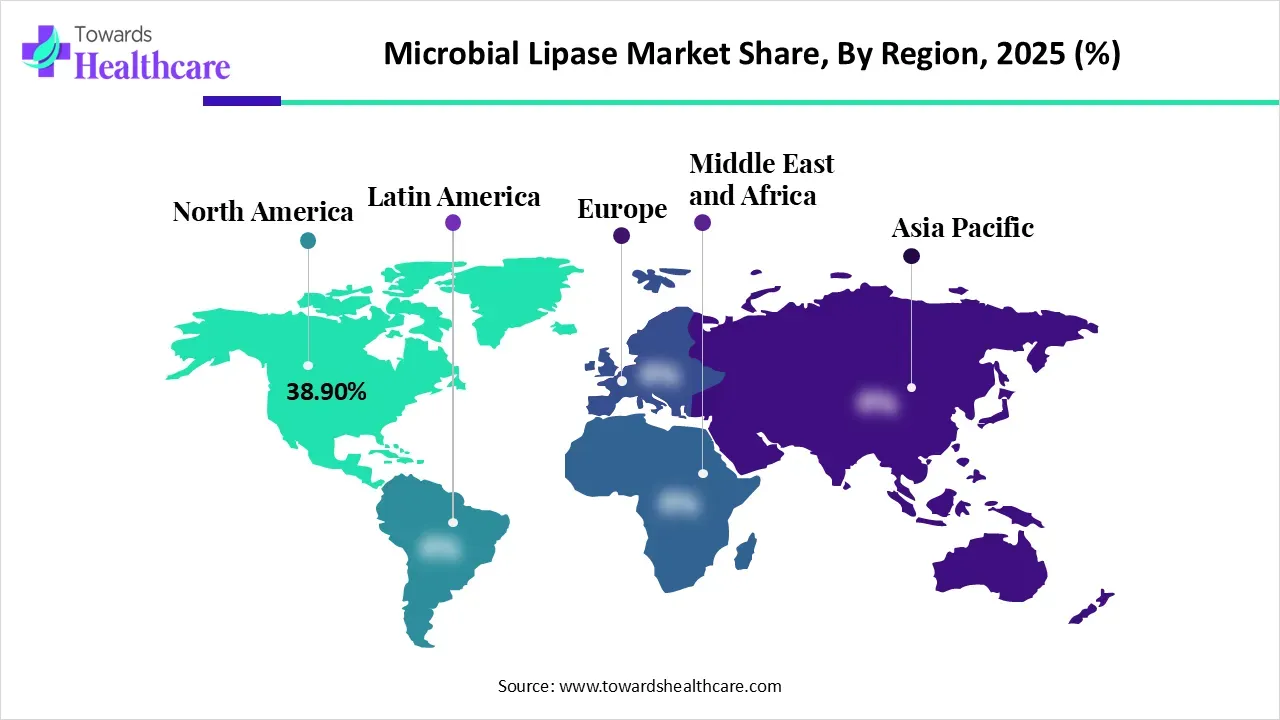
| North America | 38.90% | 150.15 | 263.65 | 5.79% |
| Europe | 28.00% | 108.08 | 197.06 | 6.19% |
| Asia Pacific | 24.00% | 92.64 | 199.83 | 7.99% |
| Latin America | 5.60% | 21.62 | 39.41 | 6.19% |
| Middle East & Africa | 3.50% | 13.51 | 24.63 | 6.19% |
Note: 2025 is the base year; 2035 values are forecasts.
Sources: Expert interviews, secondary sources, Towards Healthcare database and Towards Healthcare analysts.
North America: This region accounted for 38.90% (USD 150.15 million) of the microbial lipase market in 2025 and is projected to reach USD 263.65 million by 2035, expanding at a CAGR of 5.79% from 2026 to 2035. North America is the largest region because of its large food processing, cheese, detergent and feed industries and strong use of enzyme technology.
Europe: With a 28.00% market share (USD 108.08 million) in 2025, Europe is expected to reach USD 197.06 million by 2035, registering a CAGR of 6.19%. Europe has leading enzyme makers such as Novonesis, DSM-Firmenich, BASF, and AB Enzymes, a strong dairy and bakery sector, and demand for energy-saving detergents.
Asia Pacific: This region accounted for 24.00% (USD 92.64 million) of the microbial lipase market in 2025 and is projected to reach USD 199.83 million by 2035, expanding at a CAGR of 7.99% from 2026 to 2035. Asia Pacific is the fastest-growing region because of rising processed food and detergent consumption in China, India and Southeast Asia, growing feed production and enzyme makers in China, Japan and India.
Latin America: Valued at USD 21.62 million, equivalent to a 5.60% market share in 2025, Latin America is projected to reach USD 39.41 million by 2035, growing at a CAGR of 6.19%. Latin America is supported by food processing, feed production and biodiesel in Brazil and Argentina.
Middle East & Africa: This region accounted for 3.50% (USD 13.51 million) of the microbial lipase market in 2025 and is projected to reach USD 24.63 million by 2035, expanding at a CAGR of 6.19% from 2026 to 2035. The Middle East and Africa are supported by growing food processing and detergent demand.
Analyst View: Regional shares were built from enzyme use in each region. North America leads because of its food and detergent industries. We assign Asia Pacific the highest growth premium because food, detergent and feed production are expanding fastest there.
| Rank | Company Name | Market-Specific Revenue (USD Million) | 2025 Share | Key Products / Business | Headquarters |
| 1 | Novonesis | 105.00 | 27.20% | Food, detergent and industrial lipases | Denmark |
| 2 | dsm-firmenich | 40.00 | 10.36% | Food and dairy lipases | Switzerland |
| 3 | BASF | 32.00 | 8.29% | Detergent lipases | Germany |
| 4 | IFF | 30.00 | 7.77% | Food and detergent enzymes | United States |
| 5 | AB Enzymes | 22.00 | 5.70% | Food and feed enzymes | Germany |
| 6 | Amano Enzyme | 22.00 | 5.70% | Food and pharmaceutical lipases | Japan |
| 7 | Kerry | 12.00 | 3.11% | Food enzymes | Ireland |
| 8 | Advanced Enzyme Technologies | 10.00 | 2.59% | Digestive and industrial enzymes | India |
| 9 | Biocatalysts | 6.00 | 1.55% | Specialty enzymes | United Kingdom |
| 10 | Sunson Industry Group | 6.00 | 1.55% | Industrial enzymes | China |
Note: Company revenues and shares are 2025 estimates.
Sources: Company press releases, expert interviews, secondary sources, Towards Healthcare database and Towards Healthcare analysts.
Novonesis led the microbial lipase market with an estimated 27.20% (USD 105.00 million) of 2025 revenue, followed by dsm-firmenich at 10.36% (USD 40.00 million) and BASF at 8.29% (USD 32.00 million). Novonesis, formed from Novozymes and Chr. Hansen, leads with the broadest range of lipases for food, detergents, feed and industrial processes, including Lipura enzymes. dsm-firmenich supplies food and dairy lipases, and BASF offers detergent lipases such as Lavergy L Pace for low-temperature washing. IFF, AB Enzymes, Amano Enzyme, Kerry, Advanced Enzyme Technologies, Biocatalysts and Sunson Industry Group compete through food and detergent enzymes, feed enzymes, pharmaceutical-grade lipases, digestive enzymes and specialty and cost-competitive enzymes.
The top 10 companies garnered 73.83% (USD 285.00 million) of 2025 revenue, while the remaining 26.17% (USD 101.00 million) was shared among many regional enzyme makers and specialty biocatalyst developers. The microbial lipase market is moderately consolidated, with competition driven by enzyme performance, stability, regulatory compliance, production costs, application support, and strategic partnerships. Strain engineering and precision fermentation are key to lowering costs and improving performance.
The microbial lipase ecosystem links strain and fermentation developers with enzyme producers, formulators, industrial users, and regulators.
| Ecosystem Stage | Role in the Market | Key Companies |
| Strain Development | Engineer production strains | Enzyme R&D teams and biotech firms |
| Enzyme Producers | Ferment and purify lipases | Novonesis, dsm-firmenich, BASF, AB Enzymes, Amano |
| Formulators | Blend enzymes into products | Detergent, food ingredient and feed premix makers |
| Industrial Users | Use lipases in processing | Dairy, bakery, oleochemical, biodiesel producers |
| Regulators | Approve enzymes | Food safety and chemical regulators |
Sources: Company press releases, expert interviews, secondary sources, Towards Healthcare database and Towards Healthcare analysts.
The Towards Healthcare Companies Quadrant positions key participants in the microbial lipase market by strength, reflecting revenue scale, market share and geographic reach, and by innovation and growth strategy, reflecting product portfolio breadth, R&D intensity and partnerships. Positions reflect each company's estimated 2025 microbial lipase revenue and our assessment of its enzyme innovation, range, and partnerships.
Sources: Company press releases, expert interviews, secondary sources, Towards Healthcare database and Towards Healthcare analysts.
Leaders: Novonesis, dsm-firmenich, BASF, IFF, AB Enzymes and Amano Enzyme combine large lipase revenue with broad enzyme portfolios and strong R&D.
Innovators: Kerry, Advanced Enzyme Technologies, Biocatalysts and Sunson Industry Group bring specialized and high-selectivity lipases.
By Source
By Form
By Application
By Region
The microbial lipase market was defined as lipase enzymes produced by fungi, bacteria and yeast, in powder and liquid forms, worldwide. The 2025 base year was built bottom-up from microbial lipase volumes by source, form, application and region, and average enzyme prices, and checked top-down against the enzyme revenues of leading producers. Segment, regional and company values were allocated from sources, forms, applications, and regional demand. Key estimates were verified by cross-checking company disclosures, regulatory and industry data and published third-party estimates, and inputs that could not be reconciled were excluded. All segment, regional and company figures were reconciled to the same 2025 base year, and the 2026-2035 forecast, which applies a constant CAGR from the 2025 base, was recalculated and validated.
Analyst View: The microbial lipase market is a steadily growing segment of industrial enzymes, as food, detergent, feed and oleochemical producers shift to enzymatic processes. Our estimate links demand to enzyme volumes and prices, so the forecast follows end-industry production and adoption of new enzymatic processes. The main upside comes from oleochemicals and cold-wash detergents, while the main risks are production costs and price pressure.