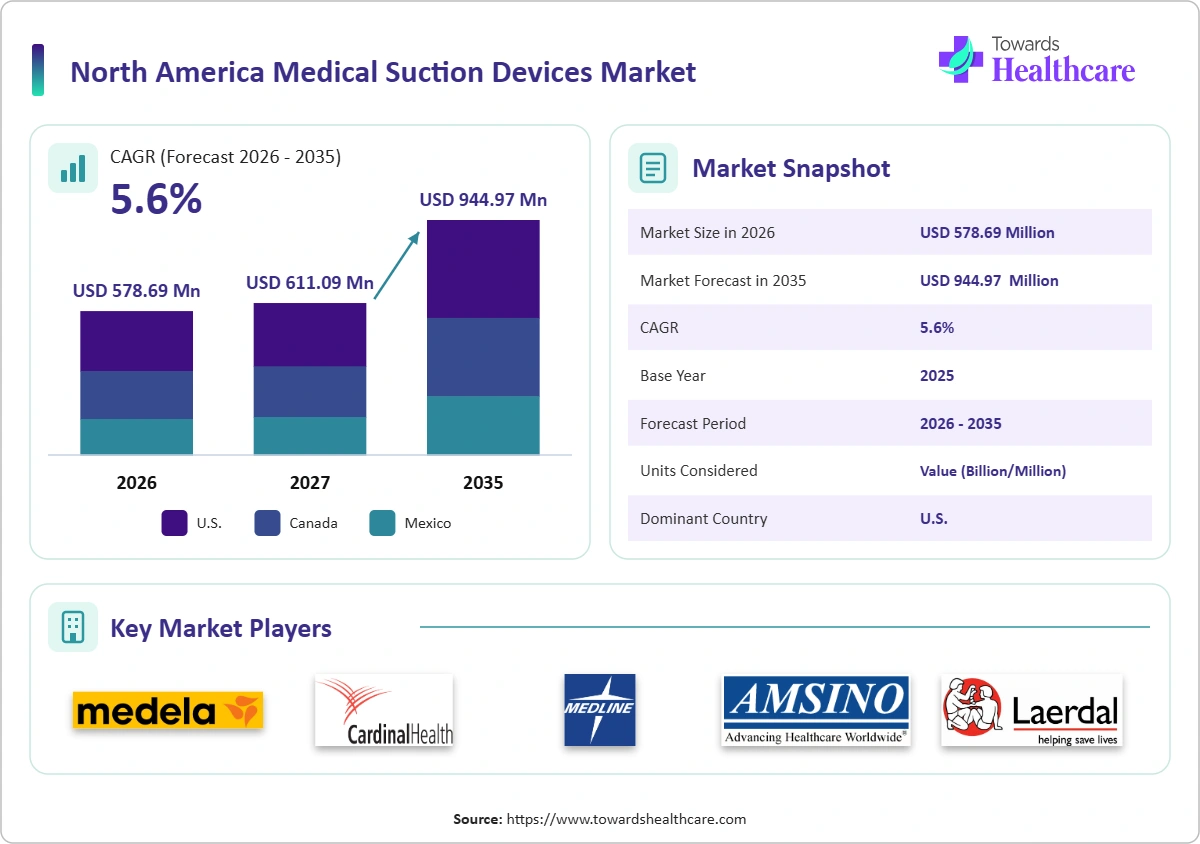
The market is expected to expand from USD 548.00 million in 2025 to USD 944.97 million by the end of the forecast period, driven by the essential role of suction devices in surgical procedures, airway management, and emergency care. Medical suction devices are being increasingly used in home-care settings. Increasing surgical volumes, significant prevalence of respiratory diseases, strong demand for emergency medical services, and rapid home-care adoption support a healthy market growth rate. The market is expected to reach USD 719.61 million by 2030 and register a CAGR of 5.60% over the forecast period.
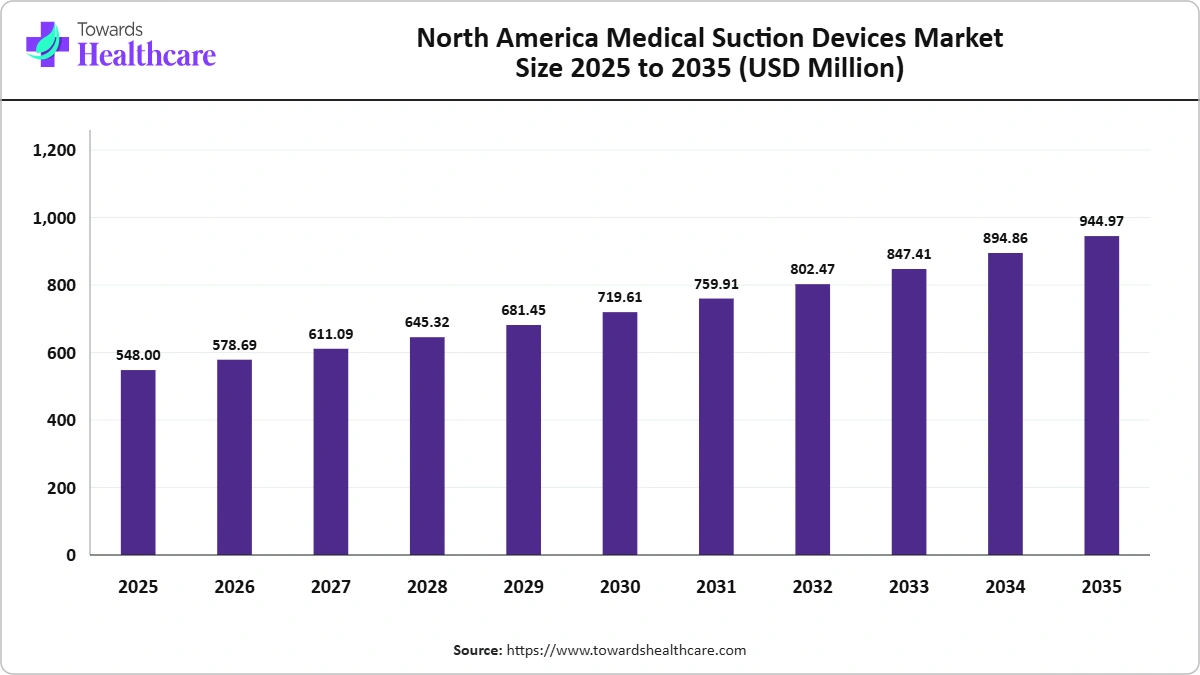
Analyst View: We built the estimate from hospital beds, operating rooms, EMS vehicles, and home patients, with device replacement cycles and consumable use, valued at average prices.
Battery-powered portable units: Lightweight suction devices with longer battery life are being increasingly demanded, which is accelerating the replacement of older models.
Home care suction: Patients with respiratory conditions are increasingly preferring home-care settings for their treatment, supporting demand for home-use suction devices.
Closed suction systems: Closed suction systems are being increasingly used to minimize the risk of infection and improve patient safety.
Infection control canisters: Single-use suction liners are being increasingly preferred as they reduce cleaning requirements and simplify device maintenance.
Lower-cost imports: New market entrants are introducing lower-cost suction devices, which is increasing price competition and expanding affordability.
The market comprises medical equipment and consumables that experience steady demand. Suction devices are widely used in operating rooms, ICUs, ambulances, and increasingly in homes. Older models are being increasingly replaced by battery-powered portable units, and growing infection control requirements fuel the demand for replacement devices, canisters, tubing, and other accessories.
| Driver | Impact | ≈ CAGR Contribution | Time Horizon | Key Regions |
| Surgical and procedure volumes | High | +2.19 pp | Short to long term | North America-wide, strongest in U.S. |
| Respiratory disease | Medium | +1.84 pp | Medium to long term | North America-wide, fastest uptake in Mexico |
| EMS fleet upgrades | Medium | +1.57 pp | Short to medium term | North America-wide |
| Infection control | Low | +1.23 pp | Long term | U.S. and Mexico |
Note: Contributions are indicative estimates of each factor's effect on annual growth.
Sources: Expert interviews, secondary sources, Towards Healthcare database and Towards Healthcare analysts.
Surgical volumes and respiratory disease drive a major proportion of growth in the market, and EMS upgrades and infection control requirements create steady demand.
| Restraint | Impact | ≈ Negative CAGR Contribution | Time Horizon | Key Regions |
| Price competition | High | -0.55 pp | Short to medium term | North America-wide |
| Hospital budgets | High | -0.41 pp | Medium term | Smaller and price-sensitive markets |
| Long device life | Medium | -0.27 pp | Short term | U.S. and other mature markets |
Note: Contributions are indicative estimates of each factor's effect on annual growth.
Sources: Expert interviews, secondary sources, Towards Healthcare database and Towards Healthcare analysts.
Stiff price competition and limited hospital budgets are the key factors that slow down the pace of growth of the market.
Home care: More patients are preferring home-based settings for their chronic treatment, creating the need for portable suction units and related supplies.
Smart regulators: Digital suction regulators with monitoring capabilities have the potential to improve patient safety and support integration with hospital systems.
Mexico: The expansion of the private hospital ecosystem in Mexico creates new demand for medical suction equipment.
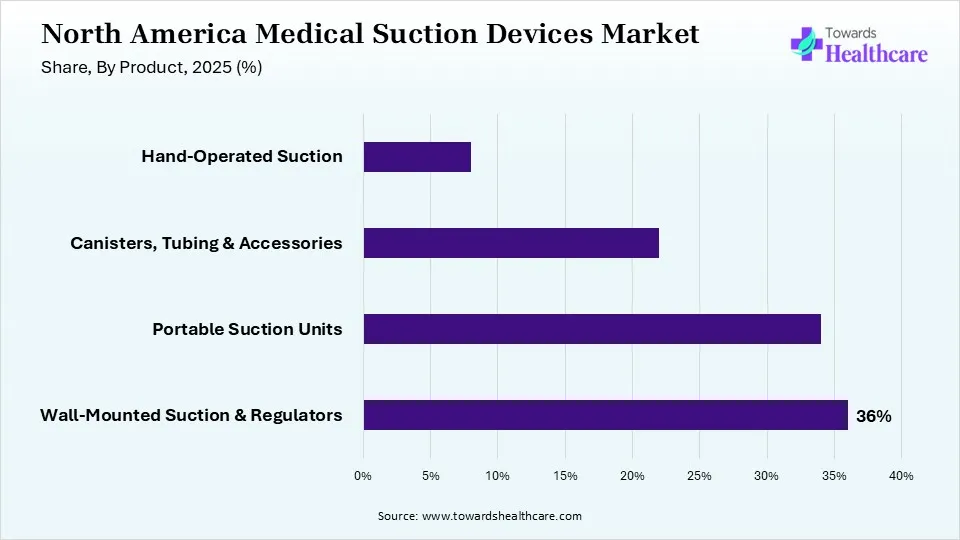
Note: 2025 is the base year; 2035 shares and CAGRs are forecasts.
Sources: Expert interviews, secondary sources, Towards Healthcare database and Towards Healthcare analysts.
Wall-Mounted Suction & Regulators: Wall regulators held 36.00% of value in 2025 because they are installed in operating rooms, ICUs and patient rooms.
Portable Suction Units battery-powered models are being increasingly used in ambulances, hospital transport and home care, and lighter designs are replacing older units.
Canisters, Tubing & Accessories they are used in every procedure and provide steady recurring revenue.
Hand-Operated Suction are used in emergency kits, disaster supplies, and as backup when power failure occurs.
Airway Management accounted for 40.00% of revenue in 2025. Suction is essential during intubation, in ventilated patient care, and in emergency settings.
Surgical: In 2025, Surgical suction captured a 34.00% share. It is used to clear blood and fluids from the operating field in nearly every procedure.
Others: Wound drainage, gastric suction and other uses make up the remaining 26.00% of revenue in the base year.
Hospitals represent the primary end-use base, but home care is expanding at the fastest pace as an increasing number of patients with respiratory conditions are preferring home-based treatment.
Hospitals held 56.00% of the demand in 2025, driven by the use of wall suction systems in operating rooms, ICUs, and patient rooms, and portable units are used for patient transport.
EMS & Pre-Hospital equip ambulances with portable suction units according to their clinical and operational requirements.
Ambulatory Surgical Centres as they perform a significant number of surgical procedures outside traditional hospital settings and suction devices are needed for every procedure.
Home Care: as patients suffering from tracheostomies, ALS and chronic respiratory disease are being increasingly cared for at home.
Analyst View: Portable units and home care are gaining share at the highest rate, while wall suction and hospitals continues to be the core of the market.
Note: 2025 is the base year; 2035 shares and CAGRs are forecasts.
Sources: Expert interviews, secondary sources, Towards Healthcare database and Towards Healthcare analysts.
U.S.: The U.S. held 86.00% of the market in 2025 due to its large hospital base, the presence of a significant number of ASCs and extensive EMS fleets.
In 2025, Canada with key demand drivers being provincial hospital systems and public EMS services.
Mexico is forecast to grow at the fastest CAGR of 7.08% throughout the forecast period, owing to expansion of private hospital chains.
Analyst View: The U.S. led the market and Mexico is growing at the highest rate as private hospitals add capacity.
| Rank | Company Name | 2025 Share (%) | Key Products / Business | Headquarters |
| 1 | Medela | 12.00% | Surgical and airway suction | Switzerland |
| 2 | Laerdal Medical | 8.00% | LSU portable suction | Norway |
| 3 | Cardinal Health | 8.00% | Yankauer and suction consumables | United States |
| 4 | ZOLL Medical (Asahi Kasei) | 7.00% | Portable suction | United States |
| 5 | Drive DeVilbiss Healthcare | 7.00% | Home suction | United States |
| 6 | Medline Industries | 7.00% | Suction canisters and units | United States |
| 7 | Allied Healthcare Products | 6.00% | Gomco suction | United States |
| 8 | SSCOR | 5.00% | Portable suction | United States |
| 9 | Precision Medical | 4.00% | Suction regulators | United States |
| 10 | Amsino International | 3.00% | Suction devices | United States |
Note: Company shares are 2025 estimates.
Sources: Company press releases, expert interviews, secondary sources, Towards Healthcare database and Towards Healthcare analysts.
Medela led the market with a 12.00% share in 2025, followed by Laerdal Medical at 8.00% share and Cardinal Health at 8.00% share. Medela leads owing to its surgical and airway suction systems, Laerdal Medical stays competitive with its LSU portable suction devices, and Cardinal Health offers Yankauer and suction consumables. ZOLL Medical (Asahi Kasei), Drive DeVilbiss Healthcare, Medline Industries, Allied Healthcare Products, SSCOR, Precision Medical and Amsino International compete through portable suction, home suction, suction canisters and units, gomco suction, portable suction, suction regulators and suction devices.
The top 10 companies held 67.00% of revenue in 2025, while the remaining 33.00% was shared among many regional suppliers. There is significant fragmentation in the market, and competition centres on reliability, battery life, portability, infection control, consumable pricing, and hospital contracts.
Medela: It is headquartered in Switzerland and held a 12.00% share in 2025, built largely on surgical and airway suction. The Towards Healthcare Companies Quadrant places it as a Leader.
Laerdal Medical: The company competes mainly through LSU portable suction. From its base in Norway, it captured 8.00% of revenue in 2025 and is rated a Leader in the Towards Healthcare Companies Quadrant.
Cardinal Health: With about 8.00% of the market in 2025, Cardinal Health draws on Yankauer and suction consumables. The company is based in the United States and appears as a Leader in the Towards Healthcare Companies Quadrant.
ZOLL Medical (Asahi Kasei): It is based in the United States and captured 7.00% of the market in 2025. Its portable suction devices enable it to stay in the Leader group of the Towards Healthcare Companies Quadrant.
Drive DeVilbiss Healthcare: The company held a market share of 7.00% in 2025. The company is a notable participant in the market. It is headquartered in the United States, focuses on home suction systems and is classed as a Leader in the Towards Healthcare Companies Quadrant.
Medline Industries: It built 7.00% position in the market around suction canisters and units. Headquartered in the United States, it is shown as a Leader in the Towards Healthcare Companies Quadrant.
Allied Healthcare Products: Most of allied healthcare products' presence in this market comes from Gomco suction systems. The company is headquartered in the United States, held 6.00% of the market in 2025, and is rated an Innovator in the Towards Healthcare Companies Quadrant.
SSCOR: SSCOR accounted for a 5.00% share of the market. Its range is built around portable suction, and the company, based in the United States, is placed as an Innovator in the Towards Healthcare Companies Quadrant.
Precision Medical: Headquartered in the United States, it offers a range of suction regulators. Its product portfolio accounted for approximately 4.00% of the North American medical suction devices market in 2025, positioning the company as an Innovator in the Towards Healthcare Companies Quadrant.
Amsino International: About 3.00% of 2025 revenue in the market went to Amsino International, whose business here centres on suction devices. The company is headquartered in the United States, and the Towards Healthcare Companies Quadrant rates it as an Innovator.
The North America medical suction devices ecosystem connects component suppliers, manufacturers, distributors, users and regulators, with each stage contributing value before the product reaches the end users.
| Ecosystem Stage | Role in the Market | Key Companies |
| Component Suppliers | Supply pumps and batteries | Pump and battery makers |
| Device Makers | Make suction devices | Medela, Laerdal, ZOLL |
| Distributors | Supply hospitals | Medline, Cardinal Health |
| Users | Use suction | Hospitals, EMS, home care |
| Regulators | Clear devices | FDA, Health Canada |
Sources: Company press releases, expert interviews, secondary sources, Towards Healthcare database and Towards Healthcare analysts.
Component Suppliers: Pump and battery quality directly affects the performance and reliability of portable suction devices.
Device Makers: Manufacturers supply suction devices and consumables to healthcare providers.
Distributors: Distributors supply canisters and tubing in significant volume.
Users: Users need reliable suction devices in case of emergencies.
Regulators: FDA 510(k) clearance requirements regulate the introduction of new devices in the market.
Market value flows from upstream material and technology suppliers to manufacturers and service providers, then through distribution partners to end users. Companies with integrated operations and strong customer relationships will be well-positioned to capture greater value across the supply chain.
The Towards Healthcare Companies Quadrant assesses key players in the market, by market strength, highlighting revenue scale, market share and geographic reach, and by innovation and growth strategy, reflecting product portfolio breadth, intensity of research and development and collaborations. Positions reflect each company's market share in 2025 and our evaluation of its product innovation, portfolio breadth and partnerships.
Sources: Company press releases, expert interviews, secondary sources, Towards Healthcare database and Towards Healthcare analysts.
Leaders: Medela, Laerdal Medical, Cardinal Health, ZOLL Medical (Asahi Kasei), Drive DeVilbiss Healthcare and Medline Industries combine high market share with broad portfolios and strong innovation.
Innovators: Allied Healthcare Products, SSCOR, Precision Medical and Amsino International bring newer technologies and specialised products.
The market includes medical suction devices used in the United States, Canada and Mexico, such as portable (battery and AC/DC) suction units, wall-mounted and vacuum regulators, hand-operated suction devices, and related canisters, tubing and Yankauer tips. These devices are used for airway management, surgical suction, emergency and EMS care and home care in hospitals, ambulatory surgical centres, EMS and pre-hospital services, and home care.
The 2025 base year was developed using a bottom-up approach based on demand volumes and average prices by product, application and end user and country. It was checked top-down against the market-specific revenues of leading companies and public industry data. Segment, country and company values were allocated from product, application and end user and country demand. Key estimates were validated against company disclosures, regulatory and industry data and published third-party estimates, and inputs that could not be reconciled have not been included. The 2026-2035 forecast was calculated using a constant CAGR from the 2025 base and subsequently recalculated and validated for consistency.
Analyst View: We expect the North America medical suction devices market to grow steadily with surgical volumes, respiratory disease and home care. Price competition from lower-cost imports and hospital budgets are the main risks.