Pipeline Programs

CGT Companies Tracked

Manufacturing Facilities


Research indicates strong growth opportunities in the North America microbiome therapeutics market. The North America microbiome therapeutics market size was estimated at USD 116.7 million in 2025 and is predicted to increase from USD 160.11 million in 2026 to approximately USD 2758.11 million by 2035, expanding at a CAGR of 37.2% from 2026 to 2035. Analysis also highlights that the North America microbiome therapeutics market is rapidly expanding due to increasing cases of recurrent CDI, growing GI disorders, increasing FDA approvals, expanding clinical development, growing technological advancements, and increasing investments.
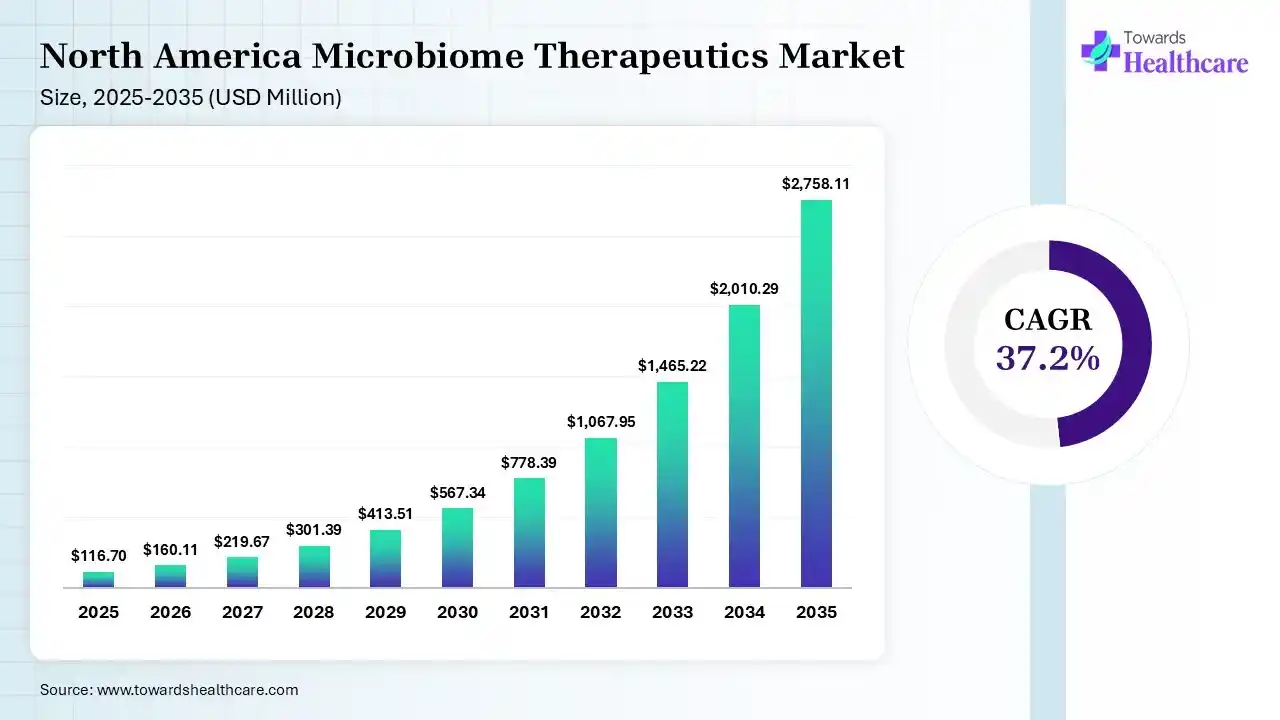
The North America microbiome therapeutics refers to medical interventions that restore and modify the microbial community. They help in the treatment of conditions like recurrent C. difficile infection, metabolic disorders, inflammatory bowel disease, etc. The report covers various therapeutic approaches, products, disease indications, therapeutic areas, routes of administration, age groups, and end users, along with supply chain intelligence, regulatory analysis, competitive landscape, TAM/SAM/SOM analysis, and consumer and buyer intelligence.
Additionally, the market is expanding at a 37.20% CAGR, where this growth is noted to be consistent from the early commercialization phase toward broader adoption of standardized oral microbiome therapeutics. The global human microbiome market was noted to be USD 1.23 billion in 2025 and is expected to grow at a 30.97% CAGR, which is driven by major growth factors like microbiome-based therapeutics, increasing gut-health awareness, chronic disease research, sequencing advances, and personalized medicine.
Analyst View - Market Size
FMT-based microbiome restoration toward standardized pharmaceutical products is recorded to be the most important commercial transition, where the U.S. consists of two FDA-approved microbiota-based products for prevention of recurrent CDI: REBYOTA and VOWST. The market growth is driven by microbiome therapeutics' successful transition from a highly specialized treatment category into a broader pharmaceutical platform, while the next growth phase is likely to depend on oral defined bacterial consortia, spore-based products, standardized manufacturing, antimicrobial-resistance applications, biomarker-guided patient selection, etc.
The U.S. regulatory pathway is moving beyond purely investigational FMT. FDA approved REBYOTA for prevention of recurrence of CDI in adults on November 30, 2022, and listed its exclusivity protection, while VOWST for the prevention of recurrent CDI in adults was approved on April 26, 2023. Thus, this creates an important precedent for developers promoting the development and commercialization of microbiome products through a recognizable biological-product regulatory framework.
Next-generation therapies are replacing donor variability with characterized strains. For example, Vedanta's VE303, intended to prevent recurrent CDI, contains eight well-characterized commensal bacterial strains produced from pure clonal cell banks. Additionally, it encompasses implications for: batch consistency, quality control, microbial characterization, manufacturing reproducibility, intellectual property, dosage standardization, regulatory documentation, supply-chain planning, and commercialization.
Fecal Microbiota Transplantation (FMT) Segment Dominates the Market with 55% share in 2025
| Segment | Share | CAGR | Strategic Interpretation |
| Fecal Microbiota Transplantation (FMT) | 55% | 34.10% | Current commercial foundation |
| Live Biotherapeutic Products | 32% | 39.20% | Fastest established modality |
| Engineered Microbiome Therapeutics | 8% | 41.60% | Precision-platform opportunity |
| Microbiome-Derived Therapeutics | 5% | 40.40% | Molecule-based diversification |
Based on our research, the table highlights different therapeutic approaches, market share, and CAGR. The fecal microbiota transplantation (FMT) segment held the dominant share of 55% in 2025 because of its shift toward standardization, along with the growth in FDA-approved fecal microbiota products like REBYOTA and VOWST. The live biotherapeutic products (LBPs) segment is expected to expand rapidly with a 39.20% CAGR during the forecast period, because it attempts to create drug-like reproducibility from living microbial communities.
Analyst View
FMT held the largest current installed commercial base, where a gradual displacement toward standardized and pharmaceutical-style products is demonstrated by the internal growth rates. Additionally, LBPs are commercially important as they offer oral administration, defined microbial composition, scalable manufacturing, reduced donor dependence, reproducible dosing, and expanding clinical applications, creating a pathway toward broader pharmaceutical adoption.
Fecal Microbiota-Based Products Segment Leads the Market with 55%
| Product Type | Share | CAGR |
| Fecal Microbiota-Based Products | 55% | 34.10% |
| Oral Live Biotherapeutic Products | 35% | 40.10% |
| Investigational Microbiome Drugs | 7% | 44.10% |
| Next-Generation Microbiome Products | 3% | 46.80% |
The given table illustrates that the fecal microbiota-based products segment held the largest share of 55% of the market in 2025, as REBYOTA established a regulated microbiota-based treatment pathway. The oral live biotherapeutic products segment held 35% in 2025 and is anticipated to show the highest growth of 40.10% CAGR during the predicted period, as oral products improve administration convenience and VOWST provides regulatory validation for oral microbiome therapeutics.
Analyst View
REBYOTA established a regulated microbiota-based treatment pathway, contributing to the dominance of the fecal microbiota-based products segment. On the other hand, growth in the VOWST business promotes commercialization of microbiome therapeutics, driving rapid expansion of the oral live biotherapeutic products segment.
Clostridioides Difficile Infection (CDI) Segment Held a Dominant Share of 61% of the Market
| Disease Indication | Share | CAGR |
| CDI | 61% | 34.80% |
| IBD | 14% | 41.20% |
| Oncology-support settings | 9% | 43.60% |
| Metabolic disorders | 5% | 42.80% |
| Infectious diseases | 4% | 44.50% |
| Dermatological disorders | 2% | 45.30% |
| Neurological disorders | 2% | 46.00% |
| Other indications | 3% | 42.10% |
As per the analysis, the table highlights different disease indications, along with their market share and CAGR. The Clostridioides difficile infection (CDI) segment held the major share of 61% in 2025 as FDA-approved microbiota products directly addressed recurrent CDI. The inflammatory bowel disease (IBD) segment held a 14% market share and is predicted to show the fastest growth with a 41.20% CAGR during the upcoming years, as developers are targeting microbiome-driven immune dysregulation.
Analyst View
CDI contributed to the primary commercial validation market for microbiome therapeutics, while IBD is recognized as commercially attractive. Moreover, the market is expanding beyond CDI, fueling developers to demonstrate differentiated efficacy against increasingly sophisticated existing treatments rather than simply showing microbiome engagement.
Gastrointestinal Disorders Segment Contributed to 70% of Market Share
| Therapeutic Area | Share | CAGR |
| Gastrointestinal Disorders | 70% | 35.60% |
| Infectious Diseases | 10% | 43.90% |
| Oncology & Hematology | 9% | 43.60% |
| Metabolic Diseases | 5% | 43.00% |
| Immunology | 3% | 42.50% |
| Neurology | 2% | 46.00% |
| Dermatology | 1% | 45.30% |
The above-mentioned table confirms that the gastrointestinal disorders segment led the market with a 70% share in 2025, as CDI and IBD remained the commercial center of microbiome therapeutics. The neurology segment held 2% market share in 2025 and is expected to expand rapidly with a 46% CAGR during the forecast period, as gut-brain research continues to expand.
Analyst View
The 70% GI concentration suggests that the market depends on diseases where the microbiome has the most direct biological connection, while the non-GI category, with a CAGR above 42%, highlights that the market is moving outside its current revenue base. This creates a classic market-expansion pattern like,
Current revenue concentration = GI/CDI
Future pipeline expansion = infection, oncology, metabolic, immune, neurological, and dermatological applications.
Oral Segment Held Major Revenue Share of 58%
| Route | Share | CAGR |
| Oral | 58% | 40.20% |
| Rectal | 32% | 34.90% |
| Topical | 6% | 44.20% |
| Other routes | 4% | 43.50% |
Based on the information gathered, the table covers various routes of administration, market share, and CAGR. The oral segment registered dominance over the market with a 58% share in 2025 and is expected to show the highest growth with a CAGR of 21.30% during the upcoming years, as it improves patient convenience and outpatient use.
Analyst View
The oral route should be treated as a commercial-enablement technology, as it can potentially reduce hospital dependence, procedure requirements, specialist administration, treatment-center burden, and logistical complexity.
Adults Segment Led the Market with 94%
| Age Group | Share | CAGR |
| Adults | 94% | 36.90% |
| Pediatrics | 6% | 42.80% |
As per the survey conducted, the table suggests that the adults segment held the dominant share of 94% in 2025, as recurrent CDI created substantial adult demand. The pediatrics segment held 6% in 2025 and is anticipated to grow at the fastest CAGR of 42.80% during the predicted period, due to expanding pediatric microbiome research.
Analyst View
With requirements such as age-specific dosing, formulation considerations, safety characterization, developmental microbiome considerations, and pediatric clinical evidence for product development, the pediatrics segment is anticipated to offer a long-term pipeline opportunity.
Hospitals & Clinics Segment Dominates the Market with 61% share in 2025
| Channel | Share | CAGR |
| Hospitals & Clinics | 61% | 35.80% |
| Specialty Pharmacies | 24% | 40.10% |
| Retail/Community Pharmacies | 10% | 39.20% |
| Research & Specialty Treatment Centers | 5% | 42.60% |
Based on our research, the table highlights different types of end users, market share, and CAGR. The hospitals & clinics segment held the dominant share of 61% in 2025 because CDI, transplant, oncology, and complicated infections frequently occurred in hospital-linked care pathways. The specialty pharmacies segment is expected to expand rapidly with a 40.10% CAGR during the forecast period, as oral microbiome products fit specialty-pharmacy distribution.
Analyst View
The dominance of the hospitals & clinics segment also contributed to academic medical centres functioning simultaneously across buyer + prescriber + trial site + evidence generator + KOL network + referral hub. Furthermore, microbiome therapeutics are shifting from hospital procedures toward oral pharmaceutical products, making the specialty pharmacies segment important commercial intermediaries.
| Region | Share | CAGR | Market Drivers |
| North America | 40.40% | 37.20% | FDA approvals, strong biotechnology infrastructure, established developers, and high investment capital |
| United States | 82.90% of North America | 37.60% | Principal commercial and clinical ecosystem, FDA approvals, and the presence of Seres and Vedanta maintaining active development programs. |
| Canada | 10.40% | 34.80% | Academic microbiome research, clinical trials, translational medicine, Canadian biotechnology partnerships, and cross-border development with U.S. companies. |
| Mexico | 6.70% | 32.90% | Expanding pharmaceutical infrastructure, robust technology and supply-chain links, and growing healthcare investment |
As per the survey conducted, the U.S. represents approximately 33.49% of the broader global/market and is expected to show the fastest growth with a 37.60% CAGR. The dominance of the U.S. is driven by FDA regulatory validation, biotechnology infrastructure, venture and institutional investment, clinical-trial infrastructure, academic microbiome research, specialist GI/oncology/transplant centers, and approved commercial products.
Analyst View - Region
The North American market is effectively U.S.-centric, which distinguishes commercial strategy between the U.S. commercial market, Canadian research/clinical-development opportunity, and Mexican medium-term commercialization opportunity.
Microbiome manufacturing has unusual technical requirements such as anaerobic organism handling, strain identity, microbial viability, contamination control, defined composition, batch consistency, potency characterization, and stability. Furthermore, Vedanta offers a dedicated CGMP manufacturing facility for its defined bacterial consortium programs and has manufactured several hundred CGMP batches involving more than 30 phylogenetically diverse anaerobic bacterial species.
Analyst View
Manufacturing capability is becoming a strategic moat. For defined consortia, technology-transfer risk can be reduced, and clinical-to-commercial transition can be accelerated by the companies controlling strain libraries, cell banks, fermentation, downstream processing, formulation, analytical methods, and quality systems.
As biological products under CBER, the fecal microbiota products used to diagnose, prevent, treat, or cure human disease are regulated by the FDA.
| Product | FDA Approval | Route | Indication |
| REBYOTA | Nov. 30, 2022 | Rectal | Prevention of recurrent CDI |
| VOWST | Apr. 26, 2023 | Oral | Prevention of recurrent CDI |
The regulatory barriers are identified across;
Defined consortia → engineered microbes → microbial metabolites → precision microbial therapeutics.
These categories require detailed characterization of identity, purity, potency, mechanism, genetic stability, manufacturing consistency, microbial safety, and unintended effects.
| Companies/Organizations | Strategic Developments |
| Seres Therapeutics | Sold VOWST to Nestlé Health Science in 2024 and shifted resources toward its cultivated live biotherapeutic pipeline. |
| 10-K reported only $789,000 in total revenue, and R&D expense was $49.06 million in 2025. | |
| Ferring Pharmaceuticals | The developer of REBYOTA. |
| It intends to reduce commercial efforts around REBYOTA in the U.S., explore second-generation microbiome therapies, and collaborate with PharmaBiome to develop a defined-consortia microbiome therapy for mild-to-moderate ulcerative colitis, and is shifting from first-generation microbiota replacement to defined-consortia second-generation therapies. | |
| Vedanta Biosciences | Current pipeline has 2 products: VE303 (Phase III) for recurrent CDI, which secured $60 million in 2026 funding, including BARDA support, and VE707 (CMC/preclinical development) for gram-negative AMR infections. |
The above-mentioned table illustrates companies and their recent strategic developments. Additionally, Towards Healthcare also includes Nestlé Health Science, Finch Therapeutics, MaaT Pharma, BiomX, 4D Pharma, Synlogic, Assembly Biosciences, Eligo Bioscience, Locus Biosciences, Microba Life Sciences, Viome, Seed Health, Pendulum Therapeutics, and others in the broader human microbiome competitive landscape.
| Layer | 2025 Value | Definition | Key Areas |
| TAM | USD 584.25M* | Broader North American human microbiome ecosystem | Therapeutics, diagnostics, microbiome testing, biomarkers, sequencing, metabolomics, personalized nutrition, research tools, CRO/CDMO services, consumer microbiome products. |
| SAM | USD 116.70M* | North American microbiome therapeutics | FMT-derived products, LBPs, defined consortia, spore-based therapeutics, engineered microbes, microbiome-derived molecules. |
| SOM | USD 5.84M* | Illustrative 5% capture of SAM | The SOM and SAM values should not be presented as an observed company market share. |
Analyst View - TAM/SAM/SOM
The broader microbiome ecosystem and the regulated therapeutics category contribute to the largest strategic whitespace. Companies can participate in multiple layers, such as,
TAM: research/diagnostics/data/sequencing
↓
SAM: therapeutic development/manufacturing/clinical services
↓
SOM: specific programs, accounts and therapeutic applications.
| Consumer Factor | Market Intelligence |
| Gut-health awareness | Increasing interest in microbiome-health relationships |
| Clinical evidence | Critical for regulated therapeutics |
| Convenience | Oral capsules provide a major adoption advantage |
| Specialist recommendation | High importance in complex disease |
| Personalized medicine | Increasing relevance to microbiome-based approaches |
| Safety | Major concern for live microbial products |
| Treatment setting | Movement from specialized administration toward outpatient treatment |
| Disease awareness | CDI currently strongest; IBD, oncology and metabolic applications expanding |
Based on the information gathered, increasing awareness of gut health, chronic disease relationships, microbiome-based therapeutics, sequencing, and personalized medicine are important factors driving the market growth. The consumer adoption pathway includes;
Patient develops disease → physician diagnosis → microbiome-related treatment considered → specialist recommendation → payer/reimbursement assessment → prescription → specialty pharmacy/hospital fulfilment → treatment adherence → clinical outcome.
| Buyer Groups | Key Requirements |
| Pharmaceutical companies | Clinical efficacy |
| Regulatory pathway | |
| Differentiated mechanism | |
| IP | |
| Manufacturing scalability | |
| Target population | |
| Commercial potential | |
| Partnering opportunity | |
| Biotechnology companies | Strain libraries |
| Microbial engineering | |
| Clinical development | |
| CMC | |
| Analytical testing | |
| Regulatory consulting | |
| Funding | |
| Partnering | |
| CRO/CDMOs | Anaerobic manufacturing |
| Microbial characterization | |
| Fermentation | |
| GMP compliance | |
| Formulation | |
| Analytical methods | |
| Scalability | |
| Batch consistency | |
| Hospitals | Clinical efficacy |
| Safety | |
| FDA approval | |
| Physician acceptance | |
| Reimbursement | |
| Administration requirements | |
| Patient selection | |
| Treatment logistics | |
| Specialty pharmacies | Reimbursement |
| Inventory | |
| Prescription workflow | |
| Cold-chain/stability requirements | |
| Patient support | |
| Adherence | |
| Manufacturer access programs | |
| Payers | The most important payer questions are: |
| Does the therapy prevent recurrence? | |
| Does it reduce hospitalization? | |
| Does it reduce antibiotic use? | |
| Does it prevent complications? | |
| What is the cost per avoided recurrence? | |
| Which patient population generates the greatest economic benefit? | |
| Is there sufficient real-world evidence? |
Analyst View - Buyer Intelligence
The ability of a therapy to alter the microbiome leads to a rise in scientific interest, which shifts the buyer landscape from clinical novelty to evidence-backed economic value. For commercial scale, buyers increasingly require clinical efficacy + safety + reproducibility + reimbursement + health economics + scalable supply.
| Decision Factor | Pharma/Biotech | CRO/CDMO | Hospital | Payer |
| Clinical efficacy | Very High | High | Very High | Very High |
| Regulatory pathway | Very High | Very High | High | High |
| Safety | Very High | High | Very High | Very High |
| Manufacturing scalability | Very High | Very High | Medium | Medium |
| Microbial characterization | Very High | Very High | High | Medium |
| Publications/evidence | High | High | Very High | Very High |
| Cost | High | Very High | High | Very High |
| Development speed | Very High | Very High | Medium | Medium |
| Microbiome expertise | Very High | Very High | High | Medium |
| Licensing potential | Very High | High | Medium | Low |
Based on the assessment, the market is expanding significantly due to the presence of well-established biotechnology infrastructure. The growth in FDA approvals and R&D activities are also driving the development of novel microbiome therapeutics. The strong growth in healthcare and biotechnology investments are also accelerating their innovations. Advancements in oral products, targeted therapies, and pediatric therapeutics can also create new market opportunities.
Payal Rabde, Senior Research Analyst, led the primary market research, developed the methodology, analysed trends, segmentation, competition, forecasts, and strategic opportunities, forming the report's analytical foundation.
Aman Singh, a multidisciplinary strategist, was responsible for collecting and validating clinical trial data, research publications, company information, partnerships, and other quantitative datasets, strengthening evidence-based analysis and market estimations.
Aditi Shivarkar, an expert business strategist, reviewed the complete research document, performed quality checks, validated findings, refined content, corrected inconsistencies, and finalized the report, ensuring accuracy, clarity, credibility, and publication-ready quality.
By Therapeutic Approach
By Product Type
By Disease Indication
By Therapeutic Area
By Route of Administration
By Age Group
By End User/Distribution Channel
By Region


Principal Consultant
Payal Rabde is a Healthcare Market Research Analyst at Towards Healthcare Research & Consulting with 4+ years of experience in pharmaceuticals, biotechnology, medical devices, and life sciences.
Learn more about Payal Rabde

Reviewed By
Aditi Shivarkar is a seasoned professional with over 14 years of experience in healthcare market research. As a content reviewer, Aditi ensures the quality and accuracy of all market insights and data presented by the research team.
Learn more about Aditi Shivarkar