
The pan genomic multi gene panel testing market is projected to grow from USD 10.40 billion in 2025 to USD 31.73 billion by 2035 because clinicians order broad gene panels to diagnose inherited conditions, choose cancer treatments, and assess family risk. Panels are replacing slower, sequential single-gene tests. Wider testing eligibility and consumer-initiated screening add new volumes, lifting the market to USD 18.17 billion by 2030 and sustaining a CAGR of 11.8% from 2026 to 2035.
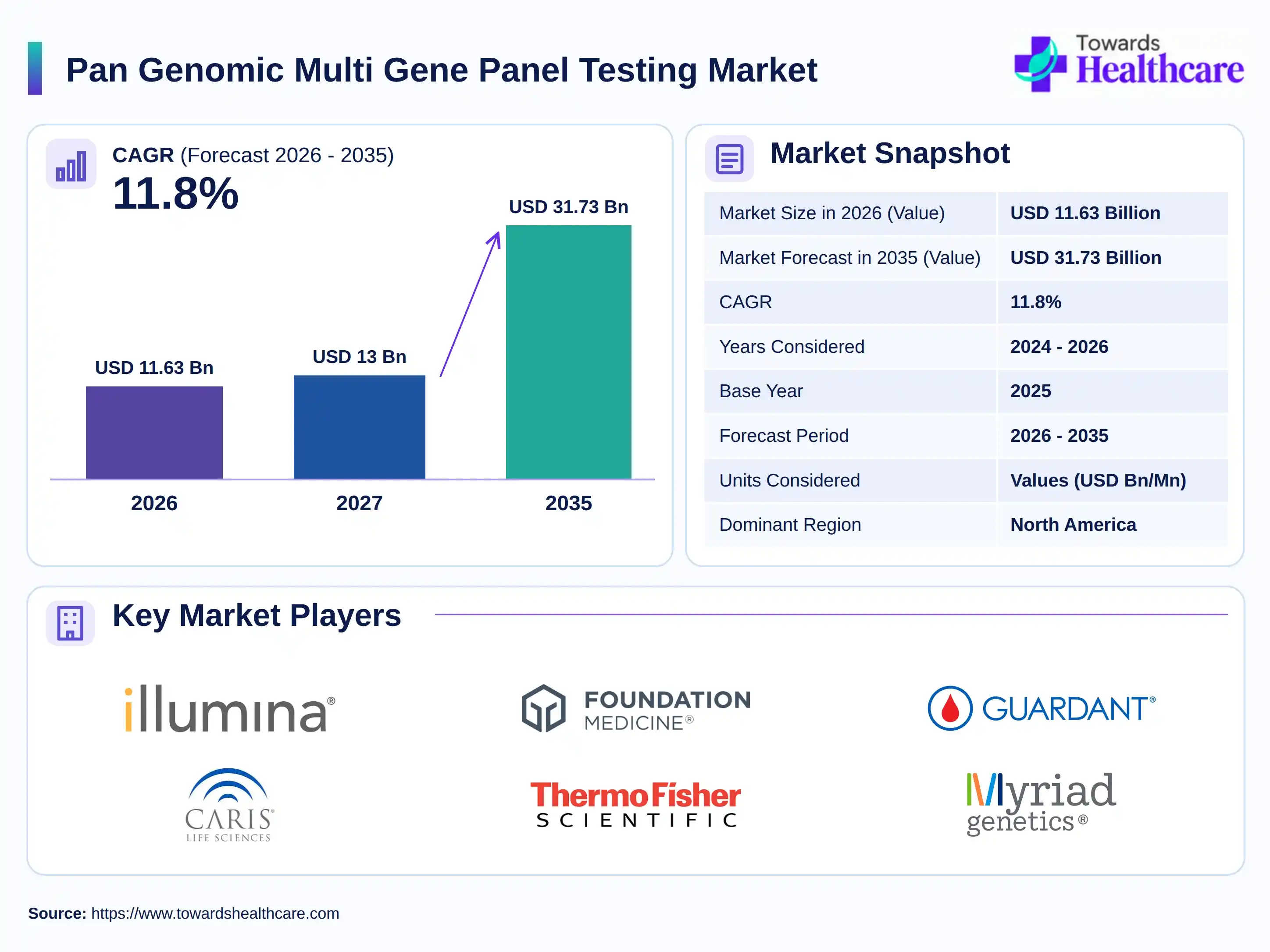
Analyst View: Volumes reflect cancer incidence and testing rates, rare disease referrals, cardiology and neurology testing, carrier screening, and pharmacogenomic panels. The 2025 market estimate was cross-checked against the panel testing revenue of specialty genetic laboratories and sequencing platform suppliers and against published estimates, which places our base year slightly above the comparable figures. The growth rate reflects broader eligibility and lower sequencing costs, partly offset by price pressure on high-volume panels.
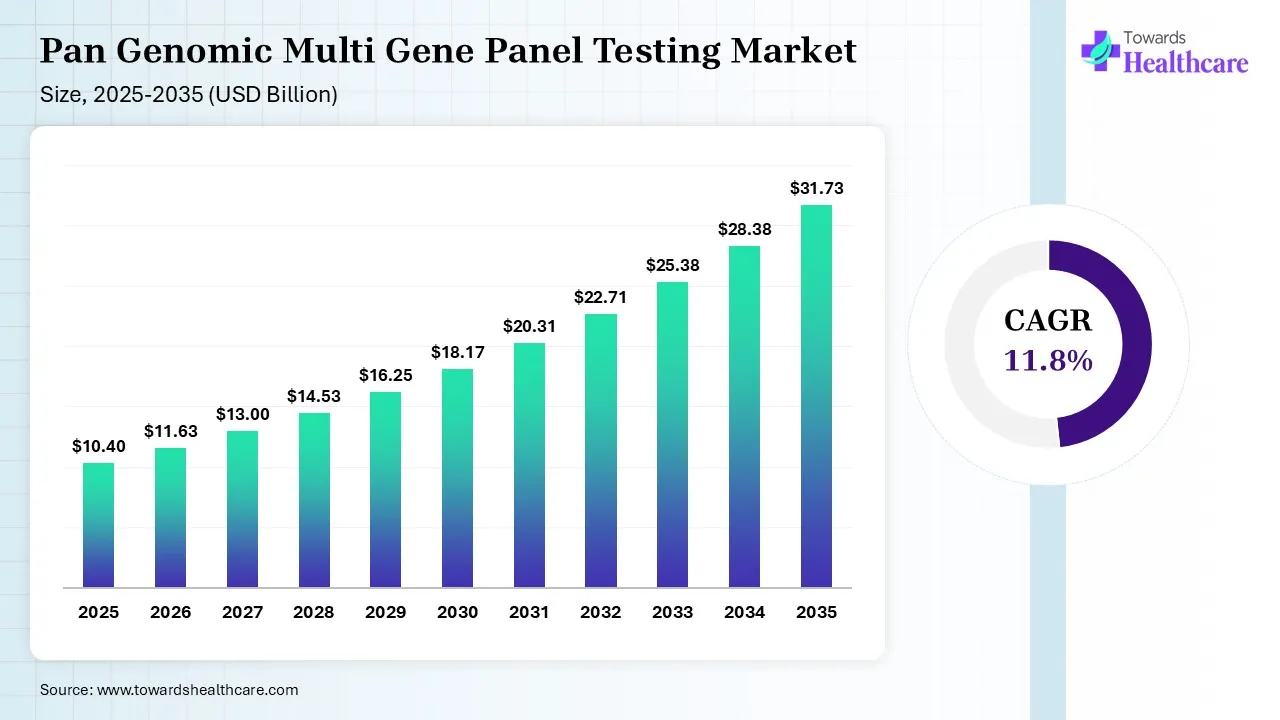
Market Size & Growth Outlook
Regional Market Spotlight
Segmental Spotlight
Sources: Expert interviews, secondary sources, Towards Healthcare database, and Towards Healthcare analysts.
Sequencing costs have decreased, making broad genetic panels more affordable than single-gene testing. Clinical guidelines now broaden eligibility for hereditary cancer and genetic testing. Targeted cancer therapies depend on the identification of specific mutations, while exome-based panels expedite the diagnosis of rare diseases. Consumer and employer interest is increasing in proactive genetic screening.
Reimbursement for genetic testing is inconsistent, influenced by test type, payer, and location. Larger panels often reveal more variants of uncertain significance, leading to confusion among patients and clinicians. The shortage of genetic counsellors hampers effective follow-up, while price pressures on high-volume hereditary panels diminish revenue per test. Additionally, data privacy concerns may discourage consumer participation.
Newborn and paediatric sequencing programmes can create large new volumes. AI-based variant interpretation can reduce costs and turnaround times. Long-read sequencing can detect variants missed by short-read panels. Population health and employer programmes can expand proactive screening. Growing genomic medicine programmes in Asia and the Middle East offer expansion opportunities.
| Segments | 2025 Share | 2025 Market Value |
| Oncology Multi-Gene Panels | 41.6% | USD 4.33 billion |
| Comprehensive Hereditary Disease Panels | 24.2% | USD 2.52 billion |
| Pan Genomic & Whole Exome-Based Panels | 22.4% | USD 2.33 billion |
| Pharmacogenomics (PGx) Panels | 11.8% | USD 1.23 billion |
Sources: Expert interviews, secondary sources, Towards Healthcare database, and Towards Healthcare analysts.
Oncology multigene panels dominated the pan-genomic multigene panel testing market in 2025, accounting for 41.6% of revenue, equivalent to USD 4.33 billion. Demand is driven by the use of tumour sequencing to identify actionable mutations for targeted therapies. Hereditary cancer panels also support market growth by identifying inherited variants in genes such as BRCA1, BRCA2, and Lynch syndrome-associated genes. Expanding clinical guidelines have increased eligibility for both germline and tumour testing among cancer patients.
Comprehensive hereditary disease panels accounted for 24.2% of the market in 2025, valued at USD 2.52 billion. These panels cover inherited conditions across cardiology, neurology, and other disease areas. Pan-genomic and whole-exome-based panels represented 22.4% of the market, generating USD 2.33 billion, and constituted the fastest-growing testing modality. Their growth reflects the ability to analyse virtual gene panels using exome-wide data and reanalyse results as scientific knowledge advances. Pharmacogenomic panels accounted for the remaining 11.8%, valued at USD 1.23 billion.
| Segments | 2025 Share | 2025 Market Value |
| Oncology | 46.8% | USD 4.87 billion |
| Rare & Undiagnosed Genetic Diseases | 16.4% | USD 1.71 billion |
| Reproductive Carrier Screening | 12.2% | USD 1.27 billion |
| Cardiology & Cardiomyopathy | 8.6% | USD 0.89 billion |
| Neurology & Neurogenetics | 8.4% | USD 0.87 billion |
| Newborn & Pediatric Genomics | 7.6% | USD 0.79 billion |
Sources: Expert interviews, secondary sources,Towards Healthcare database, and Towards Healthcare analysts.
In 2025, oncology comprised 46.8% of the market, equivalent to USD 4.87 billion, as it represented the largest clinical use of such testing. Rare and undiagnosed genetic diseases were the fastest-growing segment at 16.4%, with a valuation of USD 1.71 billion, due to exome-based panels that streamline the diagnostic process for children and adults.
Other applications include reproductive carrier screening, which comprised 12.2% of the market at USD 1.27 billion. Cardiology and cardiomyopathy accounted for 8.6% of the market, with a valuation of USD 0.89 billion, while neurology and neurogenetics represent 8.4% (USD 0.87 billion). Newborn and pediatric genomics accounted for the remaining 7.6% of application revenue, valued at USD 0.79 billion.
| Segments | 2025 Share | 2025 Market Value |
| Independent Diagnostic Labs | 48.6% | USD 5.05 billion |
| Hospital-Based Genetic Labs | 30.8% | USD 3.20 billion |
| Specialty Genomic Centers | 13.4% | USD 1.39 billion |
| Others | 7.2% | USD 0.75 billion |
Sources: Expert interviews, secondary sources, Towards Healthcare database, and Towards Healthcare analysts.
In 2025, independent diagnostic laboratories were valued at USD 5.05 billion, capturing 48.6% of the market, owing to their large, centralized sequencing operations and extensive test offerings. Hospital-based genetic laboratories, estimated at USD 3.20 billion, cater to 30.8% of the market and are the fastest-growing segment as academic centers and health systems increasingly adopt panel testing using benchtop sequencers. Specialty genomic centers represented 13.4% of the market with USD 1.39 billion, while other end users accounted for 7.2% at USD 0.75 billion.
Analyst View: Oncology leads owing to high testing volumes and higher prices for tumor panels. We expect exome-based panels, rare disease testing, and hospital laboratories to gain share.
| Region | 2025 Share | 2025 Market Value |
| North America | 46.4% | USD 4.83 billion |
| Europe | 26.2% | USD 2.72 billion |
| Asia Pacific | 20.8% | USD 2.16 billion |
| Latin America | 3.8% | USD 0.40 billion |
| Middle East & Africa | 2.8% | USD 0.29 billion |
Sources: Expert interviews, secondary sources, Towards Healthcare database, and Towards Healthcare analysts.
North America dominated the pan-genomic multigene panel testing market in 2025, accounting for 46.4% of revenue, equivalent to USD 4.83 billion. Demand is supported by specialty testing laboratories, including Myriad, Ambry, GeneDx, Labcorp, and Quest, which are expanding multigene testing as clinical guidelines increase eligibility for hereditary cancer screening. Consumer-ordered genetic testing is also creating additional demand, including Labcorp’s Genetic Health Panel, launched in 2026.
Europe captured USD 2.72 billion, accounting for 26.2% in 2025. The NHS Genomic Medicine Service offers panel and exome testing via regional hubs, while rare disease networks enhance exome-based diagnosis. Additionally, more hospital laboratories are conducting sequencing in-house.
Asia Pacific accounted for 20.8% of the market, with a valuation of USD 2.16 billion in 2025, and is the fastest-growing region. China has large domestic sequencing and testing companies. Japan's reimbursed cancer genomic profiling and South Korea's precision oncology programmes support demand. India and Australia are expanding laboratory capacity.
Latin America accounted for 3.8%, with USD 0.40 billion in 2025. Testing is concentrated in private laboratories in Brazil, Mexico, and Argentina, with samples sometimes sent abroad. Limited reimbursement slows growth.
The Middle East and Africa represented 2.8% of the pan-genomic multigene panel testing market in 2025, with revenue reaching USD 0.29 billion. National genome programmes in Saudi Arabia, the UAE, and Qatar support demand for multigene panel and exome testing. Higher rates of consanguinity in parts of the region also contribute to demand for genetic testing to identify inherited and rare diseases.
Analyst View: North America leads because of guideline-driven testing and reimbursement. We assign Asia Pacific the highest growth premium because sequencing capacity and precision medicine programmes are expanding fastest there.
| Rank | Company Name | Market-Specific Revenue (USD Billion) | 2025 Share | Key Products / Business | Headquarters |
| 1 | Illumina | 1.10 | 10.58% | Sequencing systems and TruSight panels | United States |
| 2 | Thermo Fisher Scientific | 0.62 | 5.96% | Ion Torrent Oncomine panels | United States |
| 3 | Myriad Genetics | 0.58 | 5.58% | MyRisk hereditary cancer panel | United States |
| 4 | Foundation Medicine | 0.52 | 5.0% | FoundationOne CDx tumor profiling | United States |
| 5 | Guardant Health | 0.42 | 4.04% | Guardant360 liquid biopsy panels | United States |
| 6 | Caris Life Sciences | 0.38 | 3.65% | MI Profile tumor profiling | United States |
| 7 | GeneDx | 0.36 | 3.46% | Exome and genome-based panels | United States |
| 8 | Ambry Genetics | 0.30 | 2.88% | CancerNext hereditary cancer panels | United States |
| 9 | Natera | 0.22 | 2.12% | Empower hereditary cancer test | United States |
| 10 | Fulgent Genetics | 0.16 | 1.54% | Comprehensive hereditary and exome panels | United States |
Sources: Company press releases, expert interviews, secondary sources, Towards Healthcare database and Precedence Research analysts.
The top 10 companies accounted for an estimated 44.81% of pan genomic multi gene panel testing market in 2025, while the remaining 55.19% was shared among hospital genetics laboratories, regional sequencing companies, and long-read sequencing providers.
Illumina holds a significant share of the market, with an estimated share of 10.58% and projected revenue of USD 1.10 billion in 2025. This lead is attributed to its widespread use in multigene panel laboratories, where it provides sequencing systems, chemistries, software, and in vitro diagnostic assays for oncology and genetic disease testing. Thermo Fisher follows with a market share of 5.96% (USD 0.62 billion), while Myriad Genetics holds 5.58% (USD 0.58 billion). Thermo Fisher Scientific competes in the arena of targeted tumor profiling in hospital laboratories using Ion Torrent sequencers and Oncomine panels. Myriad Genetics, Ambry Genetics, GeneDx, Natera, and Fulgent Genetics are major testing laboratories for hereditary cancer, exome and rare disease panels, while Foundation Medicine, Guardant Health, and Caris Life Sciences lead comprehensive tumor and liquid biopsy profiling.
The market combines platform suppliers with specialty laboratories, and competition centres on panel breadth, variant interpretation quality, turnaround time, reimbursement and price. Consolidation, such as Tempus's acquisition of Ambry Genetics, and new long-read sequencing panels are changing the competitive landscape.
By Test
By Application
By End Use
By Region
The pan genomic multi gene panel testing market was defined as sequencing-based multigene panel tests, including pan genomic, hereditary, oncology, and pharmacogenomic panels, with related products and services, worldwide. The 2025 base year was built bottom-up from test volumes by clinical area and region, average panel prices, and laboratory product sales. The estimate was also checked using a top-down approach the panel testing revenue of specialty genetic laboratories and sequencing platform suppliers. Segment, regional and company values were allocated from test types, applications, end uses and regional demand. Key estimates were verified by cross-checking company disclosures, regulatory and industry data, and published third-party estimates, and inputs that could not be reconciled were excluded. All segment, regional, and company figures were reconciled to the same 2025 base year. The 2026-2035 forecast, which applies a constant CAGR from the 2025 base, was recalculated and validated.
Analyst View: Overall Market - The pan genomic multi gene panel testing market is growing as broad sequencing becomes the standard approach to genetic diagnosis and cancer profiling. Our estimate links demand to test volumes, prices, and laboratory product sales, so the forecast follows guideline changes, sequencing costs, and reimbursement. The main upside comes from exome-based panels and new screening programmes, while the main risks are reimbursement limits and price pressure.