Pipeline Programs

CGT Companies Tracked

Manufacturing Facilities


Research indicates strong growth opportunities in the India pharmacogenomics market. The India pharmacogenomics market size was estimated at USD 267 million in 2025 and is predicted to increase from USD 300.64 million in 2026 to approximately USD 874.77 million by 2035, expanding at a CAGR of 12.6% from 2026 to 2035. Analysis also highlights that the India pharmacogenomics market is rapidly expanding due to growing R&D activities, expanding biotechnology infrastructure, increasing government initiatives, expanding precision medicine services, improving diagnostics infrastructure, and growing collaborations.
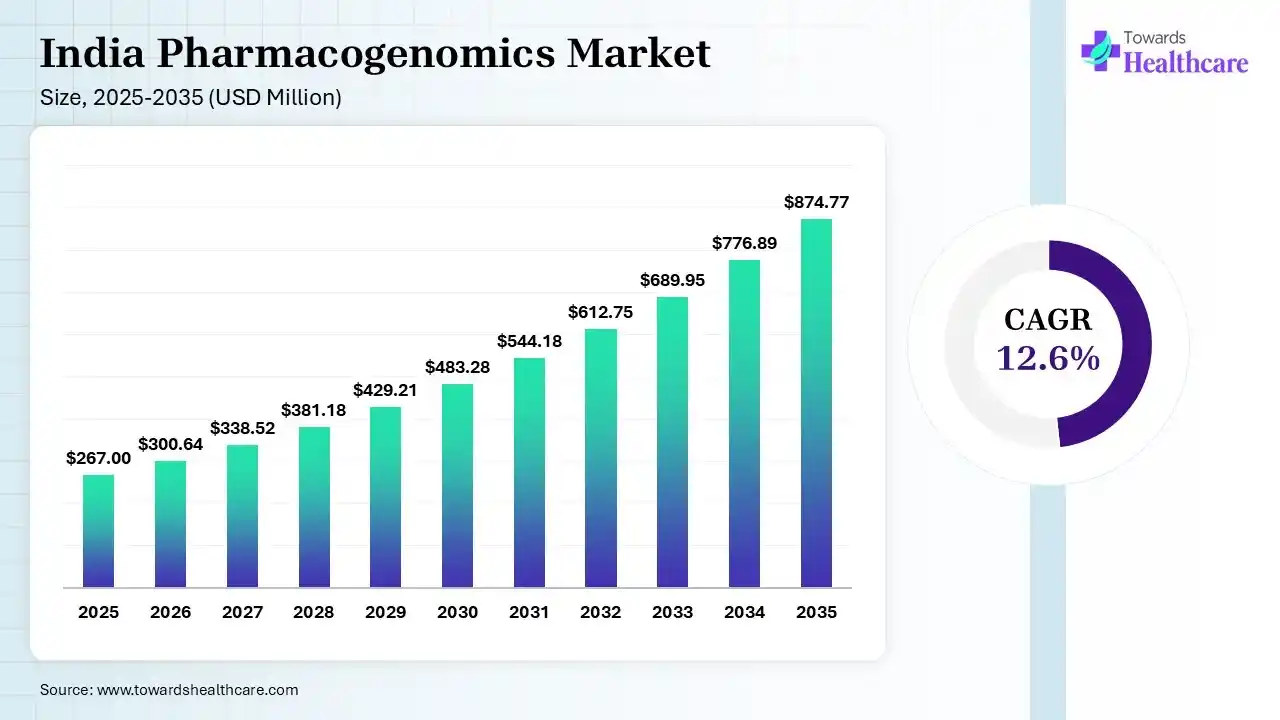
India pharmacogenomics refers to the studies combining pharmacology and genomics to understand genetic variations influencing drug effectiveness, metabolism, and safety. The market includes pharmacogenomic testing, targeted genotyping, sequencing-based PGx testing, interpretation and bioinformatics, clinical decision-support applications, pharmaceutical R&D, and related laboratory services.
| Market Metric | 2025 |
| India Pharmacogenomics Market Size | USD 267.0 Million |
| CAGR | 12.60% |
| Market maturity | Emerging/clinical-transition stage |
| Largest technology | Sequencing/NGS |
| Largest therapeutic area | Oncology |
| Largest application | Drug response & dose optimization |
| Largest end user | Pharmaceutical & biotechnology companies |
Based on our research, pharmacogenomics is one of the fastest-growing technology areas within precision medicine, while its expansion in India is driven by increasing genomic testing, precision oncology, and personalized-treatment activity.
Analyst View
Growing transition from research-led genomics toward clinically actionable pharmacogenomics is introducing new opportunities for India's PGx market. This, in turn, points to the most important commercial question: how effectively test results can be converted into prescribing decisions rather than how many genetic tests can be performed.
Pharmacogenomics examines how inherited genetic variation influences drug efficacy, dosing, metabolism, and adverse reactions. The expansion of genomic diagnostics, precision oncology, pharmaceutical R&D, and population-genomics infrastructure is driving its growth across India.
Additionally, an important foundation is provided by the GenomeIndia program, which has completed a whole-genome database covering more than 10,000 individuals representing major population groups, as mentioned by the government in April 2025. Similarly, CSIR-IGIB's analysis recorded 2,339 of 4,245 catalogued pharmacogenomic variants across 82 populations and 31 of 34 Very Important Pharmacogenes. The Department of Biotechnology also reported whole-genome sequencing data from 10,074 healthy individuals representing 83 heterogeneous populations across 99 sites. Furthermore, 24 key genes affecting 57 drugs were identified in 2025 Indian pharmacogenomics, which were relevant to actionable PGx in Indian clinical practice.
Factors such as expansion of precision medicine, increasing genomic-testing capacity, GenomeIndia and population-genomics research, growth of precision oncology, need to reduce adverse drug reactions, pharmaceutical biomarker and clinical-trial research, increasing NGS availability, development of genomic interpretation capabilities, greater interest from hospitals and physicians, and increasing availability of Indian population-specific genomic evidence are creating the strongest market pull.
Analyst View
Despite the presence of GenomeIndia improving the evidence base, clinical guidelines, physician education, reimbursement, test affordability, and the ability to provide concise, actionable reports are essential for commercialization as the data infrastructure is developing faster than routine clinical adoption.
Which Technologies are Dominating Pharmacogenomic Testing and Where is NGS Creating New Growth?
| Technology | 2025 Share | CAGR | 2035 Share |
| Sequencing/NGS | 31% | 14.40% | 37% |
| PCR/Real-Time PCR | 28% | 10.90% | 24% |
| Genotyping/SNP Platforms | 22% | 11.90% | 21% |
| Microarrays | 12% | 9.20% | 9% |
| Other Molecular Technologies | 7% | 13.10% | 9% |
Which Technology is the Dominant Segment?
The sequencing/NGS segment, with a 31% share in 2025, is the dominant technology, as NGS can examine multiple pharmacogenes and variants in a single workflow, making it suitable for comprehensive PGx panels and broader precision-medicine testing.
Which Technology is the Fastest-Growing Segment?
The sequencing/NGS segment is also modeled as the fastest-growing major technology at 14.4% CAGR, while PCR and targeted genotyping are also relevant as clinicians need a specific drug–gene result at lower cost and with rapid turnaround.
Analyst View
For broader panels and patients undergoing comprehensive genomic assessment, India is likely to develop a dual testing model such as targeted PCR/genotyping for established, high-volume drug–gene relationships and NGS.
| Therapeutic Area | 2025 Share | CAGR | 2035 Share |
| Oncology | 45% | 12.10% | 43% |
| Cardiovascular | 18% | 13.20% | 19% |
| Neurology & Psychiatry | 14% | 13.50% | 15% |
| Immunology | 9% | 12.20% | 9% |
| Infectious Diseases | 7% | 12.80% | 7% |
| Other Therapeutic Areas | 7% | 11.90% | 7% |
Why Does Oncology Remain the Dominant Segment?
The oncology segment is the dominant therapeutic area, which accounted for approximately 45% of the 2025 market, where molecular information to support treatment selection, response assessment, and toxicity management were used by precision oncology.
Which Therapeutic Area is Growing Fastest?
The neurology & psychiatry segment is the fastest-growing major therapeutic-area segment expected to expand at 13.5% CAGR, where they utilize pharmacogenomics for identification of variation in drug metabolism and individual response to antidepressants, antipsychotics, and other centrally acting medicines.
Analyst View
Oncology will remain the largest commercial entry point, while as clinical evidence becomes stronger and testing moves beyond specialized oncology centers, neurology, psychiatry, and cardiovascular will offer diversification opportunities.
| Application | 2025 Share | CAGR | 2035 Share |
| Drug Response & Dose Optimization | 34% | 11.90% | 32% |
| Precision Oncology & Treatment Selection | 29% | 13.30% | 31% |
| Adverse Drug Reaction Prediction | 18% | 11.70% | 17% |
| Clinical Decision Support | 10% | 14.80% | 12% |
| Pharmaceutical R&D | 9% | 11.20% | 8% |
Which Application is Dominant?
The drug response & dose optimization segment represents the largest application with 34% market share in 2025.
Which is the Fastest-Growing Application?
The clinical decision support segment, at 14.8% CAGR, represents the fastest-growing application, where the clinical value proposition increasingly depends on translating a genomic result into an understandable treatment recommendation rather than delivering a laboratory result alone.
Analyst View
The market's long-term value chain is shifting from:
Testing → Genomic Result → Interpretation → Treatment Recommendation
With the ability to connect the final two stages, companies can be positioned to participate in a larger share of the healthcare workflow than testing providers alone.
| Product/Service | 2025 Share | CAGR | 2035 Share |
| PGx Test Kits & Assays | 36% | 10.80% | 32% |
| Pharmacogenomics Testing Services | 29% | 14.00% | 33% |
| Sequencing Reagents & Consumables | 18% | 12.90% | 19% |
| Instruments & Platforms | 10% | 10.10% | 8% |
| Bioinformatics & Interpretation | 7% | 14.50% | 8% |
Which Product/Service Category Dominates?
The PGx test kits & assays segment held the largest share of 36% of the market in 2025.
Which Category is Growing Fastest?
The pharmacogenomics testing services segment is expected to grow with the fastest CAGR of 14.0%, which reflects the potential for hospitals and smaller diagnostic facilities to outsource specialized testing.
Analyst View
With centralized laboratories performing complex PGx testing, along with hospitals, clinics, and collection networks expanding patient access, a hub-and-spoke model could become important in India.
| End User | 2025 Share | CAGR | 2035 Share |
| Pharmaceutical & Biotechnology Companies | 30% | 12.20% | 29% |
| Academic & Research Institutions | 27% | 11.70% | 25% |
| Hospitals & Clinics | 23% | 14.40% | 27% |
| Diagnostic & Genomic Laboratories | 12% | 13.80% | 13% |
| CROs & Other Research Organizations | 8% | 9.90% | 6% |
| Total | 100% | - | 100% |
Which End User Dominates?
The pharmaceutical & biotechnology companies segment represents the largest group at approximately 30%, highlighting their use of pharmacogenomics in drug development, clinical research, and patient stratification.
Which End User is Growing Fastest?
The hospitals & clinics segment is the fastest-growing end user with 14.4% CAGR. The growing government initiatives are supporting precision diagnostics and personalized medicine, where GenomeIndia, advanced molecular diagnostics, and other personalized-medicine initiatives as part of India's healthcare development agenda were highlighted by the Ministry of Health.
Analyst View
With the growth in the development of actionable guidelines and reimbursement pathways, the market is anticipated to shift from research organizations toward clinical providers.
The following regional shares are analyst-modeled estimates, based on healthcare infrastructure, genomics activity, pharmaceutical presence, research capacity, and precision-medicine adoption.
| Region | 2025 Share | CAGR | 2035 Share |
| South India | 34% | 13.00% | 35% |
| West India | 27% | 12.10% | 26% |
| North India/NCR | 25% | 11.90% | 24% |
| East & Northeast India | 14% | 13.50% | 15% |
Why South India Held the Largest Regional Share?
South India accounted for 34% of the market, which was supported by pharmaceutical R&D, biotechnology, advanced hospitals, academic research, and genomic testing capabilities.
Which State is the Dominant Market?
Karnataka is reported as the dominant state because of the high concentration of biotechnology, genomics, pharmaceutical R&D, and advanced healthcare infrastructure in Bengaluru.
Which State Shows the Fastest-Growth Opportunity?
Kerala is anticipated as an emerging high-growth state due to the expansion of advanced diagnostics and precision-medicine services.
Analyst View
The combination of clinical infrastructure and life-sciences capability provides a strategic advantage to South India, which in turn makes Bengaluru and Hyderabad important hubs for the broader genomics ecosystem.
West India represents approximately 27% of the market.
Which State Dominates?
Maharashtra is the dominant state, which is supported by pharmaceutical, biotechnology, diagnostic, hospital, and research ecosystems across Mumbai and Pune.
Which State is Growing Fastest?
Gujarat is assessed as the faster-growing state, supported by its pharmaceutical manufacturing base, biotechnology investments, and expanding healthcare infrastructure.
Analyst View
West India is creating opportunities for pharmacogenomics companies serving both pharmaceutical R&D and healthcare providers by strongly connecting the pharma-manufacturing-to-clinical ecosystem.
North India and NCR contribute approximately a 25% share of the market.
Which Territory Dominates?
Delhi-NCR is the dominant market due to a high concentration of tertiary hospitals, research institutions, diagnostic providers, and pharmaceutical organizations.
Which State is Growing Fastest?
Uttar Pradesh represents an emerging growth market as advanced diagnostics and healthcare infrastructure are expanding outside the NCR core.
Analyst View
The opportunities across North India are relevant to clinical research, tertiary healthcare, and government-supported genomics, whereas expansion of molecular diagnostics outside major institutions is likely to determine broader adoption.
East and Northeast India account for approximately 14% of the market.
Which State Dominates?
West Bengal, particularly Kolkata, is the dominant market driven by a high concentration of tertiary healthcare, research, and diagnostic infrastructure.
Which State is Growing Fastest?
Odisha accounts for an emerging faster-growing market due to healthcare infrastructure and molecular diagnostics expansion.
Analyst View
Despite the smaller size compared to South, West, and North India, the centralized testing combined with distributed sample collection across the region can allow PGx services to reach markets where full genomic infrastructure is not yet available.
MedGenome, operating genomic diagnostics, sequencing, bioinformatics, and precision medicine, is linked to the integration of testing with genomic interpretation and clinical applications, offering relevance to pharmacogenomics.
Analyst View
Expansion beyond sequencing capacity toward clinically actionable interpretation and longitudinal genomic services offers strategic opportunity for integrated genomic providers.
How is Strand Life Sciences Contributing to Genomic Diagnostics and Pharmacogenomics?
Strand Life Sciences operates genomic diagnostics, sequencing, and bioinformatics, with applications across oncology and precision medicine, where it highlights that its capabilities underscore the importance of combining molecular testing with computational interpretation.
Analyst View
As PGx adoption increasingly requires testing plus interpretation and not a laboratory-only workflow, pharmacogenomics can benefit from Strand's broader genomic infrastructure.
How is 4baseCare Expanding the Precision-Oncology Side of the Market?
4baseCare focuses on genomic solutions for precision oncology and utilizes genomic data to support personalized cancer-care decisions, where it is currently positioned across genomic testing and actionable clinical insights.
Analyst View
Although oncology genomic profiling should not automatically be treated as pharmacogenomic testing, the overlap of precision oncology and pharmacogenomics around treatment selection and uncovering drug response can be understood by the company, which helps it strengthen its position.
How is Metropolis Healthcare Expanding the Genomic Diagnostics Infrastructure?
Metropolis, in its FY2024-25 annual reports, noted investment in NGS infrastructure, laboratory automation, and bioinformatics, which is supporting expansion of its NGS-based molecular genomics capabilities, including oncology, rare genetic disorders, and reproductive health.
Analyst View
Large diagnostic networks already possessing sample-collection networks and relationships with physicians can provide important distribution and access channels for PGx.
| Buyer Group | Primary Requirement | Most Important Buying Criteria |
| Pharmaceutical & biotech companies | Drug development and stratification | Evidence, population relevance, data quality |
| Hospitals | Treatment optimization | Actionability, accuracy, turnaround |
| Diagnostic laboratories | Testing expansion | Cost, scalability, quality |
| Research institutions | Population/genomic research | Sequencing and data access |
| CROs | Clinical research | Capacity, turnaround and interpretation |
| Physicians | Prescribing support | Clear, clinically actionable reports |
Factors influencing purchase decisions are,
Analyst View
Rather than raw sequencing capability, clinical utility is likely to matter more, where lack of physicians' confidence in connecting the result with a treatment decision can create an adoption barrier for a provider offering a technically sophisticated test.
Indian PGx adoption remains primarily clinician-mediated. Patients are more likely to accept testing when a physician recommends the test, the result directly affects a medication decision, the clinical benefit is understandable, the report is easy to interpret, testing is affordable, and privacy is clearly explained. Additionally, for broader PGx implementation, physician education, evidence development, and guidelines are considered important requirements across the Indian clinical literature.
Analyst View
Instead of focusing on generic genetic testing, the consumer proposition should be framed around “the right medicine or dose for the right patient”, which in turn makes physician communication and clinical interpretation central to commercialization.
| Market Layer | 2025 Estimated Value | Market Definition |
| TAM | USD 1.18 Billion | Broad Indian precision-genomics opportunity relevant to drug response, sequencing, genomic diagnostics, and interpretation |
| SAM | USD 267.0 Million | Addressable pharmacogenomics testing, technologies, services, interpretation, and R&D |
| SOM | USD 26.7 Million | Illustrative 10% capture of the modeled SAM |
Analyst View
The TAM represents a broader opportunity around genomic technologies and clinical applications relevant to drug response and should not be interpreted as current PGx revenue. Additionally, the potential expansion into broader clinical genomics, precision oncology, pharmaceutical trials, population-genomics applications, and clinical decision-support systems represents the gap between TAM and SAM. Furthermore, an illustrative commercial scenario is represented by SOM.
Based on the assessment, the market is expanding rapidly due to growing genomic laboratories and biotechnology infrastructure. The growth in oncology and neurology & psychiatry therapeutic areas are also driving innovations. The new collaboration among the major companies can enhance access to their services. Expansion of NGS and PCR technologies can also create new market opportunities.
Our Experts
Payal Rabde, Senior Research Analyst, led the primary market research, developed the methodology, analysed trends, segmentation, competition, forecasts, and strategic opportunities, forming the report's analytical foundation.
Aman Singh, a multidisciplinary strategist, was responsible for collecting and validating clinical trial data, research publications, company information, partnerships, and other quantitative datasets, strengthening evidence-based analysis and market estimations.
Aditi Shivarkar, an expert business strategist, reviewed the complete research document, performed quality checks, validated findings, refined content, corrected inconsistencies, and finalized the report, ensuring accuracy, clarity, credibility, and publication-ready quality.
Analyst View
Areas where population-specific genomic evidence, clinical testing, interpretation, and pharmaceutical applications intersect are likely to drive the strongest strategic opportunity. On the other hand, despite the important evidence foundation provided by GenomeIndia, the clinical guidelines, validation studies, physician education, and scalable testing models will be required for translating that resource into routine prescribing.
By Technology
By Therapeutic Area
By Application
By Product/Service
By End User
By Region


Principal Consultant
Payal Rabde is a Healthcare Market Research Analyst at Towards Healthcare Research & Consulting with 4+ years of experience in pharmaceuticals, biotechnology, medical devices, and life sciences.
Learn more about Payal Rabde

Reviewed By
Aditi Shivarkar is a seasoned professional with over 14 years of experience in healthcare market research. As a content reviewer, Aditi ensures the quality and accuracy of all market insights and data presented by the research team.
Learn more about Aditi Shivarkar