Pipeline Programs

CGT Companies Tracked

Manufacturing Facilities


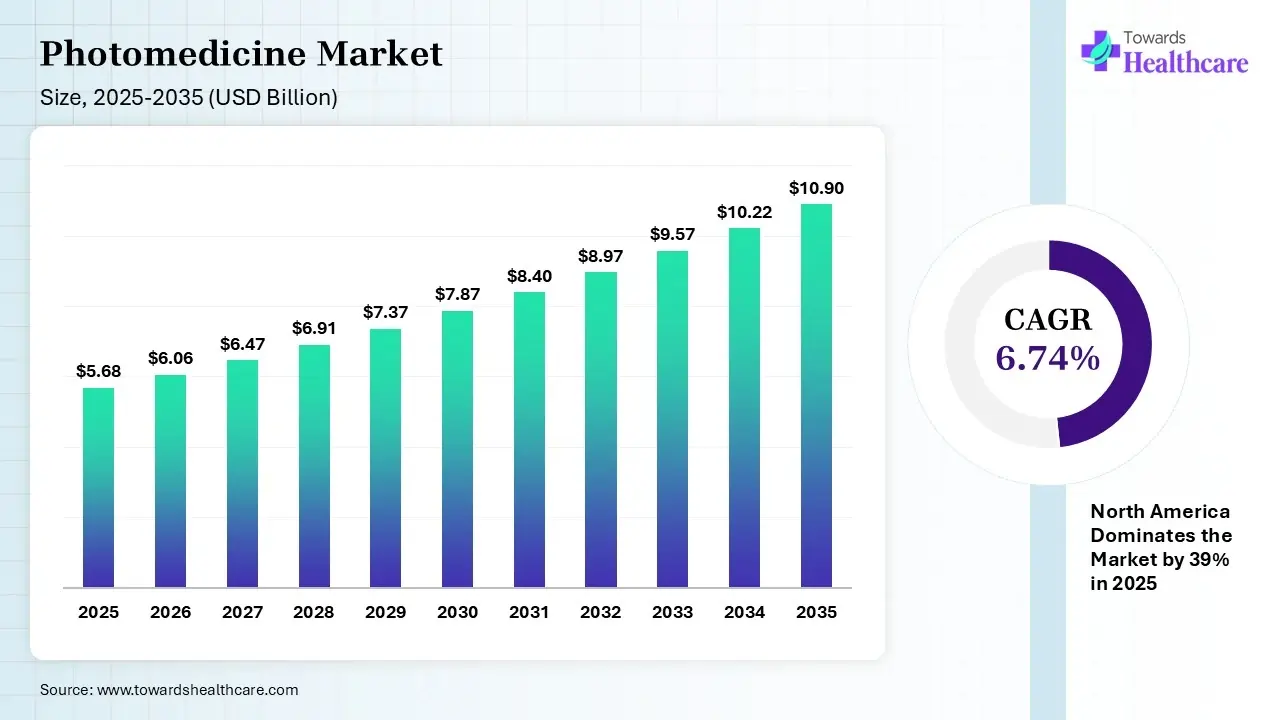
The global photomedicine market size was estimated at US$5.68 billion in 2025 and is projected to grow from US$ 6.06 billion in 2026 to US$ 10.90 billion by 2035, rising at a compound annual growth rate (CAGR) of 6.74% from 2026 to 2035. The demand for photomedicine is growing due to the growing need in oncology and dermatology.
Using photons to scan or treat medical conditions is known as photomedicine. Surgery, cardiology, radiology, cancer, diagnostics, medication delivery, dermatology, and ophthalmology are among the medical specialties that might benefit from this multidisciplinary area. We now have a complete understanding of the processes of photodamage thanks to recent developments in photomedicine, such as the identification of delayed formation of CPDs and the physiological effects of visible light.
The effects of ultraviolet (UV) radiation on the immune system, the creation of new photosensitizers for phototherapy, the effects of near-UV radiation on cellular membranes, the role of DNA damage and repair in mutagenesis and carcinogenesis, and the light activation of enzymes as a potential new form of phototherapy are just a few of the ways that photobiology will influence photomedicine in the years to come. The field of photomedicine has a promising future.
When used incorrectly, laser treatment poses the primary hazards of thermal burns and retinal impairment. Whether laser light enters the eye directly or is reflected off of bright objects, it can harm the retina.
AI is changing the photomedicine industry by allowing personalized treatments, improving diagnostic precision, and enhancing light delivery, shifting from standard methods to data-driven accuracy. Important functions include AI-assisted dosimetry in photodynamic therapy (PDT) and laser treatments, automated image analysis in dermatology, and predictive modeling for better patient results in oncology. In dermatology and oncology, AI speeds up and improves the accuracy of skin cancer diagnoses (like melanoma) by examining dermoscopic images, often matching or surpassing the performance of specialists.
AI evaluates patient-specific information such as skin type, lesion features, and genetic data to tailor photosensitizer choices and light dosimetry, minimizing off-target effects and maximizing effectiveness. AI supports closed-loop feedback systems in laser treatments, allowing for real-time adjustments during therapy for various conditions, including wound healing and pain relief. The market is moving towards AI-driven systems, which are becoming increasingly important in dermatological, aesthetic, and oncological fields.
| Table | Scope |
| Market Size in 2026 | USD 6.06 Billion |
| Projected Market Size in 2035 | USD 10.90 Billion |
| CAGR (2026 - 2035) | 6.74% |
| Leading Region | North America by 39% |
| Historical Data | 2020 - 2023 |
| Base Year | 2025 |
| Forecast Period | 2026 - 2035 |
| Measurable Values | USD Millions/Units/Volume |
| Market Segmentation | By Technology, By Application, By Region |
| Top Key Players | AngioDynamics Inc., Sisram Medical Ltd., Apax Partners LLP, Baring Private Equity Asia Limited, Biomedical Technology Holdings Limited, Koninklijke Philips N.V., PhotoMedex Inc., Colorado Skin and Vein, Thor Photomedicine Ltd, Johnson and Johnson MD&D |
| Segments | Shares % |
| Lasers | 38% |
| Light Emitting Diodes (LEDs) | 20% |
| Polychromatic Polarised Light | 14% |
| Full Spectrum Light | 10% |
| Dichroic Lamps | 9% |
| Fluorescent Lamps | 9% |
By technology, the lasers segment held the largest share of the photomedicine market by 38% share in 2025 and is expected to grow at the fastest rate during the forecast period. Because of their accuracy and precision, lasers enable physicians to perform intricate procedures and create new medical devices and designs for producers. Compared to traditional surgery, laser technology minimizes invasiveness. Most significantly, it lowers the risk of infection and postoperative pain. It is also quicker and more effective.
| Segments | Shares % |
| Ophthalmology | 24% |
| Dermatology | 18% |
| Aesthetics | 16% |
| Oncology | 14% |
| Pain Management | 10% |
| Wound Healing | 8% |
| Dental Procedures | 6% |
| Others | 4% |
By application, the ophthalmology segment dominated the market by 24% share in 2025. Low-level laser therapy, or photobiomodulation (PBM), has gained attention in the ophthalmology community recently as a promising new treatment for a number of retinal conditions, such as retinopathy of prematurity, diabetic retinopathy, Leber's hereditary optic neuropathy, age-related macular degeneration, amblyopia, methanol-induced retinal damage, and possibly others.
By application, the aesthetics segment is estimated to grow at the fastest rate in the photomedicine market during the predicted timeframe. The medical aesthetics industry is very resilient and has the potential for strategic advancements in consumer targeting, product portfolios, and business structures.
North America registered dominance with 39% share of photomedicine market in 2025, Due to elements like a high rate of adoption of cutting-edge medical technology, substantial research and development efforts, and sophisticated healthcare infrastructure. Chronic illness rates are rising in the area, which is driving up demand for cutting-edge photomedicine solutions. The market is also expanding as a result of the aging population and rising demand for minimally invasive procedures. The U.S. dominates the market in North America due to its robust medical technology industry and well-established healthcare system. Canada is a close follower, thanks to its robust healthcare system and high healthcare spending.
Asia Pacific accounted for 21% share of the photomedicine market in 2025, driven by elements like a growing population, increased rates of chronic illnesses, and rising healthcare costs. Growing middle-class populations in nations like China and India are fueling the need for healthcare, which is why photomedicine technologies are being adopted so quickly. These countries are also making investments in cutting-edge medical facilities and research, which is driving the market's growth. Japan dominates the market thanks to its sophisticated healthcare system, which benefits from a strong focus on medical research and innovation. Photomedicine is expected to continue growing as the Asia-Pacific region embraces its advantages, providing a wealth of prospects for industry participants and improvements in healthcare.
In terms of income from medical aesthetic tourism, Thailand came in fourth place in Asia, after China, Japan, and South Korea, according to Siam Commercial Bank. Among medical tourists, aesthetic medicine is the second most popular medical procedure, behind dental care. Major consumers include both domestic and foreign clients, particularly those from Cambodia, Laos, Burma, Vietnam, and Australia. According to Thailand's Medical Hub Board, the country's medical aesthetics industry is expected to grow three times from its 2020 size to $7.51 billion in 2027. There are 7,000 aesthetic clinics in Thailand, with 5,000 located in various regions and 2,000 in Bangkok.
The technology developed by CLINUVEL has the potential to upend the skincare industry in addition to the pharmaceutical industry. The company is introducing PhotoCosmetics, a line of cutting-edge skincare products based on a class of peptides called melanocortins, following 43 years of photomedicine research.
Strengths
• Photomedicine usually offers painless treatments with quicker recovery times compared to traditional surgery.
• Technologies like lasers and LEDs are versatile, used in diagnostics, dermatology, pain management, and oncology.
• There is a strong demand for cosmetic procedures and an increasing awareness of laser therapies.
• Continuous improvements in laser technologies (such as diode, dye, and gas) enhance treatment precision and effectiveness.
Weaknesses
• Advanced photomedicine tools often require a significant upfront investment for hospitals and clinics.
• Strict medical device regulations can slow down the introduction of new technologies.
• The safe and effective use of photomedicine devices needs professionals who are specialized and well-trained.
Opportunities
• The growing interest in cosmetic procedures among both young people and seniors offers substantial growth potential.
• There is a significant opportunity for growth in portable, easy-to-use phototherapy devices.
• Increasing research into Photodynamic Therapy (PDT) for cancer is opening new market possibilities.
• The rising incidence of musculoskeletal disorders is boosting the demand for photobiomodulation therapies.
Threats
• There is competition from established pharmaceutical firms and alternative surgical methods.
• Changes in safety regulations can affect market access and increase costs.
• Economic downturns may limit investments in expensive, non-essential cosmetic technologies by clinics.
• There is fierce competition among existing players to gain market share.
By Technology
By Application
By Region




Principal Consultant
Shivani Zoting is a dedicated research analyst specializing in the healthcare industry. With a strong academic foundation, a B.Sc. in Biotechnology and an MBA in Pharmabiotechnology, she brings a unique blend of scientific understanding and strategy.
Learn more about Shivani Zoting
Reviewed By
Aditi Shivarkar is a seasoned professional with over 14 years of experience in healthcare market research. As a content reviewer, Aditi ensures the quality and accuracy of all market insights and data presented by the research team.
Learn more about Aditi Shivarkar